The share price has skyrocketed by 160%, and Shenqi Pharmaceutical is really "magical".
On July 20, 2026, the closing price of Shenqi Pharmaceutical was only 4.92 yuan.
Two months later, its share price once rose to 12.77 yuan, with the maximum increase in the range exceeding 160%.
As of the close on September 18, the share price was 8.41 yuan, still up 71%, and the latest market capitalization reached 4.492 billion yuan.
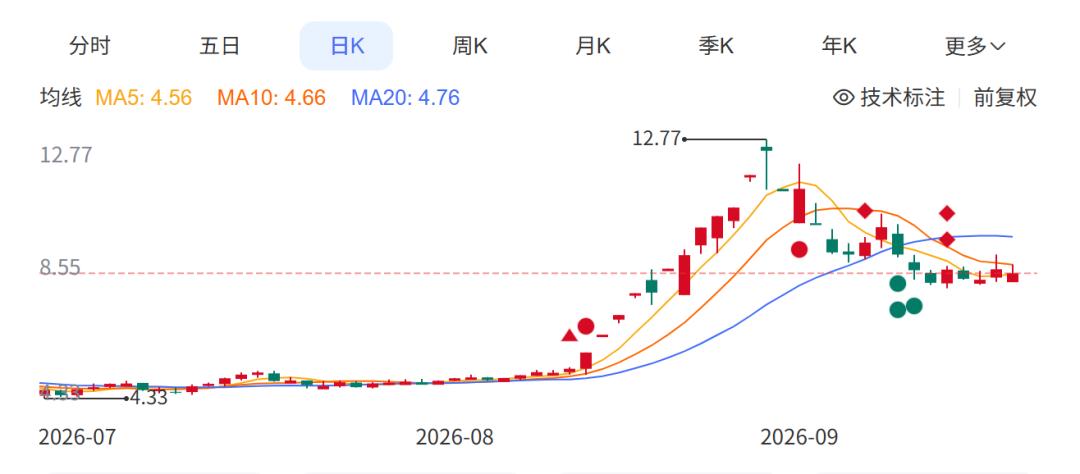
Shenqi Pharmaceutical Share Price Trend Image Source: FinScope
What is more abnormal is that during this rising period, the company has no new innovative drugs approved, no major asset restructuring or performance reversal, and no major events disclosed that are sufficient to significantly change market expectations.
In multiple announcements on abnormal stock price fluctuations, the company also explicitly stated that there is no undisclosed major information that should be disclosed.
The share price rose sharply first, but there was no simultaneous inflection point in the fundamentals. Why did Shenqi Pharmaceutical suddenly become the focus of the market?
01
From 4.92 Yuan to 12.77 Yuan:
Shenqi Pharmaceutical is Quite "Magical"
Let's start with the most intuitive contradiction: the share price is rising rapidly, while operating data is still under pressure.
Starting from the end of July, the share price of Shenqi Pharmaceutical rose slowly; after entering mid-August, the market trend accelerated significantly.
According to the abnormal stock trading fluctuation announcement issued by the company, from August 12 to August 24, 2026, the cumulative increase of Shenqi Pharmaceutical reached 91.49%, and there were 6 trading days with daily limit up during this period.
In less than two weeks, the share price has almost doubled.
Continuous daily limit up quickly raised market attention. This traditional pharmaceutical stock with limited attention before soon entered the sight of short-term capital; around August 28, the share price peaked at 12.77 yuan.
Usually, such a large increase in two months requires strong catalysts such as major asset restructuring, changes in industry policies, performance explosion or core product breakthroughs.
Shenqi Pharmaceutical did not have the above new variables in the same period.
The performance side first cannot provide an explanation matching the increase.
The 2026 semi-annual report shows that the company achieved operating revenue of 848 million yuan in the first half of the year, a year-on-year decrease of 11.73%; the net profit attributable to shareholders of listed companies was 21.9656 million yuan, a year-on-year decrease of 33.05%.
Calculated based on the operating revenue and operating cost disclosed in the financial report, the company's comprehensive gross profit margin in the first half of the year was about 44.0%, compared with about 46.8% in the same period of last year, down nearly 2.8 percentage points.
In the same period, sales expenses decreased by 26.25% year-on-year, but the net profit attributable to shareholders continued to decline, with both revenue and profit margin under pressure.
Cash flow is one of the few improved indicators. The net cash flow generated from operating activities in the first half of the year reached 98.4234 million yuan, a year-on-year increase of 107.32%.
The company explained that this improvement mainly came from the reduction of cash expenditures related to purchasing goods, receiving labor services and other operating activities; in the same period, the cash received from selling goods and providing labor services decreased from 899 million yuan in the same period of last year to 806 million yuan.
The cash flow recovery was mainly contributed by expenditure contraction, and the sales side has not yet warmed up.
Comparison of products and industries also shows no obvious operating inflection point.
The semi-annual report disclosed that the sales of the company's three major segments: prescription drugs, OTC and pharmaceutical commerce, all declined to varying degrees.
In the same period, the operating revenue of the national pharmaceutical manufacturing industry above designated size was basically flat year-on-year, and the total profit increased by 4.2%; the domestic anti-tumor specialty drug market still maintained a growth rate of more than 8%, while the operating revenue of Shenqi Pharmaceutical decreased by 11.73%.
Therefore, the operating pressure of the company can hardly be simply attributed to the overall downturn of the pharmaceutical industry.
Some tracks are still growing, but the industry growth has not been transformed into the performance growth of Shenqi Pharmaceutical at the same time, making this round of increase even harder to be understood as a value revaluation directly driven by business prosperity.
During the period of rapid share price rise, the company issued risk warnings for many times, and after verification, there were no major events that should be disclosed but not disclosed, nor major information affecting abnormal fluctuations in stock trading prices.
At the same time, Zhang Zhijun, the concerted actor of the controlling shareholder of the company, implemented a share reduction. Public information shows that he reduced his holdings by about 14.36235 million shares, with a reduction amount of about 97.5575 million yuan, and the reduction period covered from the end of May to August 20.
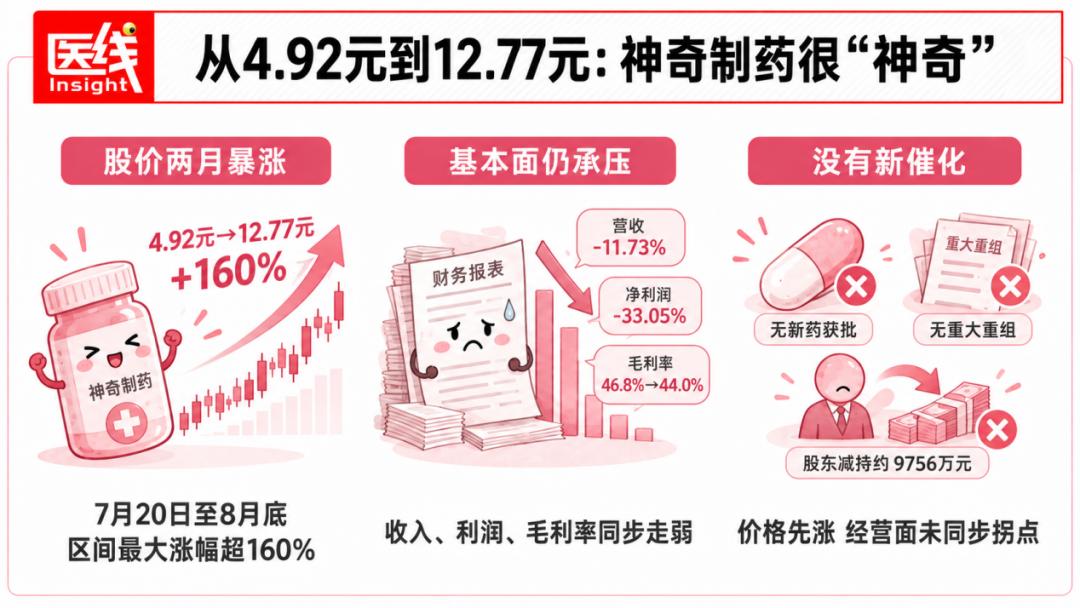
It can be seen that when the share price showed a strong market trend, the company did not simultaneously provide new catalysts at the level of performance, new drugs or major events, thus forming the dislocation between price and operating performance.
02
How did this round of market trend of Shenqi Pharmaceutical come about?
Since the fundamentals cannot explain the increase, the next step is to see what the market is trading.
The answer can be divided into two layers: first look at why this company has the basis for short-term trading, and then look at how capital pushes up the market trend.
Shenqi Pharmaceutical's main business covers two major segments: pharmaceutical manufacturing and pharmaceutical commerce.
Pharmaceutical manufacturing involves drug R&D, production and sales, covering anti-tumor, cold and cough relief, cardiovascular and cerebrovascular, rheumatism and bone pain, antifungal, tonic and sedative, gynecology and other fields; pharmaceutical commerce is mainly responsible for distribution, wholesale and retail.
In the first half of 2026, the company's pharmaceutical manufacturing business revenue was about 450 million yuan, accounting for 53.07% of the operating revenue; pharmaceutical commercial revenue was about 398 million yuan, accounting for 46.93%. The two businesses almost each account for half.
The product side is dominated by mature varieties, including Sodium Cantharidinate and Vitamin B6 Injection, Sodium Cantharidinate Injection, Loquat Cough Granules, Strong Loquat Syrup, Jingu Gutong Capsules, Coral Ringworm Remover, Quantianma Capsules, Yindan Xintai Dropping Pills, etc., which have long constituted the company's revenue base.
This is an old-established pharmaceutical enterprise with products, channels and operating foundation, but its growth momentum still mainly comes from stock business.
In the first half of 2026, Shenqi Pharmaceutical's R&D expenditure was 14.7236 million yuan, a year-on-year increase of 6.3%, accounting for about 1.7% of the operating revenue in the same period. All these investments are included in the current expenses. The semi-annual report disclosed that there are no important capitalized R&D projects and important outsourced in-process R&D projects.
The company's current R&D priorities are mainly focused on secondary upgrading of existing products, improvement of quality standards, process optimization, classical prescriptions and hospital preparations, as well as post-marketing safety evaluation, real-world research and re-evaluation of clinical efficacy of leading anti-tumor products. The R&D direction is more inclined to the deepening of existing varieties, and there is still a certain distance from the realization of heavy innovative drug pipelines.
Among them, the sodium cantharidinate series is a representative anti-tumor product.
In 2025, the company's anti-tumor drug series achieved operating revenue of about 502 million yuan; the cough relief series, Miao medicine series for strengthening tendons and bones, skin external antibacterial series, etc. also jointly constitute the product matrix.
Operating data further strengthens the feature of this "stock pharmaceutical enterprise".
In 2025, the company achieved operating revenue of 1.952 billion yuan, a year-on-year decrease of 4.71%; the net profit attributable to shareholders of listed companies was 38.2441 million yuan, a year-on-year decrease of 46.43%.
The company stated that the decline in revenue was mainly affected by the decline in sales revenue of the pharmaceutical manufacturing business.
There are also projects on the asset side that need continuous observation.
The 2025 audit report listed the bad debt provision of accounts receivable and goodwill impairment as key audit matters: as of the end of the year, the company's accounts receivable balance was about 501 million yuan, and the bad debt provision of 180 million yuan had been accrued; the original value of goodwill was about 461 million yuan, and the accumulated impairment provision was about 217 million yuan.
The key audit matters themselves do not mean that there are abnormalities in the financial statements, and the audit opinion still believes that the company's financial statements fairly reflect its financial position in all major aspects.
However, the recovery ability of accounts receivable and the goodwill value formed by historical mergers and acquisitions are still important variables to observe asset quality.
At the same time, the company has not shown obvious debt repayment pressure for the time being.
As of the end of June 2026, the monetary fund was 480 million yuan; the total liabilities decreased from 748 million yuan at the end of 2025 to 526 million yuan. In the first half of the year, the company repaid the long-term bank loans in advance, and the long-term loans at the end of the period dropped to zero.
Putting all this information together, the fundamental portrait of Shenqi Pharmaceutical is very clear: the operating foundation still exists, the growth and profitability are under pressure, and the stock resources have not yet been transformed into a new growth curve sufficient to explain the substantial revaluation of the share price.
It is precisely because of this that the explanatory focus of this round of market trend shifts to capital, sentiment and trading behavior.
First, low-position traditional pharmaceutical stocks have strong price elasticity.
Shenqi Pharmaceutical's closing price on July 20 was 4.92 yuan, and then continued to rise.
The company's announcement shows that from August 12 to August 14, 2026, the cumulative deviation value of the increase for three consecutive trading days reached 20%, triggering abnormal stock trading fluctuations. Starting from a low position combined with continuous rise, it quickly attracted more attention from short-term capital.
Second, the continuous daily limit up significantly improved trading activity.
The company disclosed in the risk warning announcement that from August 12 to August 20, 2026, the company's stock had multiple trading days with daily limit up, the cumulative increase reached 65.57%, and it warned that the short-term increase was large and there was a risk of overheated market sentiment.
At this stage, the focus of some capital shifted from the future profits of enterprises to price trends, trading volume and market popularity.
The rise in share price brings discussion popularity, the discussion popularity attracts new capital, and the expansion of trading volume further strengthens the rising expectation, forming a feedback loop of "rise - attention - trading volume increase - continuous rise".
Third, the phased sentiment recovery of the pharmaceutical sector brings capital spillover.
In the past few years, the A-share pharmaceutical sector has experienced valuation adjustments, and some traditional pharmaceutical stocks have been in a state of low attention for a long time.
When the market is looking for targets with low attention and high elasticity again, stocks lacking strong fundamental changes may also become phased trading objects.
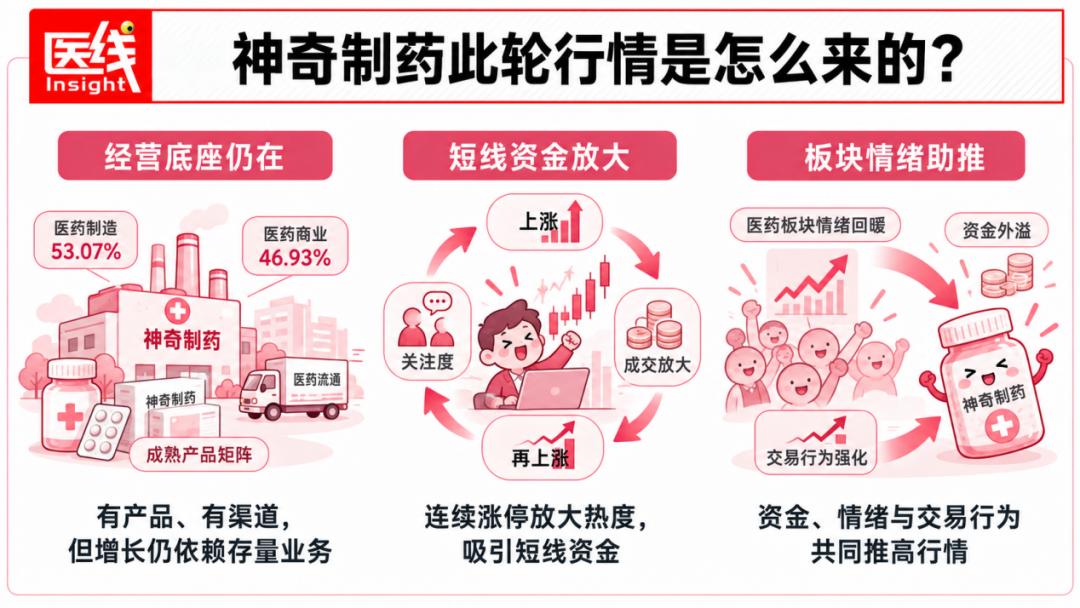
Thus, the short-term logic of Shenqi Pharmaceutical is complete.
Products, channels and cash constitute the operating base, and new growth variables are still limited.
When the sector sentiment recovers, low attention and price elasticity attract capital to enter, which is then continuously amplified by daily limit up, trading volume and discussion popularity.
03
View the trend of A-share pharmaceutical industry from Shenqi Pharmaceutical
Pulling the perspective from individual stocks back to the industry, this round of market trend also suggests a more important change.
That is, the A-share pharmaceutical sector is obviously diverging.
Shenqi Pharmaceutical's semi-annual report provides a specific industry slice.
In the first quarter of 2026, the scale of the full drug channel decreased by 5.4% year-on-year; the hospital market continued to decline, the primary medical care showed a double-digit decline, the physical retail only achieved a slight increase of about 0.6%-0.7%, and e-commerce became the only segment maintaining double-digit growth.
The differences between categories are more obvious.
In the first half of 2026, the anti-tumor specialty drug market still maintained a growth of more than 8%; affected by the high base of influenza in 2025 and the low incidence of respiratory diseases in 2026, the cough category of traditional Chinese patent medicine shrank significantly.
This means that it is difficult to summarize the pharmaceutical industry with "overall recovery" or "overall decline".
Hospitals, primary medical care, retail, e-commerce are diverging, and innovative drugs, anti-tumor drugs and traditional OTC are also diverging.
The track where the enterprise is located, the channel structure, and the ability of existing varieties to adapt to the changes of payment and terminals are becoming more and more important.
For Shenqi Pharmaceutical, this structural divergence is particularly obvious.
The company spans multiple categories such as anti-tumor, cough relief, cardiovascular and cerebrovascular, rheumatism and bone diseases, while nearly half of its revenue comes from pharmaceutical commerce. The scattered business improves the operating coverage, but also means that a single high-prosperity track cannot quickly rewrite the growth curve of the whole company.
Industrial policies are also continuing to reshape the way of competition.
In recent years, regulatory authorities have continued to promote the reform of the drug review and approval system, and encourage the R&D of new drugs with clinical value; policies such as medical insurance negotiation and volume-based procurement continue to affect the pricing, channels and business models of pharmaceutical enterprises.
For listed pharmaceutical enterprises, future competition will increasingly depend on R&D capabilities, commercialization efficiency and international competitiveness. The capital market's valuation logic for pharmaceutical companies will also diverge accordingly.
One type of enterprise gains capital attention by relying on innovative drug pipelines, and the market focuses on observing R&D investment, clinical progress and commercialization space. The other type of enterprise has mature products and stable cash flow, and the focus is more on brand, channel and profit quality.
There are also some traditional pharmaceutical enterprises that will become phased trading objects due to low valuation, theme attributes or changes in capital style.