The prices of monitors have also started to rise.
Since the start of 2026, the surge in memory chip prices driven by skyrocketing AI computing power demand has kept heating up. While the prices of RAM and solid-state drives are on the rise, the upward price pressure is being transmitted downstream along the industrial chain — signs of price hikes have also emerged in the monitor market.
On September 20, Jiemian News checked a Titan Army monitor on the DeWu APP. Data from the past 90 days shows that the price of this product has risen from 482 yuan to 547 yuan, an increase of 65 yuan, with a growth rate of about 13.49%.
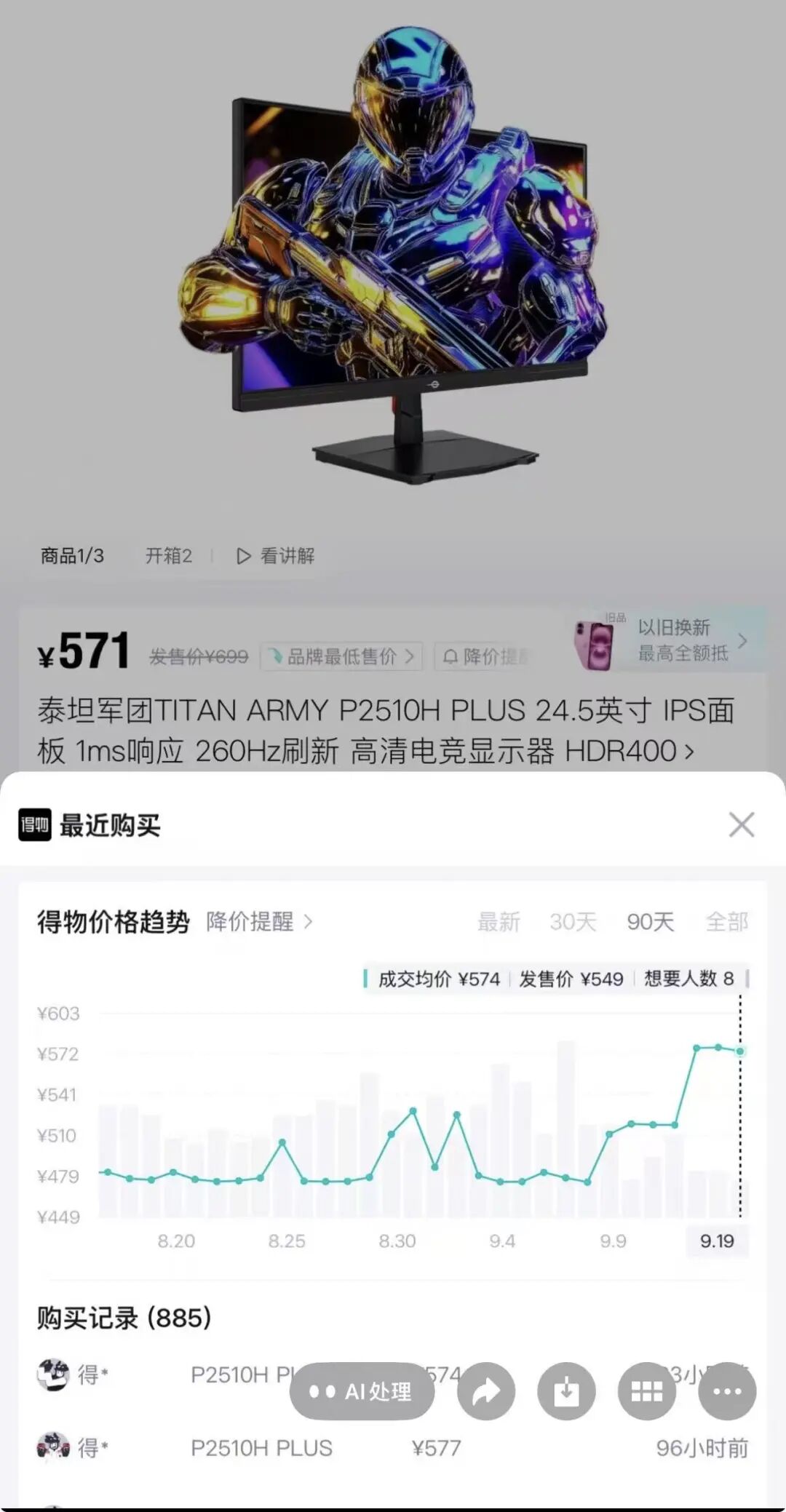
Image source: DeWu APP
In addition, Jiemian News inquired about a KTC display on JD. Data from the Manmanmai APP shows that the price of this product once dropped to a 60-day low of 1064.34 yuan on August 20, and has been rising since September 10, with the latest price at 1199.7 yuan.
The customer service of KTC's official flagship store on JD told Jiemian News: "Prices may occasionally change due to promotion intensity or market fluctuations, and price increases or decreases may occur for some products."
According to the latest report released by RUNTO, the average online market price of esports monitors in August was 1168 yuan, up about 7.0% year on year.
The report points out that the root cause of this round of monitor price hikes lies in the continuous accumulation, transmission and release of cost pressure across the entire industrial chain, covering core components such as driver ICs, motherboards, power components, and backlight modules.
On August 14, the professional display brand KTC team released the "Explanation and Commitment on Product Price Adjustment", stating that the monitor product line may see price increases in the future.
The team mentioned that the continuous price rise of core components has led to a sharp increase in monitor production costs, and KTC can no longer absorb the extra cost pressure on its own. KTC noted that "the current pricing window offers very high cost-effectiveness", and suggested users who have clear purchase demands recently reasonably plan their purchase timing.
Prior to this, the prices of RAM and hard drives had already risen. According to previous reports by National Business Daily, reporters conducted on-site investigation at Hangzhou Bainaohui Computer City and found that ordinary consumers are facing drastic price hikes of RAM and solid-state drives. Some dealers said that RAM and solid-state drives have risen so sharply that they are a bit panicked now and will not stock up too much. It is reported that the prices of some solid-state drives and RAM modules have doubled: the price of a 1TB solid-state drive has risen from 500 yuan to around 1000 yuan, and the price of an 8TB solid-state drive dedicated to PS5 is close to 20,000 yuan, which is enough to buy three PS5 Pro consoles.
Jiemian News learned that behind the rising prices of displays, RAM and hard drives is the ongoing surge in memory chip prices triggered by AI computing power demand.
Monitors themselves are not products that use memory chips intensively, but the control boards, interface chips and supporting electronic materials required by the industry are also in the overall environment of tight semiconductor production capacity, so their procurement costs have risen synchronously, further amplifying the upward cost pressure of complete monitor units.
In September 2025, SanDisk took the lead in announcing a more than 10% price hike for flash memory products to all channel and consumer customers, kicking off a new round of price increases in the industry.
Shortly afterwards, Micron Technology, the US memory chip giant, notified its channel partners that it would suspend all quotations for memory products including DDR4, DDR5, LPDDR4 and LPDDR5, and cancel all prices for contracted customers.
At present, the global memory chip market is in a state of structural imbalance between supply and demand. The latest memory industry report released by TrendForce points out that in the first half of 2026, the cumulative contract price increases of niche flash memory products NOR Flash and SLC NAND reached 100%-120% and 130%-150% respectively. The supply and demand gap will not ease in the second half of the year, and the two types of products are expected to continue to rise by 60%-75%; the contract price of general-purpose TLC NAND in the second quarter rose 70%-75% quarter on quarter, and the DRAM contract price rose 58%-63% quarter on quarter, hitting the highest single-quarter growth rate in nearly 15 years.
The core contradiction behind the above situation is that the four major memory manufacturers Samsung, SK Hynix, Micron and Kioxia have actively adjusted their capacity allocation, and transferred a large amount of mature wafer manufacturing processes to HBM high-bandwidth memory and high-layer enterprise-level 3D NAND that are in rigid demand for AI servers, thus squeezing the available production capacity for consumer-grade SSDs and mobile storage.
At the same time, cloud vendors including OpenAI, Amazon and Google continue to lock in long-term orders for large model deployment. The storage configuration of a single AI server has expanded from several TB in the past to the level of hundreds of TB, and massive enterprise-level procurement continues to consume spot inventory, forcing the consumer electronics sector to bear the premium cost of the remaining limited production capacity.
In its heavyweight research report "Chipflation–Navigating A Memory Crisis" released in June 2026, Morgan Stanley put forward the concept of "Chipflation", clearly pointing out that "this round of memory upturn is not an ordinary cyclical recovery, but an industry structural reset driven by AI". The bank believes that AI has repriced memory resources such as DRAM, HBM, NAND and enterprise-level SSDs, turning memory from an ordinary component into a "scarce strategic resource for computing power", and the upward price cycle is expected to continue until 2027.
In the storage industry report released at the beginning of this year, Goldman Sachs pointed out that the current imbalance between supply and demand in the global memory market has reached its highest level in nearly 15 years. It is estimated that the overall global DRAM supply gap will reach 4.9% in 2026, and the NAND gap will reach 4.2%, showing a typical situation of supply falling short of demand.
This article is from the WeChat Official Account "Jiemian News", author: JIANG Yiman, published with authorization from 36Kr.