The new top trending AI star Jev that has gone viral all over the world doesn't utter a single word — how on earth do you use it?
Various new models keep emerging, all eager to prove to the whole world that they can write and converse. However, the most hyped, viral top trending model that has taken the internet by storm recently is none other than Jev.
It does not speak at all.
Diogo Almeida, a researcher at OpenAI who participated in the development of ChatGPT, later proposed the Reinforcement Learning from Human Feedback (RLHF) algorithm.
This to some extent defined the direction of large language models over the past few years. But while this approach has driven the entire industry to prosperity, Almeida has grown increasingly skeptical of it.
"We had a one-off successful innovation, but we didn't turn it into something truly useful."
It took him a long time to figure out what went wrong: we have been optimizing the processing capability of human language... Over four years, we have performed extremely well at processing human language, but this is useless for automation, because computers use a different "language".
Two years ago, Almeida left OpenAI and co-founded TypeSafe AI with Erik Gafni and Sasha Sheng. The company had been operating in stealth mode until its official debut on September 15, bringing two things at the same time: a $40 million seed round financing led by DCVC, and their first model, Jev.

Jev is still a Transformer-based model, but it is deliberately not a large language model and will not output a complete sentence.
If you feed it a program state and a predefined question, it will return a typed answer, a choice, a score, or a probability between 0 and 1, along with a confidence rating.
TypeSafe refers to this type of output as "calibrated decision-making". This is also why many people were confused when the name Jev was first introduced to the public.
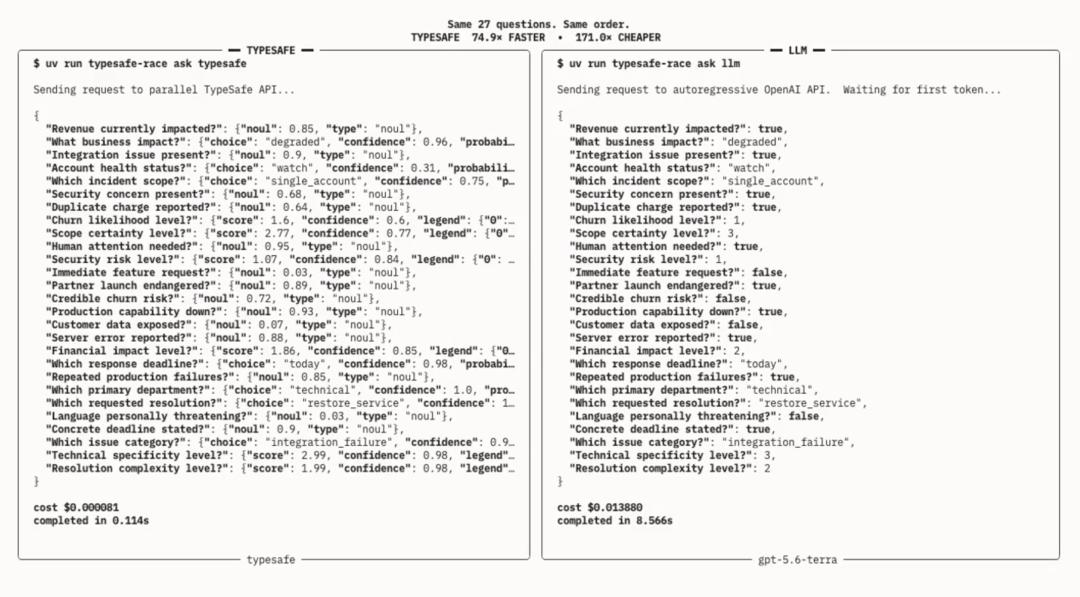
The screenshot shows the performance comparison between Jev and large language models when responding to the same request
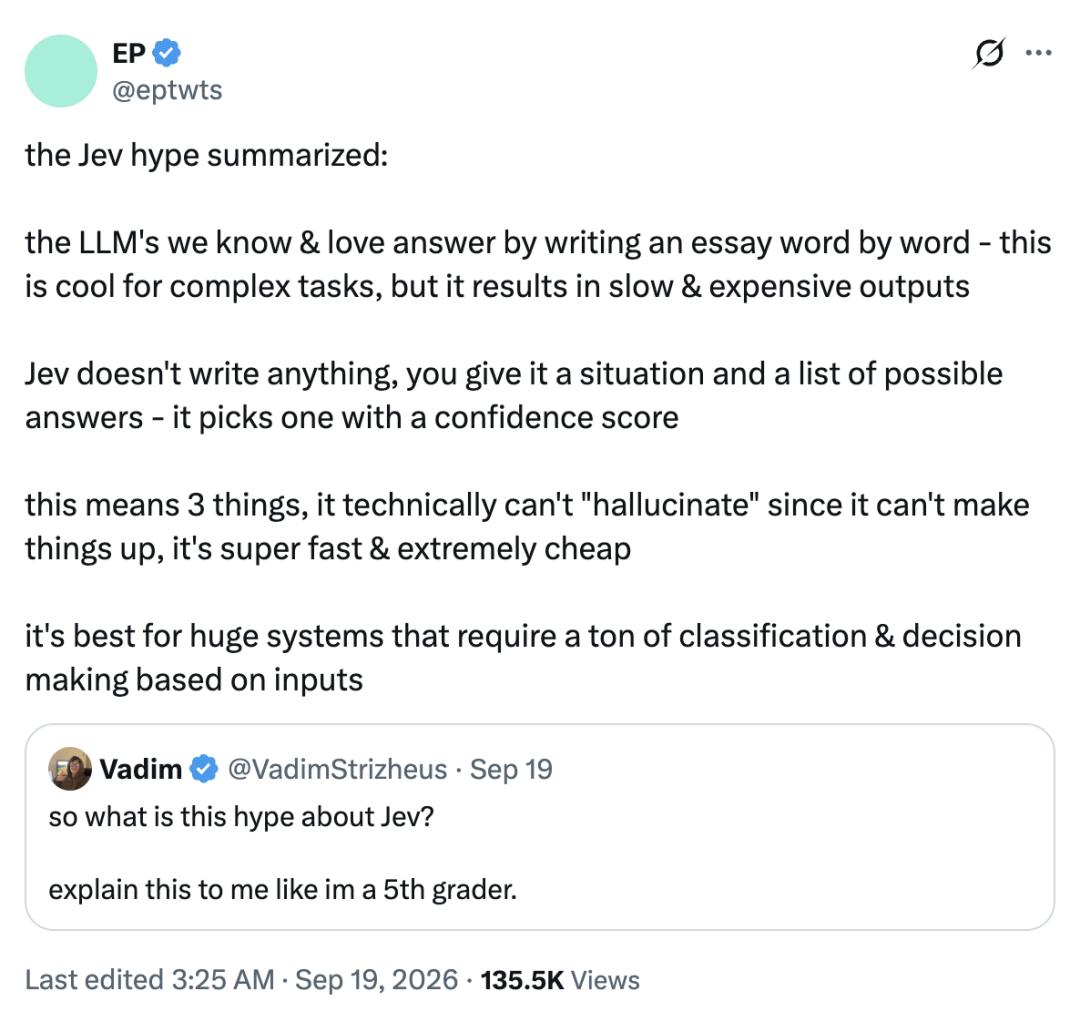
The most popular model in the AI circle is completely different from ChatGPT
To understand what Jev is doing, you might as well set aside the conventional thinking habits of large language models first.
It is easy to understand if we switch to a customer service scenario. A user sends a message: The payment service has been unavailable for several consecutive days, which has already affected my business. At this point, several judgments need to be made: whether it should be handed over to the technical team or the accounting team, how dissatisfied the other party is, and whether the issue is urgent.
According to TypeSafe's interface design, questions in the same request share the same input but are evaluated independently and in parallel. Classification and urgency assessment can be processed simultaneously.
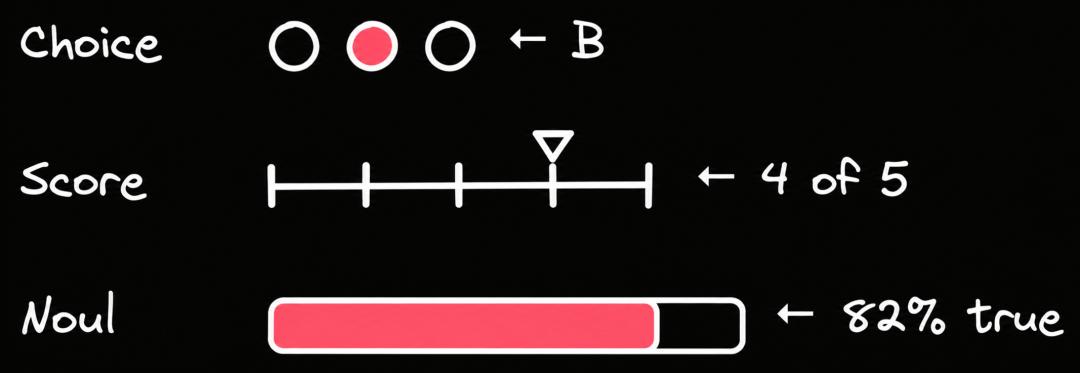
Specifically, its output has three basic forms. The first one is called Choice, which selects one item from a predefined list, supporting up to 255 options, and is suitable for routing and classification. The second one is called Score, which scores the input on a predefined scale to measure urgency, quality or risk. The third one is called Noul, which is essentially a yes-no judgment, whose answer is a number representing the probability that the matter is true.
Each response comes with a complete probability distribution and confidence level, delivering strongly typed results. There is no need to write JSON prompts, no extra parsers are required, and you never have to worry about the model suddenly wrapping the result in a Markdown code block.
Adopting this approach, the most immediate benefits are time-saving, cost reduction, and fewer formatting errors caused by free generation.
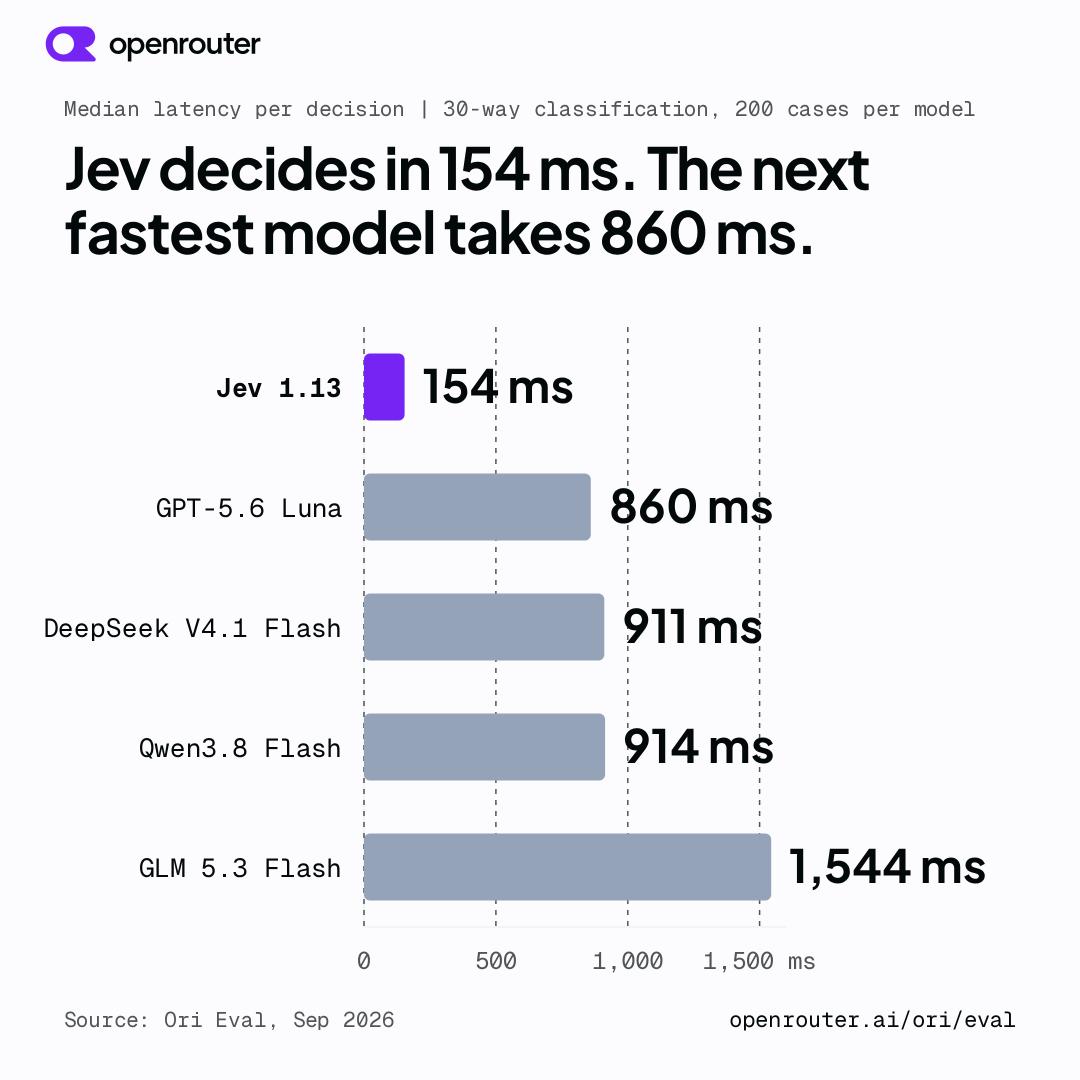
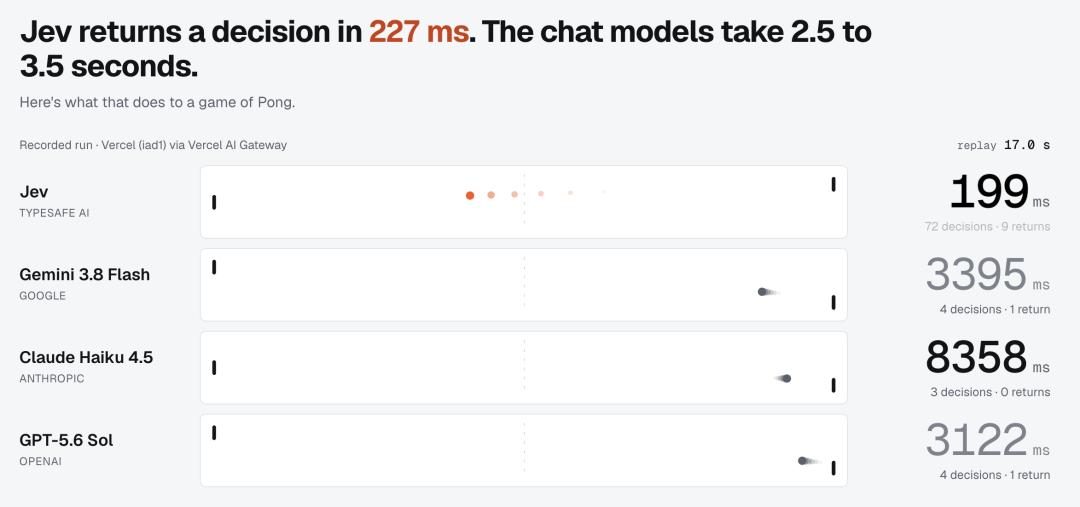
Figures released by TypeSafe show that Jev's end-to-end latency ranges from 70 to 500 milliseconds, which is 20 to 200 times faster than similar large language models.
According to the current public pricing, the input cost is $42 per billion tokens, which translates to $0.042 per million tokens in common measurement standards; output is free of charge. Newly added questions and option descriptions will still occupy input tokens, but no additional fees will be charged based on the length of the generated answers.
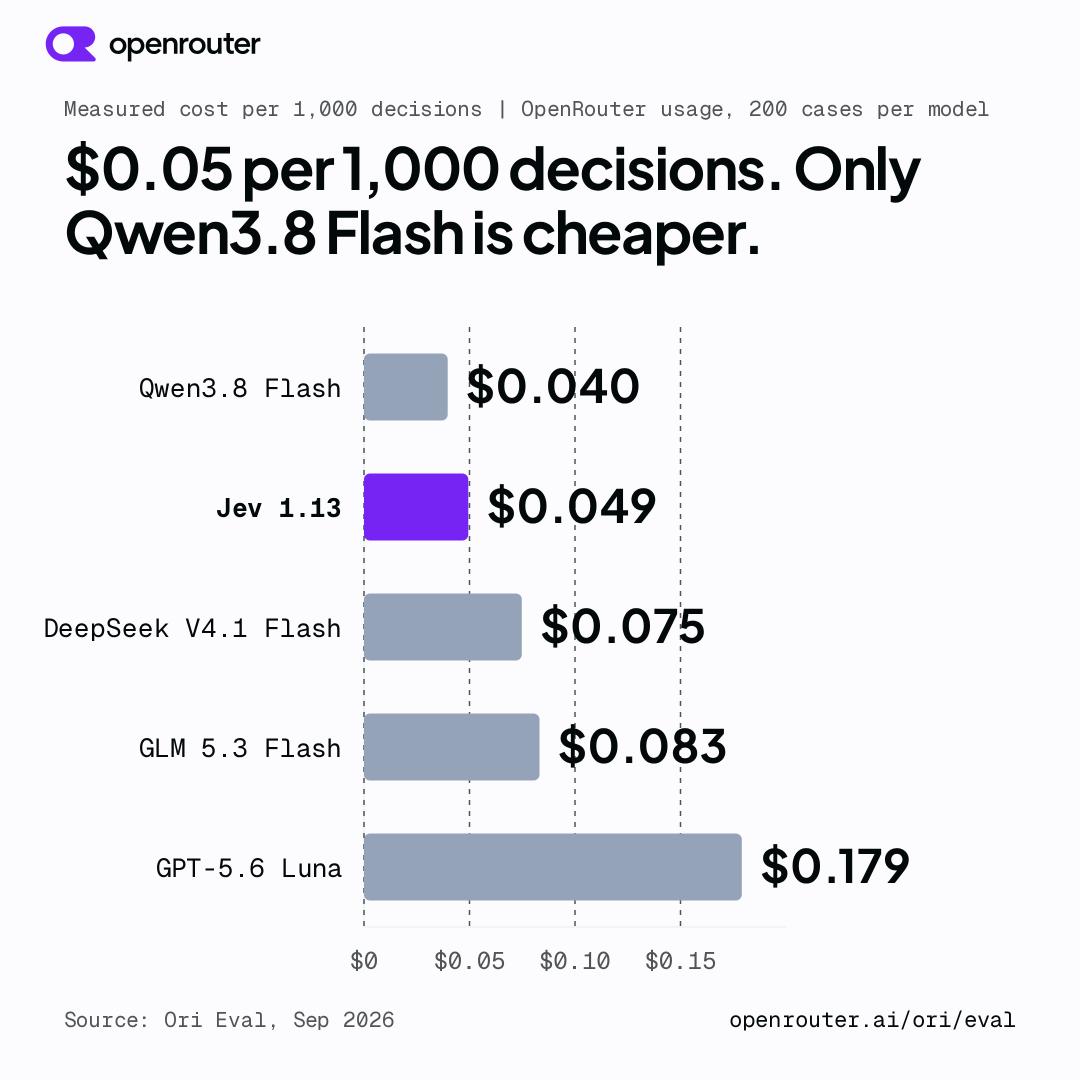
Since users can pre-define the output results, the model will not produce hallucinations. (Jev will not produce hallucinations means it will not give random answers outside the pre-set option range, but it is still possible to give wrong answers within the option range.)
In a public Ably Pong demo, Jev made 47 operation decisions in 12 seconds, while Gemini, Claude and GPT only made two or three in the same period, even though the latter still gave correct judgments in most cases.
In the Ably Pong demo, the program directly passes the numbers from the game to Jev: the position of the ball, its movement direction, the position of the paddle, and the vertical coordinate of the ball when it is expected to reach the paddle's position. Based on these numbers, Jev can select one of the three options: move up, move down, or stay still.
What are the usage scenarios of Jev
To build a playable product with Jev, you need game programs and real-time communication. The above project uses the back end to run the game, call the model, and then send the new state to the browser via Ably. In other words, the game rules, graphics and networking are not generated by Jev, it is only plugged into the repeated three-choice loop.
The speed advantage expands its application scenarios. Jev can act as the judgment layer for computer operations, guiding agents to execute instructions quickly; it can also be used for context compression, identifying which content is key information, so as to quickly narrow down the context of millions of tokens.
The public Browser Use project jev-ultrafast implements a browser agent. Every time it lands on a web page, it first reads the currently operable page elements, and organizes them into a numbered list: which one is a button, which one is an input box, what its name is, and what has been filled in so far.
Jev receives this structured state, the user's goal and the operation history. The choice space given by the program is also dynamically generated by the elements that actually exist on the current page.
Use Jev as the operation judgment layer to guide the model to quickly operate your computer https://x.com/gregpr07/status/2100411066966749359
Taking flight ticket search as an example, the goal can be "find a one-way flight from Zurich to London, set the specified date, number of passengers and cabin class, and stop when eligible results appear".
In each round, the program asks several questions at the same time: should I click, input, select a drop-down option, or wait next? If I need to click, which numbered element should I click? If I need to input, which numbered element should I fill in? These questions share the same web page state, but are answered separately.
Finally, the program only adopts the target that matches the actual operation: if clicking is selected, the click target will be used, and other answers will not be used for the time being.
When it is necessary to enter a city name, the program will separately call a small text generation model to generate the content to be filled in based on the goal and the current input box. After the browser executes the operation, it reads the new state of the page.
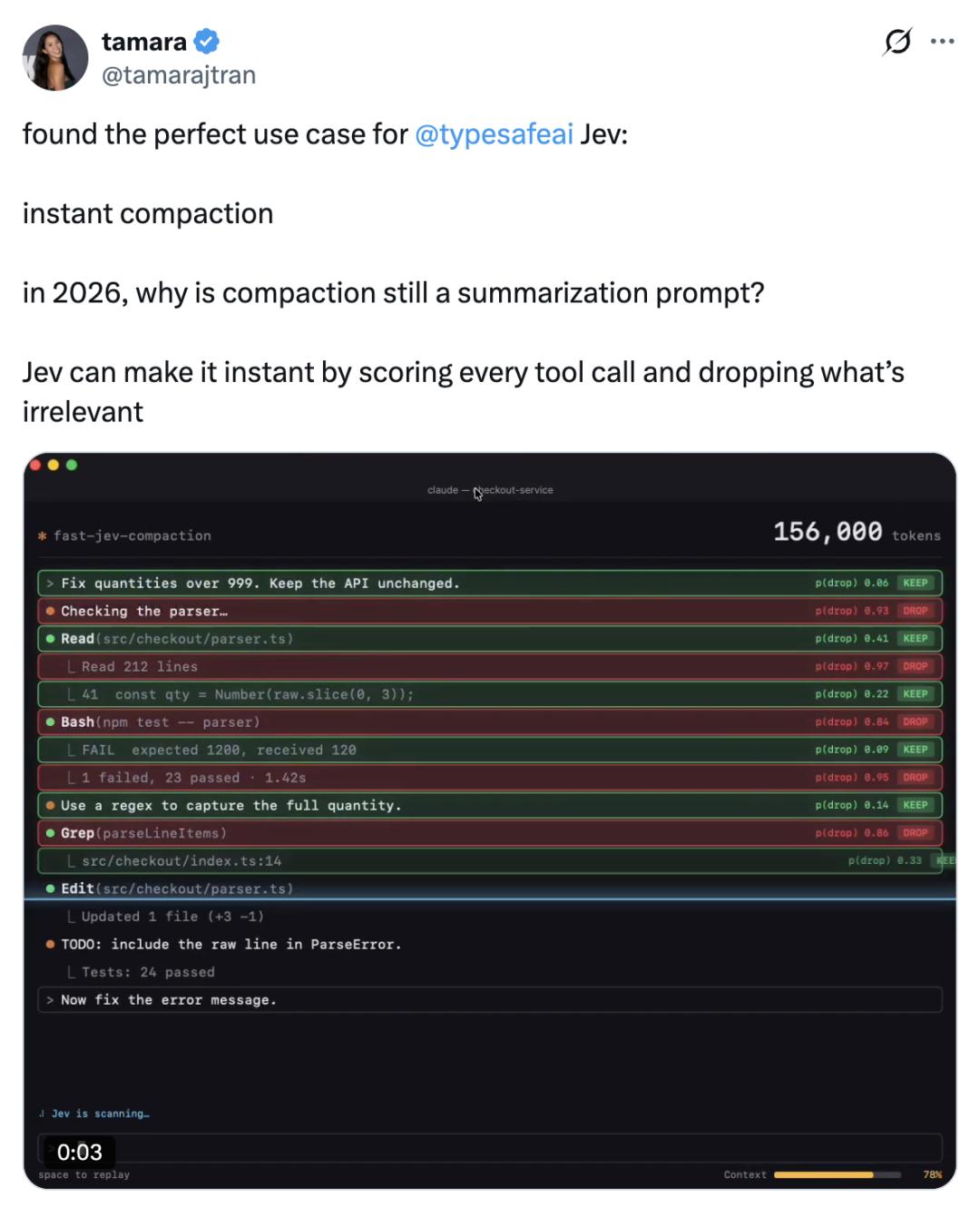
Jev judges the importance of context content to achieve near-instant context compression https://x.com/tamarajtran/status/2100694549362553153
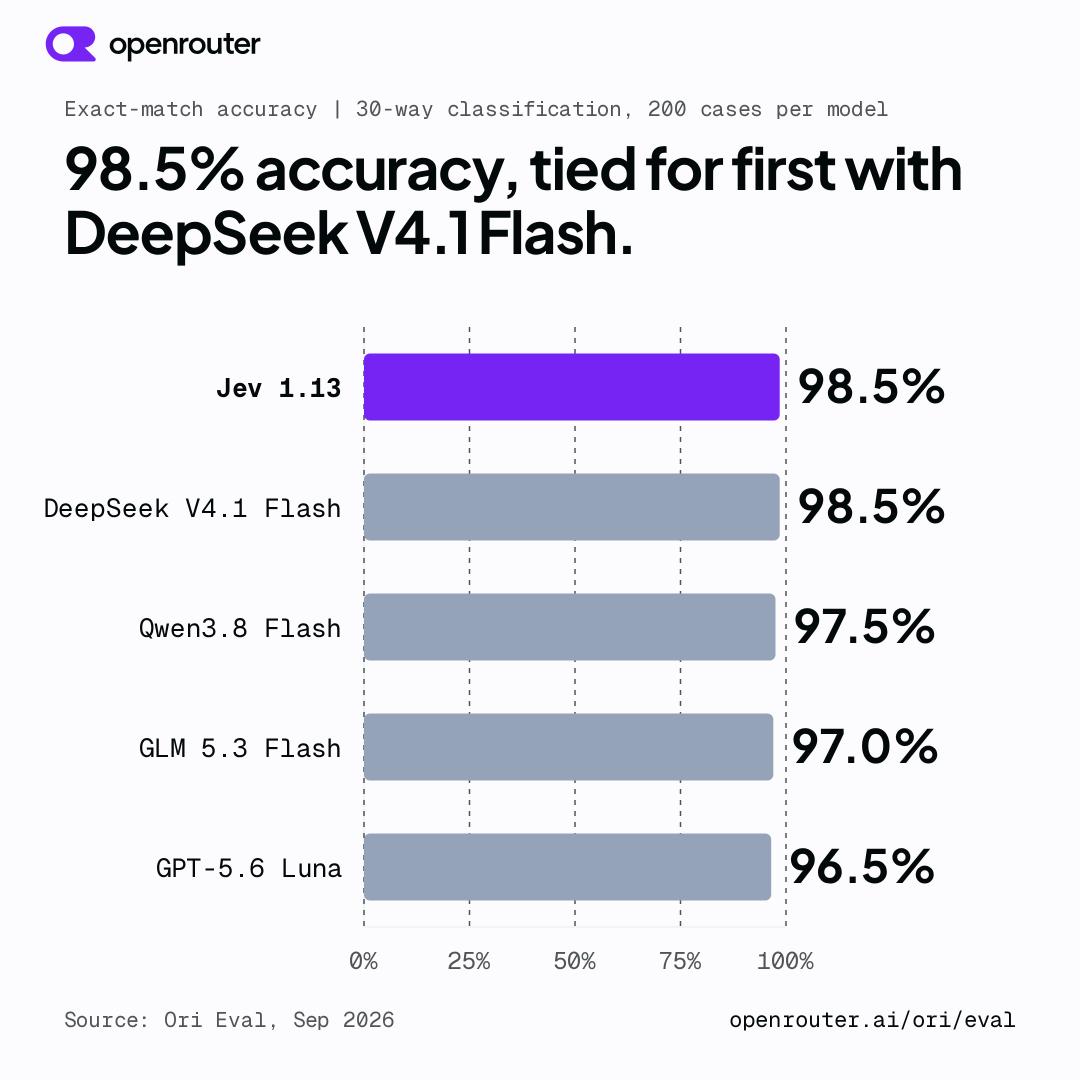
Pranit Sharma, a software engineer at Vercel, said that his company used OpenAI's ChatGPT Luna 5.6 to run classifiers to check the security of commands. After Vercel replaced OpenAI's Luna with Jev, the processing speed increased by 5 to 18 times, and the accuracy was also greatly improved.
Nikhil Mudholkar, CTO of another developer Bryo AI, also tested Jev and Gemini to evaluate their performance in classifying business emails. In his test, Gemini had slightly higher accuracy, but its cost was 10 to 20 times higher.
We can also build it ourselves following this idea: first prepare a table, each row contains the email title, body, received time and necessary context.
Then split the business into several clear questions. For example, for an email that says "the order was deducted twice, and I hope it will be processed today", you can use Choice to judge whether it should enter the after-sales, sales, partnership or other queue; use Noul to judge whether the sender explicitly requests action; and then use Score to judge the processing priority.
"At its core, this approach shifts the responsibility for handling hallucination issues slightly to the user," explained Armin Ronacher, CTO of Earendil. "Users need to decide: if the probability of this scenario is only 50%, then it may be ignored. But if the probability reaches 95%, then I can make use of it."
Ronacher said that another potential application of Jev is model routing. It is very useful to predict whether a specific task requires a dedicated model, but using a large language model to do this task will be very expensive. Jev is low-cost and fast to run, so it can realize this real-time routing function.
Automatically allocate the appropriate model to process according to the complexity of the task https://x.com/mdlahfir/status/2100314182201802811
The Wisest Decision
The name Jev is taken from the 19th-century economist William Stanley Jevons. The Jevons Paradox he proposed points out that when the cost of a certain commodity falls, this commodity will be used more and more widely. In this case, the falling cost of intelligence should lead to the widespread application of intelligence.
In other words, once invocation becomes cheaper, it will be used in more places that were not worth using it before. Almeida is obviously very satisfied with this analogy. The future he envisions is not a few huge applications monopolizing everything, but a large number of tiny intelligent judgments running scattered everywhere, "more like the early days of the Internet, rather than the large-scale applications that people are trying to build now".
TypeSafe has not made public the specific architecture of Jev so far, and it is widely speculated that it is modified based on an open-source large language model.
The company itself calls it System One Models, which is derived from Kahneman's concept of intuitive thinking, emphasizing that it relies on intuitive judgment rather than reasoning chains, and is specially tuned for specific tasks.
The official recommendation is to split complex judgments into several clear questions, and then combine them with code, instead of letting the model handle everything all at once.
Almeida revealed that, he predicted very early that he would embark on the path of processing synthetic data, which is perhaps the wisest decision he has ever made in his life, wiser than taking the company public, and even wiser than relying on real human feedback.
At present, TypeSafe is the only company on the market that adopts this route, but Ronacher predicts that as the practical value of this model is gradually verified, followers will emerge one after another. TypeSafe itself also plans to launch more versions of the model for different scenarios.
When asked if the company can be regarded as a cutting-edge lab, Almeida said: "The main outputs of cutting-edge labs are either fear or hype. I hope our main product is wisdom. We are not the kind of lab that is obsessed with creating unlimited wealth, building religious-style narratives, or trying to create a god in the data center."
After Jev was launched, the demand once exceeded expectations, and the API failed to respond normally for a short time. Some people use it to filter niche information flows, read relevant posts from the past three days, raise eight questions, run for about two seconds at a single cost of $0.007, to remove bait content and hidden advertisements.
Some teams have integrated it into the entire marketing analysis process, scanning the Meta ad library, comparing the lifecycle of different ad formats, evaluating the competitiveness of creative scripts before shooting, speeding up the judgments that originally required manual work by 30 times, and keeping the cost below $3.
AI speaks far less, but software does far more.
This article is from the WeChat official account "APPSO", written by the discoverer of tomorrow's products, and published with authorization by 36Kr.