The $1.2 million "digital territory": Global tech giants are scrambling for the ".ai" domain name
alibaba.ai, literally, is a domain name with a very clear orientation, but it did not belong to Alibaba before.
In July 2026, an investor purchased this domain name on the Spaceship trading platform for a transaction price of 3,333 US dollars, and later listed it for sale at 33,333 US dollars. But a month later, the Czech Arbitration Court (CAC) ruled that the holder, who was fully aware of the existence of the Alibaba brand, purchased the domain name only to resell it at a higher price without any genuine use, which constituted "opportunistic bad faith", and finally the domain name was forcibly transferred to the Alibaba Group.
This is not an isolated case. In the past few months, Alibaba has filed intensive complaints over multiple domain names including goofish.ai, taobao.ai, qwenchat.ai, and alibaba.ai. All of these domain names were eventually ordered to be transferred to relevant entities of Alibaba, but its application for 1688.ai was rejected.
Alibaba is far from the only internet company competing for the ".ai" domain: Tencent once initiated dispute procedures over multiple domain names including tencent.ai; Baidu also launched rights protection actions against baidu.ai.
If the arbitration disputes of major tech companies are fought for "brand sovereignty", the transaction figures in the secondary market are even more staggering. For example, in February 2026, Bot.ai was sold for 1.2 million US dollars on the Sedo platform, becoming the first seven-figure transaction in the public records of .ai suffix domain names.
Obviously, ".ai" is not just a lucrative business, but also redefining the competition rules of a global industry.
The "ransom" is extremely high yet has to be paid
In 1995, ".ai" was delegated by IANA as the country code top-level domain (ccTLD) for Anguilla, a British Overseas Territory. With the wave of artificial intelligence sweeping the world, this once obscure country code domain has unexpectedly become the most sought-after "virtual real estate" in the digital age.
After the release of ChatGPT, this suffix quickly became the identity marker of the AI industry. Relevant practitioners believe that acquiring a ".ai" domain name itself is part of the brand strategy, and it can also send a clear signal: "We are an AI-focused enterprise."
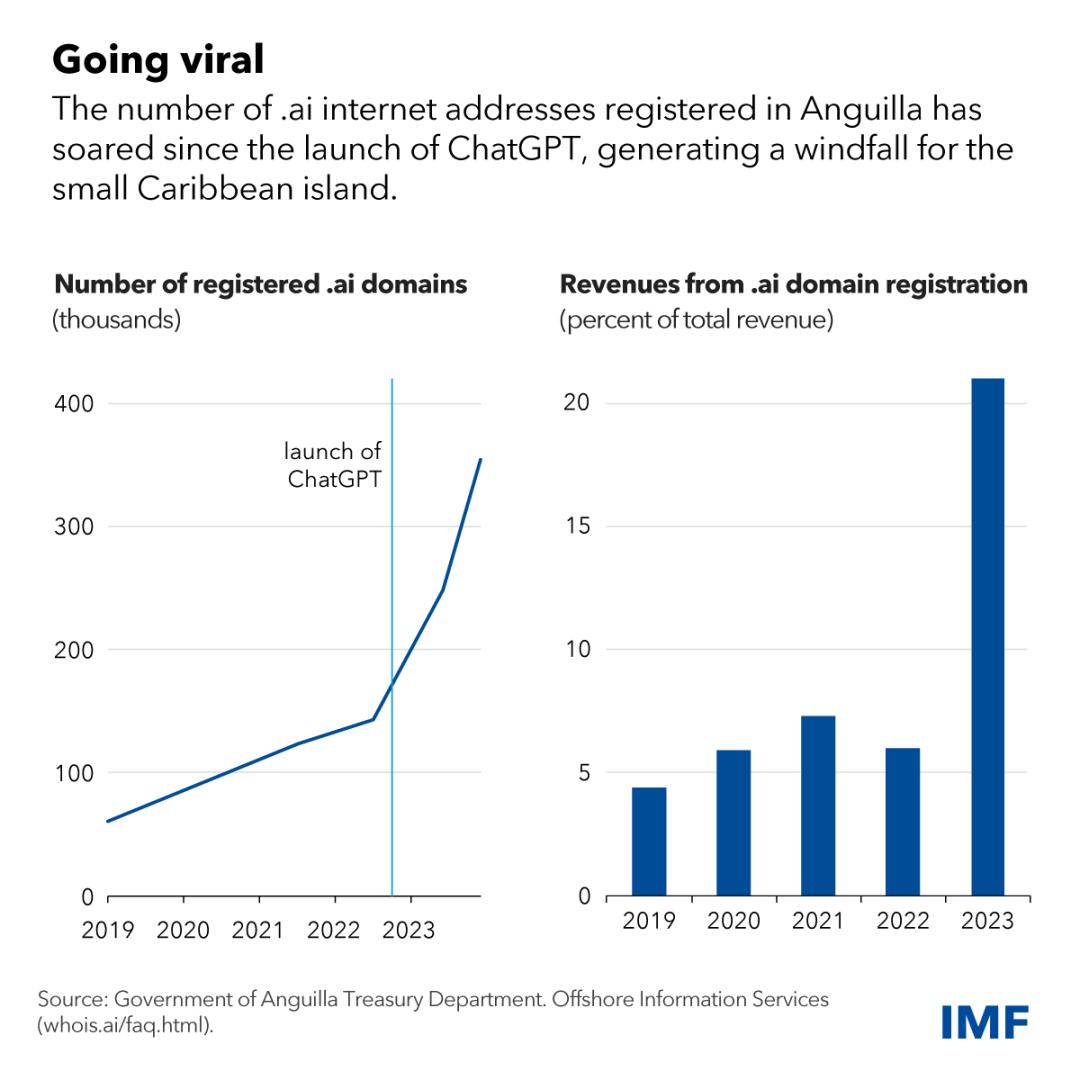
The number of ".ai" internet addresses registered in Anguilla has surged sharply
According to IMF data, the number of ".ai" domain registrations reached 144,000 in 2022. Statistics from the domain name industry show that by the beginning of January 2026, the number of ".ai" domain registrations has risen to more than 1 million.
Prior to the deployment of enterprises that are strongly associated with the ".ai" domain name, many of these more than 1 million domain names have fallen into the hands of third parties, which often becomes a thorn in the side of enterprise brand strategies, meaning that users may be misled to counterfeit websites, ranging from minor information confusion to serious phishing and fraud incidents.
For tech giants that have built a huge ecosystem such as Alibaba, Tencent and Baidu, a ".ai" domain name held by a third party not only means the loss of a traffic entry, but also may lead to the dilution of brand recognition, and even the risk of being "hijacked" by competitors or speculators.
Therefore, initiating arbitration through mechanisms such as UDRP (Uniform Domain-Name Dispute-Resolution Policy) has become a conventional weapon for major tech companies to recover their "brand sovereignty". The core of rights protection lies in the fact that the brand name itself is a registered trademark, and the domain name holder cannot prove its good-faith use. The arbitration tribunal has repeatedly emphasized a principle in relevant rulings: registering a domain name solely for resale at a high price to the trademark owner constitutes "opportunistic bad faith". This principle is also the key to Alibaba's victory in a series of cases including goofish.ai and taobao.ai.
Unfortunately, arbitration does not always go as expected. For example, Google's loss in the NanoBananaAI.com case is a typical counterexample. The arbitration tribunal held that "NanoBanana" is not a registered trademark of Google, and Google failed to prove that the term has acquired a "secondary meaning" through use, that is, the public has formed an exclusive corresponding relationship between the term and Google.
The above ruling reveals the core logic of the UDRP mechanism: it protects trademark rights, not mere brand association or business opportunities. This also means that not all brand-related ".ai" domain names can be easily retrieved by major companies. If the domain name holder can prove that the registration has reasonable grounds, or the term itself has an independent literal meaning, the complaint may be rejected.
In this case, negotiated purchase has become another common path, but this method is destined to be costly. Taking 1688.ai as an example, reports show that this domain name was once listed by the holder for 168,888 US dollars. To a certain extent, the price difference of high-quality .ai domain names from registration to transfer can be up to 1000 times: the annual registration cost of a domain name is usually only dozens of US dollars, while the resale quotation of high-quality domain names can sometimes reach hundreds of thousands of US dollars.
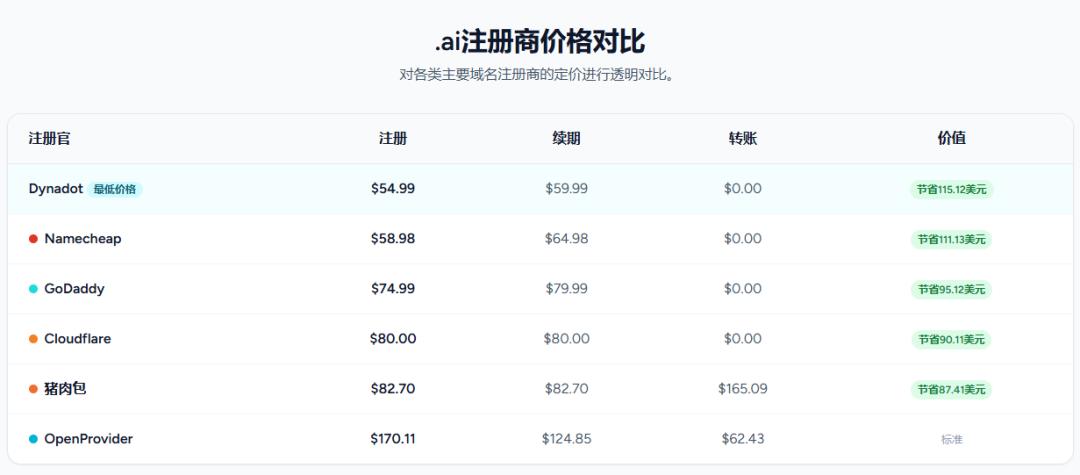
Price comparison of different domain name registrars
When the holding cost is extremely low and the transfer return is extremely high, holding a domain name itself becomes a kind of "call option", which directly gives birth to a professional domain name investment industry chain.
Sky-high transactions in the secondary market continue to emerge: in October 2023, the you.ai domain name was auctioned for 700,000 US dollars, and the buyer was Dharmesh Shah, co-founder of HubSpot; in October 2025, wisdom.ai was sold for 750,000 US dollars; in February 2026, bot.ai was traded for 1.2 million US dollars on the Sedo domain trading platform, which is also the first publicly recorded million-dollar level ".ai" domain name transaction in the industry.
These cases not only confirm the scarcity and strategic value of ".ai" domain names (which have multiple attributes such as customer acquisition entry for AI products, financing narrative material and ecological occupancy tool), but also further verify the market's valuation logic for this suffix: short, precise and targeted domain names have irreplaceable recognition and memory advantages during the outbreak of the AI industry.
What is priced is never just the domain name
"Domain name investors" (a nickname in the domain name investment circle) cannot turn a blind eye to all this. On the contrary, they are the most keen catchers of this valuation logic. Whenever a new concept ignites public opinion, domain names with related keywords are often registered in batches within just a few hours.
The balance of offense and defense has thus reversed. In the past, individual investors waited for buyers to come by registering good domain names in batches; nowadays, domain name investment shows a trend of institutionalized hoarding. Some institutions even set up special domain name funds to acquire high-quality domain names in popular tracks in batches, waiting for relevant enterprises to buy them back.
AI business is iterating rapidly, while there is a lag in the trademark and brand management process of enterprises, and this time difference is exactly the window of opportunity for third-party cybersquatters.
The key point is that the profit of the entire industry chain does not lie in the registration link at all, but in the subsequent game and negotiation. Major tech companies have mature legal teams and international arbitration channels, and can also pay to acquire domain names when necessary; while entrepreneurs, open source projects and small and medium-sized teams often lack bargaining chips, and are forced to choose between changing project names and purchasing domain names at high prices.
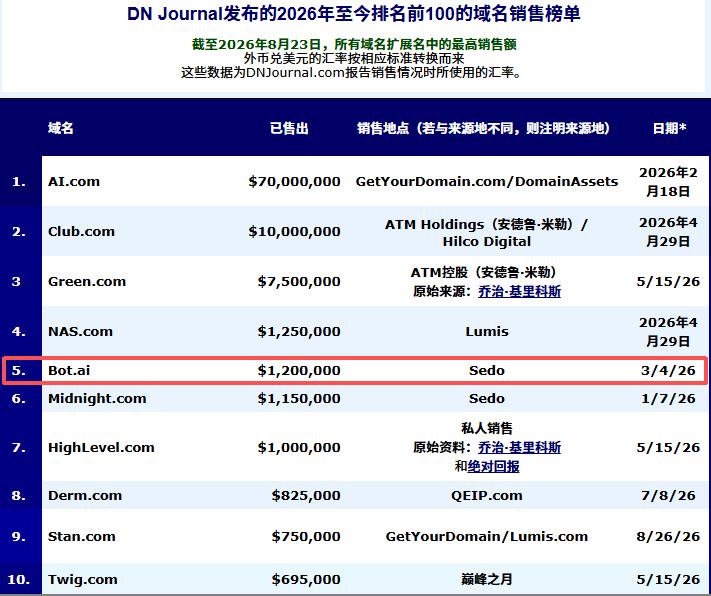
DNJournal Domain Transaction Ranking List
This asymmetric game pattern has also begun to reshape the naming strategy and brand logic of AI entrepreneurs. Previously, many entrepreneurs were accustomed to developing products first and then thinking about domain names, and brand names were often formally determined in the financing or marketing promotion stage. But in the battle for ".ai" domain names, this order has been completely reversed.
More and more founding teams have to complete a domain name attack and defense battle before writing the first line of code: checking WHOIS, sending inquiry emails, evaluating the feasibility of arbitration, and even being forced to pay for the domain name in the early stage of starting a business. For those early-stage teams that have not yet obtained financing, this expense may be enough to devour several months of operating budget, while giving up the desired domain name means long-term loss of brand recognition.
The more hidden risk is that domain name cybersquatters are not always individual "domain name investors" acting alone. Some institutional players will systematically scan new content on platforms such as GitHub (code repository), arXiv (academic papers), and Product Hunt (new product release) to capture project names that have not been officially released but have shown potential, and complete registration before their trademark application or public appearance. By the time entrepreneurs realize the problem, the domain name has already been listed at a high price. At this time, what they are facing is not only the monetary cost, but also the combined losses of user confusion, traffic hijacking and brand dilution.
The path to legal relief is equally narrow. Although UDRP provides an arbitration channel for trademark owners, its application threshold is not low. At the same time, for early-stage projects that have not yet registered trademarks, or cases where the name itself has a general meaning, UDRP is often difficult to work. Taking the path of court litigation means double consumption of time and money, which is almost unbearable for AI teams with an iteration cycle counted in weeks.
Therefore, a new industry consensus has gradually taken shape: instead of being passively attacked on domain names, it is better to take the initiative to incorporate the naming right into the product strategy. Some incubators and accelerators have begun to list "domain name availability" as one of the mandatory indicators for project screening; some founders have turned to more descriptive, easier-to-register compound words or neologisms, sacrificing part of the brand aesthetic in exchange for legal security. At the same time, services around ".ai" domain names such as insurance, trusteeship and dispute mediation have also begun to emerge, trying to get a share of this gray industry chain.
But the fundamental contradiction has not been resolved. As long as the valuation premium of the AI industry continues to exist, and as long as the ".ai" suffix is still regarded as the identity label of the technological frontier, the domain name is not only a traffic entry, but also part of the capital narrative.
When the transaction price of a domain name can exceed the valuation of an early-stage company, and when the leverage between holding cost and transfer return is as high as 1000 times, this battle around characters will not stop. What it reflects is the fierce competition for scarce cognitive resources in the explosive period of an industry, and it is also a microcosm of the redistribution of power and capital in the entrepreneurial ecosystem.
What is priced is never just the domain name, but the ticket to enter the AI competition itself.
This article is from the WeChat Official Account "Zinc Scale" (ID: znkedu), author: Zinc Scale, published with authorization from 36Kr.