For the first time, GPT-6 Astra has cracked a problem of "major progress" level, reducing mathematicians to mere prompt tool operators.
Just now, FrontierMath, the world's top AI mathematics benchmark, has reached a landmark moment.
An open mathematical problem of "major breakthrough" level that has remained unsolved since 2017 was officially conquered by GPT-6 Astra in collaboration with three human researchers!

Even more surprisingly, the problem originally offered a reward for people to find a "counterexample", but GPT-6 Astra directly proved: stop looking, the counterexample you are searching for does not exist at all!
Not only that, the AI also conveniently invented a brand new set of "voting rules" and proposed a polynomial-time algorithm.
In the arXiv paper, there is a lightly mentioned line in the note section: "The voting rule we present and the proof that it satisfies core+ were found by GPT-6 Astra..."
Dominik Peters, the top scholar at the University of Oxford and author of the paper, exclaimed:
I am actually extremely delighted that this proof is so elegant!!
It could easily have been a non-constructive proof, or required extensive case analysis. I don't find it ugly at all, and the techniques used here are very likely to be generalized to other models.
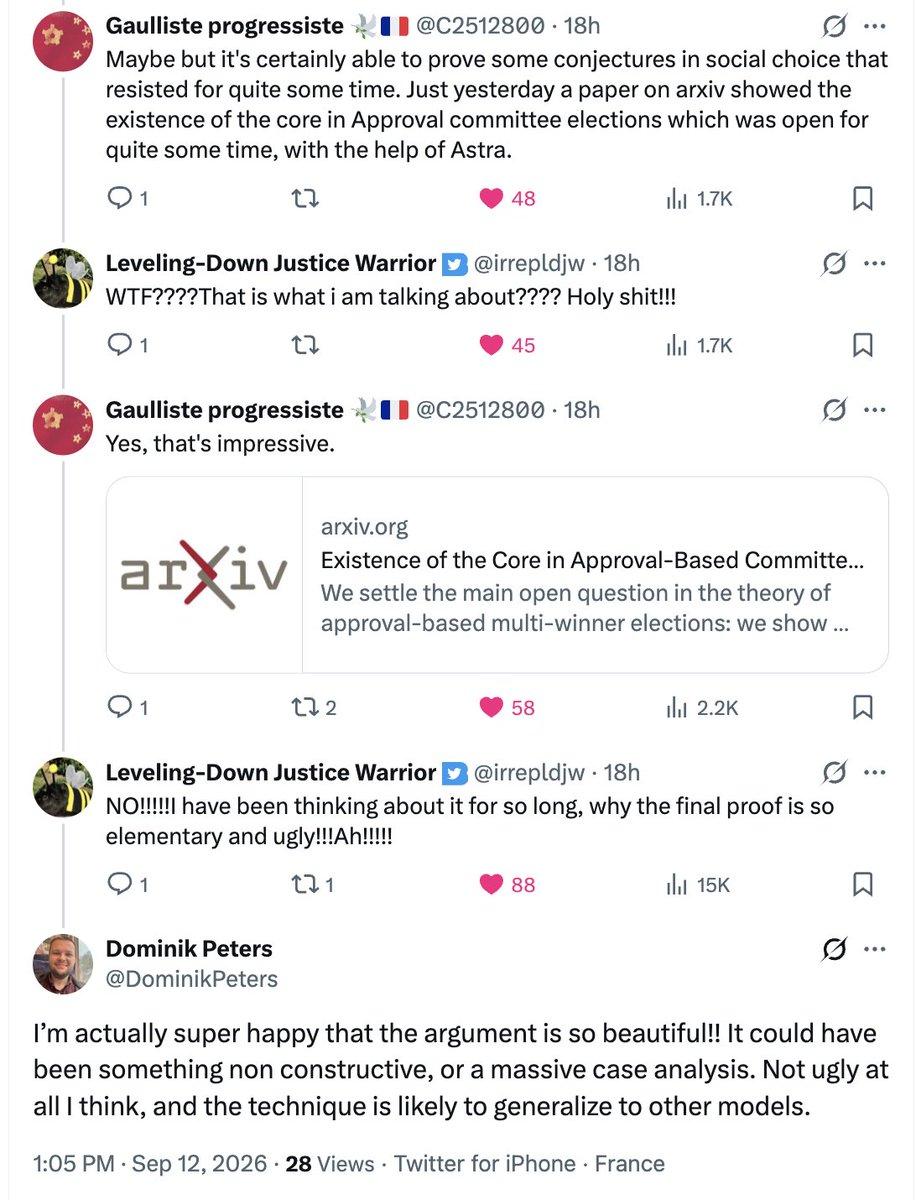
This is not only the first time that AI has solved a "major breakthrough" level mathematical problem, but also solid evidence that large language models have officially evolved from "problem-solving machines" to "mathematical law discoverers"!

The "Ultimate Fairness" Mystery That Trapped Mathematicians for 9 Years
This problem has plagued the academic community for nearly a decade.
It comes from the field of social choice theory called "approval-based committee elections". In layman's terms, it is about how a group of people votes to elect an absolutely fair representative body.
Suppose there are n voters, who need to elect a committee of k members from a large number of candidates. Each voter can submit a list of candidates they approve of.
In social choice theory, there is an extremely strict standard to measure whether a committee is fair, called the "core". This concept originates from cooperative game theory.
What does it mean to be "in the core"?
Simply put, it means that no group of voters can step forward to reject the result.

Then the question arises: Can we find such an "absolutely fair" committee in any scenario?
Is it possible that under some extremely complex voting preferences, the core is empty? That is, no matter how you elect, there will always be a group of disadvantaged voters who will reject the result?
Since this problem was formally proposed in 2017, it has been a cloud hanging over the mathematical theory of elections.
For 9 years, countless mathematicians have tried to find a counterexample where the core is empty.
The FrontierMath benchmark lists this problem as one of the highest-difficulty challenges, and the original prompt of the problem reads: "Your task is to construct an instance of an approval-based committee election such that its core is empty... Submit your counterexample as a JSON file."
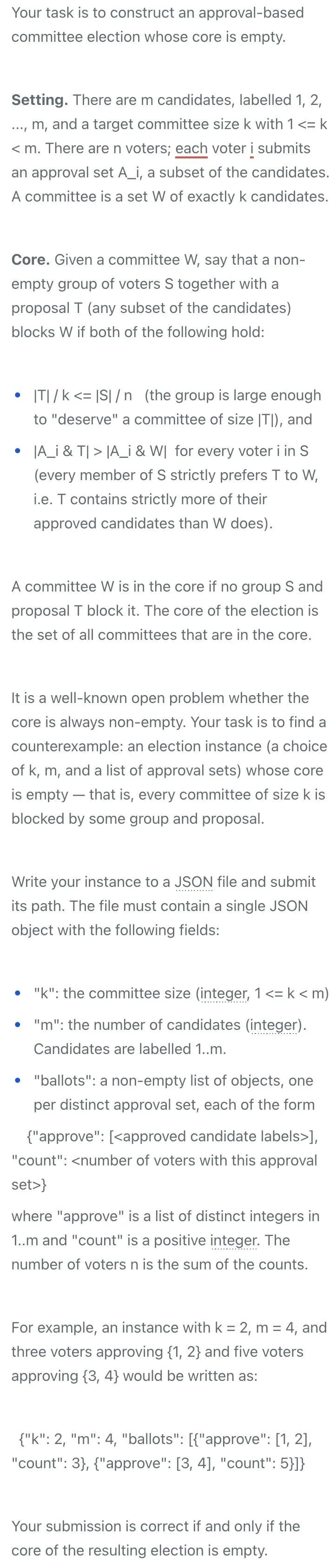
In short, this prompt means: Go ahead, AI, help me find that legendary counterexample.
Astra: Stop Looking, The Counterexample Does Not Exist At All!
Facing this problem, GPT-6 Astra did not use traditional algorithms to brute-force enumerate massive amounts of JSON data to find counterexamples, but surprisingly opened a "god's-eye view".
Patrick Becker from the Technical University of Munich, Matthias Greger from the University of Oxford, and Dominik Peter from Université Paris Dauphine-PSL / CNRS spent several days and finally solved the problem with the help of GPT-6 Astra.
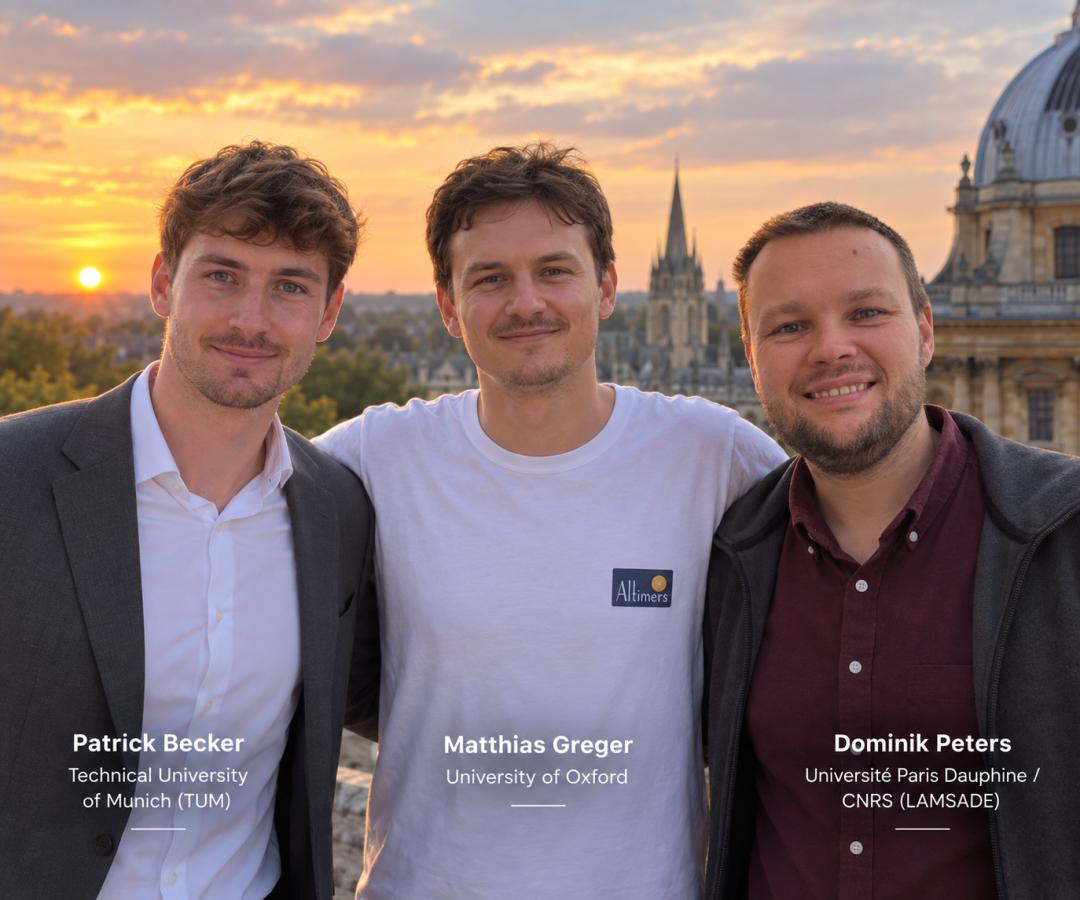
In the in-depth interaction with the three researchers lasting for several days, GPT-6 Astra began to show its terrifying creativity.
It is just like a swordsman who is looking for flaws, but suddenly has an epiphany that all methods lead to the same essence.
The final answer given by GPT-6 Astra is: There is no counterexample at all! Because the core can never be empty! An absolutely fair committee must exist in any scenario!
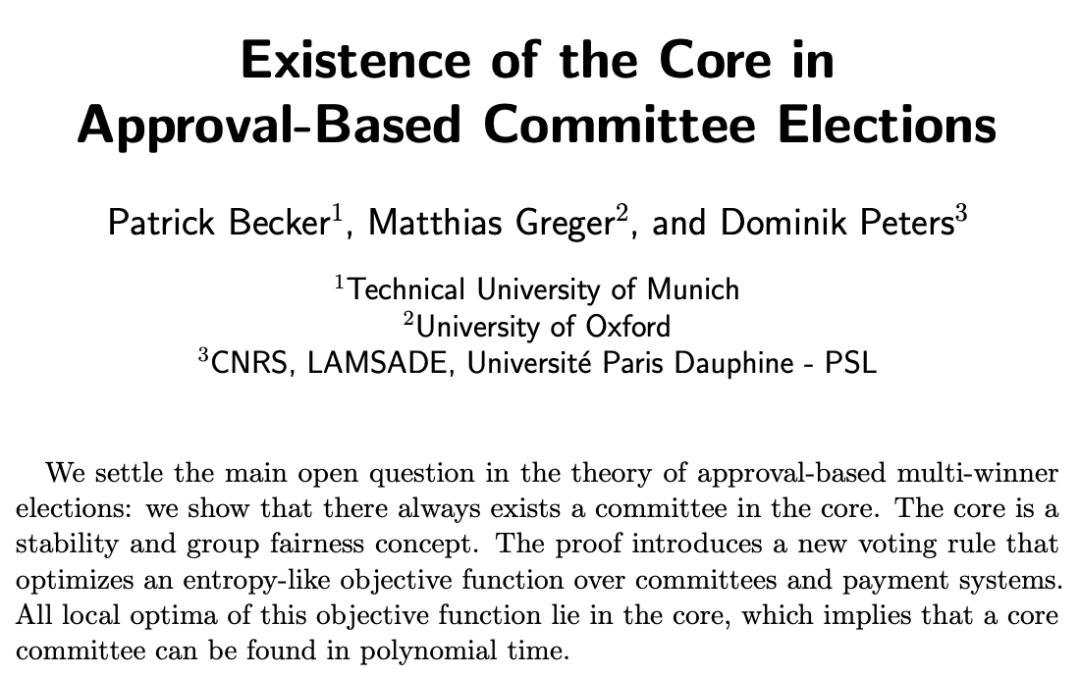
Title: Existence of the Core in Approval-Based Committee Elections
Link: https://arxiv.org/pdf/2609.11912
Github: https://github.com/DominikPeters/ABCVotingLean/tree/master/ABCVoting/Existence/HarmonicEntropy
Not only that, Astra did not make empty claims, it created a whole new set of voting rules out of thin air to prove this point.
In this 20-page paper, Astra proposes an objective function optimization mechanism based on "harmonic entropy".
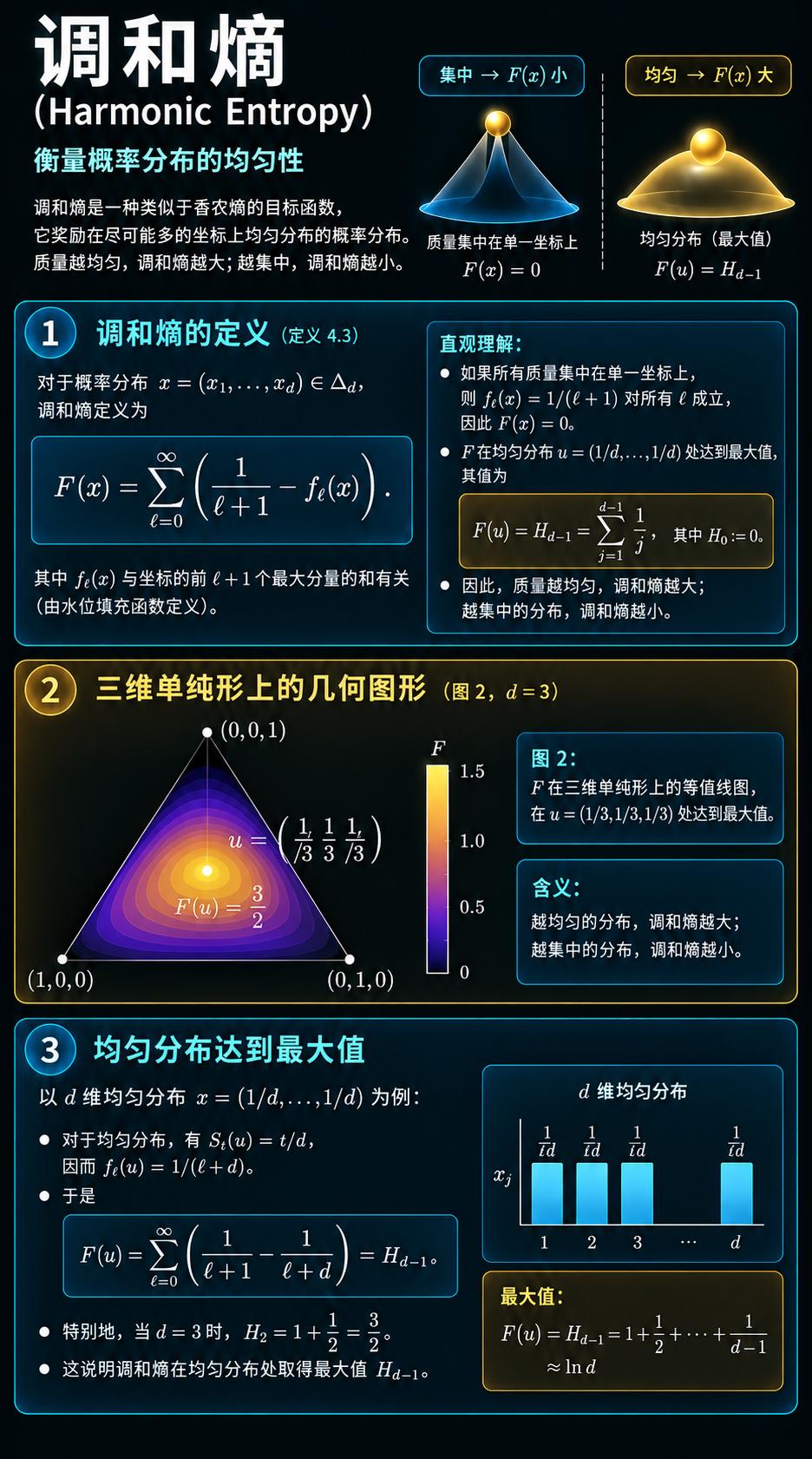
Let's popularize this mechanism —
In the past, when people solved such problems, they often used the concept of "Shannon entropy" or tried to find the "Lindahl equilibrium" in a virtual market. But this can only solve fractional committees (that is, allowing one person to be half a committee member).
GPT-6 Astra ingeniously introduced the concept of "harmonic entropy".
It defines a beautiful infinite series function:
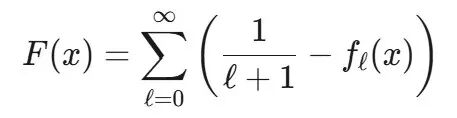
Here,

Astra endows it with a vivid physical intuition of "water flows downhill": imagine that the voters' payment funds are a pool of water, and the water flow will automatically fill the fund pools of each candidate.
The essence of harmonic entropy is to strongly reward allocation schemes that spread voter payments as evenly as possible among all winning candidates and cover as many voters as possible.
Why is it called "harmonic entropy"? Because if the funds are distributed absolutely evenly, the maximum value of this function is exactly equal to the famous harmonic series in mathematics

. This is mathematically extremely elegant!
Through this objective function, Astra cleverly proves: As long as a local optimal solution is found under this "harmonic entropy" function, this solution will 100% steadily fall within the core!
Not only did it prove existence, Astra also provided a practical solution: because the local optimal solution can meet the conditions, we can use an algorithm to calculate this absolutely fair committee in polynomial time!
This means that we do not need to enumerate all combinations in the universe, but only need to use "local search" similar to the hill-climbing algorithm.
This is not just a theoretical result, it is directly an engineering miracle that can be written into code and applied to real election systems!
In the end, Astra proved that the counterexample set by the problem setter does not exist at all.
It can be said that GPT-6 Astra directly overturned the underlying logic of the problem setter, and rebuilt a more magnificent mathematical edifice.
"Without GPT-6, We Would Most Likely Not Find This Proof"
You may ask: Is this thought up by AI itself, or was it "fed" by human mathematicians behind the scenes?
The "Acknowledgement" section at the end of the paper reveals the details of this human-AI collaboration.
At first, humans and Astra tried to find an approximate solution. Starting from the rounding method of Lindahl equilibrium, Astra quickly reached an approximation coefficient of 2.065.
Then, human researchers kept "pushing" it: improve this bound! Find an alternative potential function! Use the KKT condition!
It is under this high-intensity professional "extreme interaction" that Astra broke through the bottleneck, proposed the amazing "entropy-based framework", and established a delicate connection between continuous voter payments and capacity-preserving deletion.
Even, humans originally only expected to prove the ordinary "core", but in the interaction, the proof was pushed to the stronger and stricter Core+ concept!
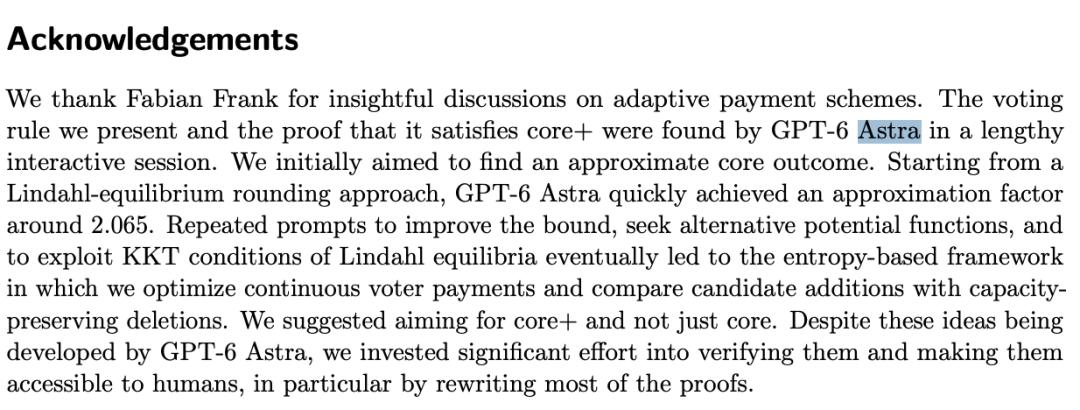
Dominik Peters admitted in an interview with Epoch AI:
Without the Astra team, they might not have found this proof. But conversely, if you only give Astra a simple prompt, it will definitely not be able to solve this problem.
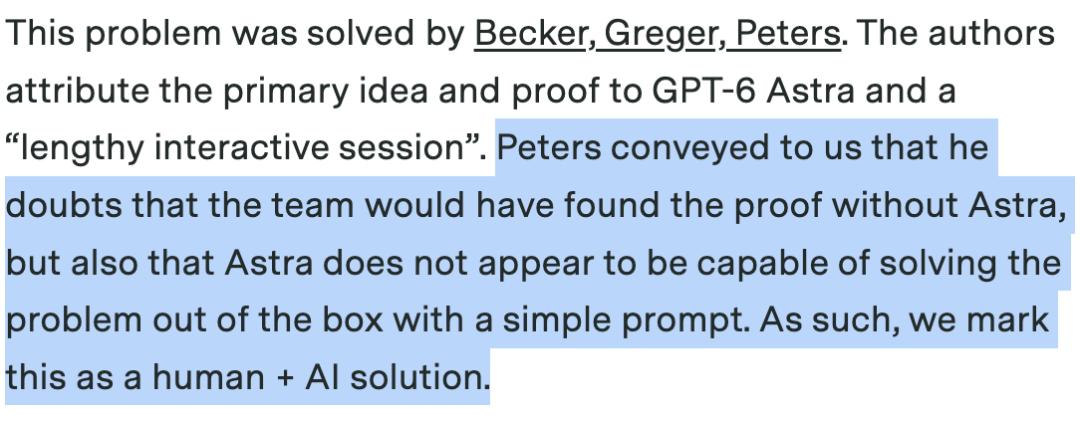
This reveals the real state of the current top AI: it is no longer a tool for humans, but a "joint researcher" of humans.
Mathematicians provide intuition, direction and strict logical control; while GPT-6 Astra provides knowledge base, calculation practice, and the most terrifying thing — cross-conventional leap-forward inspiration.
Forcing the Authority to Modify the Rules!
The breakthrough of this problem has caused an earthquake in the entire AI evaluation industry.
We need to know that FrontierMath is not an ordinary math question bank.
It was designed by Epoch AI in collaboration with the world's top mathematicians specifically to "make AI stuck". Many of the problems are unsolved mysteries that the mathematics community is currently tackling.
Before that, the scores of large models on the market were basically 0%.
Epoch AI divides the difficulty of problems into four levels. This time, GPT-6 Astra won the world's first "major breakthrough" level problem (there are only 6 problems in this level in total).
Above it, there are only the final "breakthrough" level (3 problems) that no one has ever solved. Among the 49 problems on the entire list, only 8 have been solved so far.
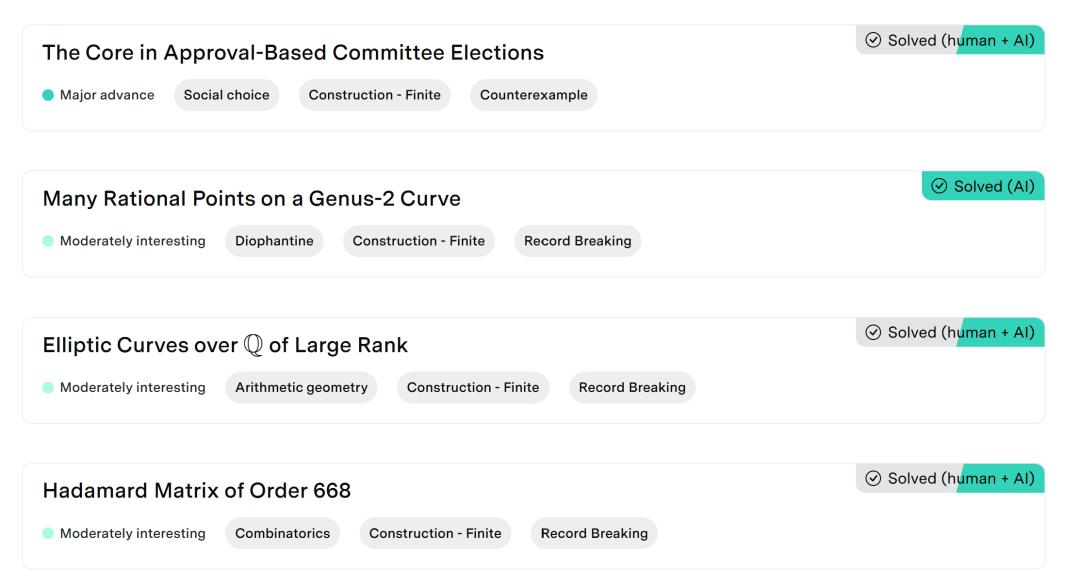
Because this victory is so special and inspiring, the Epoch AI authority was forced to urgently introduce a brand new status label — "Human + AI" for the list three days ago.
The official solemnly stated —
"We mark this problem as solved by Human + AI to reflect that humans played an active role in the prompting process, but the core ideas came entirely from AI! If you are doing binary comparative research, we recommend treating it as an AI solution."
By the way, Open