Elon Musk is currently scooping up bankrupt companies in batches... The world's richest man surely thinks differently.
Musk, you are truly a genius with sharp wits!
While others are worrying that high-quality data is getting more expensive and harder to obtain, you have immediately come up with an unorthodox workaround:
Buy data from defunct companies to train Grok.
According to the latest scoop from Bloomberg, SpaceX has held internal discussions about purchasing customer information and operational data from struggling or even bankrupt startups to improve its in-house AI models.
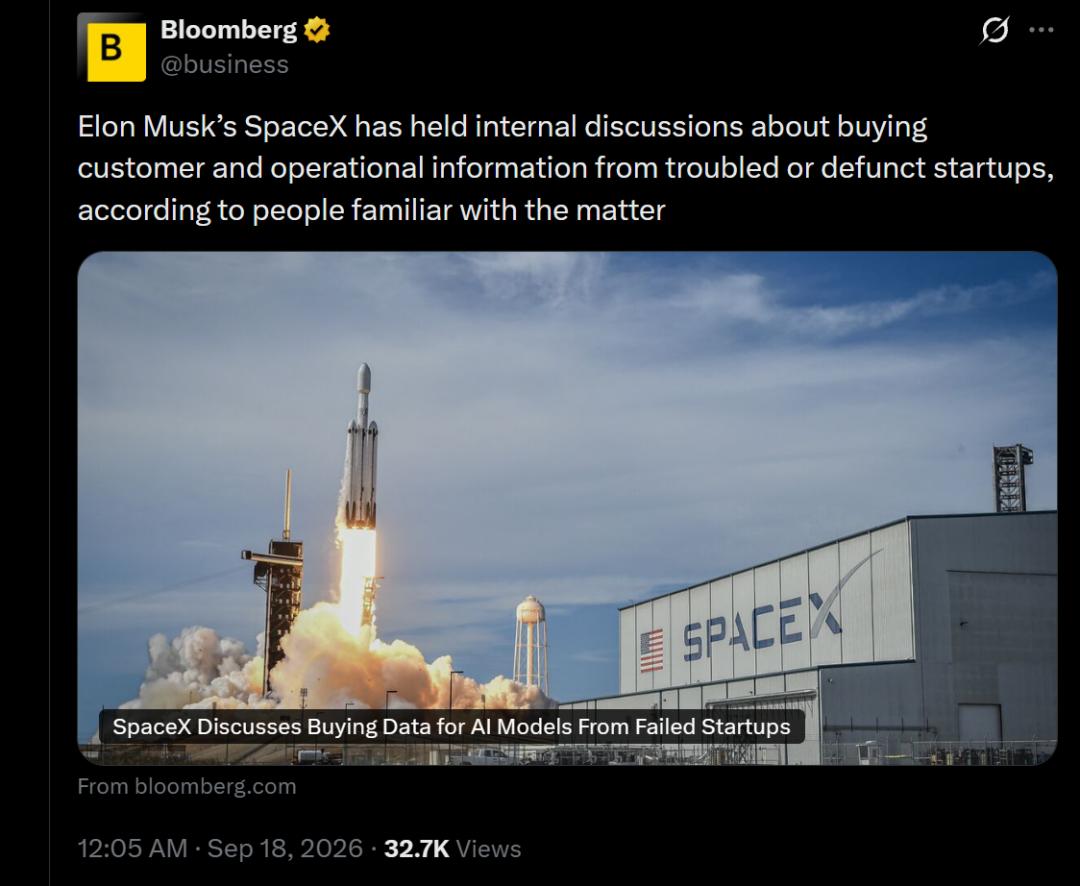
The reason is very straightforward: it's extremely cost-effective.
Even as the richest man in the world, Elon Musk never hesitates to cut costs where he can (doge).
He can recover rockets for reuse, slash the purchase price of Twitter to the limit, and now he has set his sights on AI model training.
emmm... This can be regarded as a major "marvel" in the AI era.
In the past, when a startup failed, all that was left were offices, servers, debts and a mess of loose ends.
But now? The company can go under, but its data can still find a new use right away.

Why Does Elon Musk Want to Buy Data from Defunct Companies
So why did Elon Musk suddenly set his sights on this batch of data? Is it really just a random flash of inspiration?
The answer is definitely no.
This is more like a necessary missing puzzle piece that must be completed after Grok has gone through multiple rounds of training.
Before coming up with this unorthodox solution, Grok was mainly trained on two types of data.
The first type is data from X (formerly Twitter), which has shaped the core "personality" of Grok.
X has massive real-time content, hot debates, memes, sarcastic remarks and all kinds of fragmented expressions.
That's why Grok is born with a distinct internet vibe:
It catches references fast, talks a lot, dares to push back, and more or less carries Elon Musk's personal traits.

The second type of data comes from AI tutors.
This team is mainly composed of domain experts and labeling staff, who are responsible for equipping Grok with full professional capabilities.
Where there are gaps in finance, science and code, they will fill in the corresponding data.
But this team has been undergoing adjustments recently.
According to Bloomberg's report in June, xAI once suspended the recruitment of AI tutors, and later replaced the head of this team.
The previous team leader was Diego Pasini.
Business Insider once mentioned that he entered the University of Pennsylvania after graduating from high school in 2023, then dropped out to join xAI, and participated in the management of Grok's data labeling team.
His X homepage fully reflects the style of this generation of AI practitioners:
His profile picture is in sci-fi mecha style, the background is a picture of classical ruins, and his bio only has one line: "In pursuit of truth".
He didn't finish college following the traditional path, but already got the chance to train Grok first.
His life experience and personal style are exactly what Elon Musk likes (doge).
But for Grok to further learn real business scenarios, the drive and creativity of a young man alone is no longer enough.

The person who took over his position is Jack Garabedian.
Bloomberg reports that he was transferred from SpaceX, where he worked on Starlink for many years, and joined SpaceX back in 2021.
Starlink is a global business, covering satellite networks, terminal devices, subscription services and customer operations that all need to operate in synergy.
Compared with new talents who only have a pure AI background, he is more like a seasoned veteran from the real commercial operation system of SpaceX.
Interestingly, the bio on his X homepage is very relevant to his current job:
I’m trying my best to make the data good, ok?!
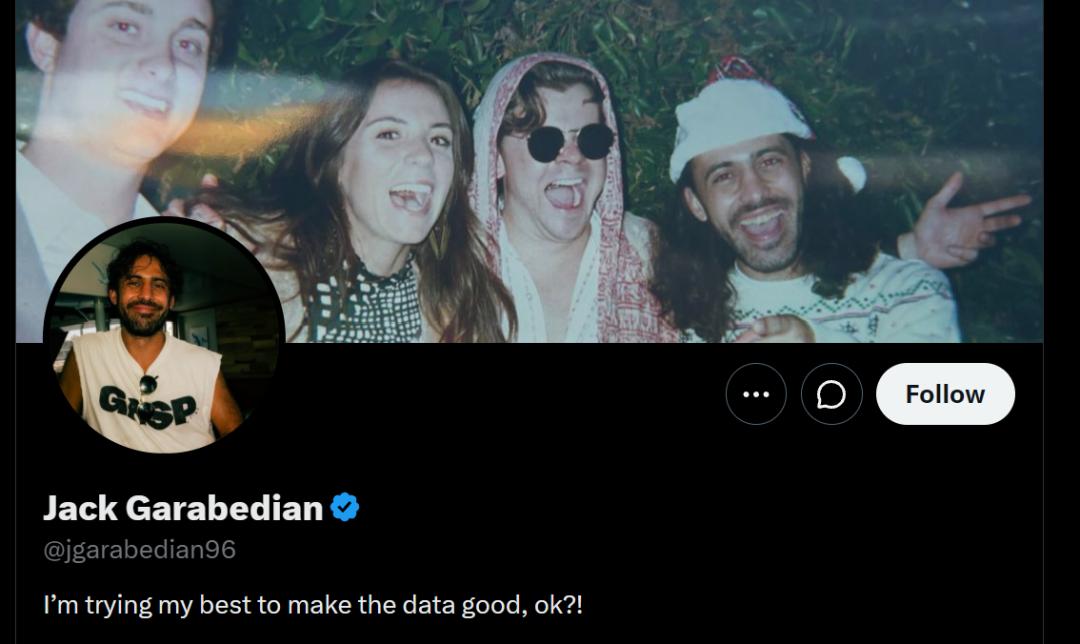
So this personnel change sends a very clear signal.
Grok's data training process is shifting from the early sprint stage to a standardized engineering production line.
Elon Musk himself put it more bluntly, he said at a recent SpaceX all-hands meeting:
We will use all SpaceX information to train Grok, including the data generated by all of you.
That means Grok will not only ingest SpaceX's codes, documents and workflows, but also all kinds of work traces left by employees in their daily work.
In this context, SpaceX's move to buy data from defunct companies is no longer unexpected.
X is responsible for shaping Grok's personality, AI tutors make up for its professional capabilities, while customer information and operational data fill the third gap:
Real business scenarios.
How customers place orders, how work orders circulate, how services are delivered, and how a company operates on a daily basis.
None of these can be learned from X, nor can they be scaled up efficiently through manual labeling.
The most direct source of such data is the customer information and operational data held by various companies themselves.
The problem is that companies operating normally are not necessarily willing to sell such data, and even if they do, the price will not be low.
Therefore, struggling or even bankrupt startups have become a very realistic choice.

Of course, this deal has not been closed yet.
Bloomberg says the relevant discussions are still at the informal internal stage of SpaceX AI, and a final transaction may not be reached.
SpaceX has not responded to the request for comment.
But Elon Musk's plan is already very clear.
Not an Isolated Case
Elon Musk is not the only one who has set his sights on data from defunct companies.
Earlier, the US low-cost airline Spirit Airlines was put on the auction block.
After the company went through bankruptcy restructuring, a batch of its internal business data entered the auction process.
Google offered 10 million US dollars to buy its de-identified business data, operational records and software codes, to train AI models and improve its products.
Since this batch of data includes not only flight schedules, but also internal emails, Teams chat records, collaboration logs, revenue data, flight operation records, employee productivity data, audit and fraud related information.
Therefore, this deal was quickly put on hold over concerns that it may lead to privacy leaks.
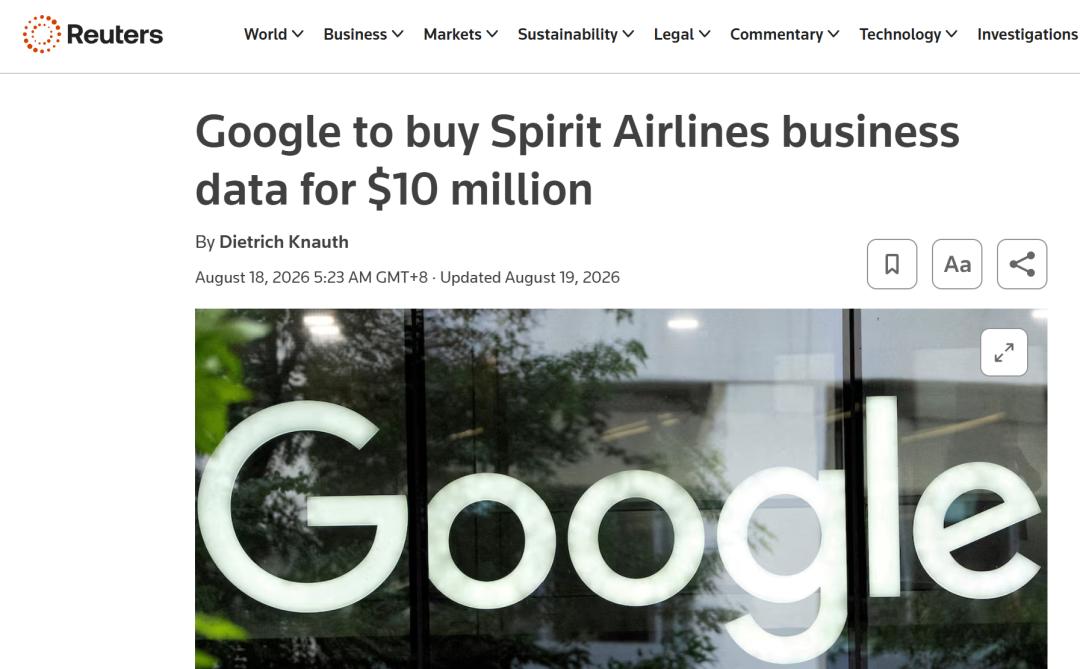
Putting the transaction result aside, the fact that both Google and SpaceX AI are targeting data from defunct companies follows the exact same logic:
For AI agents to work in enterprises, they need to understand how real businesses operate.
The entity that can get more real business data will have a better chance to push the model from being "good at chatting" to being "capable of getting real work done".
This is also a necessary step that Grok must take right now.
Looking at the latest movements in Silicon Valley in the past two weeks, you will understand why Elon Musk is in such a hurry.
At Anthropic, rumors about Claude Fable 5.2 have been circulating for a while. Although the official has not yet made an official announcement, community leaks and prediction markets are all focusing on a time window:
Late September to early October.
Over at OpenAI, things are even more lively. GPT-6 Sol was previously rumored to be launched this week, but the expected release time has been postponed again.
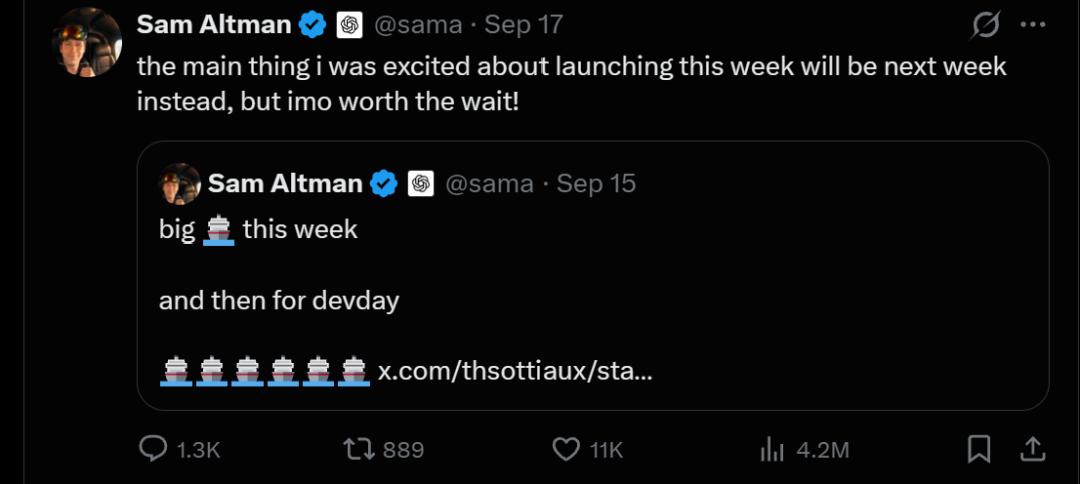
Putting aside whether the new model will be released or not, Tibo, you will reset the quota for us, right?
It's already Friday, looking at my remaining 4% quota, I can only shout in my heart that line:
The genius has fallen (just kidding)

Wait, the whole screen is full of news about OpenAI and Anthropic, where is Grok?
The last time it appeared in a large number of AI news, the situation was no longer that optimistic.
According to a Wall Street Journal report in May, Grok's downloads dropped from over 20 million in January to 8.3 million in April.
The paid conversion rate is also very unsatisfactory.
In the same report, an engineer made a straightforward analogy:
OpenAI is Coca-Cola, Anthropic is Pepsi, Grok is RC Cola.
What is RC Cola? It's totally normal if you don't know it, because the engineer immediately added:
I have barely seen anyone drink it.
That's a harsh shot, but although this comment is a bit mean, it roughly describes the awkward situation Grok is in right now.
Its unique style can attract a group of fans, but cannot attract enough paying users, let alone enterprise clients.
Of course, Grok, don't be too sad, in this AI competition, you still have Google as your fellow underdog.
When OpenAI and Anthropic take turns dominating the headlines, Gemini seems to have fallen asleep directly.
Now everyone who sees this situation will say:
All companies are calling for AI to hit the brakes, and only Google actually took that advice.
That's hilarious, netizens are really sharp with their words:
Great take, say more of that.
Reference Links:
[1]https://www.bloomberg.com/news/articles/2026-09-17/spacex-discusses-buying-data-for-ai-models-from-failed-startups
[2]https://x.com/business/status/2100617027954032932
This article is from the WeChat official account QbitAI, written by Yishui, and authorized for release by 36Kr.