Claude Code is fully open and integrated with AGENTS.md
Claude Code finally gave in.
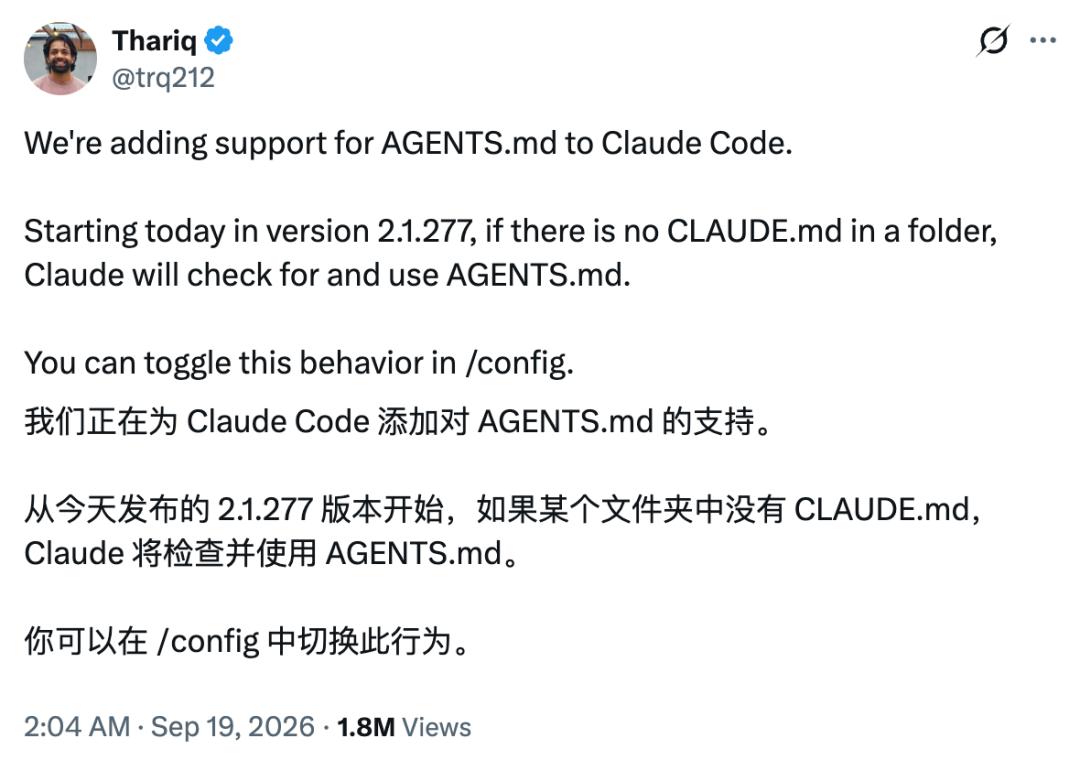
Just now, Thariq, a core engineer on the Claude Code team, posted a thread on X that exceeded 1 million views in just one hour.
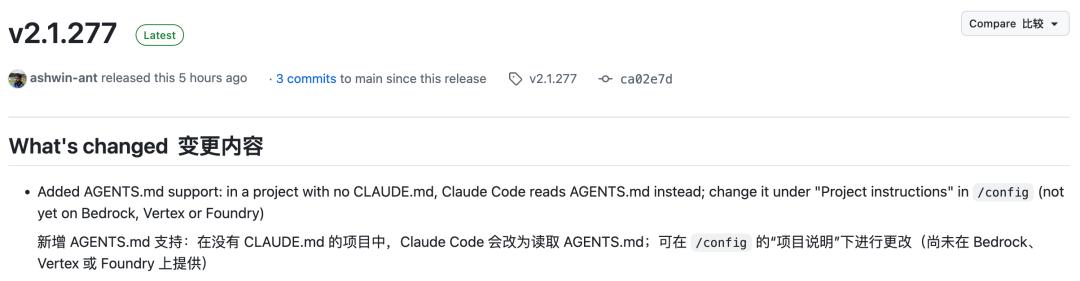
Starting from version 2.1.277 released the same day, if there is no CLAUDE.md in the project folder, Claude will automatically locate and read AGENTS.md instead.
The first line of the release notes for this version on GitHub clearly states this change.
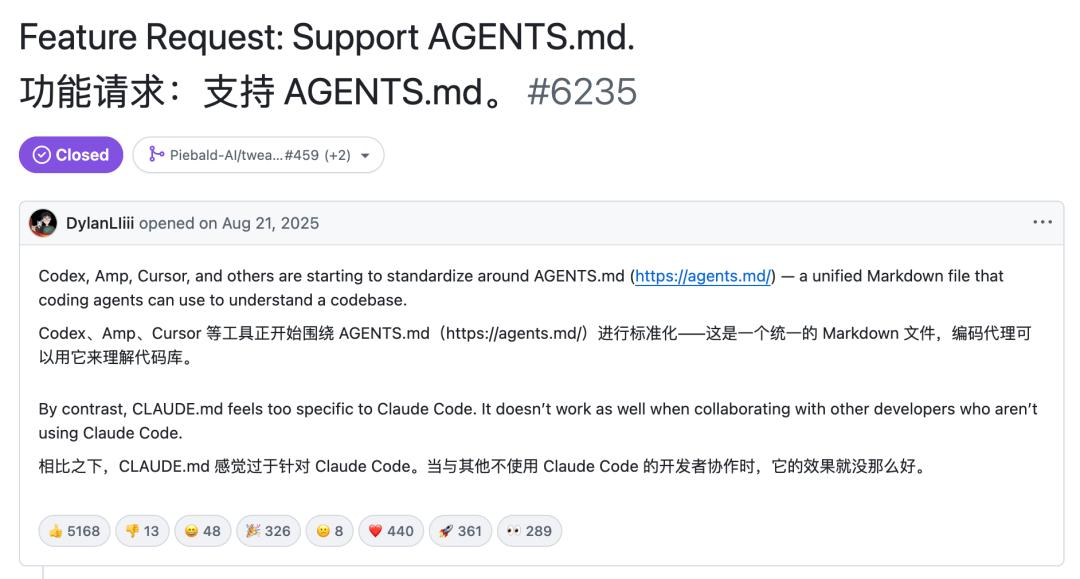
Developers have been waiting for this update for more than a year. The "Please support AGENTS.md" issue on the GitHub repository, which has been open since August 2025, has accumulated over 5,200 likes and more than 300 comments. It is the highest-voted feature request in the entire Claude Code repository, four times the number of votes of the second-ranked one.
As soon as the news was released, Tibo, head of the Codex team, immediately came to leave a comment:
Yay! This is the way. Come to the light.

What exactly is AGENTS.md
Essentially, both CLAUDE.md and AGENTS.md are "project instruction manuals" written for AI.
They are stored in the code repository, telling programming agents how to compile the project, how to run tests, and what rules to follow when writing code. Every time you start a new conversation with the AI, it reads the manual first before starting to work.
The difference lies in which tools recognize them.
CLAUDE.md is exclusive to Anthropic and is only read by Claude Code. AGENTS.md, on the other hand, is a universal format launched by OpenAI in August 2025, supported by Codex, Cursor, GitHub Copilot, Gemini CLI, Devin and many other tools.
Up to now, more than 60,000 open source projects around the world have adopted AGENTS.md.
Last December, OpenAI donated AGENTS.md to the Agentic AI Foundation (AAIF), a newly established foundation under the Linux Foundation.
It is quite funny that Anthropic is clearly listed in the platinum member list of this foundation, and Anthropic also donated its own MCP protocol to the foundation.
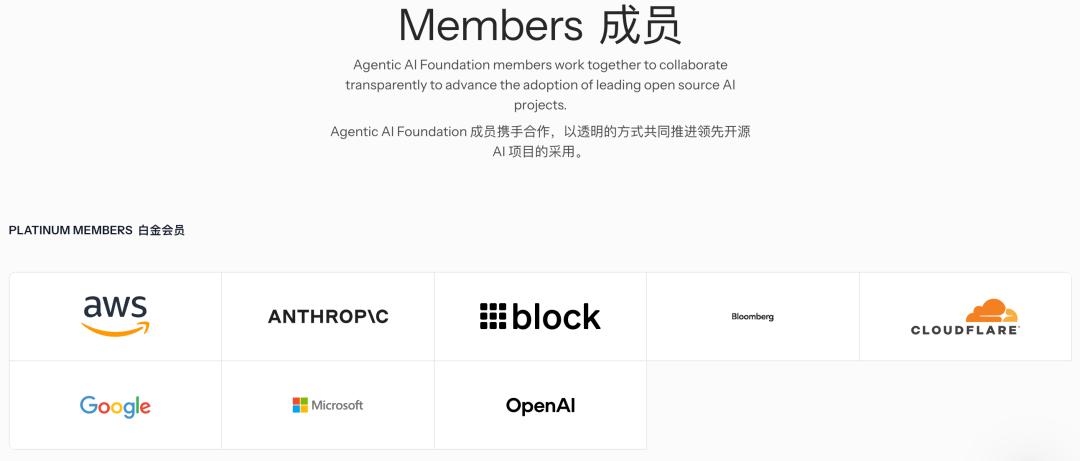
The two parties are sitting in the same foundation working on open standards, yet their most popular programming tools have long refused to read each other's instruction manuals.
This awkward situation dragged on for 13 months and was not resolved until this week.
Developers have been troubled by two sets of instruction manuals for a whole year
Where does the trouble come from? In real scenarios, teams do not only use one single tool.
One developer uses Claude Code, another uses Codex, and the third uses Cursor, so the same project has to prepare two almost identical instruction manuals.
If you modify one but forget the other, the AI will work according to the outdated manual, and the code it generates will be completely inconsistent with the team's coding specifications.
Developers have come up with a lot of makeshift hacks. Some soft-link CLAUDE.md to AGENTS.md, others write a line referencing @AGENTS.md in CLAUDE.md to import the other manual.
Others even set up a startup hook to print the content of AGENTS.md and pass it to Claude every time a new conversation starts.
AI can write code for humans, but humans still have to handle the compatibility of instruction manuals for AI. This absurd scenario has lasted for more than a whole year.
Now all these makeshift hacks can be completely discarded.
For a repository that has already configured AGENTS.md for other programming agents, you can use it directly without adding CLAUDE.md, writing import rules, or modifying any settings.
The real foreshadowing is hidden in mods
If the story ends here, it is at most a long-overdue compatibility fix.
But Thariq posted a second thread, which contains far more information than the first one.
He said that mods are the customization method Anthropic will launch next, used to modify the harness, the underlying runtime framework of Claude Code itself.
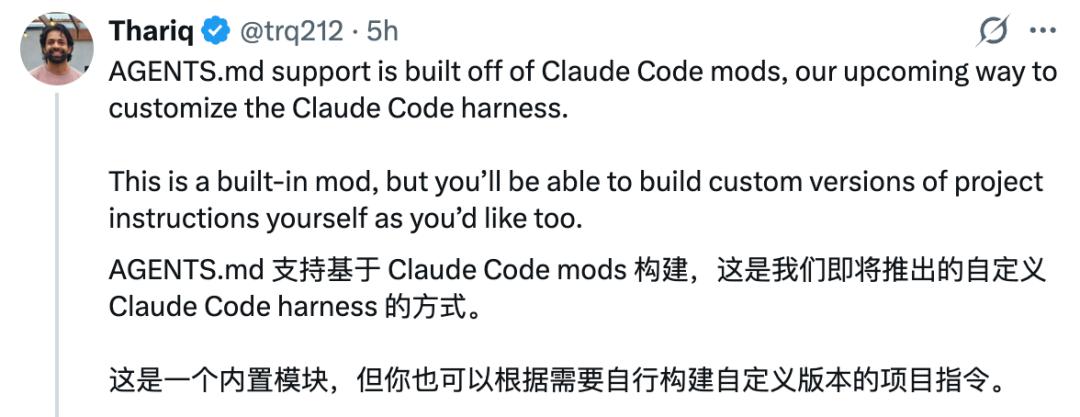
Support for AGENTS.md is implemented with Claude Code mods.
AGENTS.md is the first built-in mod, and its source code has been placed in the mods/agents-md directory of the official repository.
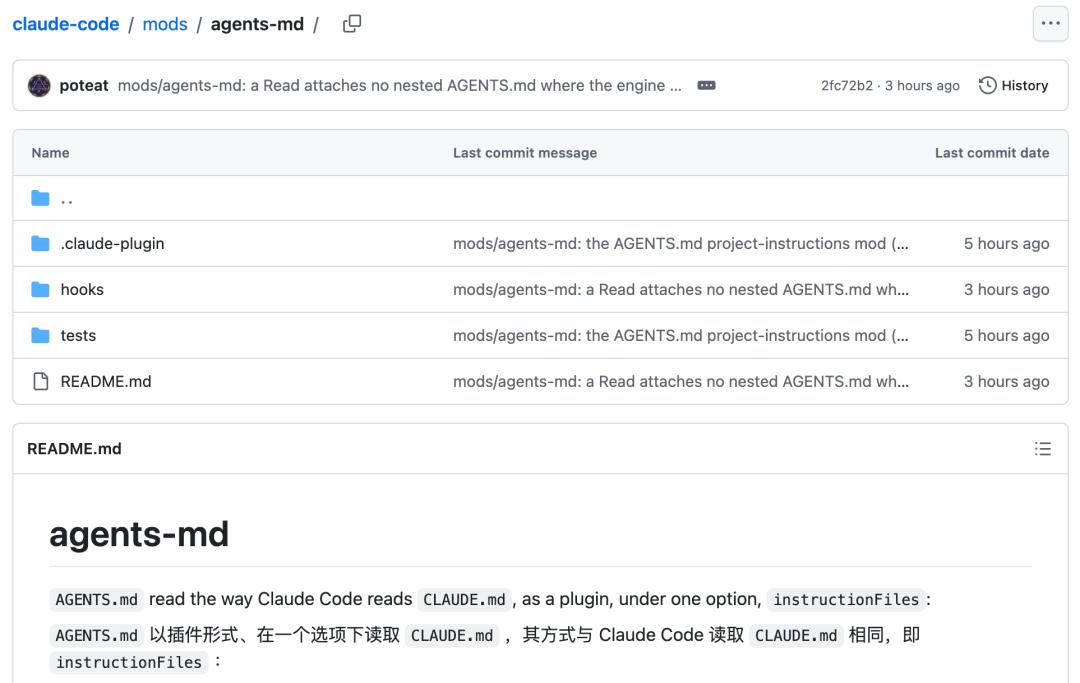
What is a mod? You can understand it as a "plugin" installed for Claude Code.
This time the official team installed a sample mod first. Thariq's exact words are: In the future, developers will also be able to make their own custom versions of how project instructions are read according to their needs.
In other words, what Claude Code reads and how it reads will no longer be entirely decided by Anthropic alone.
The reaction of the community proves this point. Some developers have already disassembled the source code on the day AGENTS.md went online to study the hook mechanism and lifecycle of mods.
Some people have incisively summed it up: mods are the real protagonist of this update, and AGENTS.md is just its first demonstration.
When it comes to the customization of harness, it is impossible not to mention DeepSeek Harness, which was just open-sourced a month ago.
DeepSeek released the Harness developer preview on the same day as the V4 Pro model, putting forward a very bold slogan: "Everything is a plugin".
Models, tools, skills, sessions, sandboxes, interfaces... all are split into pluggable components. It can even schedule Claude Code and Codex as its own sub-agents, treating them not as competing products, but as modular parts.
DeepSeek Harness has received 229,000 stars on GitHub. The enthusiasm of the developer community proves one thing: people do not just want an easy-to-use programming AI, they also want a modifiable programming AI.
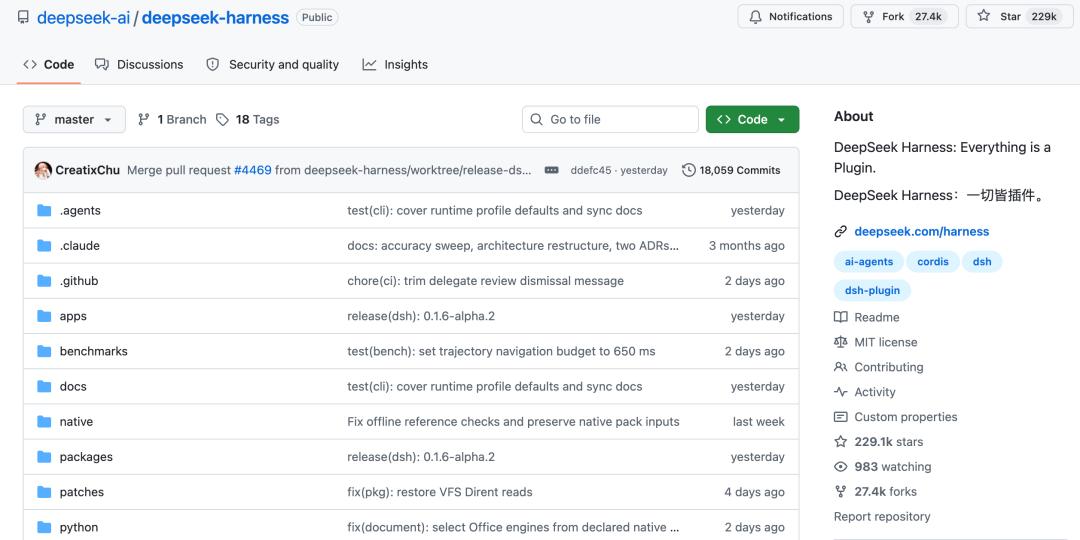
So are the mods of Claude Code and the plugin system of DeepSeek Harness following the same path?
Not exactly.
DeepSeek Harness is a ground-up open source framework based on the Cordis kernel. The entire system is a collection of plugins — even the interface itself is a plugin. It has extremely high freedom, but also a steep learning curve.
The mods of Claude Code follow a different idea: opening access points on a mature finished product.
Claude Code itself is a complete and polished product. Mods allow you to insert your own logic at specific stages without tearing down the entire existing architecture.
One approach is "building blocks from scratch", the other is "opening modification ports on a finished product".
The two routes have their own trade-offs, but the runtime framework of programming agents is no longer a black box.
References:
https://x.com/trq212/status/2101009392611278961
https://code.claude.com/docs/en/changelog
https://code.claude.com/docs/en/memory.md
claude-code/mods/agents-md%20at%20main%20%C2%B7%20anthropics/claude-code
This article is from the WeChat public account "Xinzhiyuan", edited by Solomon, and published with authorization from 36Kr.