What a slap in the face! Anthropic has also begun to "distill" other companies.
On the 17th, Anthropic dropped a bombshell.
Claude has optimized more than 30 open-source biomolecular models in less than four weeks, with an average inference speedup of about 4 times. It also launched a low-memory mode that can handle biomolecular system predictions of over 10,000 tokens on a single NVIDIA H100 GPU node.
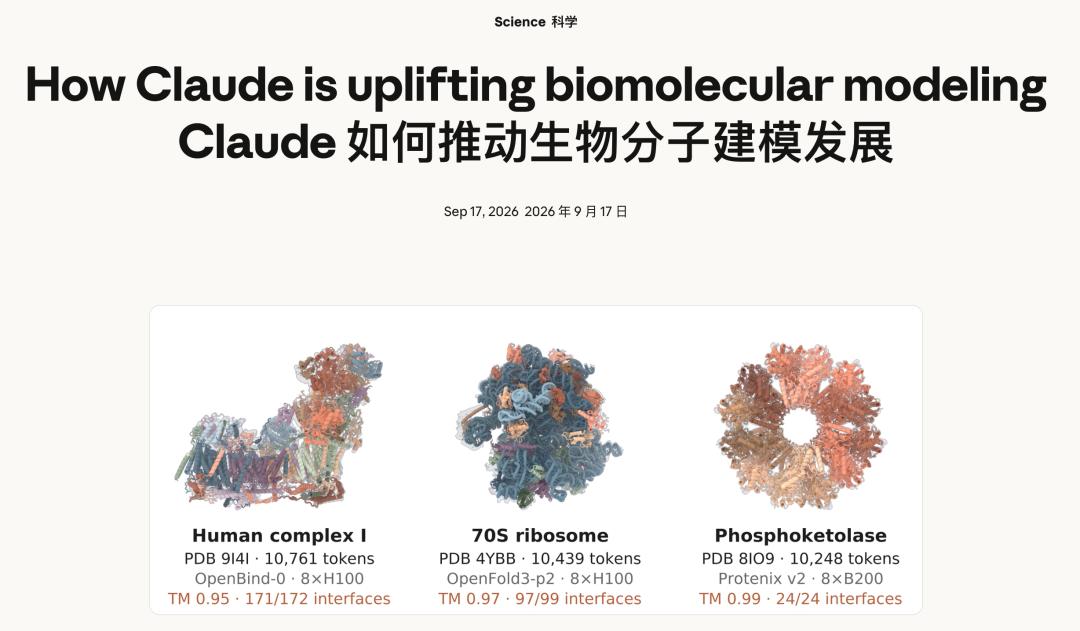
Models alone are not enough.
Anthropic also jointly launched an open protein design competition with Adaptyv Bio, carefully selecting 5 cutting-edge design challenges.
The plan is to verify more than 5,000 designs in Adaptyv's automated laboratory, providing up to $1 million in Claude credits.
As soon as the news came out, the industry was abuzz.
AI + protein + one million dollars, the trend of "Millennium Prize Problems" just blew over from the field of mathematics, and Anthropic has planted its flag in drug discovery.
Apparently, this is the boldest move this month.
But —
A quick look at the timeline reveals that Anthropic is not the first to do this.
The day before it posted the announcement, on September 16, an AI pharmaceutical company that had just been officially announced for a full week had already put up a reward of the same magnitude.
And its gameplay is even bolder: it is not offering a reward for solutions, but for the problems themselves.
The $1 Million Reward That Launched One Day Earlier
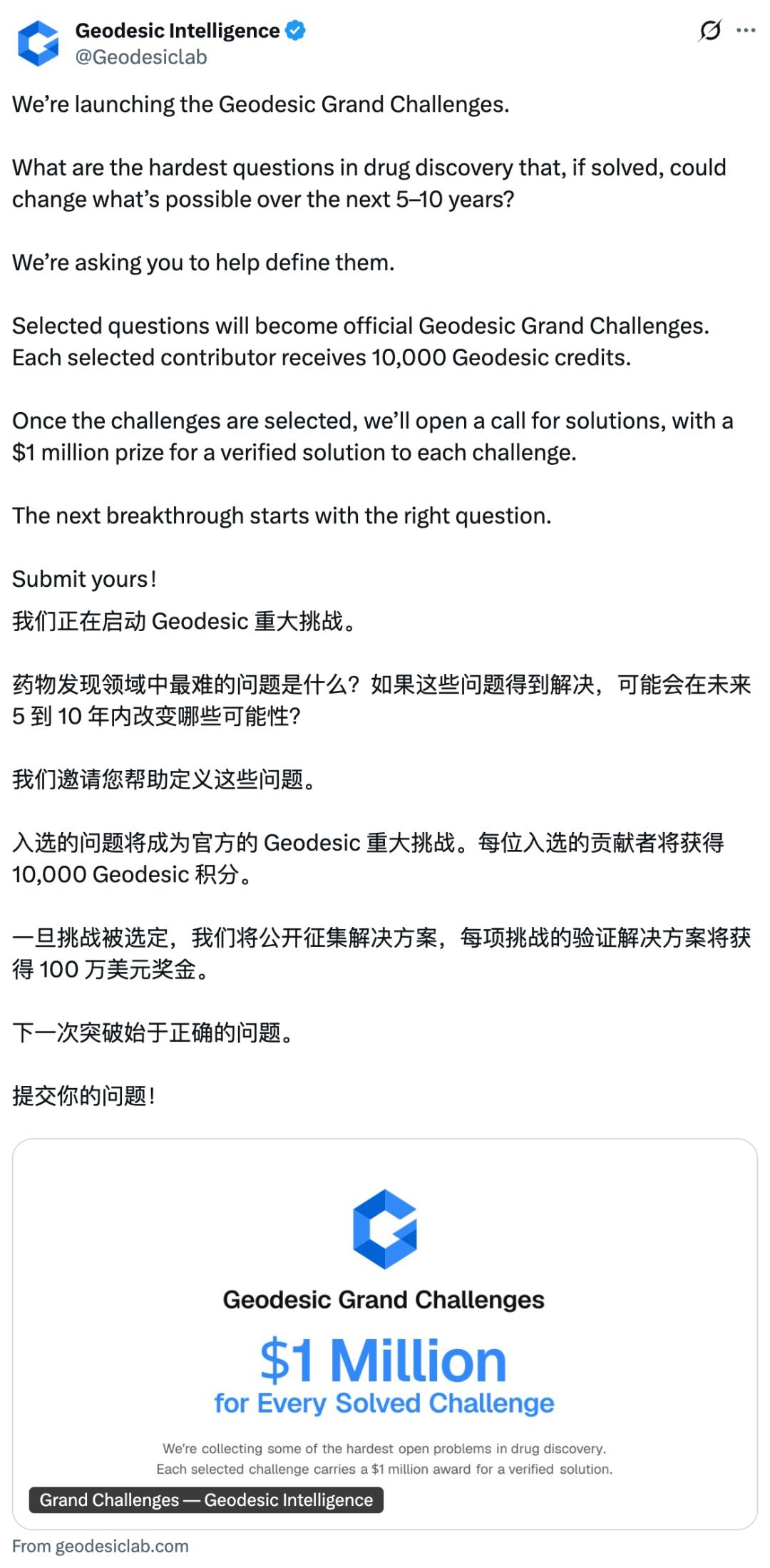
This company is called Geodesic Intelligence.
It is soliciting the hardest problems in drug discovery from around the world, with only one criterion: once solved, it can rewrite the capability boundary of this industry for the next 5 to 10 years.
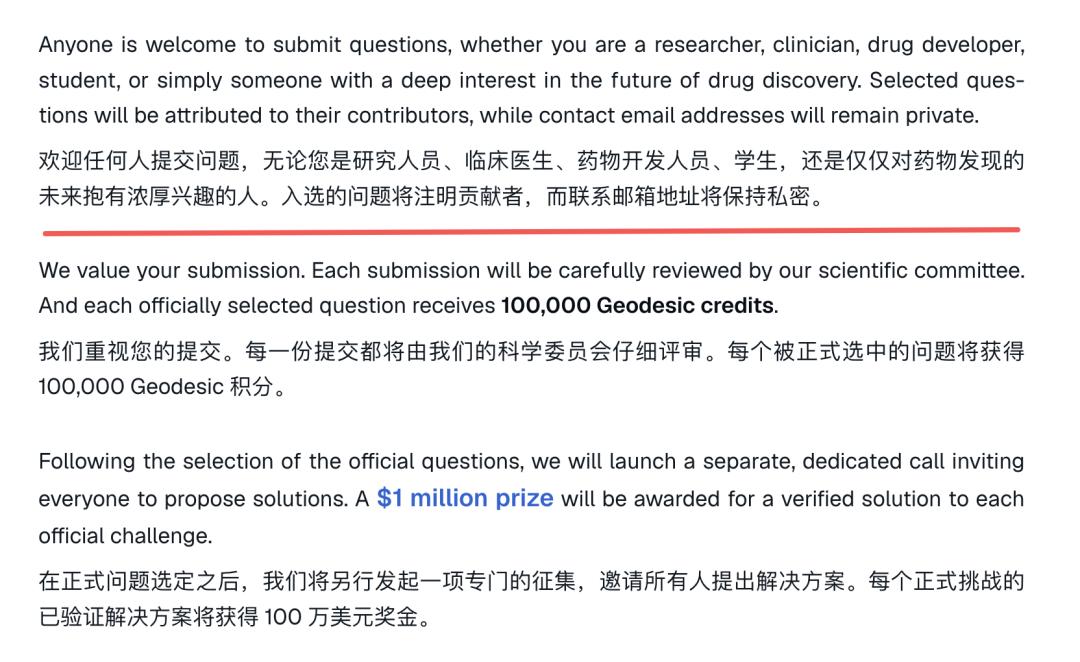
The scientific committee will conduct reviews one by one, and each selected problem will be rewarded with 100,000 Geodesic credits.
After the topics are finalized, a separate round of solution solicitation will be launched — for each official challenge, whoever submits a verified solution will be awarded $1 million in cash.
Not credits, but real money.
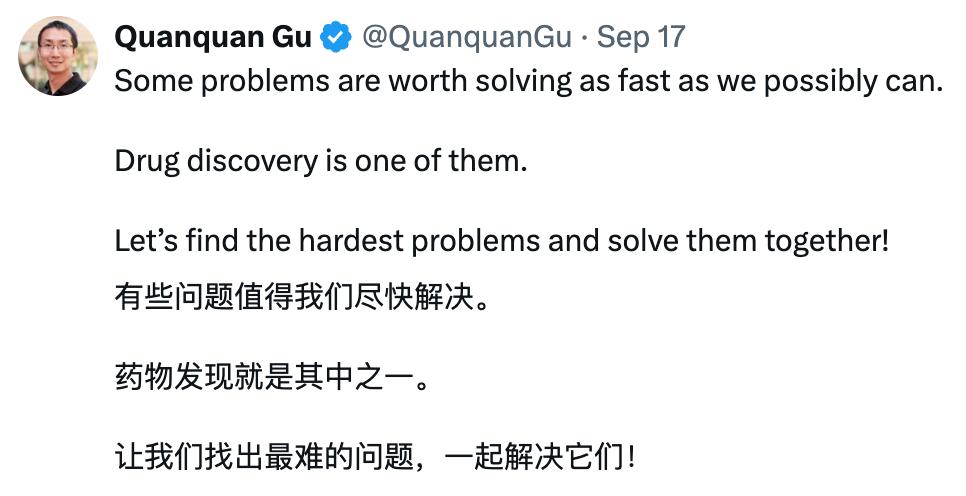
When founder Gu Quanquan reposted it, he only wrote three sentences: "Some problems are worth solving at the fastest speed, and drug discovery is one of them. Let's work together to find out the hardest problems and solve them."
Putting the two incidents together, the picture is almost surreal.
Anthropic spends money to run experiments. There is one design problem per week in the competition, which tests whose designed binder (a small protein hook that can firmly grasp the target) can be produced and measured in the laboratory.
The official terms clearly state that there is no cash grand prize, and the one million is mainly credits and wet experiment costs.
Geodesic spends money to buy problems. The $1 million in cash is reserved for verified answers, but the first step is to let the whole world tell it what problems are most worth solving.
One is delivering samples, the other is setting up research topics. In terms of time, Geodesic is ahead, and Anthropic is one day later.
It's so surreal...
A startup that has just debuted for a week has actually been "distilled" by Anthropic!
Even More Surreal Things Follow
The story does not end here.
Digging one layer deeper, a more prominent question than who came first arises — who is eligible to participate?
The Anthropic × Adaptyv Open Protein Design Competition has the large words "Open to everyone and free to enter" on its homepage.
That sounds wonderful.
However, when you turn to Section 3.1 of the official competition terms, a list of banned participants is clearly listed:
Participants must not be legal residents or registered entities of the following regions — Belarus, China, Cuba, Iran, Myanmar, North Korea, Russia, Sudan, Syria, Crimea...
This means that Chinese protein design researchers — no matter if you are a structural biologist at the Chinese Academy of Sciences, or a computational chemistry PhD from Tsinghua University, no matter how many Nature papers you have published or how many verified binders you have, you are not eligible to participate in this competition that claims to be "open to everyone".
The homepage says "Open to everyone", but the terms exclude 1.4 billion people.
Now look at Geodesic's side.
The Grand Challenges problem solicitation page clearly states:
Anyone is welcome to submit questions, whether you are a researcher, clinician, drug developer, student, or simply someone with a deep interest in the future of drug discovery.
Researchers, clinicians, drug developers, students — no matter your nationality, no matter your identity.
$1 million can reward an answer, but the qualification to raise a problem should not be determined by one's passport.
Geodesic does not have the scale of Anthropic. But it is willing to start from a simpler principle: let scientists all over the world have the opportunity to bring the problems they consider the most important and difficult to the table.
Because truly great science never belongs to a single country or a single company.
It belongs to all those who are willing to solve problems.
Who Is This Company That Got a Head Start?
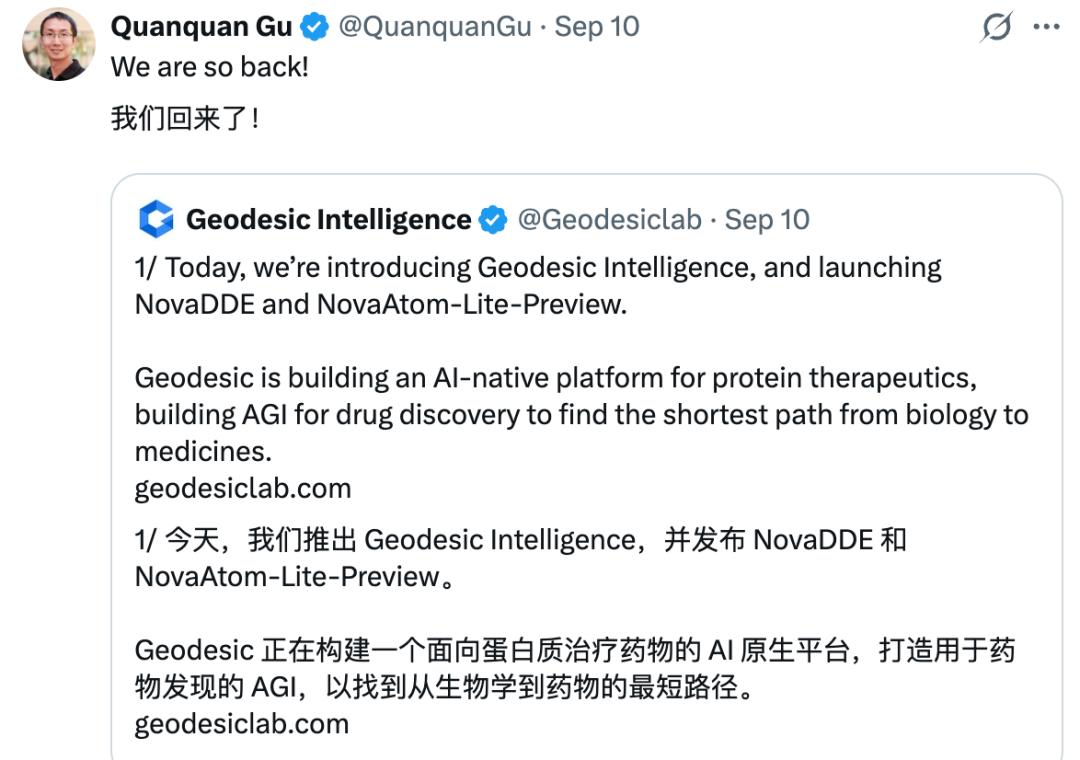
On the 10th of this month, Gu Quanquan officially announced Geodesic Intelligence on X, and released two products at the same time.
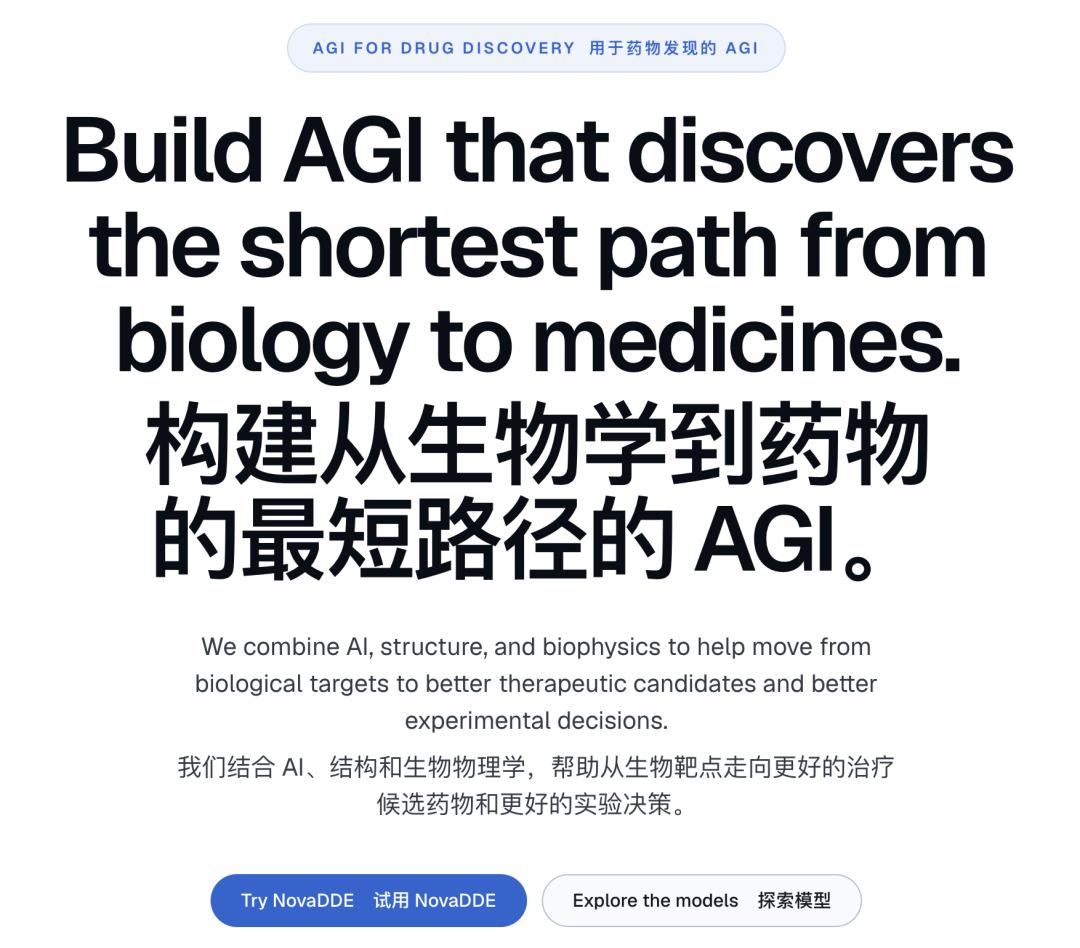
The company's official website homepage only has one goal written, so concise that it is almost arrogant: Build AGI that discovers the shortest path from biology to medicines.
How to do it? Geodesic has built a technology stack called Nova Stack, which fully controls the three layers from software to models to laboratories.
The First Layer: NovaDDE — The AI Command Center for Scientists
NovaDDE is Geodesic's agent workstation.
There are many procedures for drug development, such as reviewing literature, checking biological evidence, looking at molecular structures, running computational models, and evaluating results. Normally, you have to switch back and forth between more than a dozen tools.
NovaDDE integrates all these into one platform, using AI agents to plan tasks, call models, and evaluate results for scientists, and automatically leave records for every decision made.
You can describe the experimental decisions you want to make in natural language, or directly enter the design mode — delineate the target surface, and let the system generate binders of about 80 amino acids.
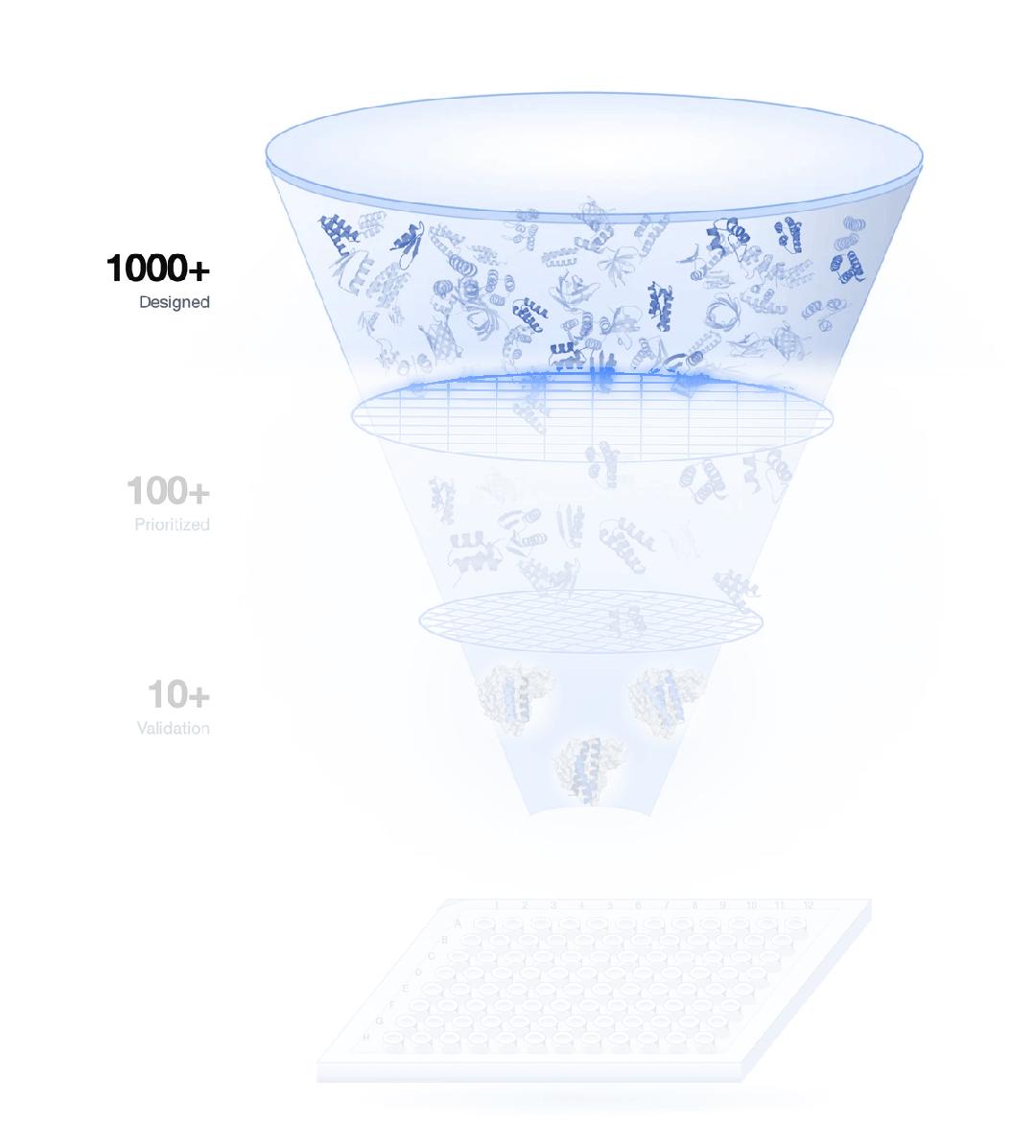
The data funnel on the official website is very intuitive: design more than 1,000 candidate molecules, screen out more than 100 high-quality solutions, and finally send more than 10 of them to the laboratory for verification.
A key detail: users' target data belongs to the users, will not be used for model training, and will be deleted upon request.
The Second Layer: NovaAtom — "Capture a Clear Picture" of Molecules
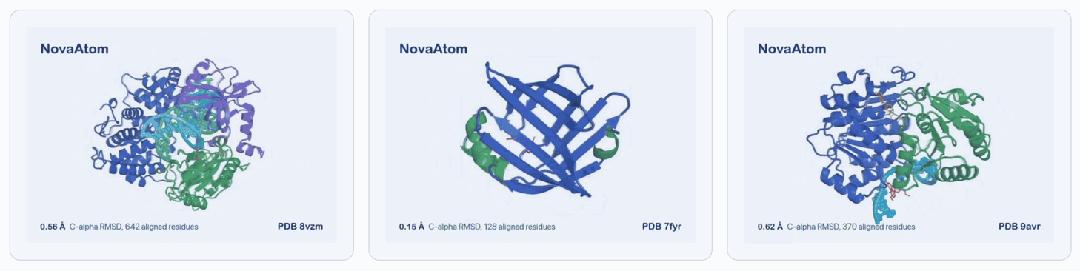
NovaAtom-Lite-Preview is Geodesic's self-developed all-atom structure prediction model, the first member of the NovaAtom family.
Simply put, input the sequence of a set of molecules, and calculate the three-dimensional coordinates of each heavy atom in them. You can see clearly what the molecules look like and how they interact with each other, just like taking a CT scan.
There are three core features.
The first is the "full suite" prediction. Proteins, DNA, RNA and small molecules are calculated together, instead of being predicted separately and then spliced, which is done in one step. This is critical to understanding the complex interactions between drugs and targets.
The second is support for complex constraints. Cyclic peptides, drugs that need to form covalent bonds with targets, specified binding positions — all can be fed to the model as conditions.
The third is built-in "credibility labels". Each target gives 5 prediction results sorted in order, and each structure is marked with how confident the model is about this position.
The lightweight and fast version released now, larger versions are still in training.
The Third Layer: NovaLab — Molecules Drawn on the Computer Must Be Actually Produced
Drawing molecules on the screen alone does not count. NovaLab is Geodesic's self-built wet experiment verification system, responsible for turning designs into real objects.
Each binder has to go through seven tests: Can it be produced? Is it produced correctly? Can it bind? How strong is the binding? Switch to another instrument to test it in reverse, is the signal real? Does it have the potential to become a drug? Does it really work?
After passing the seven tests, the experimental data is fed back to the AI to train the next generation of models. This is the closed loop that Geodesic emphasizes repeatedly: AI → Design → Experiment → Learning → Another Round.
There are many companies doing AI pharmaceuticals, but very few startups have built the full chain from AI agents, basic models to self-built wet laboratories by themselves.
Most peers either make models without doing experiments, or do experiments without making models. Geodesic bets on both, and goes all-in on full stack from the very beginning.
Drug Research Starts Paying for "Problems"
OpenAI spent millions of dollars in computing power to solve mathematical problems and turned around to give up the million-dollar bonus; Anthropic invested millions of dollars in resources to sponsor the protein design competition, giving more designs the opportunity to enter the laboratory.
Geodesic cuts in from another direction — first let the whole world tell it which problems are most worth working on.
Anthropic solves the problem of "high verification cost". Geodesic solves the problem of "whether the direction is correct".
The two things do not conflict, and both require a lot of investment.
But whoever establishes the problems first will define the next decade of this industry.
The Millennium Prize Problems in mathematics waited 26 years for OpenAI to claim to have solved the second one.
Drug discovery cannot wait that long, it deserves to be solved at the fastest speed.
This article is from the WeChat official account "New Zhiyuan", edited by Solomon, and published with authorization by 36Kr.