"I've decided to quit the PS5 modding circle," the PS5 Linux guru was forced to leave the community by AI: Some people use LLMs to find bugs and write hacks, making months of hard work all go down the drain.
If you followed the console modding scene at the start of this year, you most likely came across that video: a PS5 running Ubuntu Linux, displaying the enhanced version of GTA5 with a stable 60 FPS frame rate. Back then, the comment section was full of amazement — "Sony could never have imagined that its own console would be used to run Steam."
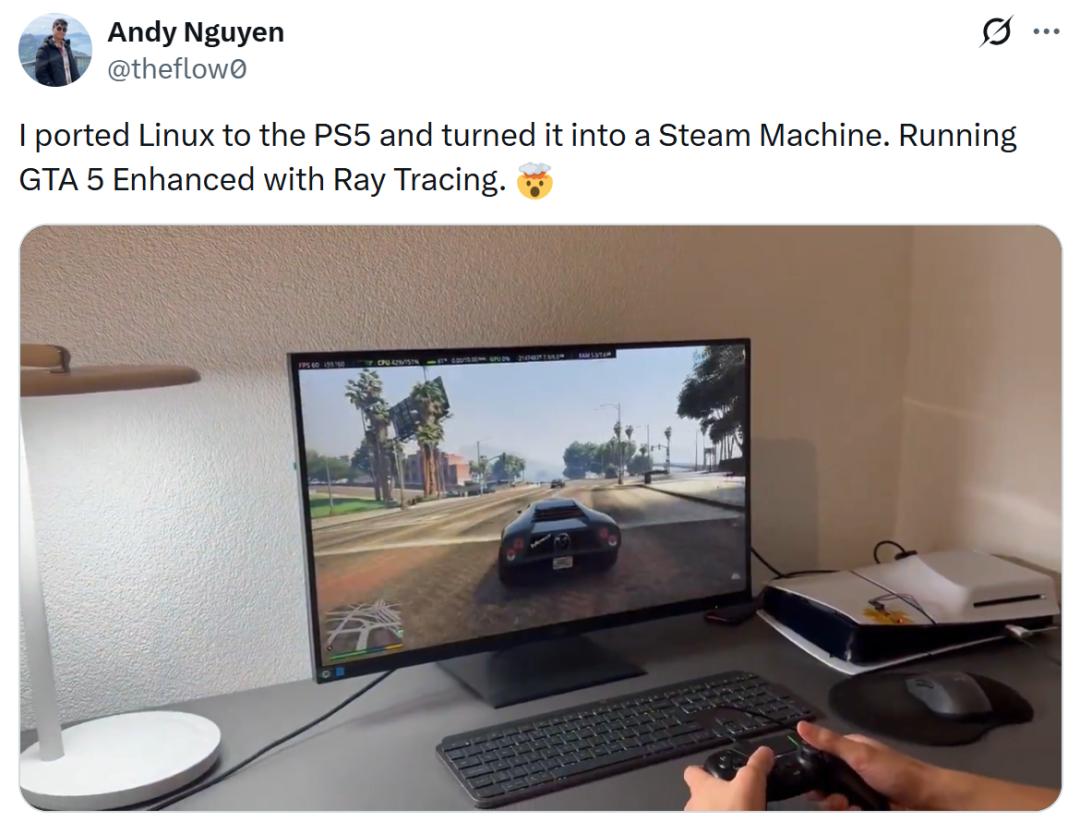
The person who made this happen is Andy Nguyen, known in the scene by his ID TheFloW. He is the core developer of the PS5 Linux project, and also one of the most prominent figures in the PS modding community.
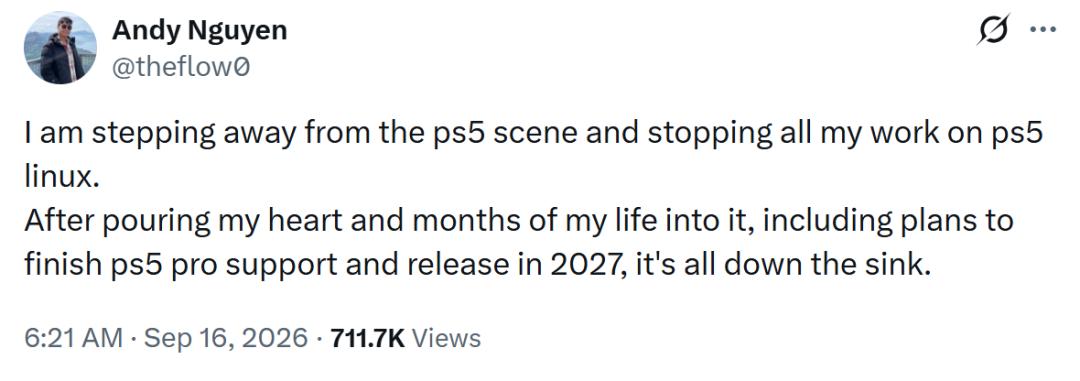
However, on September 16, he posted a tweet on X announcing that he would be quitting the PS5 modding scene and halting all work related to PS5 Linux. Even the PS5 Pro support he originally planned to complete and officially release in 2027 now has all his months of effort described by him as "it’s all down the sink" — in short, all that work has gone to waste.
So why did a project that could have easily waited until the release of GTA6 suddenly collapse overnight?
Why can PS5 run Linux?
To understand the significance of this, you first need to know what the PS5 Linux project represents.
The PS5 runs a custom operating system developed by Sony, with strictly controlled hardware resources. To get Linux to run on this machine, you have to break through a protective layer called the Hypervisor — it is responsible for isolating the system environment and controlling hardware access permissions, acting as the "access control system" of the PS5.
Nguyen found a way to bypass this "access control": he used a low-level bug in the console to gain sufficient system control, then loaded the Linux kernel, and further improved support for the GPU, display and other hardware components.
As far as we know, his PS5 Linux project allows users to install and run Ubuntu Linux on specific firmware versions, utilizing the PS5's 8-core Zen 2 CPU and RDNA 2 GPU. Once installed, this console is no longer just a PS5, but a capable Linux gaming PC that can run Steam games and emulators.
By July this year, PS5 LinuxLoader was updated to version v2.4, supporting firmware versions from 3.00 to 7.61, working on the PS5 Slim, and with built-in Bluetooth functionality enabled. However, there is one key limitation: you must stay on the old firmware, because Sony keeps patching bugs on the Hypervisor: once your firmware version exceeds the supported range, Linux will no longer be able to run.
After achieving success on the PS5, Nguyen was originally pushing forward with another initiative: running Linux on the PS5 Pro, with plans to complete and release it in 2027 — and the feasibility of this plan hinges entirely on a Hypervisor vulnerability he discovered long ago and deliberately did not make public.
The last deliberately reserved bug
According to Nguyen's own account, he has known for a long time that there is a Hypervisor vulnerability on the PS5 Pro, but he did not report it to Sony, nor did he make it public. He was waiting — waiting for GTA6 to be released.
The logic goes like this: to normally purchase and run new games via PlayStation Network, players usually need to use a newer official firmware. If this bug remains unpatched when GTA6 hits the market, he can use this bug to mod the PS5 Pro, so that players can not only play this blockbuster game on their modded console, but also enjoy the Linux system at the same time.
For the modding community, this was a "win-win" window of opportunity — but things did not go according to his plan.
Not long ago, a group called "Slop Kiddies" also found that last remaining Hypervisor bug. For this reason, Nguyen asked them to not disclose or report this bug at least until GTA 6 is released, and they agreed. But less than a day later, they submitted this bug to Sony's vulnerability bounty program: the program is hosted on the HackerOne platform, and once a bug is officially reported, it is only a matter of time before Sony patches it.
Nguyen wrote: "I asked them to wait at least until GTA6 comes out, so that people have the chance to buy the game legally and also enjoy Linux. They agreed, but before a single day passed, they decided to waste that opportunity."
Who are the "Slop Kiddies"?
Although Nguyen did not name names in his tweet, the truth of the matter quickly came to light.
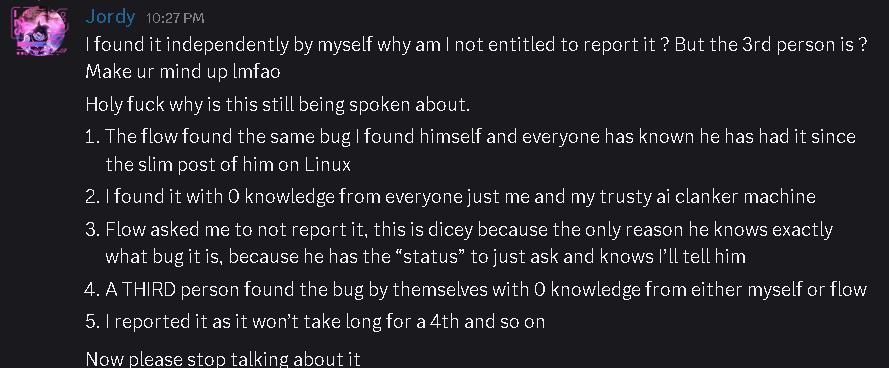
A PS5 modder named Jordy admitted that he was the one who reported the bug to Sony. He said he independently discovered the vulnerability using what he called a "reliable AI Clanker machine" — to put it bluntly, it was found for him by AI.
Even more dramatic is that Jordy said he was actually willing to wait at first, but a few hours later, a third person also found the same bug using an AI tool. Jordy worried that more people would discover this bug, so he took the lead in submitting it to HackerOne in exchange for a bounty.
Nguyen gave these people the name "Slop Kiddies", which can be understood as "AI script kiddies". This is an upgraded version of the taunt for the traditional "Script Kiddies" — in the past they were people who copied and pasted pre-written scripts, now they are people who use LLM to generate exploit code for bugs without understanding it at all.
Regarding this phenomenon, Nguyen's exact words were: "This scene used to be full of extremely talented researchers, but now all that's left is a bunch of noobs using LLMs writing mod code they don't even understand."
The community is in an uproar: some accuse him of "hoarding bugs", while others hail him as a legend
After Nguyen's exit statement was posted, the comment section quickly split into several camps.
Some people think he is "hoarding bugs". One netizen said bluntly: "Are you furious because someone else found the Hypervisor vulnerability you've been keeping private and not disclosing? Now that you don't have anything valuable left in your hands, you go attack those who found the bug and made it public. Others argue that since others also discovered the bug, they have the right to decide whether to report it to Sony: "Isn't it only natural to report security bugs to the owner of the system?"
Others pointed out that this incident is "essentially a problem of the older generation's pride" — they are used to showing off their achievements at DEF CON or CCC to gain peer recognition, but now someone can use AI to steal their limelight and even get a bounty, so it's only natural that they feel a huge sense of disparity.
But many veteran players stand by Nguyen:
"Thank you for all your work on the PSP, PS Vita, PS3, PS4, PS5 and Portal, I've been using your work for over a decade now. You are a legend, you've left your mark on the world."
"Your skills are so valuable to this community, we can't just lose you like this. Hope one day you'll come back."
"These people using LLMs to do modding don't understand what an exploit really means at all, nor do they know how to further leverage it. They find the bug, hand it over to Sony for a few bounty bucks, then Sony patches the bug before anyone can make anything interesting out of it."
There's also a comment from a netizen that perfectly sums up this familiar feeling: "Deja vu all over again! No matter how many years pass, the same reality plays out: people have zero respect for other developers! Back in the day we called these people 'script kiddies', so this doesn't surprise me at all!"
The project continues, but PS5 Pro support is no longer possible
So is PS5 Linux really over? Strictly speaking, we can't say that yet.
The PS5 Linux Loader is currently an open source project, with code hosted on GitHub under the GPL 3.0 license. So from a legal and technical perspective, other developers can still fork the code and continue to advance it.
The problem, however, is that the PS5 Pro support work Nguyen was working on was not included in the current public repository. Therefore, even if someone is willing to take over, that does not mean they can directly build on the existing code to finish the PS5 Pro version. As of now, public reports do not indicate that anyone has officially taken over this part of the work.
In other words, the PS5 Linux project has not truly "died completely" just because one developer left, but for those who were looking forward to running Linux on the PS5 Pro, that possibility is now effectively hopeless — the line Nguyen wrote at the end of his tweet is probably the best footnote to the whole incident:
"I poured my heart and months of work into this, even planning to finish PS5 Pro support and release it officially in 2027, and now it's all down the sink."
So what's your take on this whole incident?
This article is from the WeChat official account "CSDN", compiled by Zheng Liyuan, and published with authorization from 36Kr.