Did AI kill React Native?
Recently, Shopify has decided to fully migrate all its mobile applications back to native development from React Native.
Its engineering team recently published an article titled Native is now the future of mobile at Shopify on its official website, announcing that all mobile applications will be migrated back to Swift and Kotlin.

This decision is somewhat unexpected.
It should be noted that back in 2020, Shopify heavily bet on React Native, and in the following years became one of the most important users and contributors to this ecosystem. It not only built large-scale applications such as Shopify, Shop, Point of Sale, and Inbox with React Native, but also open-sourced a series of widely popular tools including React Native Skia, FlashList, and Restyle. Even in January 2025, Shopify publicly praised that the future of React Native remains bright and it plans to continue investing in the framework.
But just one year later, Shopify's decision has changed. What on earth is the reason for this?
Why did Shopify suddenly abandon React Native?
Looking back at 2020, when Shopify resolutely switched from native development to React Native, the official reasons given were very clear:
First, it saved a lot of time, eliminating the need to repeatedly build the same features;
Second, it allowed engineers without a mobile development background to participate in mobile application development;
Third, it was unnecessary to constantly catch up with the functional differences between the two platforms of iOS and Android.
This logic did work in the past few years.
Shopify stated that React Native has helped the company save a lot of development time, and freed the team from the long-term pressure of maintaining functional consistency between the Android and iOS ends.
But at the same time, Shopify also admitted that in order to make React Native run stably in such large-scale applications, they invested a lot of resources, including performance optimization, infrastructure construction, framework upgrade and external dependency maintenance.
These costs were worth paying in the past, because in contrast, the cost of writing a separate set of code for iOS and Android was even higher.
Over time, everything has changed quietly.
Shopify said that the company started using LLM to assist software development as early as 2021, which was initially mainly used to implement features, investigate issues, fix bugs and conduct code reviews. With the improvement of model capabilities, AI can undertake more and more complex tasks.
By the end of 2025, Shopify began to rethink a previously self-evident assumption: does building two sets of mobile applications really mean twice the work?
Therefore, they re-evaluated the mobile technology stack, started to reuse Swift and Kotlin for native development, and also used LLM to reconstruct the core parts of its large-scale applications.
The result surprised the team.
The AI Agent can not only implement Android features according to the iOS version, but also help developers who originally mainly use one technology stack to participate in the development of the other end. At the same time, through shared product specifications, testing and code review nodes, the cost of maintaining functional consistency between iOS and Android ends has also been significantly reduced.
Therefore, Shopify finally came to a very clear conclusion:
Native development still means building two sets of software, but AI can already undertake enough implementation, conversion, testing and review work, making "repeated development" no longer a decisive cost as it was in 2020.
It is also worth noting here that Shopify did not interpret this migration as "React Native is no longer viable".
On the contrary, the official clearly wrote: React Native has been running well for Shopify, and it is still an excellent framework. What they have really changed is the cost behind the technology stack.
Completed application rewriting in 12 weeks with AI
What really makes this migration convincing is that Shopify has verified it with actual projects.
Shop is the first application that Shopify migrated. The official revealed that with the assistance of AI, the team only used 12 weeks from proof of concept to the final release of the fully rewritten native version to the app stores.

And this is not a simple small Demo.
Shopify's larger flagship application is also being migrated. The official stated that the Shopify App has more than 300 pages, and also includes home screen and lock screen widgets, Apple Watch applications, complex features, Siri Shortcuts and more.
At present, the migration of this flagship application has already started, and the native version is expected to be released later in 2026. Other mobile applications such as Shop, Shopify, Point of Sale, and Inbox will also be migrated one after another. More notably, Shopify did not adopt the previous "transform while running" approach this time, but chose to start from scratch.
Why not migrate little by little, but directly "start all over again"?
In the past, when Shopify migrated from native to React Native, it adopted a gradual transformation approach. The reason at that time was easy to understand. If a mature large application was completely rewritten, it might take several years, and the team still had to continue developing new features throughout the process.
But this time the situation is different. Shopify believes that AI has made it realistic to rewrite large-scale mobile applications from scratch. The official gave three reasons:
AI can refer to the original React Native version to implement features with Swift and Kotlin;
A brand new project can get rid of the limitations in historical code;
The previous prototype also proved that this rewriting speed is much faster than in the past.
Therefore, instead of modifying the old RN application into native code little by little, they took the RN application as a "reference implementation" and directly rebuilt a set of native applications.
This point is actually very critical. Because it means that AI's role at Shopify is not simply a "code completion tool". It is more like a migration assistant that can read old systems, understand requirements, implement another technology stack, run tests and make continuous modifications.
What will happen to Shopify's React Native open source projects?
This is also one of the most concerned issues in the community. After all, Shopify is not just a user of React Native, but also an important contributor to the ecosystem.
For some mainstream open source libraries, Shopify clearly wrote in the blog post:
The maintenance of React Native Skia will not stop immediately. Shopify stated that it will continue to sponsor the project until the end of 2026, and William Candillon will continue to maintain it afterwards. In the next few months, he will fork a new project from the existing repository and continue to release it under a new name. The original repository will be archived after the migration is completed. For developers who already depend on React Native Skia, Shopify also said that it will release migration information in advance, and suggest users to consider sponsoring William Candillon directly.
The situation of FlashList is different. Shopify stated that the project currently has about 2 million downloads per week, and has become one of the important solutions for high-performance list rendering in the React Native ecosystem. Therefore, Shopify will not abandon it immediately. Before a new long-term maintainer is confirmed, Shopify will continue to fix critical bugs that may cause compatibility issues. At present, Shopify is discussing the subsequent long-term maintenance arrangements for FlashList with many companies.
Restyle will stop maintenance at the end of 2026. In contrast, Restyle has a smaller user base. Shopify has decided to archive the repository, continue to maintain it until the end of 2026, and then stop maintenance. The project allows other teams to fork and continue development directly, and Shopify also said it will assist in completing the handover.
Judging from the currently announced plan, Shopify is trying to hand over several core projects to the community or new maintainers respectively.
During the rewriting process, will AI produce a bunch of "garbage code"?
If you let AI directly read a huge React Native project and say: "Help me convert all of it to Swift and Kotlin.", the result will most likely not be very good.
Shopify itself has tried this.
The official said straightforwardly, "We directly handed over the React Native codebase to the large language model and asked it to rewrite the same features with native code at once. But it turns out that this does not work. Even if the model is allowed to collect as much complete information as possible first, organize this information into specifications and task files, and then start implementation, the final result may still be a large amount of code that is difficult to maintain and cannot be released at all."
Therefore, they specially built a system called Helix, which adopts a more gradual approach. It does not assume that the result generated by the model for the first time is correct, but establishes a continuous iterative closed loop: an imperfect result cannot move forward, and can only enter the next step after continuous correction and reaching the available standard.
Specifically, developers only need to assign a certain page to Helix.
Helix will first read the React Native code, and then propose a series of small task nodes that can be checked within a few minutes. After AI completes each node, it must meet several conditions at the same time:
Behavior tests are passed;
Visual comparison with the running original application is performed;
Two rounds of adversarial code reviews are passed;
Confirmation from human developers is obtained.
Only after all conditions are met can the code be submitted, and then move to the next node.
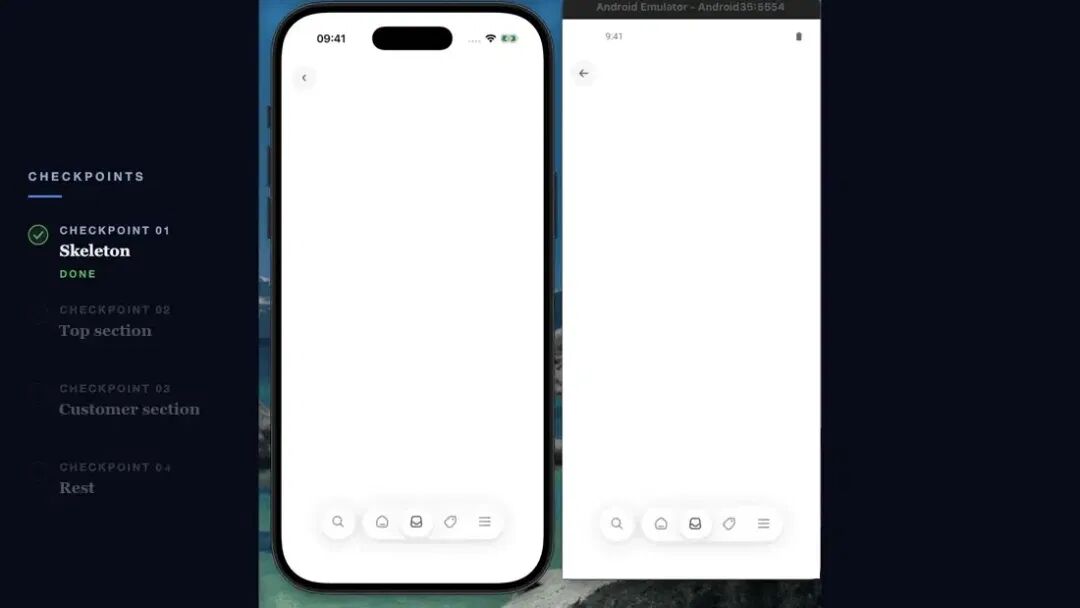
The feedback obtained from each previous review will also be remembered by the system, making the subsequent migration process more and more automated.
Shopify found that AI can write code extremely fast. What really slows down the whole process is mobile testing.
Because if AI needs to observe the page through the simulator, read the accessibility tree, click buttons, take screenshots, and then judge the result, a complete feedback may take several minutes.
The model can modify the code in a few seconds, but a single verification takes several minutes.
For AI Agents that require repeated iterations, this efficiency is unacceptable.
So Shopify simply redesigned the application architecture. They put forward a core principle — business logic must be completely decoupled from the UI, and can run headlessly in a desktop environment without relying on the mobile interface.
Then they opened up this capability to AI Agents through CLI.
In this way, the Agent can directly check the application status, perform navigation and execute operations, without having to start the simulator and observe the interface every time. Some operations can be completed at the millisecond level, instead of the previous minute level.
Only when it is really necessary to verify the UI will the Agent connect to the simulator for testing through the remote mode.
Is React Native really going to "decline"?
For this migration, many netizens directly interpreted it as "AI has killed React Native".
But Shopify itself does not think so. It specially emphasized at the end of the article: React Native was the right choice in 2020, and native development is the right choice today.
In fact, the core problem solved by React Native in the past was that developers did not want to repeatedly write a large number of similar codes for different platforms. Now, AI Agents are taking over part of the repetitive work that used to be done manually. When the cost of "writing code repeatedly" begins to drop, cross-platform solutions that originally existed to reduce development costs naturally need to recalculate their value.
This does not mean that cross-platform frameworks such as React Native or Flutter will lose their value in the next three years. For many teams, cross-platform development still means a mature ecosystem, a more unified development experience, and lower maintenance costs.
But Shopify has taken the lead in conducting a fairly large-scale experiment. What is really worth paying attention to next may not be whether React Native will "decline", but whether more large teams will re-examine their past technical choices after having similar AI Agent capabilities.
React Native has not suddenly become worse. What has changed is the cost of writing native code. And this is probably where AI is rewriting the software development technology stack.
This article is from the WeChat official account "CSDN", sorted out by Tu Min, and published with authorization from 36Kr.