36Kr Exclusive | PCI-Suntek Technology Enters the Space Intelligent Computing Track, Its Incubated Enterprise Secures 100-million-yuan Level Financing
Author | QIAO Yujie
Editor | YUAN Silai
This article contains about 2600 words, with a recommended reading time of 7 minutes
Hard Krypton learned that Yusu Xinghe Technology Co., Ltd. has completed the 100-million-yuan level angel round and pre-A round of financing within two months. The financing was led by Lingge Venture Capital, with participation from Haizhu Urban Development, Fresh Capital, Gaojie Capital, Knowledge City Group and Jifu Capital.
Founded in May this year, Yusu Xinghe is strategically incubated by A-share listed company Jiadu Technology (600728). It is a space computing company focusing on the "Space Data Space Computing" track, whose core business is the space-based large model that can operate on-orbit. It aims to realize real-time training, inference and closed-loop processing of remote sensing data on the space end, and provide native intelligent model capabilities for on-orbit computing.
At this stage, China's domestic space computing power industry is in an accelerated phase of transitioning from on-orbit verification to commercial implementation. With the large-scale networking of low-orbit constellations, continuous iteration of spaceborne AI chips and the decreasing launch cost, the demand for on-orbit computing is accelerating to be released, multiple experimental space computing power constellations have been launched one after another, and the pace of financing and technical implementation of related projects has also been significantly accelerated.
However, after the computing power satellites are put into orbit, there is a more practical problem: what models to run, and how to use the limited on-board computing power to process data more efficiently? This is exactly the entry point for Yusu Xinghe.
The core personnel of Yusu Xinghe come from Jiadu Technology, a leading enterprise in smart transportation. Its co-founder Wang Kai is a joint-training PhD of Tsinghua University and California Institute of Technology, who once served as the Chief AI Scientist and Dean of the Central Research Institute of Jiadu Technology Group. Relying on Jiadu Technology's 30 years of accumulation in the smart city industry, the team has formed the hardware and software integrated capabilities covering computing power satellites, artificial intelligence and industry application services.
In May 2025, ADA Space launched the industry's first set of 12 computing power satellites into orbit, and the Yusu Xinghe team began to cooperate with ADA Space in the R&D of on-orbit large models.
Wang Kai introduced to Hard Krypton that most of the current attempts of on-orbit operation models in the industry are to prune the existing ground models and then deploy them on satellites, while models truly trained based on space data do not exist yet.
In Wang Kai's view, space computing is not simply "moving" the ground large models to space. Different from general ground models, satellites are faced with data generated by the space end such as remote sensing, whose model architecture, computing power configuration and data processing methods all need to be redesigned around the space scenario. "If you put the Doubao large model on a vehicle, it cannot drive the car. Similarly, if you put the Doubao large model in space, it cannot realize the understanding and prediction of Earth observation." Wang Kai said.
The space-based large model that Yusu Xinghe hopes to realize takes space data as the core, trains the model at the space end, and uses space data as inference input at the same time, finally forming a complete closed-loop of the model operating entirely in orbit.
Traditional remote sensing analysis usually goes through atmospheric radiation correction, geometric and orthorectification, noise masking, image stitching, and then completes identification combined with algorithms such as YOLO, leading to a long processing chain. Yusu Xinghe hopes to use the end-to-end large model to directly infer and output results from the original remote sensing images, reducing the intermediate links in the traditional remote sensing processing workflow.
To adapt to the space computing scenario, Yusu Xinghe's space-based large model adopts a dynamic computing architecture, shifting from "uniform grid" to "latent space deduction". Through the adaptive multi-scale computing paradigm, it completes the processing from perception to cognition under limited computing power. At the same time, the model will integrate multi-source physical constraints for hybrid modeling, and carry out constrained evolution of future dynamic representations in the latent space predictor, so that the prediction of future states has certain physical interpretability. In terms of cross-modal Earth field perception, the model will further move from single remote sensing identification to unified modeling of macro and micro Earth states.
On September 22, 2025, in the 4th Pazhou Algorithm Competition, the Yusu Xinghe team realized the on-orbit operation of its self-developed large model, becoming the world's first team to deploy a multi-modal large model on a space computing power satellite and complete commercial tasks.
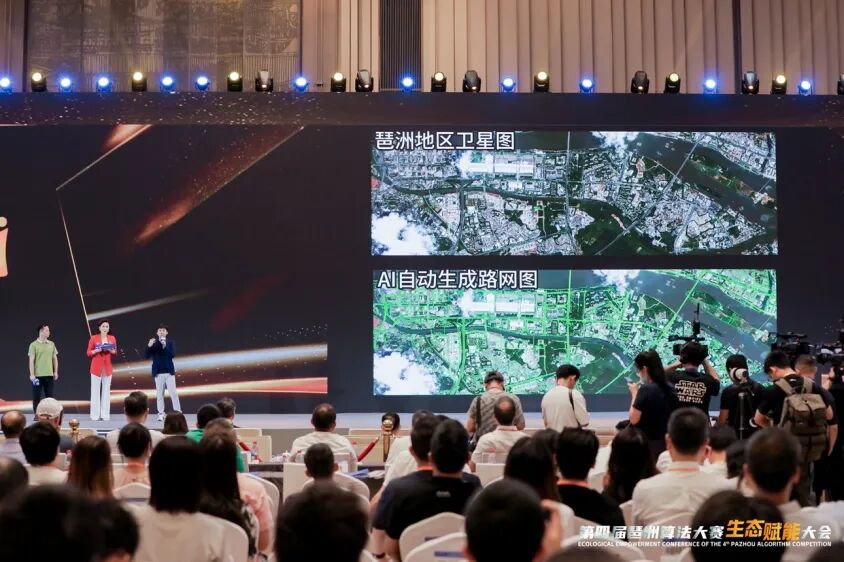
The team publicly demonstrated the "Space Data Space Computing" at the award ceremony of the 2025 Pazhou Algorithm Competition
At this stage, Yusu Xinghe is simultaneously promoting the on-orbit verification of every link of the space-based large model operating in space.
Wang Kai introduced that Yusu Xinghe hopes to start from the on-orbit large model side to reversely define the requirements for computing power satellites, so as to further improve the adaptation degree between computing power satellites and models. The company plans to build 24 computing power satellites in the first batch to form an "on-orbit AI laboratory", which is used to verify the space-based large model inference and training architecture natively designed for the space environment, and provide infrastructure for subsequent applications of space-based large models.
This year, the company will continue to cooperate with ADA Space, and the two parties plan to promote the on-orbit verification of the first batch of satellites within this year.
In terms of commercialization, Yusu Xinghe currently mainly provides two types of services. One is MaaS (Model as a Service), which provides model Token interfaces for industry platforms; the other is SaaS (Software as a Service), which directly targets industry customers such as transportation, finance and insurance, and outputs analysis results through a dialogue interface. Wang Kai revealed that some customers have prepaid for package services in advance, and will use the relevant space-based large model services after the satellites are delivered in orbit.
The following is an excerpt of the communication between Hard Krypton and Dr. Wang Kai, founder of Yusu Xinghe:
Hard Krypton: Why do space computing scenarios require dedicated space-based models?
Wang Kai: A considerable part of the data generated by remote sensing satellites cannot be transmitted back to the ground in time. Therefore, we hope to use the data in space to train large models in space, and the inference input is also data from space, so that the entire closed-loop can be completed in space, forming a truly native "space-based large model".
The biggest value of in-space training is real-time performance. In the future, multiple satellites can transmit data through laser communication to update the model in time, so that the model can continuously perceive the latest Earth dynamics. However, if all data is transmitted back to the ground for training and analysis, it will face problems such as limited data transmission capacity and transmission delay of emergency shooting data.
There are very few large models that are truly oriented to large-scale remote sensing data pre-training. Google's AlphaEarth is more of a scientific research attribute, which requires users to upload data for secondary fine-tuning training, and is not oriented to the interaction of ordinary users. Our goal is to allow users to interact with the space-based large model through natural language just like using large models in daily life.
Hard Krypton: The early "Space Data Space Computing" mainly focused on image segmentation and recognition, what is the difference between Yusu Xinghe's space-based model and it?
Wang Kai: We have upgraded from simple image recognition to truly understanding the space and time of the Earth.
In the past, remote sensing large models were more like "looking at pictures and narrating", inputting an image to let the model complete classification, segmentation or recognition. But our space-based large model covers the entire Earth's spatial grid, and users do not even need to actively upload an image, but can directly ask questions in natural language. For example, if a user asks "What is the sowing area of cotton in Xinjiang this year", the space-based large model can directly answer based on its understanding of the vegetation status on the corresponding Earth surface.
This is also one of the differences between us and the robotics world model. The robotics world model mainly covers human activity areas, while our space-based large model needs to cover the entire Earth, including areas with less human activities such as deserts and forests. In the next step, we will also add the time dimension. For example, we can not only judge the crop growth in the past five years, but also predict the yield of this year combined with historical data.
We plan to release a version of the space-based large model in September, and further release it in November in line with the relevant schedule, including white papers and more technical details.
Hard Krypton: At this stage, the hardware cannot support large-scale model training in space, what is the company mainly doing at present?
Wang Kai: At this stage, we will first use offline data to get through the most advanced native large model technical solution based on remote sensing data, and make pre-preparations for on-orbit training at the same time. For example, we plan to launch the first set of computing power satellites in October this year to verify the capability of inter-satellite data transmission and collaborative work. The overall plan of the company is to launch 24 computing power satellites to form a computing power satellite constellation, verify the basic capabilities step by step at each stage, and finally realize the complete on-orbit training pipeline.
The computing power satellites are jointly developed and procured by ourselves. It is a bit like Zhipu's early stage, when they first procured their own GPU cluster to build a model room to verify the training method and improve the inference efficiency in order to train large models. We adopt a similar idea, so the computing power satellite constellation is procured and built by ourselves.
The first set of computing power satellites is expected to be launched in October this year. We need to verify some capabilities that have not been systematically verified before. First, whether the large model can run continuously 7×24 hours in orbit. At present, no computing power satellite can achieve this, and our computing power satellites will be designed according to this goal. Second, the computing power satellites do not work alone, but work collaboratively across multiple satellites. It is necessary to verify that different satellites in space establish high-bandwidth links through laser communication, so that multiple satellites can perform computing in parallel and in a distributed manner.
We need to complete a series of work that no one has systematically verified before, gradually verify every technical link of "space data space training" and "space data space inference", and finally realize the complete on-orbit training and inference closed-loop.