Overnight, Claude has ended up being just like ChatGPT.
The "unification" moment for Claude has finally arrived.
Just now, Anthropic announced that Claude Chat and Cowork, the product focused on complex task processing, have been merged into a unified version of Claude.
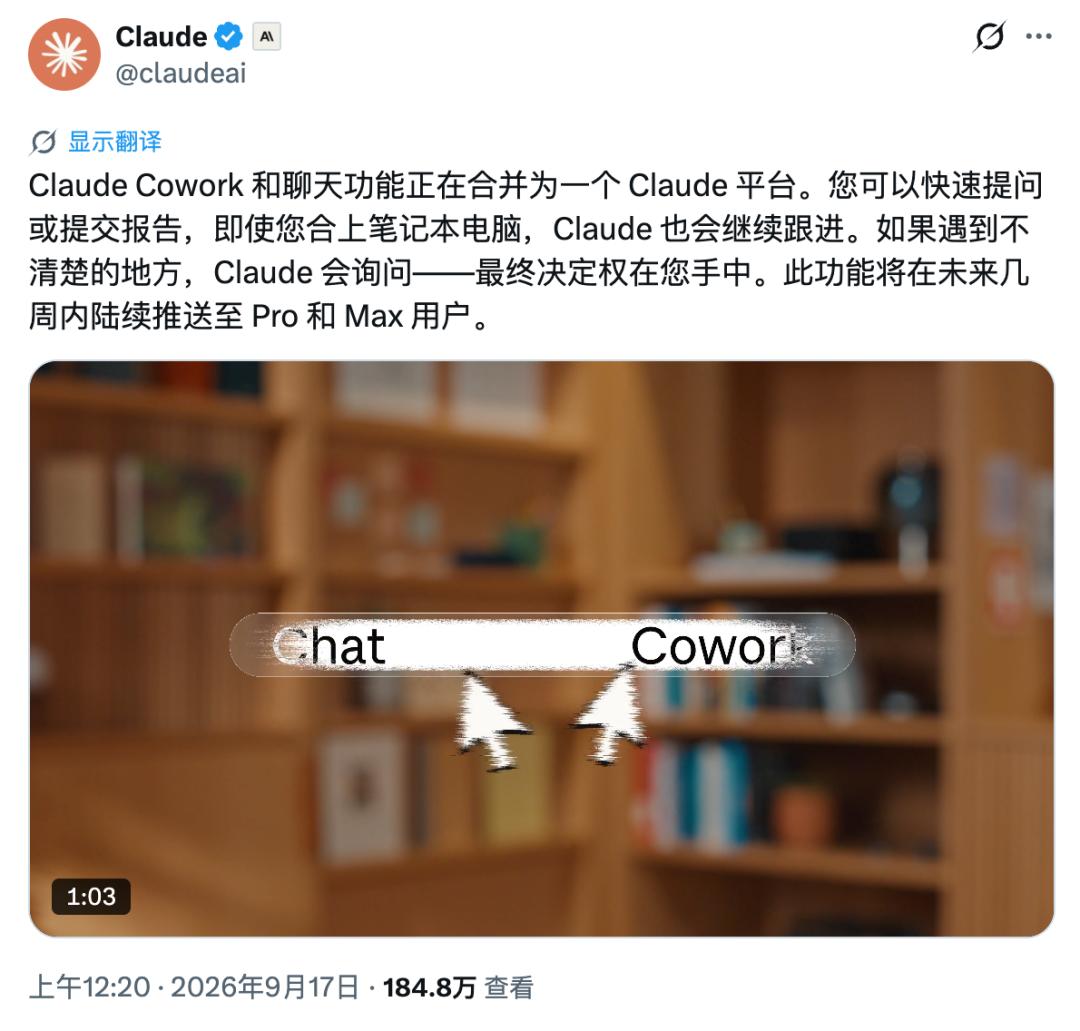
At the same time, Anthropic has also launched two new features, Claude Docs and Claude Slides, and integrated the Claude Design capability into the chat interface.
Claude, which was originally just a chat window, has adopted OpenAI's unification concept, and is evolving into an AI workspace that covers writing, office work, design and complex task execution.
One Claude to take over all tasks
Looking back over the past year, Anthropic has been continuously expanding the capability boundaries of Claude.
In January this year, Anthropic launched Cowork, hoping to help users complete more complex non-code work with the help of AI; in April, the company launched Claude Design for web page and prototype design; in July, Cowork was further migrated to the cloud.
As features keep increasing, a new problem has gradually emerged.
Users began to wonder which entry they should use for a specific task. Simple questions can be asked directly to Claude, projects requiring in-depth processing are assigned to Cowork, and visual design requires opening Design. Different functions are independent of each other, which also means users need to constantly switch between environments, and the context accumulated earlier cannot be naturally continued.
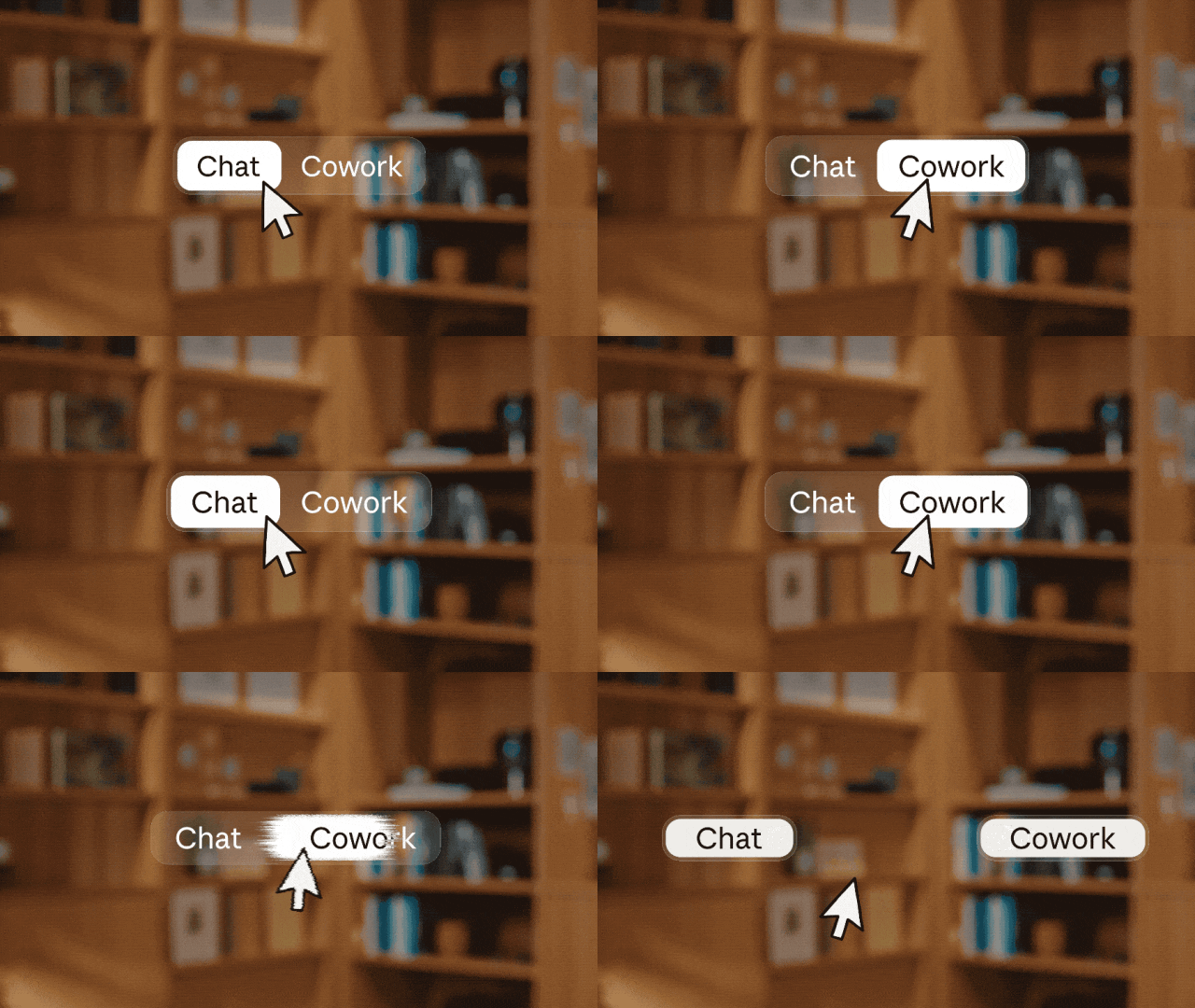
After this update, Anthropic has removed the differences between these entries.
The new Claude integrates chat, Cowork, Artifacts and Claude Design into the same interface. Users do not need to judge the task type in advance, they only need to describe their goals, and Claude will automatically decide which capabilities to invoke.
Whether answering a simple question or processing a complex report, Claude can complete it all in the same chat window.
Anthropic says Claude can now invoke existing context, skills and connectors based on task requirements, making the capabilities of Cowork and Design directly available in any chat session.
Recently, Cowork's memory layer has also been upgraded, enabling Claude to retain more user background information across different conversations.

Senior economist Andrew Keller shared his user experience.
He said he can ask Claude to access the legal research database, automatically find relevant cases, read the content, identify other cases that may be needed, and download and organize the materials into a specified folder for his later review.
In addition to the changes in task execution methods, Anthropic has also increased users' control over the AI working process.
By default, Claude will ask for user confirmation before performing critical operations. If users want less interaction, they can also enable a more proactive working mode, which allows Claude to continuously advance the task and request feedback only when further confirmation is needed.
The final decision-making power remains in the hands of users. For existing Cowork users, this upgrade will not affect their existing content. Chat history, projects, Artifacts, connectors and skills will all be preserved.
If users are accustomed to using the regular chat function, or want to continue to use Claude Design separately, they can still keep their original usage habits.
Directly challenging traditional office software, Docs and Slides are launched
In addition to unifying product entries, Anthropic has also launched Claude Docs and Claude Slides.
The two features are currently in Beta, allowing users to create documents and presentations directly through Claude conversations.
Users can ask Claude to generate content, request further revisions, or manually adjust details.
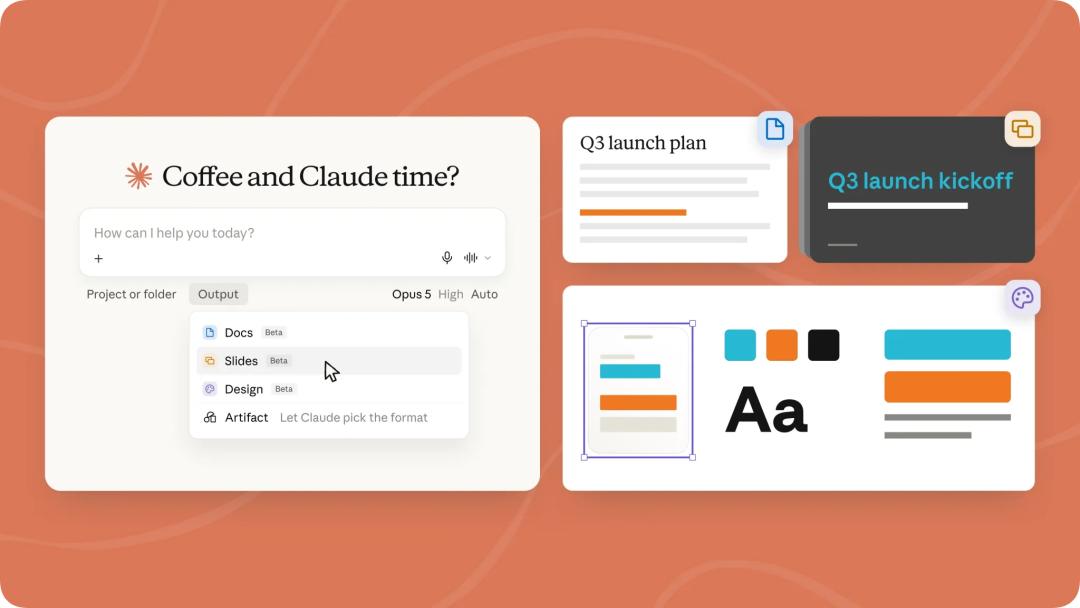
Slides supports direct presentation, and can also be exported as PowerPoint or PDF files. Docs provides a collaborative experience similar to Google Docs.
Documents created by users are kept private by default, but can be shared with other collaborators via links for co-editing and leaving comments.
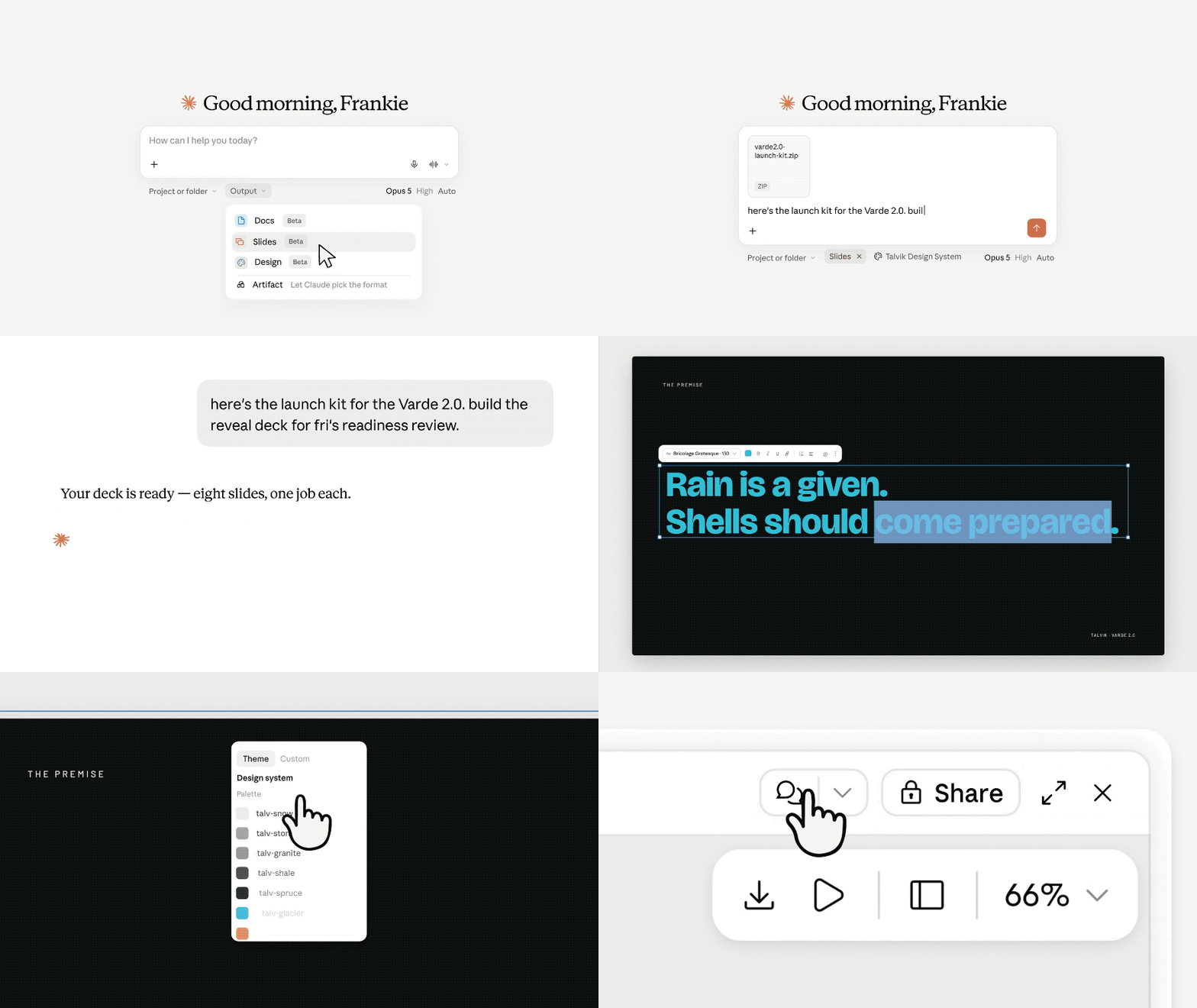
Anthropic demonstrated a typical work scenario.
For example, a weekly report needs to be submitted before noon. Users can tell Claude the progress of last week's projects before going out, ask it to generate a report in the format commonly used by the team, mark delayed items, and organize five pages of presentations required for the management meeting at the same time.
If there is ambiguous information in the task, Claude will take the initiative to ask. Users can check the task progress on their mobile phones during their commute, and when they arrive at the office, the reports and slides will already be ready.
Since both are generated from the same conversation, they share the same context, which avoids inconsistencies between the report and the presentation. Users can modify the content by themselves, or directly comment on a slide to let Claude adjust according to the feedback.
If the task needs to be executed repeatedly for a long time, users can also set a cycle to let Claude automatically start preparing the report at a fixed time.
All content created through Claude Design, Slides and Docs will be gathered in one shared link.
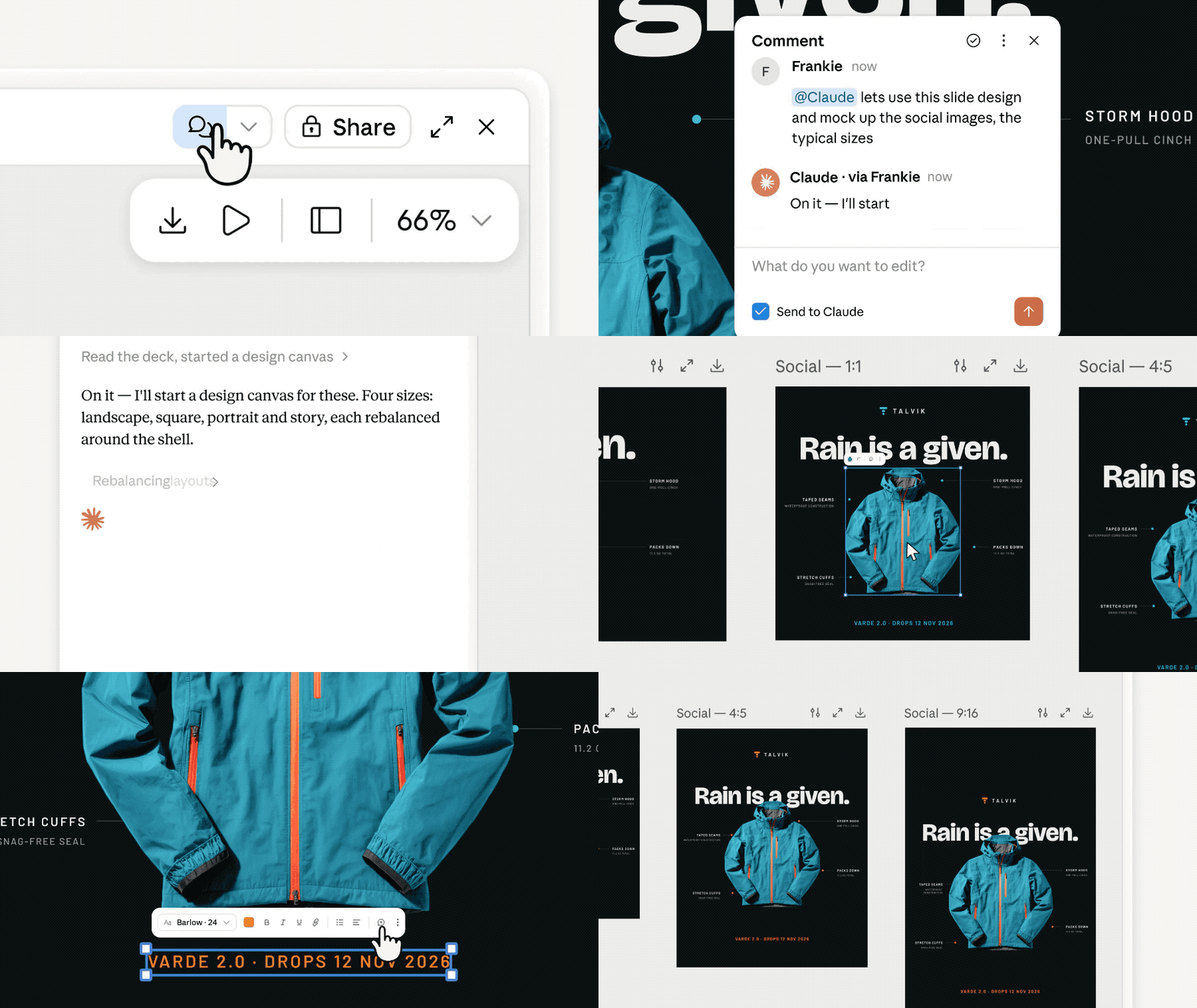
Users can access it via mobile phones, or directly select elements to move or modify them.
With the addition of Docs and Slides, Claude is moving closer to an AI-native office platform.
In the past, one of the advantages of Google Gemini was its ability to deeply connect with Google Docs, Sheets, Slides and other office services. This year, Google further expanded Gemini's capabilities in the office suite, allowing users to directly generate and edit documents and create presentations.
By launching Docs and Slides in this update, Anthropic is also reducing the need for users to leave Claude and switch to other office tools.
Currently, these newly upgraded Claude features are being rolled out to users on Pro and Max plans, covering web, desktop and mobile terminals, and will be available to all new and existing users in the coming weeks.
You don't need to do any manual setup, it's ready to use as soon as you open it.
Users on Team and Free plans will also be able to experience these features soon. For enterprise admins, they will receive a notification of changes at least 30 days in advance, and can decide when to enable the beta features of Docs and Slides for their teams.
If you have been putting off a messy, large project, now may be the best time to hand it over to the new version of Claude.
Official blog🔗 https://claude.com/blog/cowork-is-now-claude
This article is from the WeChat official account "APPSO", author: Discover Tomorrow's Products, published with authorization from 36Kr.