Renovating primary schools into nursing homes and old houses into dormitories: Who can seize this new wave of traffic in the home furnishing market?
First look at the policies: three sets of data on stock space redevelopment
2024 · University Dormitories: In January, seven departments including the National Development and Reform Commission, the Ministry of Education, the Ministry of Finance, the Ministry of Natural Resources, the Ministry of Housing and Urban-Rural Development, the People's Bank of China, and the National Administration of Financial Regulation issued the *Guiding Opinions on Strengthening the Construction of University Student Dormitories* (Fa Gai She [2024] No. 25) — encouraging the purchase and leasing of off-campus talent apartments, commercial and residential buildings and other social properties to supplement dormitory supply. For existing housing stocks, safety appraisal shall be carried out first, followed by renovation, design and construction in accordance with mandatory engineering standards, and supporting facilities shall be built to the same standards as on-campus facilities.
2025–2026 · School-to-Elderly Care Conversion: Document Zi Ran Zi Fa [2025] No. 216 (issued jointly by the Ministry of Natural Resources, the Ministry of Civil Affairs, and the National Health Commission on December 12, 2025, publicly released in January 2026) — existing idle school buildings and other stock properties converted for elderly care use that meet safety, health and environmental protection requirements may be used in accordance with their original land use purpose and right type during the five-year transition period, without temporary changes or additional land price charges; (Editor's note: fire safety, building safety, and elderly care institution permits still require separate approval in accordance with the law).
2026 · Jiangsu Subsidy: Su Cai Jiao [2026] No. 59, issued by the Provincial Department of Finance, Development and Reform Commission, and Department of Education — covering 75 provincial universities under the "renovate, lease, purchase, build, reallocate" framework. 30% subsidy for expansion/renovation based on the bidding price, 2000 yuan per bed per year for leased beds, 30% subsidy for new purchases limited to low housing price areas such as Xuzhou, Huaian and Lianyungang, 30% or 40% subsidy prioritized for high-quality "Double First-Class" undergraduate universities for new construction, and reallocation follows the renovation or leasing subsidy standards.
In September 2026, 352 existing commercial housing units across from Yangluo Campus of Hubei University were officially designated as student dormitories. The annual rent for a double room for postgraduate students is 1320 yuan, with air conditioners, hot water and washing machines fully equipped. Students joked that they "feel like residential community owners without paying property fees".
Almost at the same time, Jiangsu introduced a new policy, offering a 30% subsidy for provincial universities that purchase existing housing stock in low housing price areas such as Xuzhou, Huaian and Lianyungang to convert into dormitories, and a fixed subsidy of 2000 yuan per bed per year for leased beds.
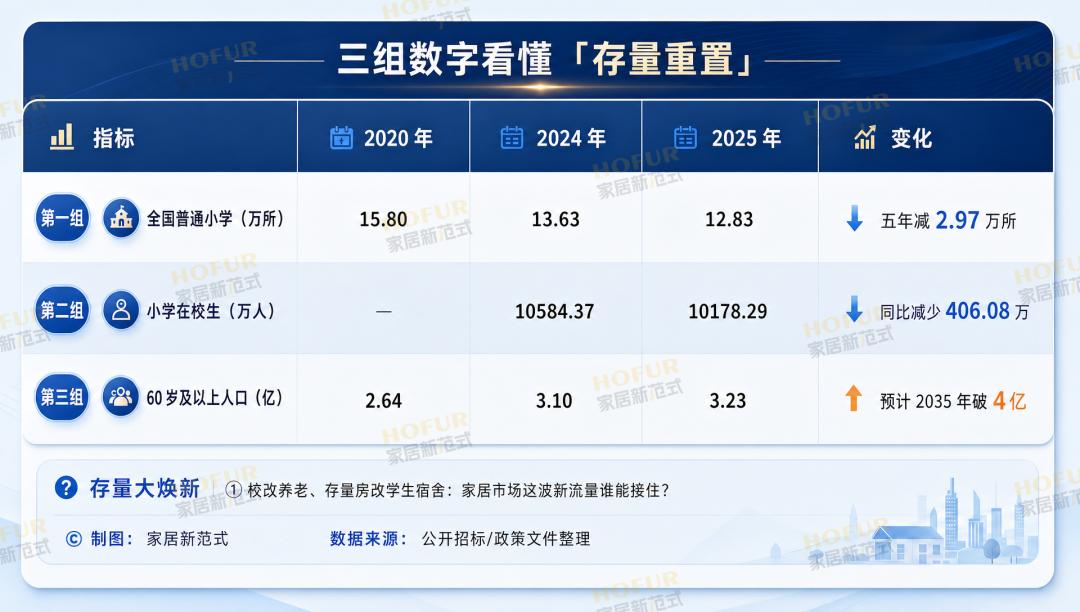
These two trending news items in the industry are intertwined with the latest data disclosed by the Ministry of Education: in 2025, the number of regular primary schools nationwide decreased by 29,700 compared to 2020, and the number of enrolled students decreased by more than 4 million compared to 2024. As the five-year land transition policy for converting idle school buildings into elderly care facilities is clarified, it points to an ongoing reality: Functional redevelopment of existing assets has evolved from sporadic pilot projects to a clear policy orientation.
From the perspective of *New Home Living Paradigm*, this is not a simple shift from "To C" to "To B", nor is it a replacement of home decoration by commercial fit-out. Instead, it is a reconstruction of the underlying logic of residential space. The buildings remain the same, but the residents have changed, and the definitions of "living" and "livability" have also changed. This is not only a test for university logistics departments, but also a survival environment that all home furnishing enterprises must face.
01
Calculation: Not unaffordable, but cost-effective
The acquisition deal of Hubei University has been carefully calculated.
Target: Wuhan Urban Construction · Shui An Buildings 5 and 6, 352 existing commercial housing units
Total Investment: Nearly 200 million yuan (around 172 million yuan for acquisition + around 25.86 million yuan for renovation)
Output: 2800 new beds, put into use in the fall semester of 2025
Unit Price: The acquisition price of the bare unit is about 4650 yuan/㎡, which is more than 30% lower than the record price in earlier years, and media estimates show the discount is close to 40% off
Amortization: Amortized based on the total investment of acquisition and renovation, the comprehensive investment per bed is about 70,000 yuan
Five years ago, when universities faced dormitory shortages, their first reaction was to acquire land for new construction. Today, land quotas are tightened, and the construction cycle often takes three to five years, which is far from solving the urgent need. Acquiring existing housing stock for renovation not only has a short cycle, but is also more cost-effective in total. The subsidy policy in Jiangsu further adds leverage to this calculation, making the "buy old and renovate new" model economically more advantageous than the "demolish old and build new" model.

This logic is not unique to universities. In Yongren, Yunnan Province and Shanyang, Shaanxi Province, hundreds of idle village primary schools have been converted into elderly care centers. Local governments are also doing the math: is it more expensive to re-acquire land and build new elderly care centers, or to renovate existing school buildings, install handrails and lay non-slip flooring? The answer is obvious.
This is a clear signal for the home furnishing industry. Whether it is university logistics or civil affairs elderly care, Party A is no longer the "property owner" who only pays the bill, but has become a cost-conscious "steward". The steward calculates the input-output ratio comprehensively, and focuses on three key points: Is the product durable? Is it easy to repair when broken? Can it pass audits and inspections?
And the "durability" of the product should be measured by the number of uses, not the procurement unit price. Some universities have included load-bearing capacity, wear resistance, number of disassembly and reassembly cycles, and warranty response requirements in their bidding documents — desktop wear resistance of 2000 cycles, 3 times of modular disassembly and reassembly, no less than 3 years of warranty, on-site troubleshooting within 48 hours after failure, all have become mandatory clauses. The nearly 200 million yuan investment of Hubei University amortized over 10 years is even more cost-effective than the "low bid winning, repair every two years" model. When buying a building you look at the unit price, when buying furniture you look at the full life cycle cost — that is the real calculation the steward is doing.
02
Role Shift: The Change of Standards after Procurement Power Returns
When properties are transferred from developers to universities or the government, the procurement power changes accordingly, and the product evaluation criteria also switch. In the past, people chose based on color, style and brand, pursuing "residential aesthetics"; now they choose based on wear resistance, fire resistance and ease of maintenance, pursuing "operational efficiency".
However, there is a common misconception in the industry: the change of standards means that "livability" is no longer important. On the contrary, in the stock era, livability is broken down into specific scenarios.
Peak morning wash time: No odor return from floor drains, no glare from vanity mirrors
Evening self-study time: No flickering light on the desk lamp, no abnormal noise from cabinet doors
Getting in and out of bunk beds late at night: Non-slip pedals, silent and stable bed frames
Moving books at the start of semester, clearing rooms at graduation season: Sturdy cabinets that can withstand repeated use
In the dormitories of Hubei University, you can see bed frames with rounded anti-collision corners, wear-resistant and easy-to-clean desktops, and modular lockers. In the renovated elderly care centers, you can see corridor handrails, non-slip bathroom surfaces, motion sensor night lights for getting up at night, and call buttons within easy reach.
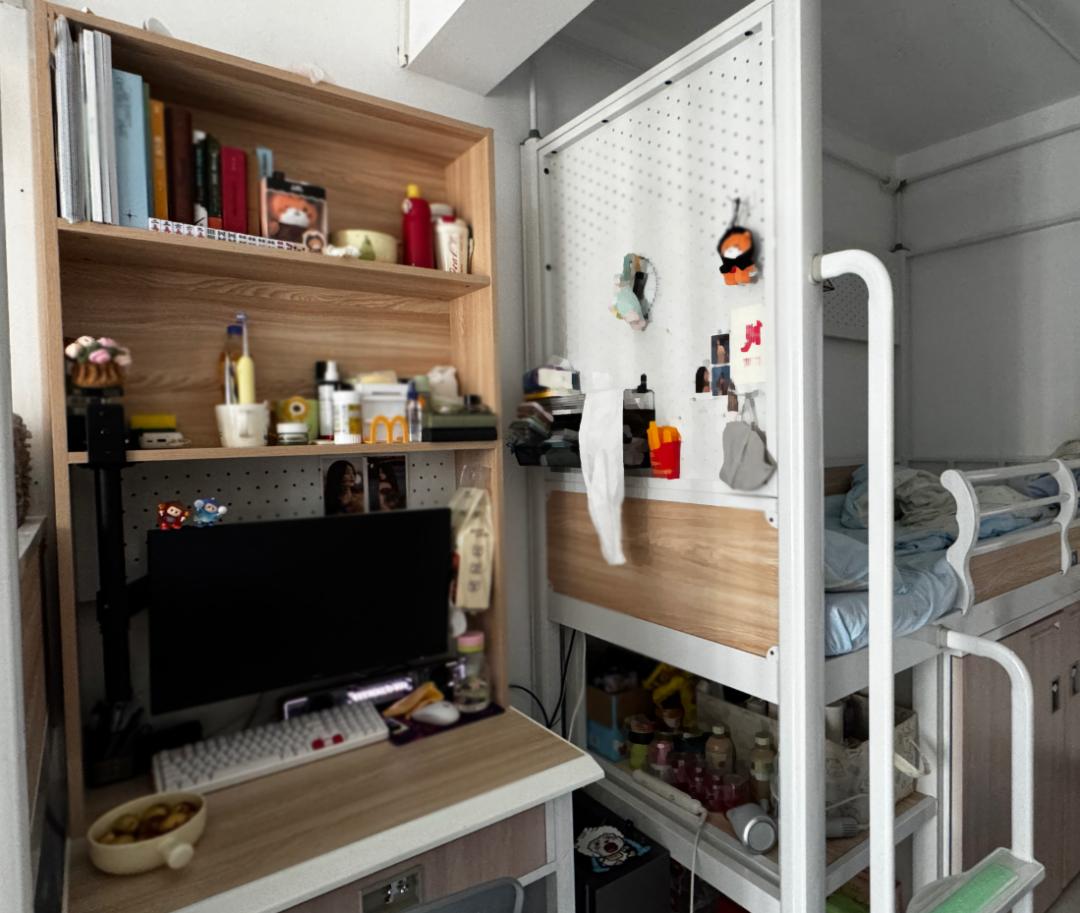
Through these details, *New Home Living Paradigm* observes: when procurement power shifts from "C-end property owners" to "B-end institutions", the product evaluation criteria change from "good-looking" to "durable". But real industry insiders know that durability is the bottom line, and livability drives repurchases. Standards can help you meet the "qualified" requirement, but cannot guarantee the product is "user-friendly".
03
Final Goal: Space Serves People Ultimately
Beyond the cold cost calculation, we need to look at the people living in these spaces, which is the unchanging anchor of the entire home furnishing industry.
Students say they "feel like residential community owners", which is a very accurate comment. They do not need five-star luxury, but need stable hot water, smooth network, acceptable sound insulation, and humanized dorm management. Translating this evaluation into specific scenarios: when returning to the dorm at 11 p.m., they can take a hot shower without worry; when someone goes out at 6 a.m., they will not wake up all roommates; when staying alone on the upper bunk, they can feel that this small space belongs to them. Durability solves the university's operation and maintenance problems, while user experience ensures that students are "willing to stay".
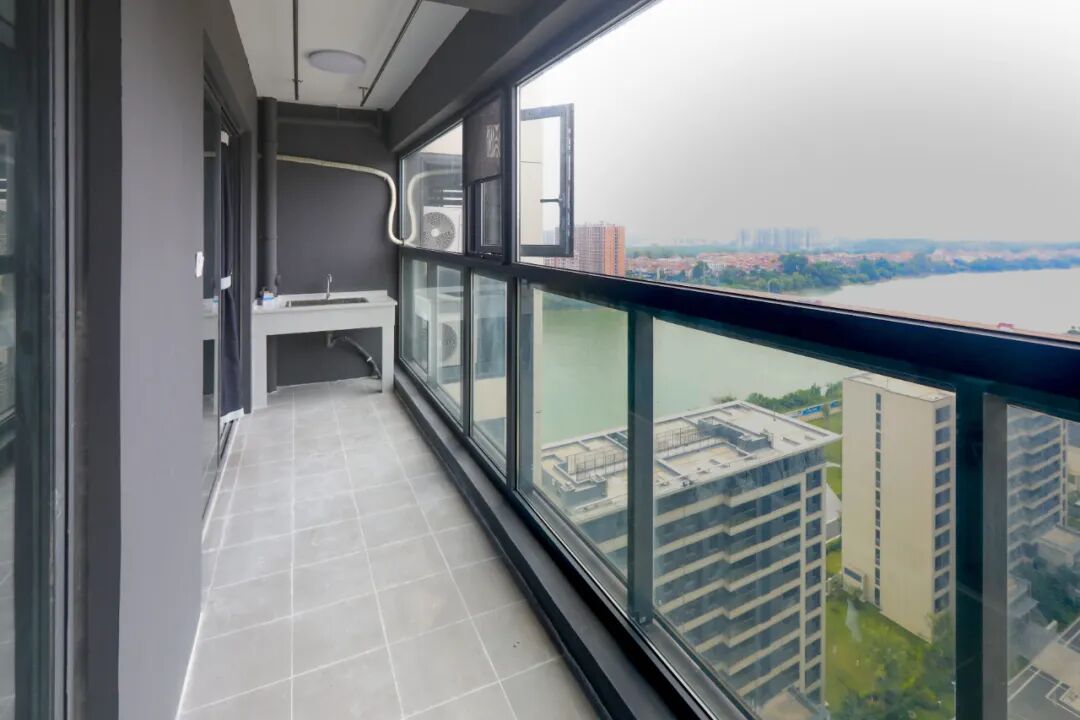
Similarly, elderly people moving into renovated elderly care centers do not need high-tech gimmicks. Whether the height of handrails is appropriate, whether the mattress hardness and softness can support the waist, whether the light is dazzling — *New Home Living Paradigm* believes these details are more important than any "elderly-friendly concept". The motion sensor night lights, anti-collision corners, bathroom handrails, and one-touch call buttons that repeatedly appear in local renovation practices look inconspicuous, but correspond to three specific scenarios — no fumbling in the dark when getting up at night, no slipping when bathing, and easy access to handrails when using the toilet.
The industry calculates the total macro cost, but product implementation focuses on "detail accounting". If people's feelings are ignored, winning a centralized procurement bid is only temporary; only by grasping the details can we create truly livable life in old spaces. Home decoration and commercial fit-out have never been separated in the underlying logic of "serving people".
04
Conclusion: Survival Rules in the Stock Era
Primary schools converted into elderly care centers, commercial housing units converted into dormitories — these are not warm social news, but a "painful but necessary" restructuring of assets forced by the reversal of population structure.
Noisy traffic will eventually ebb. When classrooms are converted into bedrooms and existing assets start their "second career", the top priority of the home furnishing industry is no longer to "sell more products", but to adapt old spaces to new lives.
In the stock era, the best products are not the most expensive ones, but the most suitable ones. They can stand cost calculation, withstand long-term use, and live up to people's expectations. This is not only the threshold for commercial fit-out, but also the return of home decoration.
This article is from the WeChat official account "New Home Living Paradigm", written by Fan Shijun, authorized for release by 36Kr.