AI Creates AI on Its Own? The Viral RSI Is Not That Scary
From the Prompt popularized by ChatGPT to the viral OpenClaw and AI Agent this year, the new buzzwords hyped in the AI circle are comparable to the internal jargon of Internet companies.
Recently, there are rumors that Google's DeepMind is close to achieving the superpower of AI, RSI (Recursive Self-Improvement).
At a time when industry giants including Microsoft, Anthropic, OpenAI and Elon Musk are frequently calling for slowing down the development of cutting-edge artificial intelligence, RSI has begun to appear in numerous reports frequently.

To explain RSI with a relatively imprecise statement, it is "AI creates AI by itself". In other words, a mature AI system is used to help develop the next generation of more powerful models and improve the R&D efficiency of future models. Once the cycle runs, the progress speed of AI may far exceed the current iteration solutions.
Although RSI has only become popular recently, the origin of this idea can be traced back more than 60 years. In 1965, British mathematician I.J. Good proposed that if a machine can surpass human intellectual activities, designing machines should also be within its capability scope. It can design a machine smarter than itself, so that machine intelligence enters an accelerated positive feedback cycle, which he called a "superintelligent machine".
It is such a sci-fi concept that is moving towards reality at a speed beyond expectations recently.
In early September, OpenAI publicly disclosed the progress of RSI for the first time, predicting that it will realize automated AI researchers before March 2028; its chief scientist Jakub Pachocki published an article warning that humans are not yet prepared to cope with the rapid evolution of superintelligence.
Another AI giant Anthropic has also tried to advance automation to security research. It previously used Claude Sonnet 5 to help the early version of Claude Opus 4.8 improve its security performance, and only with about 2400 training samples, the performance was optimized to a level close to the official release version.
In addition to modifying the model itself, there is a more realistic path in the industry, which is to patch the supporting software system of the model, known as "Harness Engineering" in the industry. This engineering paradigm enables agents to improve their own recording methods, correct faulty tool interfaces, and rewrite inefficient code. These changes may not alter the model weights, but can significantly enhance the capabilities of the entire system.
However, compared with the real RSI, not all self-improvement can deserve the title of "recursive". At present, the vast majority of so-called "AI evolution" essentially cannot do without human intervention. The real RSI, in addition to having obvious progress compared with the previous generation, also has a feature that it is better at "manufacturing" successors than the previous generation.
In other words, a system may get one point higher than the last time every time, but it becomes slower, more expensive, and more dependent on labor, which can only be regarded as version updates; in contrast, another system may not have such a high benchmark score, but it gets better at manufacturing better successor versions with fewer resources, which is closer to the concept of RSI.
Of course, the industry is still exploring the accurate definition of RSI. On September 10, arXiv published a paper jointly completed by 33 domestic authors, covering institutions including Shanghai Jiao Tong University, Tsinghua University, ByteDance, Shanghai AI Lab, etc.
This paper divides the autonomy of RSI into five levels from L1 to L5, from executing the improvement schemes given by humans, to independently finding improvement strategies, to acquiring experience and converting environmental feedback into continuously retained modifications; when it reaches L5, the improvement mechanism itself also becomes the object of improvement, and what humans create is no longer just a model, but a system that can continue to manufacture models.
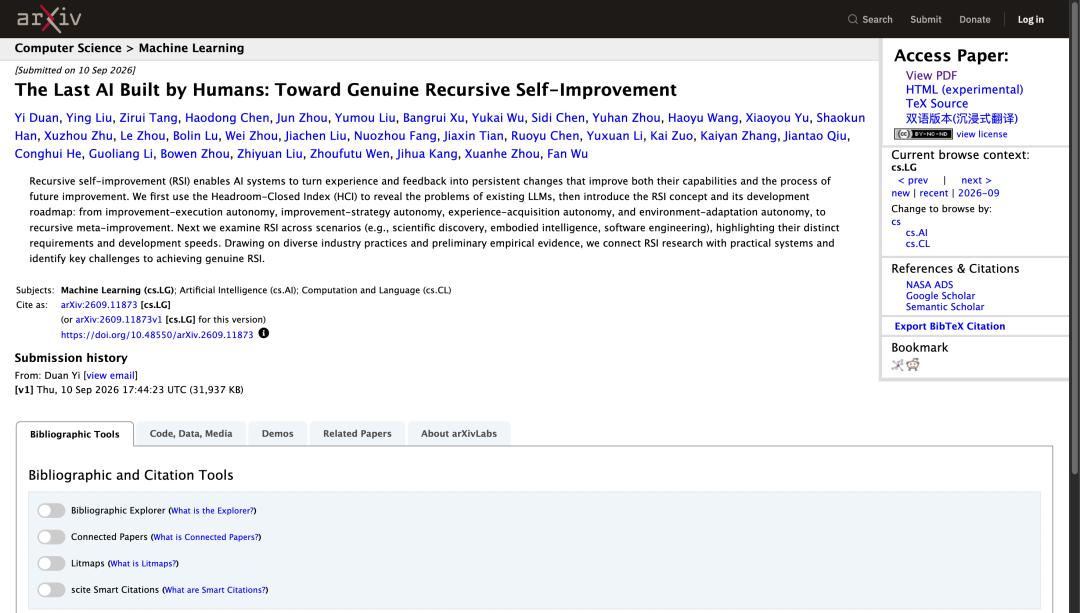
According to this standard, the vast majority of current so-called models cannot meet the requirements of RSI, and most of the related discussions are just to render the "AI doomsday theory".
At present, the debates around RSI have long gone beyond the technical scope.
Anthropic CEO Dario Amodei called on peers to collectively slow down, proposed to introduce a third-party evaluation team with permissions close to employees for long-term supervision, and OpenAI and Elon Musk rarely formed a united front.
However, some people point out that the large laboratories' request to slow down development is not entirely out of security considerations, and it may also be to fight for regulatory moats. Once the regulation tightens, large companies with huge security teams and audit resources are more likely to meet the requirements, while the open source community and small and medium-sized enterprises will face higher thresholds.
This article is from the WeChat Official Account "Meke", author: Meke, published by 36Kr with authorization.