Tencent has quietly open-sourced a "WorkBuddy"
Our company recently plans to deploy an AI Agent locally for the business team. When I was browsing Tencent's projects today, I accidentally came across an open source project called Octop, which blew my mind.
After going through all its features, I found it is extremely similar to the WorkBuddy product, and both are developed by the Tencent Cloud team: multi-Agent, expert system, Skills, MCP, knowledge base, automation, local workspace, all the core capabilities that WorkBuddy is currently focusing on developing are basically covered by Octop.
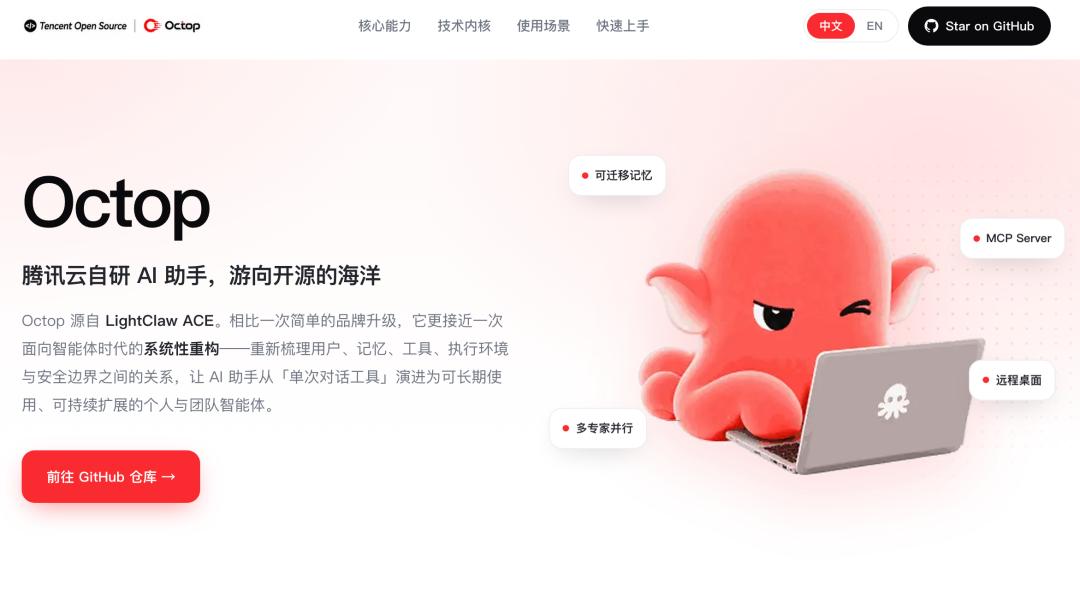
So if I have to sum it up in a sentence that is easy to understand, I think Octop is somewhat like a "self-deployable, self-modifiable open-source version of WorkBuddy".
Of course, this is only an analogy in terms of product form. Tencent has not yet defined Octop as the open-source version of WorkBuddy.
Tencent open-sourced a complete set of "AI colleagues"
Octop is hosted under Tencent Cloud's official GitHub organization. The official positions it as an open-source, self-hosted AI Assistant that supports multi-user and multi-Agent scenarios, and is released under the MIT License.
But what's really interesting is not the word "open source" itself, but that it already integrates a fairly complete set of Agent capabilities.
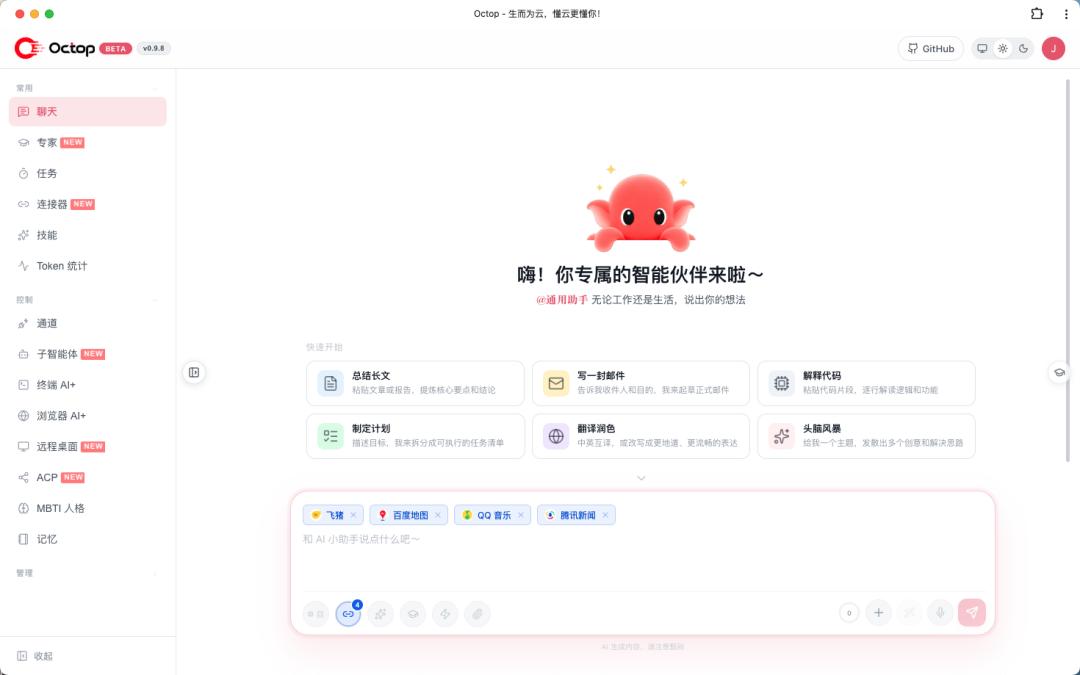
You can create multiple Agents, and assign different workspaces, models and roles to different Agents; it has an expert library, Skills, knowledge base, long-term memory, and also supports OAuth, MCP and plugin extensions.
It even has built-in capabilities such as browser automation, Terminal, scheduled tasks, and remote desktop.
Octop can also connect to Lark, DingTalk, QQ, WeCom and Discord, allowing Agents to not only stay in a web chat box, but truly integrate into daily workflows.
If you are using WorkBuddy on a regular basis, you must have felt familiar with the features described above.
The more you look at it, the more it resembles WorkBuddy
The official positioning of WorkBuddy right now is "all-scenario AI office workspace".
Users only need to input tasks in natural language, and it can think independently, break down tasks, call tools, and then deliver results directly. The official is currently focusing on highlighting capabilities such as experts, expert groups, Skills, MCP, connectors and local file operations.
So the product logic of the two is actually very close.
The old generation of AI works like this:
You ask, it answers.
Products of this new type now work like this:
You give it a goal, and it will find a way to finish the task on its own.
WorkBuddy follows this direction, and Octop does too.
Even both sides have the concept of "experts", hoping to split a general AI into different roles, so that operation specialists handle operation work, development specialists write code, and data specialists analyze data.
Octop also provides ACP, which can further assign tasks to Coding Agents such as CodeBuddy, Claude Code, Codex, and OpenCode.
So if you need an easy-to-understand metaphor:
WorkBuddy is like a fully furnished apartment renovated by Tencent, while Octop hands over the bare apartment together with the construction drawings to you.
The former can be used immediately after installation.
The latter allows you to deploy by yourself, switch models, install plugins, modify Agents, and even continue to develop new features based on it.
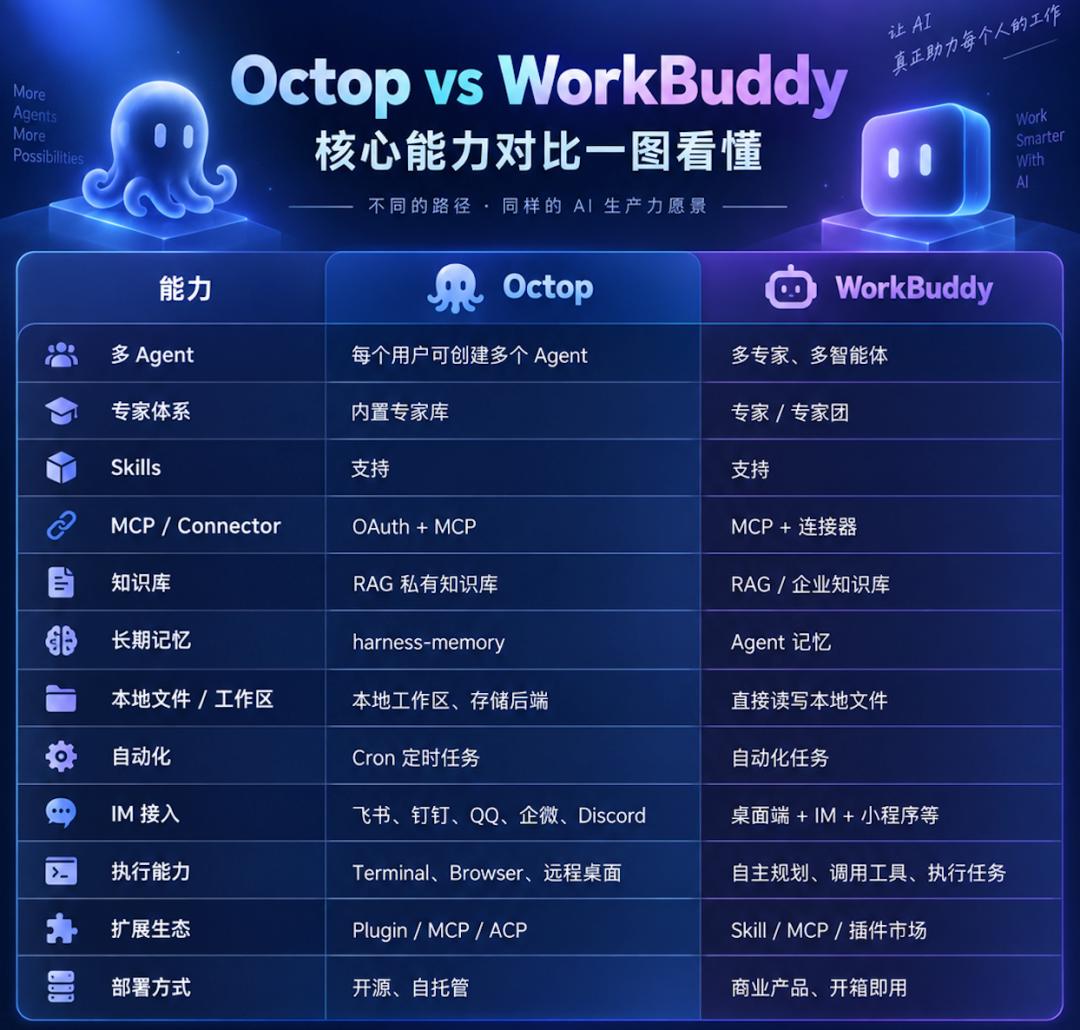
The real difference lies in "control"
This is also the most notable feature of Octop.
WorkBuddy targets ordinary users.
It aims to hide all the complex parts of Agents, MCP, Skills and model calls, so that people who cannot write code can also have a group of AI colleagues.
Octop, on the other hand, is clearly more oriented towards developers, small teams and enterprises.
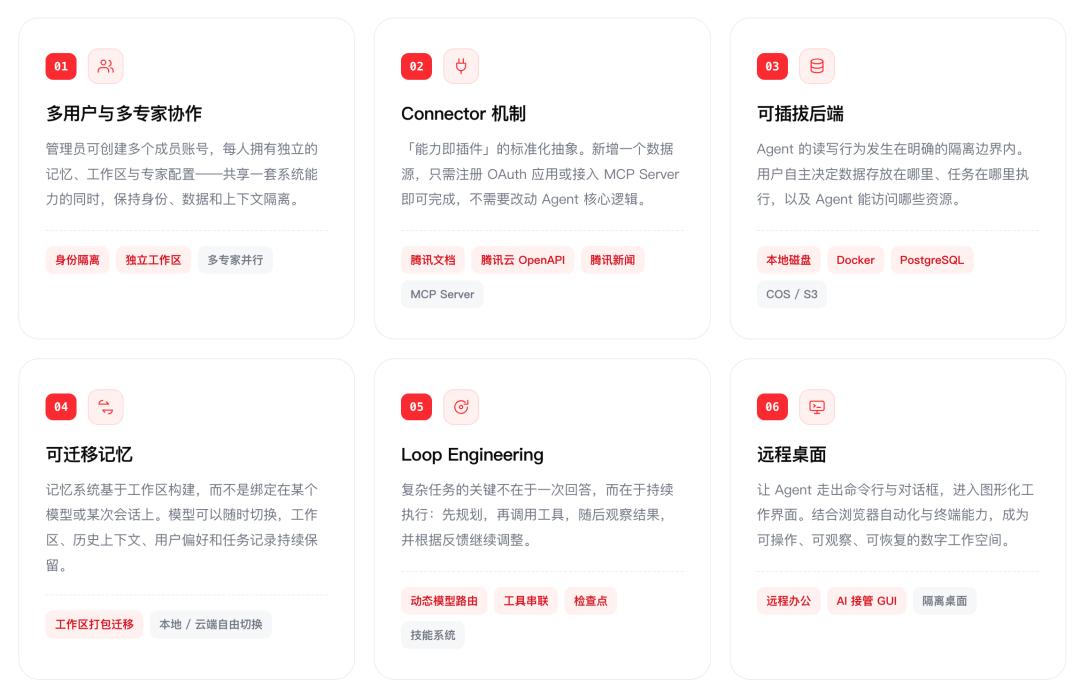
It emphasizes self-hosted, so data such as chat records, workspaces and credentials can be kept on your own machines; the model is not locked, and it can connect to different Providers such as OpenAI Compatible API, Qwen and Ollama.
The two products seem to be doing the same thing, but their business logic is quite different.
WorkBuddy targets users. Octop is more targeting developers.
The former hopes to become the AI work entry point on everyone's computer, while the latter hopes that more people will continue to build products based on Tencent's set of Agent capabilities.
Tencent may be betting on two paths at the same time
So I think what is really worth paying attention to about Octop is not that "Tencent has open sourced another project".
Instead, Tencent has already embarked on two very clear product paths in the AI office sector.
The first path is represented by WorkBuddy.
It continuously lowers the threshold, packages all complex things such as expert groups, Skills, MCP and multi-models into products, and finally makes ordinary users feel that they just "recruited a few more AI colleagues".
The other path is exactly Octop.
It breaks down and exposes models, Agents, memory, knowledge bases, browsers, Terminal, MCP, workspaces and other components, allowing developers to assemble them on their own.
Octop's Roadmap even has a pre-written AgentTeams feature: in the future, a coordinator will automatically schedule multiple experts to complete complex tasks together.
This is almost exactly the "expert group" direction that WorkBuddy is currently focusing on promoting.
Of course, this does not prove that Octop is the open-source version of WorkBuddy.
But at least one thing is clear:
Tencent's internal consensus on what the next generation of office software will look like is getting stronger and stronger.
It may no longer be Word, Excel, PPT with an AI button added, nor just a chat box.
Instead, it will be a group of Agents that can read files, open browsers, call tools, connect to enterprise systems, and even collaborate with each other.
From this perspective, Octop is more like Tencent taking apart these "AI colleague" capabilities and handing them over to developers to experiment first.
If you also want to build your own "custom version of WorkBuddy", I suggest you try this project.
This article is from the WeChat official account "Everyone is a Product Manager" (ID: woshipm), written by Guai Ge, and published by authorization from 36Kr.