AI Phone 2.0, Doubao has "behaved well" this time
More than nine months later, the new "Doubao Phone" is released.
On September 16, 2026, the Nubia NaviX Ultra (hereinafter referred to as the second-generation Doubao Phone) officially went on sale, with the 12GB+512GB version starting at 5999 yuan. Equipped with the Doubao Mobile Assistant (consumer edition), the new device is officially positioned as the world's first AI agent smartphone.
Previously, when the technical preview version Nubia M153 was released in December 2025, the 30,000 units of the first batch priced at 3499 yuan were sold out, which once pushed ZTE's stock price to the daily limit. It became a hit with cross-app price comparison and check-in functions realized through screen reading and simulated clicks, marking the first large-scale deployment of GUI Agent (Graphical User Interface Agent) on real consumer devices. However, a few days later, exceptions occurred in WeChat login, and risk control verification was successively triggered on Taobao and banking apps. The official then removed financial and some sensitive operation permissions, and the "full automation" capability was significantly reduced.
The biggest difference between the second generation and the first generation lies in the execution strategy: it has changed from direct screen reading plus simulated clicks to a priority protocol mechanism with simulated clicks as fallback and manual confirmation. Two days before the launch event, it released the Screen Automation Operation Protocol (SAEP): third-party apps can declare their operation boundaries from three dimensions: page level, business intent level, and operation type level. This path converges with the solutions of mobile phone manufacturers including Apple, Huawei, Honor and Xiaomi, bypassing direct operation on app interfaces, and turning to collaboration between system interfaces and agents.
This phone is worth paying attention to for two reasons. First, it is the first attempt to restart the GUI Agent route after the first-generation Doubao Phone, and also the first mobile phone in China that officially writes AI agent into its product definition. Second, behind it is a unique cooperation model: ByteDance's Doubao provides the large model, assistant interaction layer and protocol specifications, while ZTE's Nubia provides hardware and system-level permissions. This set of system-level permissions is the core competitive advantage of Doubao compared with other third-party AI assistants on the market.
But when all mobile phones learn to "knock on the door" to apply for permissions, what makes users choose Doubao? If super apps only provide query permissions but do not allow transaction operations, is the "automatic task execution" function of the second-generation Doubao Phone a real agent, or just an advanced Q&A tool? This is the problem it needs to solve next.
01. What can the second-generation Doubao Phone do?
In terms of hardware, the new device is equipped with the 5th generation Snapdragon 8 Elite chip, a 7100mAh large South China Sea battery, a 6.78-inch ultra-narrow four-sided equal display, and a flagship triple camera system consisting of a 200-megapixel main camera, a 50-megapixel ultra-wide-angle lens and a 64-megapixel periscope telephoto lens. However, its focus is not on hardware, but on integrating AI into every link of mobile phone use.
According to the official release information, the new system has been upgraded in three dimensions: interaction, task execution, and anti-interference. It can run in the background continuously without interruption even when the screen is locked, and supports one-click pending answer setting for specific numbers such as food delivery calls, allowing AI to handle daily trivial matters. Among all the updates, three points are the most noteworthy.
First, the interaction is more user-friendly. The Doubao assistant can be activated through the AI key, voice command, and video scenarios.
The most obvious change lies in the AI key: its position is adjusted to the area that the right thumb can reach when holding the phone, and it integrates fingerprint identification. One press can complete unlocking and wake up the assistant, eliminating the secondary unlocking step. The official claims that this "fingerprint + AI key" combination is the first in the industry. For comparison, the native AI assistants of Apple, Huawei and Xiaomi all require long-pressing the side key or voice wake-up.
The voice wake-up function has also been optimized in a targeted manner, accessing the Seed full-duplex voice large model, which supports interruption at any time and continuous dialogue. It can be triggered in scenarios of long distance, noisy environment, fast speaking speed, and dialects. For example, when users are cooking and their hands are occupied, they can directly ask Doubao for recipes.
What brings more imagination space is the screen Q&A and video interaction function. Users can open the camera to aim at the indoor environment, say "According to this decoration style, help me choose a cabinet within 1.2 meters and the price no more than 1000 yuan", and Doubao can combine the picture information and requirements to find and recommend eligible products on e-commerce platforms.
Second, the task execution is more autonomous.
Doubao can independently decompose tasks and complete cross-app continuous operations such as ordering coffee, comparing prices, and hailing a taxi, with an announced end-to-end task success rate of over 80%. Taking hailing a taxi as an example, when the user says "Help me call a car to the company", Doubao will confirm the commonly used address and initiate the order, and the basic operation has been fully implemented.
Feishu is the app with the deepest integration so far. Doubao can independently initiate a meeting for tomorrow afternoon and notify the specific participants, without requiring users to fill in the information one by one. This type of task involving multi-step and cross-application collaboration used to require users to switch repeatedly between different apps, but now it can be completed with just one sentence. However, Feishu is ByteDance's own product, so the deep integration has natural advantages, and whether this model can be replicated to external super apps remains to be seen.
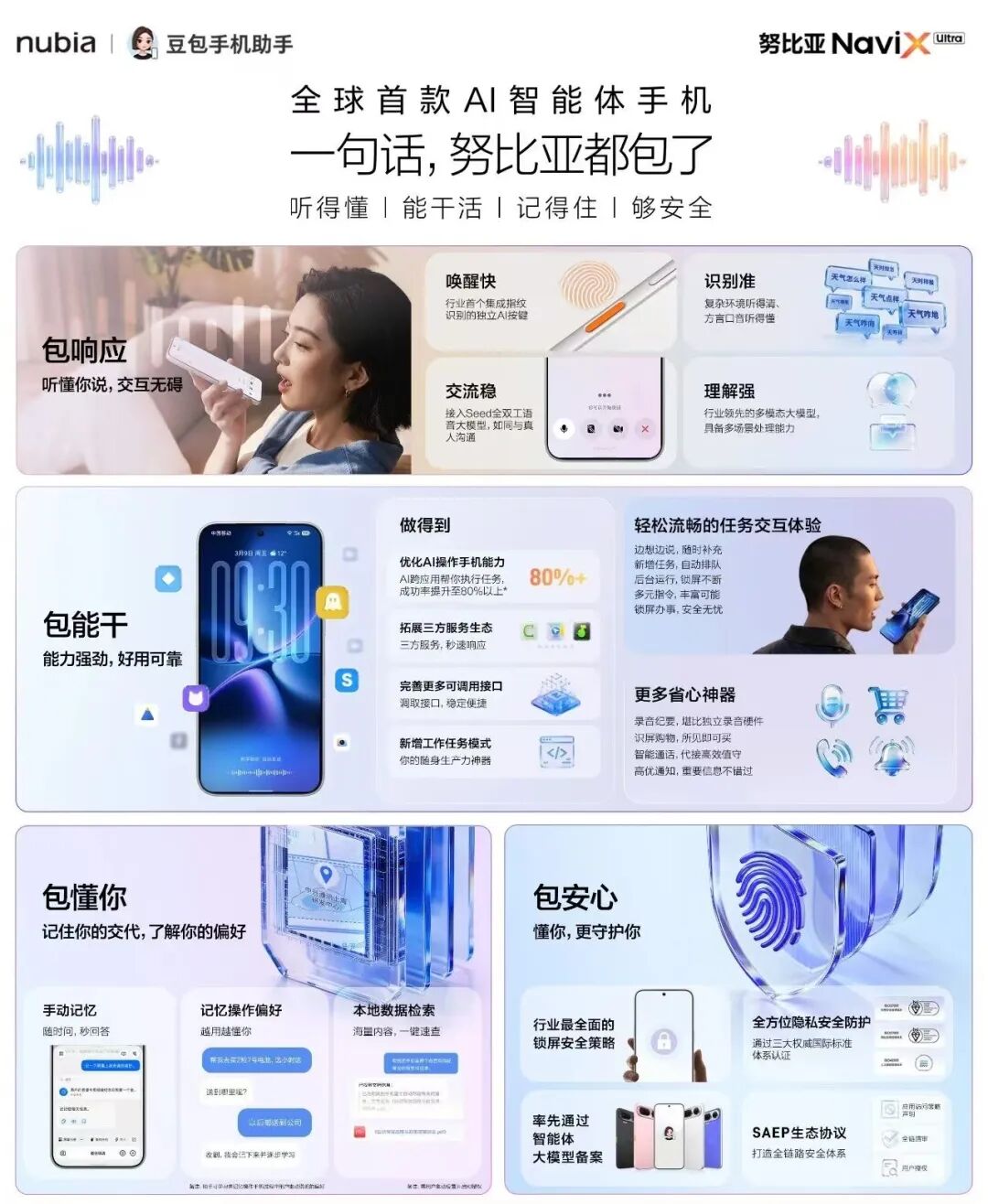
Finally, the memory capability is stronger.
Doubao can retrieve the existing data in the user's mobile phone, including SMS messages, photo albums, notes, and recordings. When the user receives an appointment SMS, it can extract the appointment information and save it to the note; when recording a meeting, it can synchronize the transcribed content to Feishu Minutes. When the user asks what time the business flight is or when the wedding anniversary is, it does not need to search temporarily, but directly finds the answer in the local information.
This step complements the "personalization" capability, which organizes the personal information scattered in the mobile phone into retrievable and callable context, making AI dialogue and task execution more user-aware.
The most notable feature of the first-generation Doubao Phone is that it can "automatically operate the mobile phone", while the second generation is built into a larger framework: it can not only complete tasks, but also reduce interference to users, and remember users' habits.
02. From GUI to "Knocking on the Door", Doubao Phone Adopts a New Strategy
In addition to richer functions, the second generation also provides new solutions for the controversial privacy and security issues existing in the first generation.
First is the "physical isolation" at the interaction level, which uses the AI key to set up a screen lock security mechanism. Only when the user presses the key can the Doubao assistant be activated. Second is the qualification and certification level, the AI agent large model has completed the filing, and an AI certification protection system has been established.
But these two points are not the core concern of the industry. What the industry cares most about is how the AI "operates" apps.
At present, there are two main paths in the industry. One path is to let AI "look at the screen and click buttons like a human", namely GUI Agent. Its advantage is that it bypasses app manufacturers and directly covers the existing application ecosystem with AI capabilities, but the cost is that it cannot pass the risk control of super apps and is easy to be "blocked". The other path is to let AI "enter through the main entrance" through protocols, authorization and APIs, and its core lies in "cooperation". AI invokes capabilities through the interfaces opened by app manufacturers. Its advantage is compliance and stability, but whether apps are willing to open interfaces and to what extent depends on separate negotiations, which leads to slower progress.
The two paths have their own advantages and disadvantages. The first-generation Doubao Phone chose the former, which quickly became popular, but subsequently caused disputes.
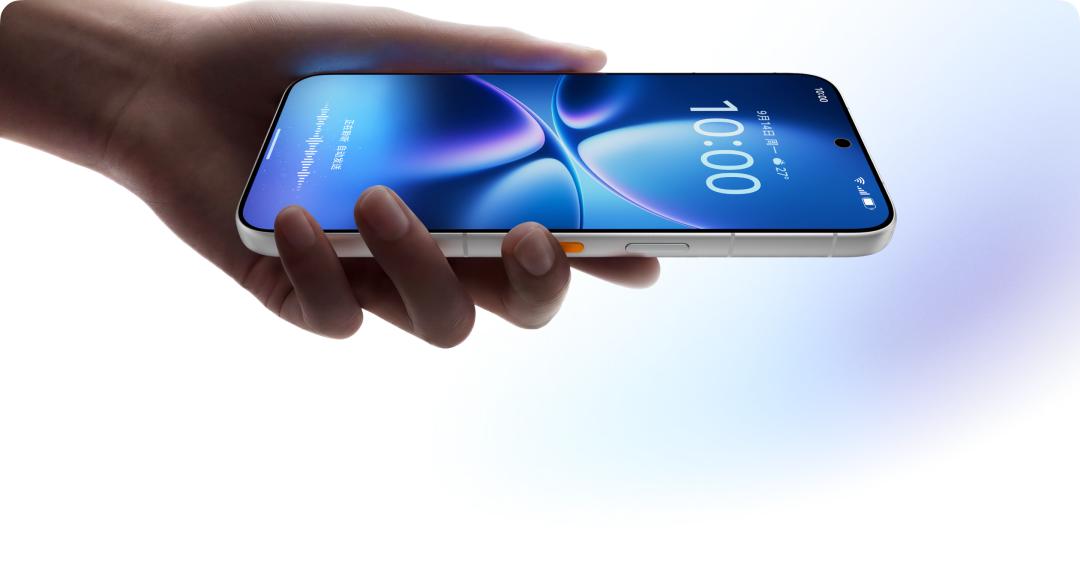
Image source / Official website of Doubao Mobile Assistant
In the view of Qin Xiang, an AI software engineer, the problem of the first-generation Doubao Phone is not an engineering problem, but an ecological problem. "The simulated click of GUI Agent is regarded as a plug-in by the risk control system of WeChat and Alipay. At the same time, it bypasses the advertisements and entrances of super apps, and also brings data and responsibility risks." No matter how strong the technology is, it cannot work without the authorization of the platform.
The solution of the second-generation Doubao Phone is to adopt multiple parallel routes, using a hybrid architecture of MCP (Model Context Protocol) + A2A (Agent to Agent) protocol + GUI screen reading, while the GUI operation follows the protocol-first principle.
Two days before the launch event, the official Doubao Mobile Assistant released the SAEP protocol. Its core idea is to grade GUI operations: third-party apps can declare their boundaries from three dimensions: page, business intent, and operation type. The system decides whether to execute the operation by combining the agent identity, security baseline, app declaration and user authorization. The SAEP protocol has a 30-day rule publicity period from its release. During the publicity period, third-party apps are not operated by automation by default, and apps that explicitly refuse will never be operated. After the publicity period, apps that do not refuse will be gradually opened according to the risk level.
Take ordering takeout as an example. When the user says "Help me order a cup of iced coconut latte with the takeout app", Doubao will first judge which situation the app belongs to, and then decide how to execute the task.
The first situation: the app has accessed the MCP and A2A protocols. Doubao will not open the interface, but directly send the demand to the app. The app itself queries the menu, calculates the price and creates the order, and Doubao only feeds back the result.
The second situation: the app has not accessed the protocol, but agrees to simulated clicks. Doubao will open the interface, search and add to cart under the SAEP rules. The app will set restricted areas in advance, for example, the login page cannot be touched, the payment page cannot be touched, and lottery and check-in activities cannot be automatically grabbed. Doubao is only responsible for selecting the products, and the final payment step is left to the user.
The third situation: the app refuses to be operated by simulated clicks. Doubao will not force the operation, but help the user open the app and stay on the search page, and the user will complete the rest of the steps manually.
In essence, the technical architecture of the second-generation Doubao Phone has not changed much. What has changed is the "interaction mode" between Doubao and apps: from the one-sided operation of "acting on behalf of users and apps" in the first generation, to a negotiated execution mode with clear boundaries, authorization and fallback mechanisms. The advantage of this operation is that more third parties can be accessed, reducing the concerns of super apps. But how fast it can finally move forward depends on the super apps.
03. More compliant, but also more ordinary?
Under a stricter compliance framework, how many applications the Doubao assistant can invoke, and to what extent the automation can be promoted in the accessed applications, is no longer determined by technology, but by the rules and the cooperation degree of the apps. This leads to a question: while becoming safer, has it also become more ordinary? According to the opinions of practitioners, we can judge from three dimensions.
First is the breadth of authorization.
The publicly announced capabilities of the second-generation Doubao Phone cover system tools and some third-party applications, including weather, app download, Bluetooth, notes, SMS search, selfie countdown, contacts, countdown, calendar, song playback, as well as Feishu schedule, recording transcription, Caocao Mobility, map, Qishui Music, etc.
Although the number of covered applications is large and the coverage of daily scenarios is relatively wide, most of the scenarios that can be automatically executed are concentrated in two categories according to the type of partners: one is the native system tools of mobile phone manufacturers, such as calendar, Bluetooth, SMS, and photo album; the other is ByteDance's own products, such as Feishu schedule and recording transcription.
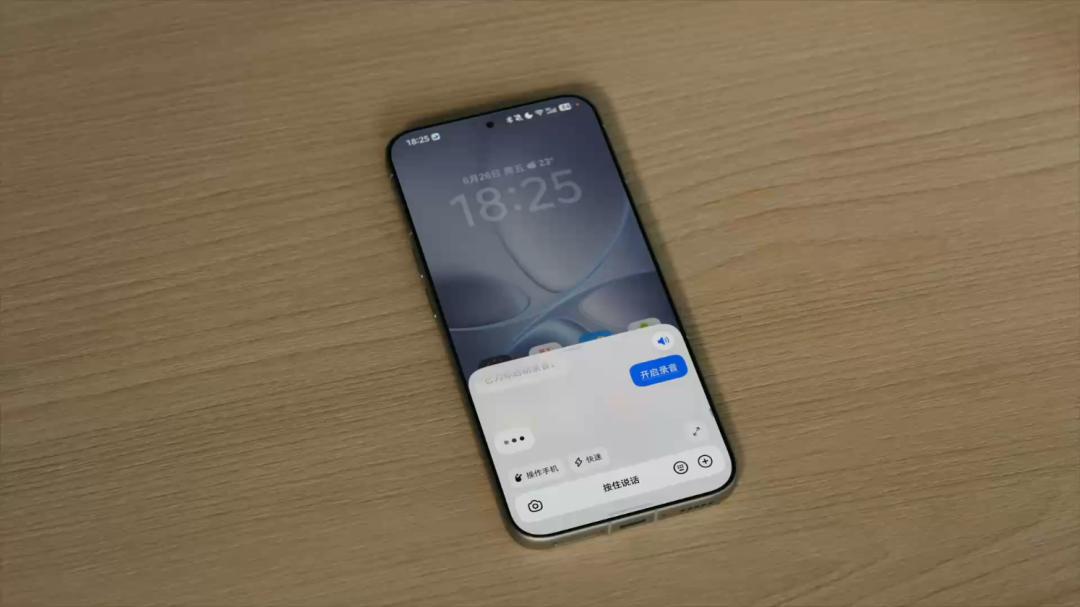
Image source / Official website of Doubao Mobile Assistant
These scenarios do not involve the account, password and capital operations of external applications by nature, so the integration resistance is small. For transaction scenarios that really require the cooperation of external applications, the authorization is still relatively limited. For example, in several high-frequency scenarios such as hailing a taxi, ordering takeout, buying tickets, paying fees, transferring money, and registering for medical treatment, most of them are still at the stage of query, guidance or manual user confirmation.
Second is the system substitutability and ByteDance's ecological openness.
As a third-party assistant, how many system capabilities Doubao assistant can obtain depends on the openness of Nubia; how much of its own ecology it can invoke depends on the decentralization degree of ByteDance.
At present, through cooperation with Nubia, it has obtained permissions such as AI key control, screen lock wake-up, fingerprint authentication direct access, and system file access, which is equivalent to half stepping into the system-level entrance. However, compared with the native AI assistants of Apple, Honor, Xiaomi and other manufacturers, it cannot obtain all the underlying permissions by nature. ByteDance has not fully opened up its own ecology either. Feishu is its own application with the highest openness so far, while products such as Douyin and Toutiao are mostly limited to content search and information acquisition.
Third is the execution mode and user experience.
This is a more hidden problem. Under the SAEP protocol, Doubao does not directly operate the interface of super applications, but converts user demands into standard instructions and sends them to the target apps. The super application's own AI completes menu query, price calculation, order creation, and then returns the result to Doubao. What users see is that the task is initiated by Doubao, but the actual executor is the target application. Although this approach avoids the old path of the first-generation screen reading and simulated clicks that trigger the risk control of super apps, the cost is that the execution depth is determined by the partner app. Qin Xiang believes that the second-generation Doubao Phone exchanges part of its initiative for a compliance pass, and its product difference from that of mobile phone manufacturers will narrow.
Moreover, how far this route can go depends on the other end of the protocol. Xiao Shi, a buyer of the first-generation Doubao Phone and a large model practitioner, said that the A2A route mainly depends on the latter Agent. If the other party does not develop AI capabilities or its AI performance is poor, the protocol is almost useless. The capability boundary is also a realistic problem. He gave an example that to make a super fine-grained travel plan, Codex combined with CUA (Computer Operation Agent) may still be needed. The high-level demands of heavy users may not be met by the current Doubao Phone. This is the root cause that it is difficult to make a breakthrough in user experience: the key execution links are controlled by others, so the certainty and differentiated experience that Doubao can provide will be reduced.
Overall, if the second-generation Doubao Phone wants to take the lead in the future, it mainly depends on whether it can continuously expand third-party cooperation, especially to obtain more open permissions in transaction scenarios, and whether it can provide a more convenient overall experience than users' manual operations when the final execution is undertaken by the target application.
The keys to these two things are in the hands of Doubao on the one hand,