After the three global leading giants in the household energy storage sector, the balcony energy storage track has also seen the rise of its new "top three" leading players.
Search for "Balkonkraftwerk Speicher" on Amazon Germany, and the top results are neither well-known home appliance companies, nor any residential energy storage brand you can think of.
It is Anker, a Chinese company that has been making power banks for more than a decade.
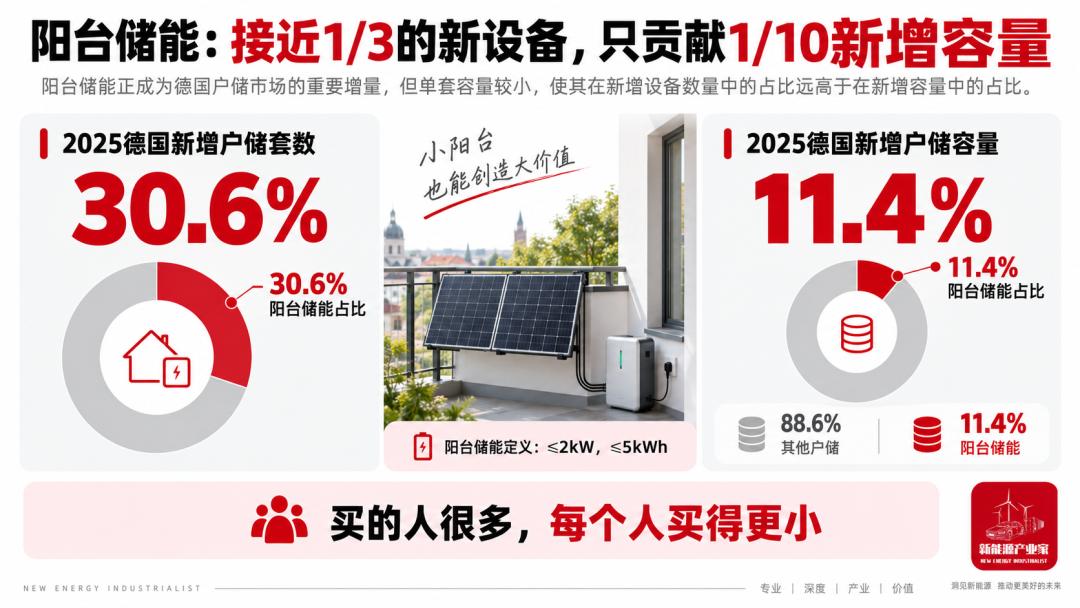
This is no coincidence. Over the past two years, Germany's balcony energy storage market has developed rapidly. Data from P3 and RWTH Aachen University shows that among the new residential energy storage installations in Germany in 2025, 30.6% are "balcony energy storage" products —
They have a power output of less than 2kW and a capacity of no more than 5kWh, so consumers can buy them online and install them by themselves.
This product category barely existed before 2023.
In just two or three years, balcony energy storage has evolved from a very niche product to the choice for nearly one third of new residential energy storage installations in Germany, gradually forming a new track independent of the traditional residential energy storage sector.
According to data from Frost & Sullivan, the global balcony photovoltaic energy storage market reached 137 billion yuan in 2025. Orient Securities predicts that this figure will rise to 349 billion yuan by 2030.
More interestingly, the first few companies to stand out in this new market are all from China, but none of them are traditional residential energy storage players.
Frost & Sullivan data shows that in 2025, the top three players in the global balcony photovoltaic energy storage market by revenue are:
Anker takes the first place with a 14.6%;
Zendure ranks second, accounting for 5.8%;
Jackery, the brand under Huabao New Energy, ranks third with a 4.4% share.
New Energy Industrialists call them "the new top three players in balcony energy storage".
Anker Innovations, headquartered in Changsha, was founded in 2011 and started its business with chargers and consumer electronics. Its revenue share in the global balcony photovoltaic energy storage market reached 14.6% in 2025, corresponding to a revenue of about 20 billion yuan calculated based on the total market size.
Jianghai Technology behind Zendure is headquartered in Guangzhou, founded in 2017, and initially entered the market through consumer hardware such as power banks. It holds a 5.8% revenue share in the global balcony photovoltaic energy storage market in 2025, corresponding to a revenue of about 7.9 billion yuan.
Huabao New Energy, headquartered in Shenzhen, founded in 2011, listed on the ChiNext in 2022, and its subsidiary Jackery has long been deeply engaged in portable energy storage. Its 2025 global balcony photovoltaic energy storage revenue share is 4.4%, corresponding to a revenue of about 6 billion yuan.
The three companies jointly captured 24.8% of the global balcony photovoltaic energy storage market revenue in 2025. Calculated based on the global market size of about 137 billion yuan, the absolute revenue amounts to about 34 billion yuan.
What is more noteworthy is that these three companies share a very distinct common feature:
They all have strong To C consumer hardware genes. Anker makes chargers, Zendure makes power banks, and Huabao New Energy makes portable energy storage.
This is not a coincidence.
Balcony energy storage was originally more like a consumer product: lower price, placed online for order, and installed by users themselves.
Anker, Zendure and Huabao New Energy are exactly good at these areas. They did not seize an existing market share from traditional residential energy storage players, but took the lead in this newly emerging niche.
01 Where is the new market for balcony energy storage?
Germany is one of the markets with the earliest penetration and the largest scale of balcony photovoltaics in Europe, and it is also the first country to complete product, channel and user verification for balcony energy storage.
The story of balcony energy storage starts with the increasingly common balcony photovoltaic panels.
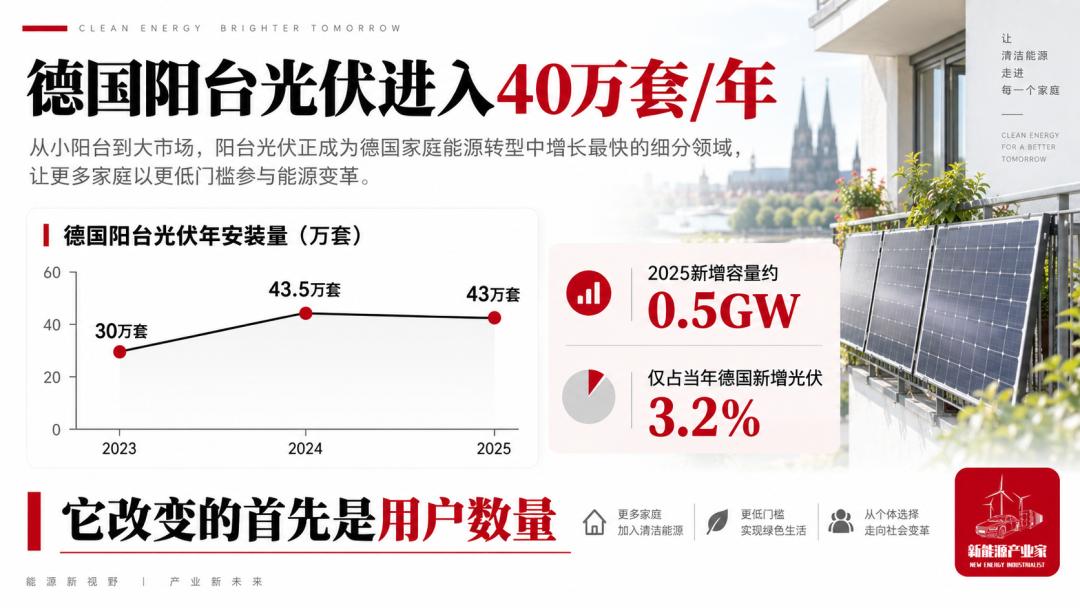
In 2024, the German Federal Network Agency registered about 435,000 new plug-and-play balcony photovoltaic systems.
In 2025, about 430,000 more sets were registered, maintaining a volume of over 400,000 sets for two consecutive years.
In June 2025, the German Solar Energy Association estimated that the number of operating plug-and-play balcony photovoltaic systems has exceeded 1 million sets.
The energy storage allocation rate for local balcony energy storage in 2025 also rose from about 13% in 2024 to about 35%.
These devices contribute little to the new photovoltaic installed capacity — Germany's new photovoltaic installed capacity reached 16.4GW in 2025, while balcony photovoltaics only accounted for about 0.5GW, taking up 3.2% of the total.
But the change it brings lies in the number of users. Behind 1 million sets of devices are millions of households who started generating their own electricity for the first time at a cost of only a few hundred euros.
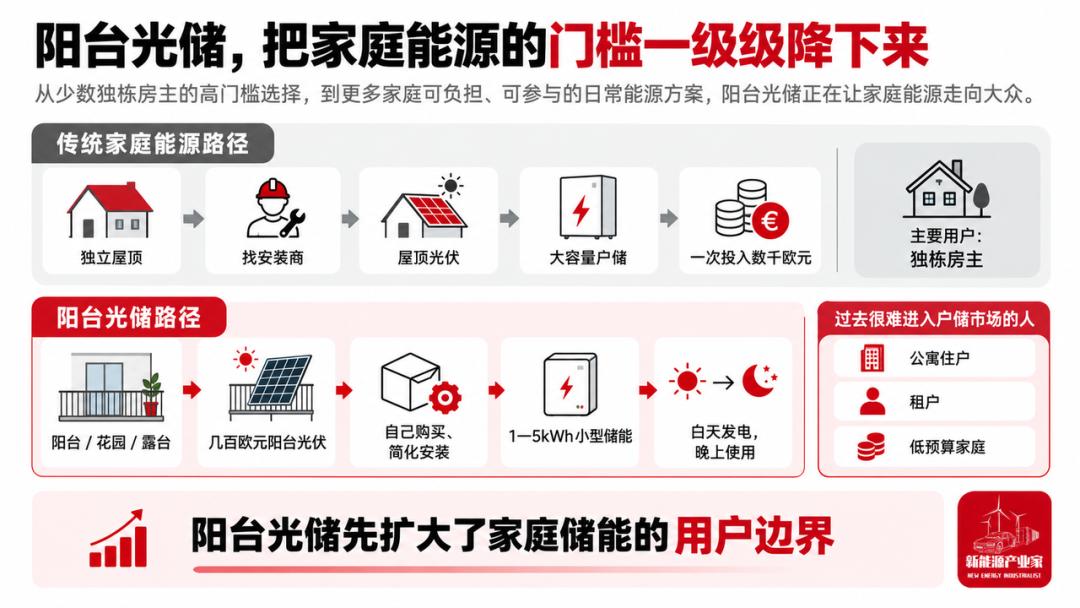
Traditional rooftop photovoltaics require installers to come to the site for survey, design, construction and grid connection. It is very difficult for families living in apartments, tenants, and people who are unwilling to invest thousands of euros at one time to go through this process.
Balcony photovoltaics lower the threshold to the minimum.
After the adjustment of Solarpaket I took effect in 2024, eligible devices only need to be registered with the Federal Network Agency, and no separate declaration to the grid operator is required. You can buy a set for a few hundred euros, place it on the balcony or terrace, and start generating electricity. But the generated power cannot be fully consumed.
The sunniest hours are in the daytime, when many families have no one at home. Refrigerators, routers and standby appliances can only consume part of the generated electricity, and the remaining power flows into the grid, bringing limited benefits to users.
Matching a set of traditional residential energy storage that costs thousands of euros for a balcony photovoltaic that only costs a few hundred euros brings the investment back to the original high level.
Manufacturers therefore began to make batteries as easy to use as balcony photovoltaics. Initially, the capacity was only 1 to 2kWh, consumers could place orders online and connect them to their existing photovoltaic systems by themselves.
As products mature, building material stores, supermarkets and e-commerce platforms have also become sales channels.
The change here is more important than the growth of capacity — The sales chain of traditional residential energy storage is installer-recommended: a home battery is first added to the installer's product catalog, and then the installer brings it to the property owner.
Balcony energy storage bypasses this chain, enabling manufacturers to reach end consumers directly on a large scale for the first time.
P3 and RWTH Aachen University also regard online sales, direct consumer reach, and photovoltaic and energy storage packages in building material stores and supermarkets as the reasons for the rapid growth of this market.
By 2025, balcony energy storage accounts for 30.6% of the total new residential energy storage installations in Germany, but only accounts for 11.4% in terms of total capacity.
The combination of these two figures best illustrates the nature of this market: It first expands the number of energy storage users, rather than replacing traditional large-capacity residential energy storage.
The first home battery many consumers buy only has a capacity of a few kWh.
Anker, Zendure and Huabao New Energy rank top three in global revenue, which is no accident. The channel change mentioned earlier — shifting from installer recommendation to direct consumer ordering — is exactly the battlefield they are most familiar with.
02 Why are they the ones that stand out?
Let's first look at a set of rankings.
Frost & Sullivan data shows that the top three players in the global balcony photovoltaic energy storage market by revenue in 2025 are Anker (14.6%), Zendure (5.8%) and Huabao New Energy (4.4%), with a combined share of 24.8%.
In the local German market, according to statistics from P3 and RWTH Aachen University, in 2025, by installed capacity of balcony energy storage in Germany, Anker accounts for about 55%, taking a leading position far ahead of others; Growatt accounts for about 12%, Marstek about 10.3%, EcoFlow about 5.6%.
Anker is performing exceptionally well in Germany, while Zendure and Huabao New Energy rank among the top three in the world with revenue from other regions. The two lists have different statistical calibers, but point to the same fact: the top three players in this market all have obvious To C consumer hardware and portable energy genes.
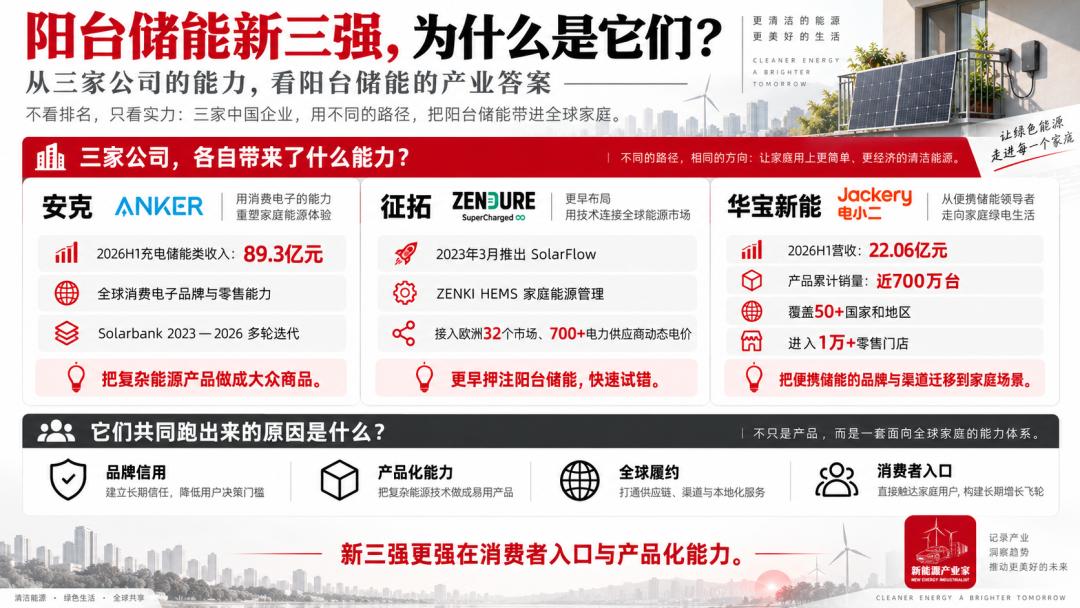
Anker is the largest player among the top three. With more than ten years of experience in making power banks and consumer electronics, its brand recognition and traffic operation capabilities in European and American online retail are its deepest moat.
In the first half of 2026, Anker's charging and energy storage revenue has reached 8.93 billion yuan, a year-on-year increase of 31%.
From the first generation of Solarbank in 2023 to the Solarbank Max AC and Solarbank 4 series in 2026, Anker has completed multiple rounds of iteration, continuously pushing up the capacity and functional boundaries of its products.
Zendure is the first among the three to bet all its resources on balcony energy storage. In March 2023, it launched SolarFlow in Europe;
Its differentiation mainly relies on ZENKI HEMS — an AI-powered home energy management system that takes dynamic electricity prices and intelligent scheduling as the core functions of its products. This system can already access dynamic electricity prices from more than 700 power suppliers in 32 European markets.
Huabao New Energy takes a different path. Jackery has built global brand recognition in the portable energy storage sector, especially in North America and Japan.
In the first half of 2026, the company's revenue reached 2.206 billion yuan, a year-on-year increase of 34.71%; by the end of 2025, the cumulative sales volume of Huabao New Energy's products was close to 7 million units, covering more than 50 countries and regions and over 10,000 retail stores worldwide.
Its M2C direct-to-consumer model — selling self-developed products directly to end users through its own channels — allows it to reuse existing brand and channel assets when extending from portable energy storage to balcony energy storage.
The three companies have different paths, but the reasons for their success are actually similar.
On the surface, balcony energy storage is a simple consumer product: a main unit, several cables, and an App. But behind the product, it needs to handle cells, BMS, inverters, MPPT, thermal management, grid connection control and electrical safety at the same time.
Previously, installers helped manufacturers digest part of the complexity, but for balcony energy storage, all these problems are embedded into the product itself in advance.
Users do not need to know how to configure the inverter, nor should they call an electrician just because the device cannot connect to Wi-Fi. The more the product looks like a home appliance, the more tough problems manufacturers need to solve behind the scenes.
Moreover, after there are no installers in the middle to screen brands for consumers, consumers have to make their own purchase decisions.
A product that runs in the home for many years is not a pair of earphones, and you cannot return it casually if you make a wrong purchase.
In addition, without installers and channel partners undertaking product selection, installation and after-sales services in the middle, manufacturers are getting closer to consumers.
Balcony energy storage manufacturers need to directly take charge of sales, after-sales and other links.
Anker, Zendure and Huabao New Energy have already practiced this set of capabilities in their consumer electronics business over the past decade.
If the three leading players of residential energy storage first mastered installers, then the new top three players in balcony energy storage first mastered consumers. The two capability systems enter the same household from different entry points.
03 Balcony energy storage is growing larger and larger
In 2023, Anker launched the first generation of Solarbank, with a capacity of 1.6kWh, and the function is very simple: connect it next to the balcony photovoltaic system, store the unused solar energy generated in the daytime for use at night.
Three years later, the product has evolved into a completely different form.
Anker Solarbank Max AC starts at 7kWh, and can be expanded to a maximum of 42kWh.
Zendure SolarFlow 2400 AC+ starts at 2.4kWh, and can be expanded to a maximum of 16.8kWh; the Mix series released in April 2026 starts at 8kWh.
Huabao New Energy's Jackery HomePower 2000 Ultra can be expanded from 2kWh to 8kWh.
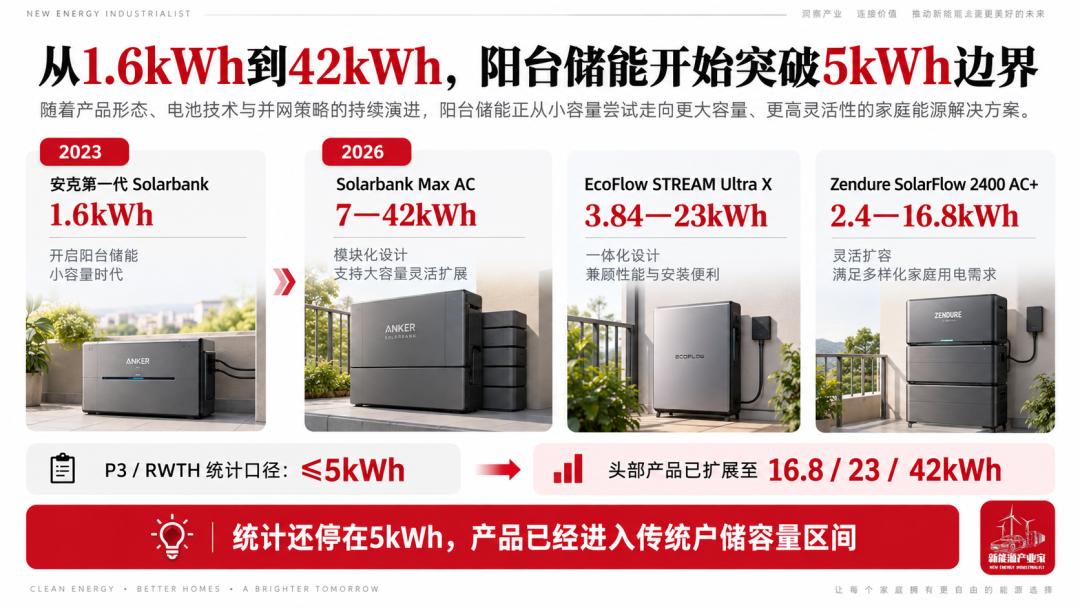
The maximum capacity of the three companies' products has exceeded the statistical boundary of "no more than 5kWh" for balcony energy storage set by P3: Huabao New Energy has reached 8kWh, Zendure 16.8kWh, and Anker's maximum capacity has reached 42kWh.
If we expand the scope to the entire balcony energy storage market, EcoFlow's STREAM Ultra X can also be expanded to a maximum of 23kWh.
Capacity growth is only the surface. What is more important is the functional expansion.
The early Solarbank only stores power in the daytime