Dalio and Altman: The Love-Hate Saga Between AI Giants
Dario: Daniella and I, along with several core researchers, will officially leave OpenAI.
Altman: All those who intend to resign, please exit the meeting.
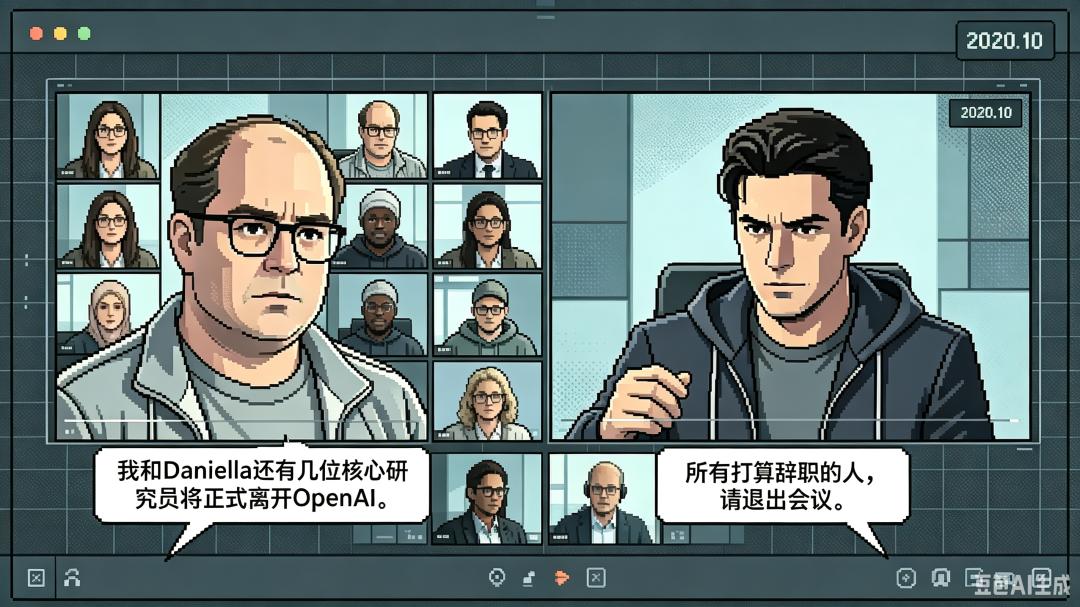
Dario, his sister and a group of engineers successively left the online meeting...
Dario gave up everything: options worth tens of millions of dollars, within-reach financial freedom, and GPT-3 that he led the development of, which was the core of ChatGPT that kicked off the global AI era two years later.
At this point, the two most powerful figures in the AI industry parted ways.
The reason why Dario left was that Altman was too aggressive, ignoring safety in pursuit of larger and more capable models. Back then Dario was like a valiant dragon-slayer, determined to guard human safety.
Six years later, Dario built a larger and more powerful model at an even faster pace, successfully surpassing Altman and making his company the world's most valuable AI startup, yet he also became the very kind of person he once abandoned everything to stop.
All of this originated from a dinner party that summer.
01 The Rosewood Dinner
In the summer of 2015, a small group of people sat around a table in the restaurant of the Rosewood Hotel on Sand Hill Road in Silicon Valley. The initiators were Elon Musk and Sam Altman, who decided to found a laboratory that later became OpenAI. Their only goal was to build AI that benefits all of humanity.
Later, this meal was known to the world as: the Rosewood Dinner.
Altman was the head of Y Combinator at that time. Also at the dinner table were Greg Brockman, CTO of Stripe, Ilya Sutskever, the most promising researcher at Google Brain, and Dario Amodei who was still working at Google then.
With infinite imagination for AI, Musk promised to provide 1 billion US dollars, and everyone co-founded this laboratory. Everyone agreed on the spot except Dario, who did not give an immediate answer.
After spending several months at Google Brain, Dario finally walked into the OpenAI office.
He recalled later: At that time he asked Altman and Brockman: Everyone outside says your goal is to build friendly AI and then open source it, is that really true?
The answer he got was: Our current goal is to do the best thing possible.
Although it was a vague answer, Dario still joined OpenAI, because the top-tier platform he needed for his safety research was only available at OpenAI back then.
And OpenAI happened to need a safety brand at that time. With him on board, it was easier to raise funds and polish its own narrative.
In March 2017, the Open Philanthropy Foundation donated 30 million US dollars to OpenAI, with only one condition: Holden Karnofsky, co-founder of the foundation who was about to marry Dario's sister Daniela at the time, would join the board of directors.
02 From Moore's Law to the Scaling Law
In 2018, Dario published a report titled *AI and Compute* at OpenAI.
They tracked the actual compute consumption of every major AI breakthrough in history, and found that the total compute used for state-of-the-art AI tasks doubled almost every 3.4 months, surging 300,000 times in just 6 years from 2012 to 2018.
This speed far outpaces Moore's Law, and the competition in the AI era is larger and faster.
Back when he was at Baidu's lab, Dario only had an intuition about this rule, which was continuously verified later at OpenAI. Dario's team gave it a more formal name: the Scaling Law.
The larger the model, the more data, and the more sufficient the compute, the smarter the AI will be. This rule later became the belief of the entire industry.
When GPT-2 was born in February 2019, Dario advocated not releasing it, for two reasons: the model could be misused, and open sourcing it was equivalent to giving away a far more powerful tool for free.
People inside and outside the company all thought he was overreacting, and finally a compromise was adopted: OpenAI released it in four phases: the smallest version in February, the 345 million parameter version in May, the 762 million parameter version in August, and the full 1.5 billion parameter version was not released until November. The whole process dragged on for nine months.
Right in August of the same year, two graduate students who were still in school uploaded the open source replica of GPT-2, including both code and weights, to the Internet.
This led Dario to make a very counterintuitive decision next: accelerate!
Since the Scaling Law holds true, we should make the model as large as possible as soon as possible, but do not release it immediately after scaling up. Use the lead time we grab to research how to make it safe.
Why must we go fast?
Because if you don't accelerate, others will. Even two students can replicate an open source version, others will only build larger and less secure models.
To ensure that AGI is beneficial, the person who knows the most about safety must run at the forefront. If you fall behind even one step, you will lose the qualification to conduct safety research at all.
03 Be 10 Times Better Than Rivals, or Get Out
In his book *Zero to One* published in 2014, Peter Thiel wrote: A new product must be 10 times better than its alternatives to have real significance.
This became Altman's code of conduct: Be 10 times better than rivals, or get out.
Both Dario and Sam firmly believe that AGI will definitely be built.
But training large models is a compute-eating monster that consumes massive capital. Tens of thousands of GPUs, massive electricity consumption, the speed of burning money far exceeds the affordability of a non-profit laboratory. The hardware cost for GPUs alone amounts to hundreds of millions of dollars.
How much money did OpenAI have on its books back then?
When it was founded, Musk once promised 1 billion US dollars, but only 130 million US dollars was actually received, and Open Philanthropy only donated a mere 30 million US dollars.
To train larger and more powerful models faster, more capital was needed. To raise more funds, Altman approached Bill Gates and Microsoft.
In July 2019, Microsoft announced that it had first finalized a 1 billion US dollar cooperation deal, and at the same time helped OpenAI build a 10,000-GPU supercomputer. On the day the news was announced, Microsoft's own market value rose by 10 billion US dollars.
Likewise, for OpenAI, which had been established for almost 4 years and had zero revenue, this was not just a huge sum of money, but also solved many technical problems. This supercomputer took nearly a year to build and debug, and was officially delivered in 2020.
It was Dario and his team who used this supercomputer to train the largest model at that time, GPT-3 with 175 billion parameters.
Dario, who was the most conservative at the beginning, instead became the most staunch accelerationist at OpenAI.
Although the GPT-3 corpus he accelerated to produce was not clean. The dataset called Books2 was about 402GB and had never been fully disclosed, but insiders said it contained texts extracted from pirated book libraries.
Later, writers Sarah Silverman, Paul Tremblay, Mona Awad, George R.R. Martin (author of *A Song of Ice and Fire*), John Grisham, Jodi Picoult and others successively sued OpenAI in court.
04 Parted Ways, the Dragon-Slayer Picked Up His Sword
While Dario was busy scaling up the model, Altman kept busy raising funds, and negotiated deeper technology licensing terms to get more capital.
When Amodei's safety team saw the terms afterwards, they found that the permissions promised to Microsoft far exceeded the consensus the company had reached internally before.
If the model had a serious safety problem, these terms would deprive the safety team of the power to stop it.
A witness from the safety camp later described the situation at that time like this:
"We traded something that we didn't even fully understand ourselves."
Amodei and his team, who should have been most involved in the decision-making, were precisely the last people to know about it. Over the next two years, the Amodei siblings gradually saw through a pattern of practice.
Every major decision was made first and reported later. By the time they saw it, it was already a done deal. Every reassurance spoke in line with their wishes, making them think their opinions still mattered. Until everything became irreparable, Dario realized that the right to speak had always been an illusion.
In June 2020, the GPT-3 API was officially launched, which was the first time OpenAI turned a large model into a product for customers.
Before the launch, the business camp led by Sam Altman and Greg Brockman insisted on prioritizing market implementation, accelerating commercialization, and seizing industry opportunities.
While the safety camp led by Dario Amodei firmly believed that model safety alignment was not yet mature, and it should not be hastily opened to the public.
The two sides had countless fierce debates, repeated tugs-of-war, and continuous games, and internal meetings were almost deadlocked every day. Eventually the commercial line won overwhelmingly, and GPT-3 was successfully launched as scheduled.
After launch, the product achieved far more success than expected.
The 175-billion-parameter model demonstrated remarkable few-shot learning capabilities. Developers used it to write copy, generate code, and create stories, spawning hundreds of AI startups in just a few months, shocking the entire Silicon Valley developer community.
In September 2020, Microsoft obtained the exclusive license for GPT-3. At the same time, Microsoft got access to the underlying model, could directly integrate GPT-3 into its own products, and had the rights to independently modify and redevelop it.
This was an important implementation of the 1 billion US dollar investment agreement between the two parties, meaning that OpenAI's core large model was deeply tied to the commercial giant.
Altman won this line struggle, but behind this grand success, OpenAI fell into an unusually quiet state internally.
Everyone acquiesced to this commercialization choice, and no one continued to discuss the hidden safety risks in depth. This silent consensus completely shattered Amodei's last expectation.
So Amodei, Daniela who was already Vice President of Safety and Policy, and several core researchers were privately discussing the same thing: leaving OpenAI.
Dario believed that the Scaling Law means that the threshold for training frontier models will only get higher year by year. If they wait longer, the scale of compute and capital will be so large that they will never be able to enter the game.
Thus, the scene at the beginning of this article took place at the all-hands video meeting in December 2020.
05 The Dispute Began
In May 2021, Dario founded Anthropic, whose name comes from the Greek word "anthropos" meaning "human being".
In interviews, Dario kept emphasizing publicly: "Not like Sam." "Not like OpenAI."
Can a Safer AI Ever Be Built?
To avoid repeating the same mistakes, he not only registered the company as a public benefit corporation, but also set up a "long-term benefit trust" composed of five members with no financial ties to the company, who have the right to appoint and remove some directors, to ensure that the safety mission can still be upheld even after the company goes public.
Just like Altman, Dario's ultimate goal is also AGI.
To achieve AGI, you have to train the most powerful model, which requires more GPUs, more power, more talents, and more capital.
Many people thought Claude had a very smooth start in fundraising, but the opposite was true.
When Anthropic was first founded, all mainstream VCs rejected them. The $124 million Series A round was invested by bigwigs in the effective altruism circle such as the founder of Skype.
In April 2022, Anthropic completed a $580 million Series B round of financing, but this funding plunged Dario into bigger trouble. $500 million of that sum came from Sam Bankman-Fried.
The founder of FTX was the most prominent "benevolent rich man" in the world back then. He claimed to believe in effective altruism: make as much money as possible, and then donate all of it.
But a few months later FTX collapsed, dragging Anthropic into the litigation storm together. Court documents showed that the $500 million came from customer deposits that were illegally misappropriated.
This $500 million became part of the largest financial fraud case in US history. In March 2024, SBF was sentenced to 25 years in prison. Anthropic was also dragged into the mess. Its capital chain could break at any time, and its equity was ordered by the court to be frozen to repay the victims of the fraud case.
Later, the FTX bankruptcy liquidator sold its Anthropic shares in 2024 and got back about 1.3 billion US dollars. But if it had held on to the shares, that stake would have been worth around 770 billion US dollars by May 2026.
Was the Launch of ChatGPT Actually an Accident?
Meanwhile, the management of OpenAI heard rumors: It is said that Anthropic is testing a chatbot and may release it at any time.
But the truth was that Anthropic had no release plan at all. It was too entangled in the FTX lawsuit to get away at that time.
But OpenAI did not intend to take the risk. Altman would never let Dario get a head start.
Thus came the most memorable moment in AI history two weeks after that Thanksgiving: ChatGPT was launched.
No press conference, no advance notice.
The night before the launch, people in the office were betting: How many people will come to use it this weekend?
Some guessed thousands, some guessed tens of thousands. To be on the safe side, the infrastructure team prepared servers for 100,000 users.
You all know the rest of the story: ChatGPT exceeded 1 million users 5 days after launch, and its monthly active users exceeded 100 million 2 months later. The wave of AI swept the whole world.
One investment bank did a set of statistics: To grow from zero to 100 million users, the telephone took 75 years, the mobile phone took 16 years, the Internet took 7 years, Facebook took 4 and a half years, and Instagram took 2 and a half years.
ChatGPT took two months.
A former employee's exact words were: "What's shocking is that people actually liked it. To all of us, they just downgraded something we had been using internally and released it."
What runs at the bottom of ChatGPT is still the line of research Amodei led the team to develop back then. The thing he left behind when he departed became the most sought-after product in the world.
Overnight, Altman Was Removed From Office
In October 2023, two executives came to the board of directors, saying that they could no longer trust Altman, and presented evidence that he lied and manipulated others on different occasions. They described the atmosphere at OpenAI as toxic, and even used the term "psychological abuse".
On November 17, the board of directors of OpenAI announced that Altman was removed from his position as CEO. The reason was only one sentence: he was "not consistently candid in his communications with the board".
OpenAI was valued at tens of billions of dollars at that time, holding the world's most popular AI product, but the board of directors only had four people: Helen Toner, Tasha McCauley, Adam D'Angelo,