A post published by a DeepSeek engineer has sparked widespread heated discussion, and the genius skilled at operator development is also considering a career transition.
Early last night, a 3,000-word long article titled "I Had to Bury My Talent in Yesterday" quietly spread in tech circles, and later went viral overseas.
Phoenix Tech found based on the GitHub profile information provided by the author that the author is Liu Shengyu. In April 2025, he joined DeepSeek as a Machine Learning Systems (MLSys) engineer, and his workplace is located in Hangzhou.
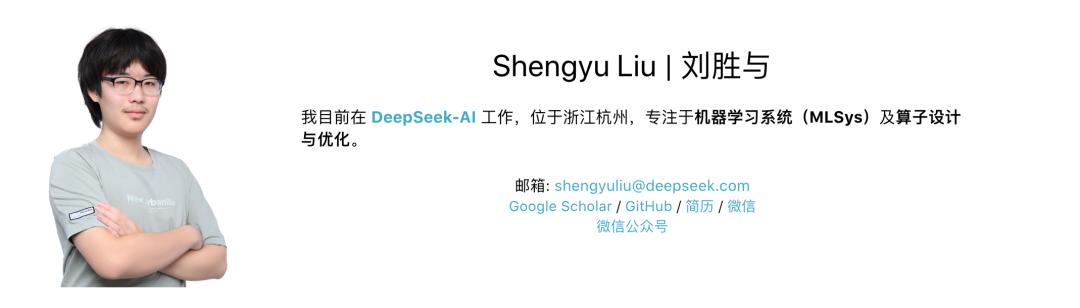
As a member of the 2021 Turing Class of Peking University, Liu Shengyu once served as the captain of the Peking University Weiming Supercomputing Team, representing the university to compete in the international student supercomputing contest SC23. Just a few days ago, he had just delivered the main Attention operator for DeepSeek V4.1, the MQA attention with head dim equal to 512, which is a core component that directly determines the model inference efficiency.
Judging from his past posts, Liu Shengyu is a young man with a very vivid personality. He would complain that the university is too far from the subway, which makes it inconvenient for him to go out to comic exhibitions. "If I want to attend a comic exhibition starting at 9 or 10 in the morning, adding 2 hours for makeup preparation, half an hour for washing and grooming, and 1.5 hours for commuting, I have to get up at 5 or 6 in the morning." He also mentioned that he gave up the opportunity to pursue a doctoral degree. Although he received PhD offers from the University of California, Berkeley and Carnegie Mellon University, he finally decided not to pursue a doctorate due to financial considerations and the lifestyle of the new generation of young people, among other reasons.
That's why many people think the essay he wrote is very powerful and sincere. "Of course I hope I won't be overthrown by the revolution, but if I have to be overthrown, I hope the one who revolutionizes myself is me."
In particular, he and DeepSeek have a high degree of tacit understanding on AI philosophy, that AI should be fast, powerful and inclusive, which is also the reason why he chose to stay at DeepSeek.
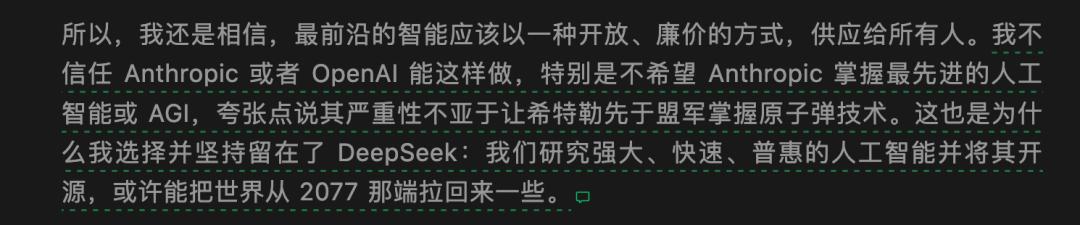
This is not a story about unemployment. It is a story about a "craftsman" witnessing the skill he relies on for a living being caught up by the system he helped build with his own hands, and rethinking his future.
Over the past six months, extreme remarks on the AI track have emerged frequently. Liu Shengyu's thinking may be a neutral, referential and sincere state worth noting.
The people supporting the computing power base are also thinking about career transition
In the R&D chain of large models, algorithm scientists define the network architecture, while MLSys engineers like Liu Shengyu are responsible for making these huge networks run on physical hardware. He dives deep into the lowest level of the GPU architecture, analyzes the stalls of the hardware pipeline at the granularity of PTX assembly and SASS machine code, and performs register allocation and shared memory scheduling.
This is a work that relies extremely on experience and intuition. Unlike upper-layer application development which has abundant documentation and toolchains, it is more like a tacit "craft": knowing where to save a memory access, and where the instruction pipeline can be compressed for one more cycle. For a long time, it has been regarded as one of the fields hardest to be replaced for human programmers.
Liu Shengyu has gone deep enough on this path. According to his past resume, in February 2025, he was deeply involved in the FP8 extreme performance GEMM operator optimization of DeepGEMM, laying a hardware acceleration foundation for the training and inference of the DeepSeek series of models; in April 2026, he participated in the reconstruction of the DeepEP V2 communication operator, systematically reducing the cross-node data exchange bottleneck of the Mixture-of-Experts architecture; until September 2026, he independently completed the delivery of the V4.1 main Attention operator.
In the historical posts of this account, a message suspected to be from Cui Tianyi, the head of the DeepSeek harness team, appeared in the comment area, who called Liu Shengyu the "Operator Immortal".
Liu Shengyu wrote in his post: "AI has become a master of operators." He inferred that in the next six months to one year, the ability of AI to independently evaluate scheduling schemes, design and implement end-to-end extreme operators will most likely catch up with or even surpass top human engineers. The reference he gave is specific: AI can process 300 tokens in one second and write a complete code in 20 seconds, "but I can't".
This may be a structural transformation. "When the day comes that AI writes operators better than me, what will happen to me then? My judgment is: I will not be 'unemployed', but I must 'change my career'."
"I Hope the One Who Revolutionizes Myself Is Me"
Liu Shengyu revealed in his article something he called the "technical paradox".
He is proud of the success of DeepSeek v4.1, because its main Attention operator was written by him. But the better the work of operator engineers is, the higher the training and inference efficiency of the model will be; the faster the model iterates, the earlier the ability of AI to independently write operators will mature; and the earlier this ability matures, the shorter the cycle for operator engineers themselves to be replaced will be.
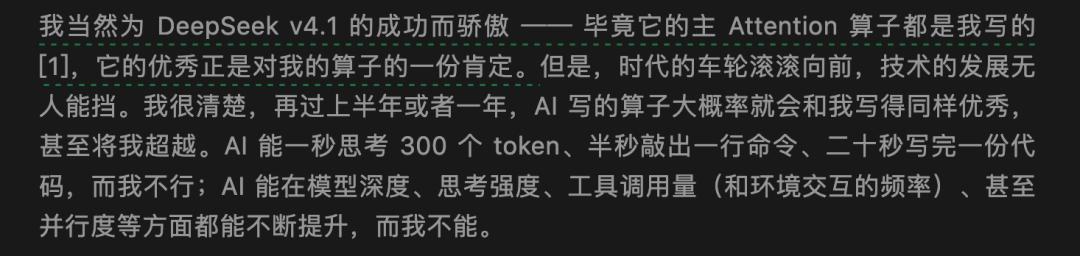
In other words, every line of code he optimizes shortens the lifespan of his own craft.
At present, this kind of thinking about the topic is emerging around the world. A recent Reuters report mentioned that researchers from Anthropic publicly warned that the increasingly powerful AI models may break free from human control, and in extreme cases even threaten the survival of humanity. Interestingly, those who issued these warnings, like Liu Shengyu, are all direct builders of AI capabilities.
But Liu Shengyu's expression does not stay at the level of warning. His attitude and thinking are more pure and real.
His judgment on his own situation is: he will not be "unemployed", but he must "change his career". The so-called career transition refers to shifting from the field of operator design, writing and optimization that he has dived into for many years and loves deeply, to becoming a "mecha pilot" of Agent.
He admitted frankly that in the past, his interests, strengths and the demands of the industry were basically aligned; now, AI has made what he is good at better mastered by itself, and the demand of the industry has shifted from "people who can write high-performance operators" to "people who can use AI to produce high-performance operators faster". He still believes that he can produce operators with high quality by virtue of his understanding of engineering, upper-layer model demands and underlying hardware, and may love the new direction, but "the feeling of having your passion taken away is really not pleasant".
He used the metaphor of knitting sweaters to describe this loss: a craftsman who is proficient in knitting sweaters makes a living by his skills and interests, until a machine can automatically knit sweaters of the same quality. The job can be kept, but the fun of sitting by the window listening to the rain and threading the needle is eventually crushed by the roar of the machine.
He wrote: "I have to bury my talent in yesterday, and become a mecha pilot. I have more gears in my hands, but less rhythm in my heart."
The Two Kinds of Discussions Have Completely Different Starting Points
The reason why Liu Shengyu's article sparked discussions both in China and abroad is that it touches on a larger narrative rift.
In the United States, the mainstream discourse about AI threats is rapidly converging to two extremes. One end is the "existential threat". Dario Amodei, CEO of Anthropic, publicly published an article on September 12, warning that humanity may lose control over AI, and this technology may be misused for cyber attacks, bioterrorism and cause serious economic damage. Sam Altman of OpenAI and Elon Musk of xAI immediately expressed their support, and the latter said "Dalio is right". The Wall Street Journal published an article stating directly: "The panic over AI in the United States has begun".
But at the other end, Jensen Huang said that the "AI doomsday theory" is "unscientific sensationalism", RSI is by no means "out-of-control black magic", and the scary warnings about AI are "exaggerated".
The two forces are pulling against each other to the extreme in overseas markets.
A survey targeting young people in China and the United States provides another perspective, which is a more peaceful and scientific perspective: for Chinese respondents, the concern about AI replacing jobs dropped from 60.5% last year to 39.44%, while 45.79% of the respondents believe that the biggest risk is "the atrophy of personal abilities caused by the overuse of artificial intelligence". This is an anxiety completely different from "human extinction", which points not to being destroyed by AI, but to being emptied by AI.
Liu Shengyu's article just falls at the intersection of these two anxieties, and provides a more scientific, sincere and positive sample. Liu Shengyu wrote at the end of the article that he will still continue working. It's just that the way of working has changed.
He is no longer a "craftsman". He is becoming a "craftsman who operates craftsmen". Or in his own words, a "mecha pilot". Perhaps this is the normal logic and thinking about the development of science and technology. AI does not simply replace a certain type of job, but redefines "what is worth optimizing" and "who defines the optimization goal". For operator engineers, the real challenge may not lie in how fast AI can write, but in whether they can find a more creative position on the new foundation built by AI.
This article is from the WeChat Official Account "Phoenix Tech", author: Phoenix Tech, published with authorization from 36Kr.