A 27-year-old assistant professor from Tsinghua University founded a startup to explore the autonomous evolution of AI, and secured hundreds of millions of yuan in financing within two months.
This year, using AI to self-improve AI has almost become the consensus of leading laboratories at home and abroad.
In the past year, Andrej Karpathy, founding member of OpenAI, Tian Yuandong, former research director of Meta FAIR, and Jeff Dean, former chief scientist of DeepMind, have all successively joined the boom of RSI (Recursive Self-Improvement) startups.
What is happening to RSI is almost a story highly similar to that of the world model — even the most advanced laboratories have not made breakthrough achievements in recursive self-improvement. The technical uncertainty has soon been submerged by grand narratives and the hot capital market. Tian Yuandong is a typical example. In May this year, his startup company Recursive Superintelligence had not yet delivered any results, but it had officially announced the completion of $650 million in financing, with its valuation pushed up to $4.65 billion.
This boom has also spread to China. In January this year, Chen Yongchao, who was about to graduate with a doctorate from the joint training program of Harvard and MIT, was standing at the crossroads of career choices: on the one hand, there was a job offer from DeepMind, and co-founder invitations from many overseas startups focusing on AI automated scientific research; on the other hand, the startup timing he had waited for two years had just arrived at this moment.
What he wanted to do was to train a general model capable of self-evolution, so that it could independently complete the research done by human scientists on a set of self-evolvable Harness, including conceiving ideas, retrieving literature, and running experiments.
After a series of considerations, he chose the latter, returned to China to found Apex Intelligence, focusing on the R&D of self-evolving foundational models, and joined Tsinghua University at the same time.
27-year-old Chen Yongchao became the youngest assistant professor in the history of the School of Artificial Intelligence of Tsinghua University. Apex Intelligence, which he officially announced the establishment of in July, has completed two rounds of 100-million-level financing in just two months.
Intelligent Emergence learned that recently, Apex Intelligence has completed nearly RMB 400 million in angel round and angel+ round financing. The angel round was jointly led by IDG Capital, Starlink Capital, and Crystal Tech, followed by Duxun Capital, Infinity Fund, Chuxin Capital, and Yunxiu Capital, bringing together leading US dollar funds, industrial capital and market-oriented investment institutions. The angel+ round was jointly led by leading state-owned assets in Beijing, Shenzhen and Shanghai — Zhongguancun Science City Fund, Shenzhen Venture Capital, and Shanghai Future Industry Fund.
This round of financing will be mainly used for the construction of foundational models and computing power infrastructure, R&D investment in recursive self-improvement technology, and the expansion of the core team.
This is a research-led founding team. Chen Yongchao, founder of Apex Intelligence, has conducted large model related research in overseas laboratories such as Google DeepMind, Microsoft and IBM. The core members of the team come from leading large model manufacturers such as ByteDance, Kimi and Zhipu AI, with frontline model R&D experience.
Different from the RSI that focuses on the Agent layer, Apex Intelligence does not focus on the Harness and applications of AI for Science, but explores the recursive self-improvement capability at the foundational model layer, so that the trajectories generated by each research task can be turned into training data for improving the model and further tackling more difficult problems.
Inside Apex Intelligence, this logic is summarized as "Research is the engine of RSI", which means research is the engine of recursive self-improvement. Its ultimate goal is to connect the digital world and the physical world with a set of recursive intelligent systems, and extend the unified capabilities to various fields such as AI, mathematics, physics, chip design, robotics, industrial manufacturing, chemistry, and biology.
"After the equalization of Coding, the next wave will be the equalization of Research." In Chen Yongchao's view, the self-evolution of AI is becoming a reality.
The first strong evidence in his hand came from May this year, when they let the company's self-evolving AI System independently produce 34 papers. The results were quite surprising. After these papers were submitted to ACL Rolling Review (the unified review platform for ACL series conferences), 11 of them scored more than 3 points in the preliminary review, which is a preliminary review score no lower than the doctoral level, and 2 of the papers scored higher than 99% of human researchers.
"Many ideas are quite eye-opening. Some papers are almost at the level of doctoral students, which is beyond our expectation, but also reasonable, because this moment will come sooner or later," Chen Yongchao said.
In addition to papers, from AI independently conducting AI-oriented research to exploratory experiments in basic science fields such as mathematics, Apex Intelligence's AI system has completed preliminary verification in many high-difficulty research fields. At present, the company has accumulated tens of thousands of high-quality research trajectories internally, covering expert trajectories, synthetic trajectories and AI autonomously generated research trajectories.
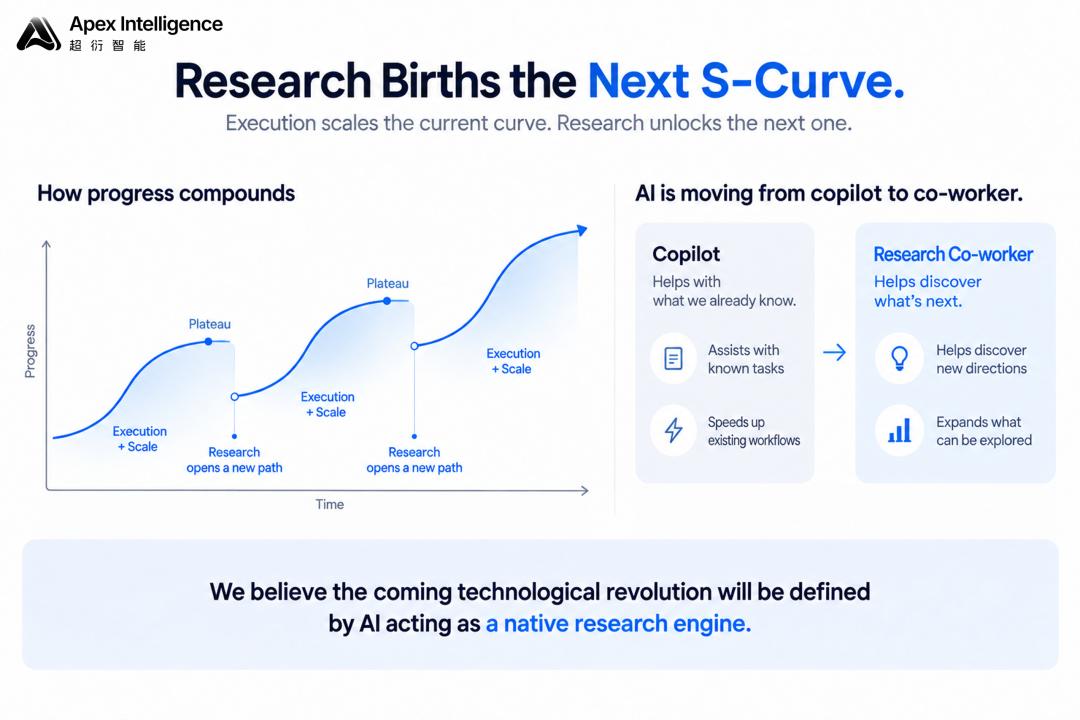
Research is the engine of recursive self-improvement, Source: Enterprise
If you put the evolution of intelligence on a coordinate axis, Chen Yongchao believes that it does not rise smoothly, but follows an S-shaped curve, breaking through a bottleneck, climbing rapidly, then leveling off, and waiting for the next bottleneck. At this stage, we are in the stable stage after the last Scaling Law inflection point, waiting for the emergence of a new inflection point and the next moment of rapid intelligence explosion.
Chen Yongchao is firmly convinced that this inflection point is about to come, "The times will not wait for you. This is the same situation as not making large models two years ago and not making embodied intelligence one year ago. RSI is the best startup timing right now."
Regarding returning to China to start a business, choosing the RSI direction and thinking about the evolution of intelligence, we came to the office of the School of Artificial Intelligence of Tsinghua University with a series of questions and had an exchange with him. The following is the transcript of our conversation with Chen Yongchao, slightly edited:

The stability and innovation of the model are in opposition
Why did RSI suddenly explode this year?
Chen Yongchao: Many people think that it is because the model capability has reached a bottleneck period and new paths need to be explored, but I think this is a secondary reason. The main reason is that the technological turning point has arrived, and the model has been strong enough to do much of the research done by human researchers. This is also the direction we are exploring: to train the next generation of models so that they can reach or even surpass the level of human researchers.
In simple terms, what is the difference between a self-evolving model and the current large model?
Chen Yongchao: The current large model is a stability-oriented model, a model for the public, conservative, and not intended to make mistakes. For example, if you ask it 100 questions, it can answer 95 of them, and for the remaining questions that it cannot answer, we try to reduce its hallucinations, or let it directly answer that it does not know.
But the self-evolving model is an innovation-oriented model, and it does not have high requirements for stability. For example, if you ask it a question that it cannot answer, but we expect it to come up with 100 different methods to solve this problem. It does not matter how absurd 99 of them are wrong, as long as one is correct. That is to say, a large number of methods are allowed to fail in the exploration process, but as long as one of them is proven effective, the system can identify it, retain it, and turn this success into a reusable capability in the future.
Model innovation and stability often cannot be achieved at the same time. If the model is too stable and conservative, its innovation will be weak. Sometimes we even find that the better the model's general evaluation results are, the worse its innovation is.
To realize the self-evolution of the model, what are the key technical bottlenecks?
Chen Yongchao: The first is the model's ability to come up with imaginative ideas; the second is the autonomous execution capability; the third is the verification capability. At present, whether the model can come up with good ideas, screen out good ideas, execute them independently and do a good job in verification is a particularly big bottleneck.
How can these bottlenecks be solved?
Chen Yongchao: The model's training methods and model architecture, especially the upper layer architecture, need to be adjusted, and the data has also changed a lot. For example, use some adversarial training methods to let a model play different roles: it can not only come up with good ideas, but also evaluate by itself to judge how well the ideas perform in rationality and innovation. Through iterative self-improvement methods, ideas are getting better and better, and the level of creativity is getting higher and higher.
Why try to implement the model's self-evolution capability from the scientific research scenario first?
Chen Yongchao: The scientific research scenario has the most urgent demand for intelligent brains. Self-evolution itself is pursuing the upper limit of intelligence, which means benchmarking or even surpassing human researchers. It usually targets those scenarios that are at the upper limit of intelligence and most in need of innovation.
What is the relationship between AI for Science, AI Scientist, Auto-research and Recursive Self-improvement? Is there any overlap between them?
Chen Yongchao: In my opinion, although RSI, Auto-research and AI Scientist are not literal synonyms, they essentially point to the same goal, which is to build a general research intelligence that can independently carry out research and continuously improve its own capabilities in the research process. AI Scientist describes the role this system plays, Auto-research describes the process of it completing research independently, and RSI describes the mechanism by which it continuously improves itself based on research results.
AI for Science is not at the same conceptual level as them. AI for Science describes where AI is applied, that is, using AI to solve scientific problems; it can be a scientific research tool, a vertical domain model, or a complete autonomous research system, but it does not necessarily have the capabilities of autonomous research and self-improvement.
Although Auto-research and AI Scientist appeared earlier, many people working in these two directions have narrowed the concept. Auto-research is not just building an Agent to write papers, and AI Scientist is not just training a small model in a vertical field. The real problem they need to solve is to train a general model to surpass human researchers, so that AI can become the coworker of human researchers.
What is the foreseeable upper limit of RSI? What level can it reach?
Chen Yongchao: It depends on which level of human researchers it can finally become. It is hard to say whether it can finally reach the level of doctoral students in top universities such as Tsinghua University, or the level of Newton and Einstein.
When will the explosive growth of intelligence occur?
Chen Yongchao: I think there will be an inflection point, which may occur when the model is more efficient than humans in some links, or its innovation ability is similar to that of humans. It advances according to bottlenecks and stages. Once a bottleneck is broken through in a certain period of time, it will rise in an S-shaped curve, develop rapidly first, and then gradually level off. At that time, you will start waiting for the next bottleneck to break through.
What stage is intelligence in now?
Chen Yongchao: The first S-shaped curve is Scaling Law, and now it is in the stage where the first S-shaped curve is approaching saturation. At this stage, the capability improvement of model iteration is not so fast, and it has reached the upper end of the S-shape. RSI may be the next S-shape, or it may be a methodology to help discover many S-shaped curves to break through bottlenecks.

Conduct research like human scientists
Overall, what are you doing now?
Chen Yongchao: We have built an AI System for automated scientific research, which is used to do AI for AI, AI for Math, and various disciplines. At the same time, we are also training our own large model and building a benchmark that can evaluate the capability of large models in the research field.
What is the end-to-end process for this self-evolving AI System to independently complete a scientific research project? Are there any specific cases?
Chen Yongchao: This is very similar to human doing research, and it is "full-stack" like a human scientist, who can do experiments by itself: conceive ideas, do experiments, connect GPUs, build environments, train models, and finally improve methods based on experimental results, and summarize the results into reports, code repositories, products or papers.
For example, it can now help mathematicians make major breakthroughs in mathematics and prove theorems; it can also do things in the AI field, optimize the kernel, data distribution and operators in AI training by itself; it can also do data simulation of robotics VLA and improvement of VLA architecture.
How long is the cycle for doing a project research in this system? Compared with human doing research, how much faster can it be?
Chen Yongchao: It depends on the difficulty of the research. For a project with relatively high difficulty, AI may take two or three weeks, but it is already very fast compared with humans. For humans, it may take several months or even a year.
Has this product been launched?
Chen Yongchao: It has been launched recently and is in a small-scale internal test.
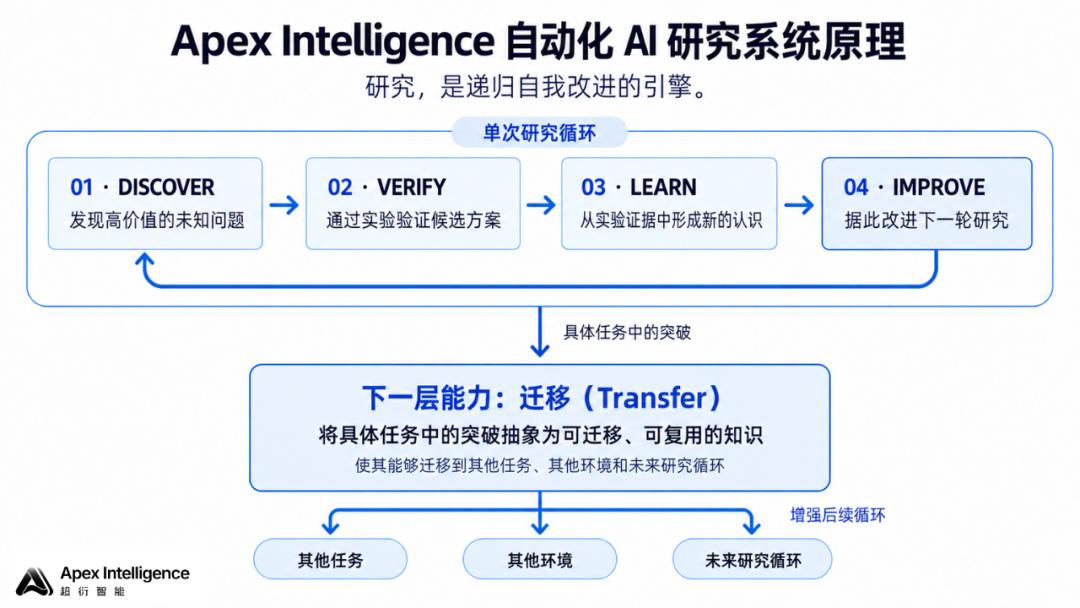
Principle of automated AI research system, Source: Enterprise
Can you elaborate on the model you are training now?
Chen Yongchao: First of all, this model is definitely a model with large parameter scale.
The big difference between it and the previous generation of models is that we focus on innovation and research capabilities. It may be slightly worse than the closed-source SOTA models in some general capabilities such as programming and mathematics, but it will be significantly stronger in complete research capabilities.
Are you training the model from scratch?
Chen Yongchao: We are still doing mid-training and post-training based on open source models. More capital reserves are needed to do pre-training.
What effects can your model achieve now?
Chen Yongchao: From our own perspective, some aspects are quite amazing, such as data self-evolution and Harness self-evolution, but at present, only small optimizations can be done, and it is still difficult to make great breakthroughs in innovation.
We want to train a general model first, which can do research in many fields, such as AI for AI, mathematics, robotics, chip design, and quantum. Among them, a lot of data of the general model will cover various fields, and then fine-tuning based on the general model can also be quickly implemented in vertical scenarios.
Why make a general model first, and then slowly develop various vertical scenarios?
Chen Yongchao: Innovation