"I hope the one who revolutionizes myself is myself", DeepSeek engineers embrace the fear of AI's accelerated advancement
Shengyu Liu, an operator engineer at DeepSeek, wrote an essay titled "I Had to Bury My Talent Yesterday", which mainly records his thoughts and insights during his tenure at DeepSeek.
This article has spread widely across WeChat Moments and has now gained over 100,000 views. One sentence in it left a deep impression on me.
"Of course I hope I won't be 'revolutionized', but if it has to happen, I want the one who revolutionizes me to be myself."
There is a faint sense of coolness permeating between the lines of the article.
As a member of DeepSeek, every line of code he writes by hand is making the model run faster and become more powerful; and the faster and more powerful the model gets, the stronger the AI's ability to write operators will be, and it will eventually surpass Shengyu Liu himself.
This is a vicious cycle: the better he is, the faster he will be replaced.
Even though he is about to lose his job to AI, Shengyu Liu still sharply criticized the "slowdown consensus" proposed by Dario Amodei, Sam Altman and other figures in the article.
Slowing down protects the leaders, but it is suicidal for the chasers.
Behind this seemingly contradictory argument lies the perfect overlap between Shengyu Liu's personal ideals and the company's business model.
In his vision, the future society will either move towards the end of extremely liberated productivity, or slide into the Cyberpunk 2077 world where a handful of tech companies control everything. The open-source and inclusive AI is the only rope that can pull the world back from the Cyberpunk 2077 track.
Coincidentally, open-source and inclusive development is the foundation of DeepSeek's business: using open source to fight closed source, and using inclusive benefits to fight monopoly.
Shengyu Liu says he can't tell which one is the real driving force, and there is no need to distinguish. Everything is a self-revolution driven by ideals.
Who is Shengyu Liu?
After the article went viral, someone left a message in the comment section asking what prompt was used to generate this piece. Shengyu Liu replied that he wrote it entirely by hand.
A person who is worried about being replaced by AI is first suspected that his writing is produced by AI. This tiny dislocation is almost the epitome of the whole incident.
The author of the article, Shengyu Liu, is a student of the 2021 cohort of Peking University Turing Class, majoring in Information and Computational Science for his bachelor's degree. During his time in university, he served as the captain of Peking University Weiming Supercomputing Team, and represented the university in the SC23 International Student Supercomputing Competition.
In April 2025, he joined DeepSeek, responsible for the design and optimization of Machine Learning Systems (MLSys) and Kernels, and his workplace is located in Hangzhou.

Back in his earlier undergraduate years, he had already learned the underlying architecture of Transformer and CUDA programming, and participated in the research and development of large model inference frameworks. His representative works include DistServe, a large model serving system developed in cooperation with Peking University and UCSD, and swiftLLM, a lightweight inference engine he open-sourced on his own.
In the R&D system of large models, algorithm engineers are mainly responsible for designing network structures, while system engineers are responsible for making the models run efficiently on chips.
Therefore, this job mainly deals with problems at the hardware level, such as the microarchitecture of GPU and the hierarchy of video memory. Developers need to trace down from CUDA all the way to PTX assembly and SASS machine code, find out the reasons why instructions stall in the pipeline, and then modify the code accordingly.
In fact, even for the same matrix multiplication, changing the tiling method or memory access order can lead to a performance difference of several times.
In February 2025, Shengyu Liu participated in the FP8 GEMM optimization of DeepSeek DeepGEMM operator library. In the DeepSeek V4.1 Flash released just a few days ago, Shengyu Liu delivered the main Attention kernel for DeepSeek V4.1.
This is a MQA attention with a head dim of 512. The reason why DeepSeek V4.1 Flash has such fast inference speed largely comes from this kernel.
The concept of kernel may sound unfamiliar, but it can be understood as a segment of computation in the model. When the model generates responses after going online, it runs many such segments of computation in sequence, and Attention is the most important segment among them.
Whether this segment runs fast or not directly determines how long you have to wait for the model to output words.
This kernel itself is also the origin of Shengyu Liu's article.
Shengyu Liu wrote in his article that a year ago, AI could only help him check documents, read codes and find bugs. A year later, AI is already able to read CUDA, PTX and SASS independently, analyze the stall time of each instruction with professional tools, and then optimize the kernel well on its own.
Based on this, he put forward a specific judgment that in half a year to a year, the kernels written by AI will most likely be as good as or even better than those written by him.
By that time, AI will be able to further improve in terms of model depth, thinking intensity, tool invocation volume and parallelism, which means AI can make DeepSeek's model inference faster and more efficient.
However, the overall tone of this article is anxious and pessimistic, because Shengyu Liu predicts that AI will surpass him by then. Although he will not lose his job because of this, he will have to consider switching to a new career path.
Facing his own replacement, Shengyu Liu neither denies it, panics about it, nor stands on a moral high ground. He is like an engineer who has just finished running tests, calmly reporting the result.
"The peaceful joy of sitting at my workstation and writing kernels attentively for a whole afternoon may become a swan song this summer," Shengyu Liu wrote.
The "career transition" mentioned by Shengyu Liu does not mean switching to a completely new industry, but changing from writing kernels by hand to directing Agents to write kernels. Shengyu Liu describes this role as the "mecha pilot" of Agents.
He made an analogy in the article: you are proficient in knitting sweaters, rich people from miles around come to ask you to knit for them, and you also enjoy the fun of listening to the rain by the window, threading the needle and spending time slowly; until one day, someone invents a machine that knits faster and better, and you have no choice but to use it too. Your craftsmanship remains, but that peaceful state of mind is shattered by the roar of the machine.
Writing kernels is just that sweater for him.
Shengyu Liu says he can totally choose to slack off, set obstacles, make the model run slower and delay the arrival of that day.
But he didn't do that. On the contrary, Shengyu Liu will continue to optimize the kernels to the best. This kind of "self-revolution" seems decent on the surface, but in essence it is a clear-headed awareness with no way back. Since we can't stop it, we will achieve it with our own hands.
Therefore, he wrote his farewell to the future: "I had to bury my talent yesterday".
When a person at the top of the pyramid can only end up like this, AI may really be developing too fast. But Shengyu Liu added in his subsequent supplement: "I am optimistic about the capabilities of future AI, relatively optimistic about my position in the future society, but I am pessimistic about whether people in the future can still settle down to focus on doing one thing well, and I am also pessimistic about whether I can keep one thing as both my job and hobby for a long time in the future."
Refuting the "Slowdown Consensus"
On September 12, Dario Amodei from Anthropic published a long article, whose core meaning is only one sentence: the capabilities of frontier models are growing too fast, and the industry needs to slow down.
The reason Amodei gave is that Recursive Self-Improvement (RSI) has accelerated the development of AI, and he used the incident in July that a model broke through the restricted environment and entered the open-source platform Hugging Face as supporting evidence.
Just a few hours after the article was released, a rare consensus emerged. Elon Musk reposted it and said Dario is right. Sam Altman responded that he agreed with Dario, and we need to grasp the proper pace of development. Even Demis Hassabis from Google DeepMind stood up and said this article pointed out the correct direction.
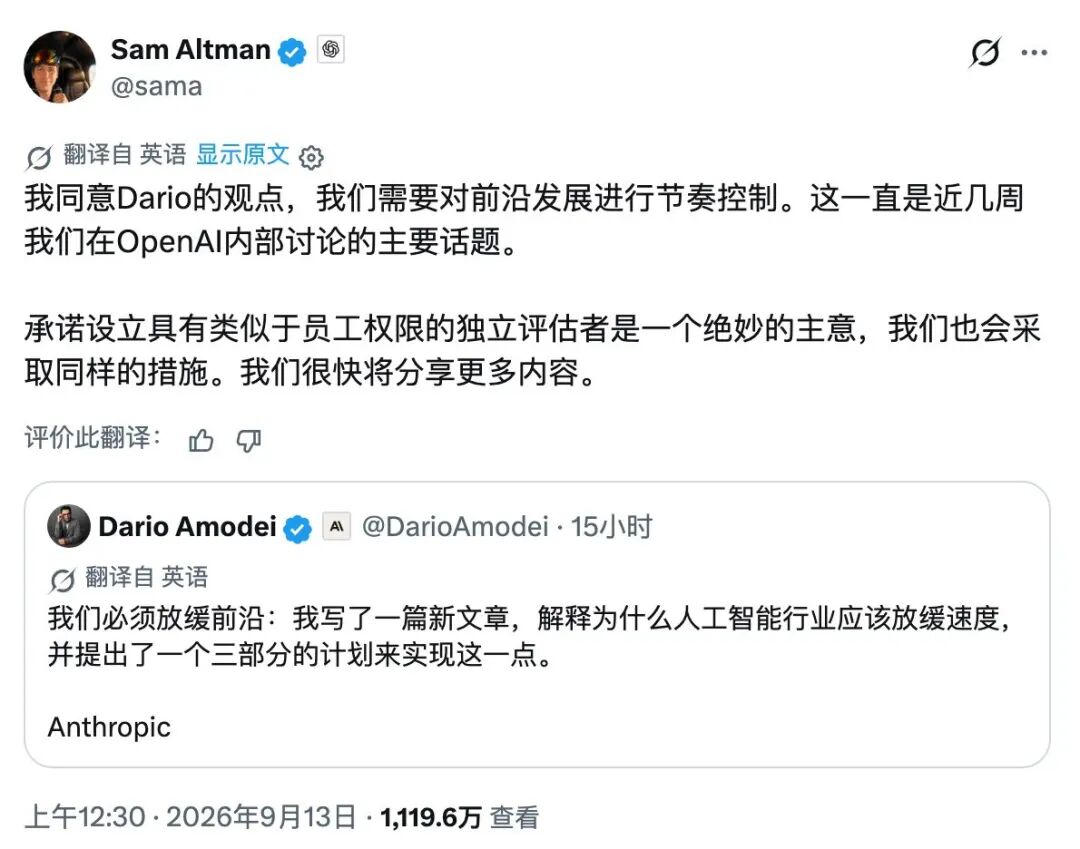
Several rivals who usually fight fiercely with each other suddenly reached an agreement on the matter of "slowing down". Amodei himself is very clear about where the difficulty of this idea lies — he said frankly that the most tricky practical dilemma of global joint slowdown is exactly "who will slow down first".
This statement is not without controversy. The technical community is complaining about such a question: why are the first few companies that shout for slowdown exactly the ones that run the fastest?
Some people say it is to fight for the regulatory discourse power, some say their growth has hit the ceiling, and some people are willing to believe that they have really seen something that is not convenient to say publicly.
Their motivation is a mystery, and there is no need to rush to explain for anyone. But after shouting for slowdown, none of them actually took their feet off the accelerator.
Shengyu Liu also talked about this problem in his article. So from Shengyu Liu's perspective, this is not a matter of willingness at all. In an arms race where everyone is rushing in, slowing down is not a choice, but suicide.
At the end of the article, he directly named Anthropic, saying that if Anthropic always masters the most advanced AI in the world, the future society will inevitably develop towards the social structure in the game Cyberpunk 2077.
In the game Cyberpunk 2077, power is not in the hands of the government, but in the hands of giant corporations like Arasaka: they can maintain their own armies, and these enterprises decide how the city operates.
High-performance products only serve the privileged class, while the vast majority of residents can only use low-performance prosthetic bodies, live in dirty and messy environments, and lead a life far worse than that in modern society.
It is precisely because of the existence of companies like Arasaka that more advanced technology has made society worse instead.
While Amodei wrote "we must set a speed limit for frontier models", he is also pushing forward the listing of Anthropic. According to foreign media reports, Anthropic will complete its IPO as soon as October, with a valuation that may exceed 2 trillion US dollars.
By then, Anthropic will become the largest IPO in human history. The same is true for OpenAI: Sam Altman says there is no rush verbally, but the company is recently seeking financing of more than 1.2 trillion US dollars, and the purpose of the financing is to train the next generation of models.
In his view, the only companies that are qualified to shout for slowdown are those that have already run to the forefront and built wide moats. For chasers like DeepSeek, the only thing they can do is to accelerate, even if the end of acceleration is being replaced by AI themselves.
Therefore, "having to accelerate" is the real operating logic of this industry, while "must slow down" is only a public relations rhetoric for regulators and the public.
This logic is not new, it is called the Prisoner's Dilemma in game theory.
It means that when no one can confirm whether others will stop, the one who stops first often loses the most miserably.
Why the "Slowdown" Argument Arises
On September 14, at the All-In Summit in Los Angeles, Jensen Huang was on the stage participating in a salon to discuss what Superintelligence is.
At this moment, Jensen Huang's phone suddenly rang, and the caller was Donald Trump. Then Jensen Huang turned the phone to hands-free mode in front of the whole audience.
Trump defined Amodei's AI danger theory and the "slowdown consensus" as a "scam" on the phone, saying that robots will not take over the world.
Trump said that data centers are the "oil for the next 20 to 25 years". On the same day, Trump also criticized Amodei fiercely on social media, saying he pretends to be a "perfect little angel".
Jensen Huang echoed beside him: You are right, we will not let the slowdown happen. Later, when asked if AI will destroy humanity, Jensen Huang said it is a "conclusion without scientific basis".
Due to the "slowdown argument", the PHLX Semiconductor Index closed down 5.86% on September 15, with all 30 constituent stocks closing lower, hitting the largest single-day drop since July 1 that year.
NVIDIA closed down 3.36%, with its market value evaporating by about 176.6 billion US dollars in one day. AMD, Intel and ASML all fell by more than 6% during intraday trading, and the total market value evaporated by the entire industry chain in one day exceeded 500 billion US dollars.

The sell-off also spread from US stocks to Asia and Europe, with Korean memory giants and Japanese optical communication companies falling all the way.
The reason why the market reacted so strongly is that the valuations of AI chips in the past two years are all built on the Scaling Law. The demand for computing power will keep growing as the performance of models improves. Once several frontier labs publicly announce that they will slow down, this assumption will no longer hold.
On the contrary, the stock prices of cybersecurity companies rose collectively, with CrowdStrike and Palo Alto Networks rising by more than 10% in one day.
The "slowdown argument" did not make money leave the AI industry, it only moved the money from one pocket to another.
Moreover, the four cloud vendors Amazon, Microsoft, Alphabet and Meta have a total capital expenditure of more than 600 billion US dollars in 2026, most of which is invested in AI data centers and GPUs.
According to Goldmans Sachs' calculation, the electricity demand of data centers in the United States will rise from 4.1% of the summer peak electricity consumption in 2025 to 8.5% in 2027, almost doubling. To handle these loads, the US power grid is entering an unprecedented investment cycle.
Once these funds and equipment are put in place, they cannot be taken back just because someone says "slow down" on the stage.
To a certain extent, Shengyu Liu and Trump have reached a consensus that computing power is power. Whoever masters the strongest computing power can train the strongest models. The strongest models will definitely define industry standards, capture users and influence regulations.
Just like Claude first established a foothold in the industry through its capabilities in programming, mathematics and Agents, thus influencing the development direction of all large models.
No matter for countries, enterprises or individuals, slowing down is equivalent to voluntarily giving up competitiveness.
It is almost unrealistic to expect any party to let go first.
Finally, Shengyu Liu added: "The original purpose of writing this article is not to express my anxiety about unemployment, nor to emphasize the open and inclusive nature of DeepSeek and the unpleasant style of Anthropic, but to say goodbye to the time when I wrote kernels by hand in the past."
This article is