Chuangcai Shenzao completes Series A+ financing: it drives self-evolving RSI with real data, and nearly 20 high-performance metal materials have been put into mass production and actual application.
Hard Krypton has learned that Deep Material, a leading enterprise in the AI for Science industry for metal materials, has completed a Series A+ financing of nearly 100 million RMB. This round of financing is jointly led by existing shareholder Source Code Capital and new shareholder Jinyu Maowu, with Yichen Capital and other institutions participating in follow-on investment. The company has taken the lead in completing the full closed loop of AI-driven material R&D, and launched nearly 20 new high-performance materials, many of which have been put into mass production.
The funds from this round will be mainly used for the continuous R&D of the core intelligent system M-Loop, the replication and capacity expansion of the automated high-throughput experimental platform M-Lab, the continuous accumulation of high-quality material dataset M-Data, the construction of the distributed self-driven laboratory network OPL (One Person Lab), and the introduction of top interdisciplinary talents, to replicate AI R&D capabilities to more material fields and further expand the leading edge in the industry.
AI4S Enters the Deep Development Stage, Industrial Implementation Becomes the New Focus of Competition
In the past few years, AI for Science has kept heating up, but the industry focus is shifting from "model capability" to "industrial implementation". The early market paid more attention to computing power level and single-point experimental efficiency, while the core of current discussions has turned into: whether the technology can be applied in real industrial scenarios, whether it can shorten the R&D cycle and reduce trial-and-error costs, and whether the laboratory results can be stably promoted to the process, manufacturing and delivery links.
Behind this is the rapid upgrading of global AI4S competition levels — from model competition to data competition, then to experiment competition, and now it has entered the "infrastructure competition" stage. Models are becoming more and more accessible, while real scientific data, especially high-dimensional data containing experimental conditions, process parameters, failure results and process feedback, is becoming a scarce resource. The winner in the future will be the infrastructure organizer that can connect data, models, experimental systems, computing power and industrial demands.
Policies are also accelerating the catalysis of the industry. The *Opinions on Further Implementing the "Artificial Intelligence +" Action* (Guofa [2025] No.11) issued by the State Council clearly proposes that the AI4S application penetration rate will reach 70% by 2027 and exceed 90% by 2030. Beijing and Shanghai have successively released special implementation plans for AI4S, and the construction of autonomous laboratories and scientific datasets has been elevated to local strategies. In the United States, the Department of Energy's "Genesis Mission" has invested 5 billion US dollars to connect 17 national laboratories, and the NSF-led NAIRR Pilot has incorporated computing power, datasets and models into national-level scientific research resources. In addition, overseas giants have also accelerated their layout: Anthropic launched Claude Science for scientific research scenarios, and OpenAI has continued to increase resource investment in scientific research. This reflects the global re-judgment of the next-generation scientific research and advanced manufacturing capability base. As China and the United States increase investment in this field simultaneously, the competition focus has shifted from technical verification to the construction of systematic infrastructure.
Metal materials are the core basic materials that have supported human civilization for thousands of years, with an industrial scale exceeding one trillion US dollars, which directly determines the capability ceiling of strategic industries such as aerospace, new energy, semiconductors and high-end equipment. Compared with the long verification cycle of biomedicine, metal materials have natural advantages such as fast verification, clear indicators and complete industrial chain, making them the best landing direction for AI-empowered R&D.
How Far Are We From the Embodied AI Material Scientist With Self-Evolution Capability
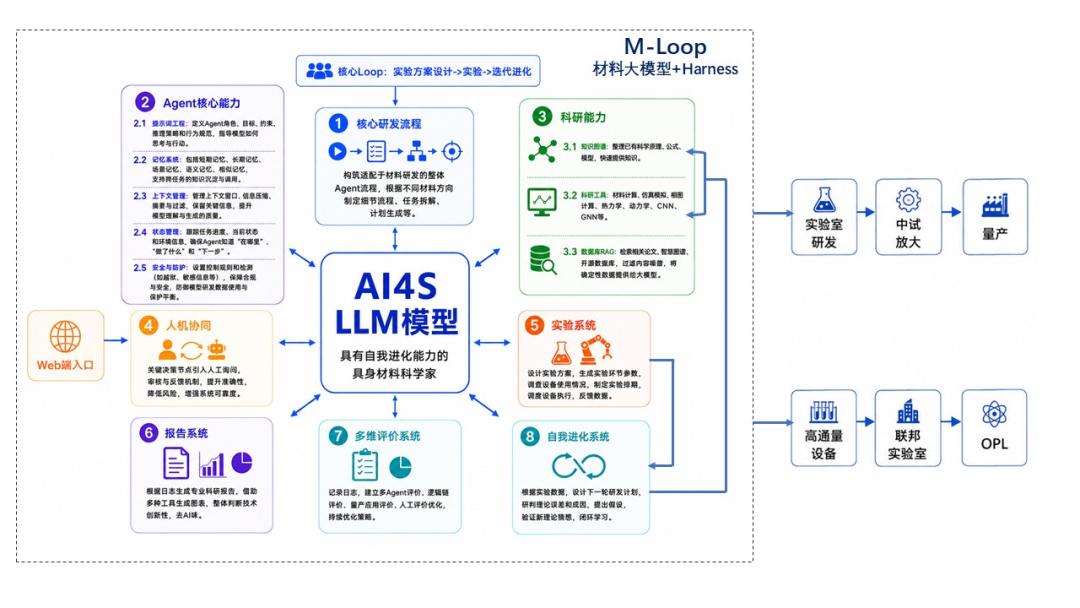
Put forward the performance requirements of a new material, and you can automatically get several formulas verified by real experiments in a few days, as well as new theories and methods. This "wish-style" R&D is the ideal ultimate form of AI-driven material R&D. To achieve this ultimate goal, it is necessary to build a set of AI material R&D intelligent system with self-evolution capability (RSI) that can conduct experiments in the physical world. This system consists of four underlying supporting elements: large models and Agents, tool-based algorithms and dedicated small models, automated high-throughput laboratory closed loop, and large-scale high-quality multi-modal data adapted to AI training.
Deep Material has established significant technical leadership and industry barriers in all the four dimensions mentioned above:
M-Cortex Large Model and Agent: With the continuous improvement of general large model capabilities, Deep Material uses exclusive self-developed full-process multi-modal experimental data to train a dedicated vertical large model for materials, which significantly improves the causal reasoning, scientific research thinking and extrapolation generalization capabilities, and builds an agent truly suitable for material R&D. M-Cortex is the core of R&D process orchestration and intelligent scheduling. Based on literature review, the company's historical data and R&D know-how, the system automatically generates scientific hypotheses, candidate formulas and R&D scripts, cooperates with M-Science to complete scientific computing and candidate screening, schedules M-Lab to carry out real experiments, and continuously rewrites R&D strategies and memory according to experiments and delivery feedback.
M-Science Tool-based Algorithms and Dedicated Small Models: Material professional algorithms can be divided into two categories: small-scale algorithms and large-scale algorithms. Small-scale algorithms represented by DFT perform well in fields such as medicine that focus on molecular interactions, with long development history, high technical maturity and high open source degree. However, when facing the mesoscopic and macroscopic interactions such as functional groups and metallographic phases, small-scale algorithms will fail due to the upper limit of atomic scale and chaos effect. At this time, large-scale algorithms become the necessary capability for macroscopic material R&D, and the implementation of large-scale algorithms is highly dependent on real experimental data. With the industry-leading dataset in scale and quality, Deep Material has achieved significant technical leadership at the large-scale algorithm level.
M-Lab Laboratory Closed Loop: The self-evolution of material agents is not only reflected in performance iteration, but also in the continuous breakthrough and accumulation of their knowledge graph, tool algorithms and logical thinking. Therefore, it is crucial to build an automated high-throughput dry-wet closed-loop laboratory. Deep Material made forward-looking layout as early as 2021, independently developed high-throughput equipment and built the automated laboratory M-Lab. At present, M-Lab has been iterated to version 3.0, which has fully realized automation, high-throughput and standardization. The production efficiency of experimental data has increased by hundreds of times, the cost has been reduced by dozens of times, and the closed-source real-world data generated by M-Lab has more than 400 dimensions, with the storage size of a single original data exceeding 10GB. With huge leading advantages, the overall solution of M-Lab has been widely recognized and purchased by top universities and research institutes at home and abroad. In the future, the company will promote the formulation of industry standards, and build a federal laboratory and OPL (one-person lab) in the field of metal materials through integration and upgrading to lead the development of the industry.
M-Data AI-adapted Material Data: Professional industry data is the largest source of effect gap for agents. Traditional material data is usually knowledge-based data, with low feature dimension, poor consistency, scarce quantity and high price, which is difficult to be used for AI training fitting or in-depth understanding. Relying on M-Lab, Deep Material has built the most AI-adapted material dataset M-Data in the industry. At present, the data volume exceeds 100,000 entries, with unified format, rich dimensions, covering the whole experimental process and failure results. In the next two years, the overall scale of the high-throughput laboratory will be expanded by 5 times, which will continue to amplify the technical leading advantage at the data level.
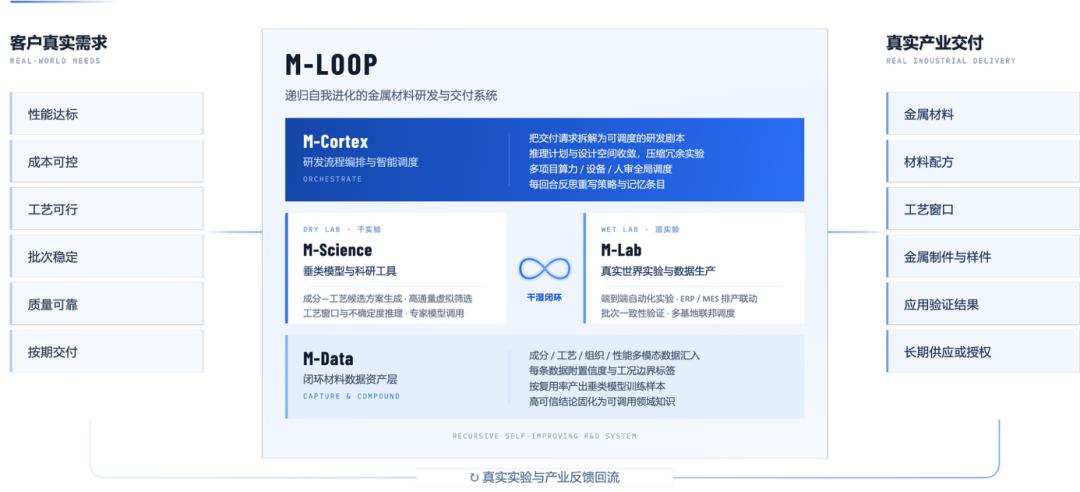
Deep Material treats AI4S with an end-to-end perspective, actively lays out full-chain technologies, has reached the industry-leading level in all key links, and maintains high barriers.
Implementation Process Is the Biggest Core Differentiator in the AI4S Industry Competition
AI4S is in the early stage of exploiting a huge gold mine. The real opportunity is not just "selling shovels", but going to the gold mining site in person with the best shovels. In the whole chain of demand definition, laboratory R&D, pilot scale-up and mass production delivery, the value brought by AI will be amplified step by step. Deep Material has taken the lead in getting through the whole link from "demand input" to "real delivery" — transforming customers' material demands into calculable, verifiable, optimizable and deliverable materials and parts results, forming a positive flywheel of "real experiments generate data → data drives system evolution → system evolution improves delivery certainty → delivery results feed back the next round of R&D".
At present, the company has shortened the material R&D, testing and verification cycle from 5~10 years to 2~3 months, reduced the cost to 1/10, and has launched dozens of new materials with full independent intellectual property rights. All these materials have been tested by CNAS accredited testing institutions and downstream customers, with performance far exceeding the world's leading level. The company is cooperating with leading enterprises in various industries to promote implementation, including:
① Cooperate with the world's leading 3C manufacturer to promote the implementation of anodizable aluminum alloy appearance parts, ultra-high strength and toughness stainless steel connecting parts, and ultra-high strength titanium alloy appearance parts;
② Cooperate with China's leading controlled nuclear fusion company to carry out R&D and testing of materials such as refractory high-entropy alloy first wall, low activation steel cladding and lithium-based tritium breeder;
③ Cooperate with the world's leading golf brand to promote the implementation of ultra-high strength and toughness stainless steel striking face, integrated titanium alloy shell, high-strength aluminum connecting button and high-entropy alloy counterweight block;
④ Cooperate with leading commercial aerospace companies to promote the implementation of superalloy engine nozzles and high-strength aluminum support structural parts;
⑤ Cooperate with the world's leading tire mold company to promote the implementation of high-strength heat-resistant aluminum alloy inserts and high-strength mold steel materials.
⑥ Cooperate with China's largest titanium mining company to develop technology for producing high-performance titanium alloy materials from low-grade raw ore with multiple impurities;
⑦ Cooperate with leading quantum computing companies to explore the new generation of core AI4S algorithms.
The delivery forms cover material formulas, process windows, metal parts and samples, application verification results and long-term supply or authorization, which have verified the universality and reliability of the M-Loop system in real industrial scenarios from multiple dimensions. At the same time, the company has developed a number of materials such as high-strength titanium alloys and aluminum alloys, and has realized their implementation in additive manufacturing and other fields.
Outlook: Free Human Beings From the Limitation of Materials
Materials are the underlying code for human beings to transform the world. For thousands of years, this creation has always relied on trial and error and accident — from imagination to reality, a new material often needs to go through a long period of exploration. AI is changing all this: it liberates the discovery of materials from uncertainty, and turns it into a clear path that can be followed. People can touch it, test it, and install it in products. This is not an upgrade of tools, but a transfer of creation rights.
In the past, material innovation belonged to a few institutions with huge resources. When there is no longer a gap between "feasible in laboratory" and "manufacturable in factory", when R&D, process and supply chain are integrated into the same decision-making framework, material innovation will evolve from an experience-dependent metaphysics to an engineering that can be systematically organized. The right of creation is being transferred from a small number of scientists and large institutions to every creator driven by real problems. The performance boundary of materials will no longer be defined by historical experience, but directly defined by current demands. One day, material capabilities will be as plug-and-play as electricity — every creator trapped by material problems can cross the gap from imagination to reality, and get the once unreachable answer.
The following is an excerpt of the interview with Wang Xuanze, founder of Deep Material:
Hard Krypton: In the process of developing AI-driven material R&D, why do you have to build your own high-throughput automated laboratory? What problems have been solved by data?
Wang Xuanze: Data can be said to be the biggest bottleneck in the field of AI for Science at present, and it is also one of the most urgent problems to be solved, as well as one of our core advantages.
What we are working on is macroscopic materials, such as metals, ceramics, inorganic non-metals, polymers and composite materials. For the R&D of such materials, real physical experimental data is absolutely necessary. Relying solely on simulation is not enough, which will cause large errors.
In addition, there are several problems with traditional experimental data. First, the data dimension is relatively low, usually only a dozen values, such as the corresponding performance of composition and process, and most of the recorded data are successful data. The failed data is too large in quantity to be analyzed and understood.
Second, data is difficult to obtain, because it is core intellectual property, and enterprises usually do not provide it. Even if the data is obtained, the equipment of different companies is different, and the data consistency is very poor. Once the equipment is changed, the deviation of the data may be very large, which may pollute the entire data pool when used for AI training. Third, the cost is too high and the production efficiency is too low. A single piece of data may cost tens of thousands of yuan, which is completely unacceptable for AI.
So we started to build our own laboratory and generate data from 2021. Now it has been iterated to version 3.0, and we are working on version 4.0. Now a single piece of our data can reach 720 dimensions, with a storage space of 10GB, and more than 1GB after compression. The cost of a single piece of data has been reduced to several hundred yuan, and the data generation rate of a single experimental line can reach more than 1000 pieces per second. One of the most important things in this round of financing is to deploy 5 to 10 experimental lines to further expand our leading advantage in data.
Hard Krypton: Compared with other AI for Science companies, what are your core advantages?
Wang Xuanze: First of all, our team is a very comprehensive team. From the first day of its establishment, we have set up a dedicated AI team and a material team. Now we have developed nearly 20 new materials, all of which are materials with independent intellectual property rights. For example, for our ultra-high strength aluminum, the fatigue performance, which is one of the core properties, is more than twice the world's leading level, and other properties also have a certain degree of leading advantage. At the same time, our cost is about 1/10 of that of foreign counterparts and about 1/3 of that of domestic counterparts.
In addition, we are more focused on implementation. The most important thing is that we have actually produced the materials, and are mass-producing the new materials we have developed. Terminal customers are using our raw materials to make parts, such as 3C parts, golf parts, commercial aerospace and robot parts, which are in the testing stage. After passing the test, many products you use in the future, such as mobile phones, may use our materials.
Hard Krypton: What do you think of the current stage of the entire AI for Science industry? What will Deep Material do next?
Wang Xuanze: As far as the entire AI for Science industry is concerned, I think it is on the eve of a blowout development. The next milestone is not far away. The next consensus in the industry is that materials developed by AI will be truly applied around people, such as mobile phones, computers, automobiles and various daily products, to achieve real mass production.
At least from our progress, this time point is very close. We have taken the lead in completing the entire R&D closed loop, and can complete the whole process from scratch to delivery. The next step is to find more real demands and larger application scenarios, and then replicate our capabilities rapidly.
At the same time, from the technical level, we are also building an all-in-one service platform called M Loop (Material Loop). This platform aims to realize the all-in-one vision: from data production, algorithms, to material R&D, testing and characterization, to scale-up, and even part of the mass production, all completed on one platform. The 1.0 version of M Loop is planned to be released by the end of this year.