The watershed for mass production of humanoid robots: two leading giants have crossed the 10,000-unit milestone, while the 10-billion-yuan unicorn is still catching up.
In August 2026, a historic scene unfolded in China's capital market: Unitree Technology's stock price surged by 460% on its first day of listing on the Sci-Tech Innovation Board, with its market value exceeding 340 billion yuan — a figure that surpassed the $39 billion valuation of US-based Figure AI. A Chinese company established only eight years ago has demonstrated to the world the increasingly strong market competitiveness of China's humanoid robot industry with the most plain and solid indicator: shipment volume.
Unitree is just the tip of the iceberg. According to the August 2026 report from Counterpoint Research, global shipments of humanoid robots in the first half of 2026 exceeded 22,000 units, representing a year-on-year increase of nearly 300%. The top five vendors are all Chinese companies, jointly accounting for 86% of the global market share. Agibot ranked first globally with shipments of about 9,700 units, followed by Unitree with over 7,000 units, while Galaxy Universal, Ubtech, and Leju took the third to fifth places respectively.
From "demo stunts" to "mass production of 10,000 units", from "concept hype" to "real tangible revenue", 2026 has become a watershed for China's humanoid robot industry. 13 leading players — including giants with a market value of 100 billion yuan, a group of unicorns valued at over 10 billion yuan, and adherents in vertical tracks — jointly form the competitive landscape of China's humanoid robot industry.
"Volume" and "Price" of the Two Giants
The competition of humanoid robots is essentially the competition of "mass production capacity". In this dimension, Unitree Technology and Agibot have already pulled away from all their competitors.
Unitree Technology is the company that most resembles the "business card of Chinese manufacturing" in this wave. It was listed on the Sci-Tech Innovation Board on August 19 this year, with a market value of 341.8 billion yuan on the first day, setting the highest record in the A-share humanoid robot sector. What supports this market value is the solid shipment volume — its humanoid robot shipments exceeded 5,500 units in 2025, ranking first in the world; its revenue in the first half of 2026 reached 1.152 billion yuan, with a net profit of 274 million yuan, turning losses into profits. The self-development rate of core components exceeds 90%, the cumulative sales of quadruped robots exceed 33,000 units, ranking first globally, and as of July 2026, the cumulative offline output of bipedal humanoid robots is about 18,000 units. Unitree's development strategy verifies an industry law: the first humanoid robot that achieves commercial success is not the "smartest" one, but the one that is "most durable, affordable and easy to repair".
Agibot is the "fastest runner" among the two giants. In the first half of 2026, it topped the global ranking with shipments of about 9,700 units, taking a market share of over 43%. Its revenue trajectory soared from 300,000 yuan in 2023 to 1.05 billion yuan in 2025, and exceeded 1 billion yuan in the single quarter of Q1 2026. Positioned in industrial scenarios, Agibot has in-depth cooperation with Longcheer Technology and Joyson Electronics, and has realized cluster deployment in consumer electronics and automotive component production lines. It has already launched the process of listing in Hong Kong, with a target valuation of 40-50 billion Hong Kong dollars. If Unitree represents the ultimate cost-effectiveness of the "hardware school", Agibot represents the imagination of the data flywheel of the "embodied intelligence school".
The common points of the two giants are: both have crossed the shipment threshold of "10,000 units", both have realized large-scale delivery, and both take the Chinese supply chain as the foundation. The difference between them is that Unitree extends upward from motion control, while Agibot penetrates downward from AI; one is a robot company that does AI, the other is an AI company that makes robots.
10-Billion-Yuan Unicorn Group: Eight Paths, Each Showing Its Strength
Under the two giants, China has formed at least eight humanoid robot unicorns with a valuation exceeding 10 billion yuan. Their shipment volume may not yet catch up with Unitree and Agibot, but they have their own characteristics in technical routes, scenario selection and capital layout.
Galaxy Universal: The "Financing Champion" Supported by National Teams
Galaxy Universal has been established for only three years, with cumulative financing of 7 billion yuan and a valuation exceeding 20 billion yuan. In the financing round in March 2026, the National Artificial Intelligence Industry Investment Fund (Phase III Major Fund) made its first investment in the embodied intelligence track, sending a clear signal of industrial policy. In terms of shipment, the cumulative shipment in the first half of 2026 exceeded 1,100 units, ranking third. Galbot G1 has realized 7×24-hour operation on CATL's production lines, and has entered manufacturing enterprises such as SAIC Motor, BAIC, Bosch and Hyundai. Galaxy Universal's path is the classic industrial development approach of "financing — verification — re-financing — capacity expansion".
Zhi Pingfang: The Technical School Adhering to "Brain First"
Zhi Pingfang completed nearly 5 billion yuan in financing in June 2026, with a valuation exceeding 20 billion yuan, becoming the first embodied intelligence enterprise in the Guangdong-Hong Kong-Macao Greater Bay Area with a valuation breaking 20 billion yuan. Its core asset is the self-developed brain-inspired VLA model NeuroVLA — which has been open-sourced to the public, and can reduce robot motion jitter by more than 75%. In terms of commercialization, it has signed a 3-year order of 1,000 units with HKC, a giant in semiconductor display sector, with a total amount of nearly 500 million yuan, which was recognized by Morgan Stanley as "the largest single order for productivity robots worldwide". The differentiation of Zhi Pingfang lies in: selling "brains" before selling "bodies", and technical barriers are more difficult to cross than production capacity barriers.
Zibianliang Robot: Rare "Joint Investment" by Four Major Internet Giants
Zibianliang Robot has completed multiple rounds of financing continuously this year, with its valuation rapidly exceeding 20 billion yuan from 10 billion yuan. Its investors cover Meituan, Alibaba, ByteDance and Xiaomi — the four major Chinese internet giants have jointly invested in the same company, which is extremely rare in the history of venture capital. In addition, more than 30 institutions including HSG, IDG Capital and China Mobile have participated in the investment. In terms of products, it has self-developed the WALL-B architecture of "World Unified Model", with the efficiency of fully autonomous logistics sorting reaching 1,816 pieces per hour and an accuracy rate of over 98%, 45% higher than that of US peers. According to reports in August, the company has secretly submitted an application for listing on the Hong Kong Stock Exchange.
Qianxun Intelligence: Raised Over 4.5 Billion Yuan in Financing Within Three Months
Qianxun Intelligence has completed three consecutive rounds of financing in three months this year, with a total amount of over 4.5 billion yuan. Its shareholder lineup is also very strong — Shunwei Capital (Lei Jun) and Yunfeng Fund (Jack Ma) have rarely invested in the same project, with industrial parties including CATL, JD.com and TCL Venture Capital deeply participating. What really makes Qianxun Intelligence stand out is the hard power at the technical level: its self-developed embodied base model Spirit v1.6 ranked first globally in the comprehensive score of the RoboArena benchmark test, the "Olympics" of embodied intelligence in North America, becoming the first Chinese embodied model to top this platform. In terms of products, it has formed two product lines: Moz1 industrial humanoid robot and Moz2 commercial service robot, and the world's first humanoid embodied intelligence production line has been put into operation at CATL Zhongzhou Base.
Starwise Era: Representative of "Tsinghua System" with Full-Stack Self-Development
Starwise Era completed a 1 billion yuan strategic round of financing in March 2026, and received over 200 million US dollars in April, with cumulative financing of nearly 2.5 billion yuan. Its investors include industrial giants such as Samsung, Alibaba, Geely and SF Express. The moat of Starwise Era lies in "full-stack self-development" — it has independent R&D capabilities across the whole chain from "brain" to motion control, ontology, joint modules and dexterous hands, which is one of the few enterprises in the industry with such capabilities. In terms of commercialization, its cumulative orders have exceeded 500 million yuan, 50% of which come from overseas; 9 of the top 10 technology companies by market value in the world are its customers, and its embodied intelligence inspection solution for SF Express's cross-border logistics has been put into use in customs. In Q2 2026, it started batch delivery at the scale of 1,000 units.
Exceed Dynamics: A Player with Over 50% of Orders from Overseas
Exceed Dynamics completed nearly 200 million US dollars in Pre-IPO financing in July 2026, with a valuation of 15 billion yuan; it secretly submitted its Hong Kong Stock Exchange IPO application in August. Its differentiation lies in "flowers bloom more outside the wall than inside" — among thousands of units of orders for all product lines, more than half come from overseas. Nearly 70% of the funds in this round of financing come from institutions in Europe, the Middle East and North America, and it is regarded as "the international benchmark of Chinese embodied intelligence" in the international capital market. In 2025, the shipment of complete machines was 241 units, with a small base but a promising growth rate.
Percy Perception Technology: Underlying Player Starting from "Tactile Perception"
Percy is the most special existence in this list — it does not start with the whole machine, but develops upward from the underlying technical link of tactile perception. Its founder Xu Jincheng studied under Professor Sugano Shuki, the disciple of Professor Kato Ichiro, the inventor of the world's first humanoid robot WABOT-1, with a pure technical pedigree. In August 2026, it completed a 1 billion yuan strategic round of financing, with cumulative financing of 3.5 billion yuan, the largest financing amount in the global tactile perception field. This round was jointly led by global consumer electronics and semiconductor trillion-level giant, BOC International Investment, Kunpeng Fund and other institutions, with a valuation exceeding 10 billion yuan. Its self-developed tactile chips have shipped nearly 1 million units in the past year. BYD and JD.com have successively become shareholders from customers. Percy's long-term vision is to become "the physical interaction data infrastructure in the Physical AI era".
Proprio Robotics: Debuted with "Front Somersault", Proved Its Strength with "Mass Production"
Proprio Robotics completed 200 million US dollars in Series B financing in April 2026, with Luxshare Precision making a strategic investment, and its valuation exceeded 10 billion yuan. Its annual framework orders in 2025 exceeded 500 million yuan, covering three scenarios: patrol and inspection, guide and shopping guide, and industrial manufacturing. The T800 is priced from 180,000 yuan, and the PM01 is priced from 88,000 yuan, taking the lead in the "price war". The first batch of T800 units at its Shenzhen and Zhengzhou bases have been mass produced and rolled off the production line. According to reports in June, the company has secretly submitted its Hong Kong Stock Exchange IPO application.
Cross-border Players and Adherents — From Service Robots to Elderly Care Scenarios
Pudu Robotics: Representative of "Cross-border Players"
Pudu Robotics started with commercial service robots, with cumulative shipments exceeding 130,000 units, covering more than 80 countries and more than 50 million hours of real operation data every year, which has become the core asset of Pudu to extend to humanoid robots. After completing the Series E financing in the first half of this year, the company's valuation exceeded 10 billion yuan. In June 2026, it released the industrial-grade humanoid robot PUDU D7. Pudu's logic is: the competition of humanoid robots is ultimately the competition of scenario data and iteration speed.
Ubtech: The "First Humanoid Robot Stock" on the Hong Kong Stock Exchange
Ubtech's revenue in 2025 was 2.001 billion yuan, with sales of 1079 full-size humanoid robots. In the first half of 2026, it ranked fourth globally, with delivery volume reaching the level of 1000 units. The management has raised the full-year shipment guidance to 5,000 units. Its market value is about 44.5 billion Hong Kong dollars — although it has been overtaken by Unitree and Agibot in shipment volume, its brand premium from "first listing" and cross-scenario verification capabilities are still intangible assets that latecomers cannot quickly catch up with.
Fourier Intelligence: Taking the "Elderly Care Vertical" Route
Fourier Intelligence has a valuation of about 8 billion yuan, and its ecological niche is the most unique among all robot unicorns — it crossed over from rehabilitation robots to humanoid robots, and its GR series has been deployed in hospitals and nursing homes, avoiding direct large-volume competition with the strategy of "elderly care + open source", and guarding its own niche market.
Understand 13 Companies in One Table
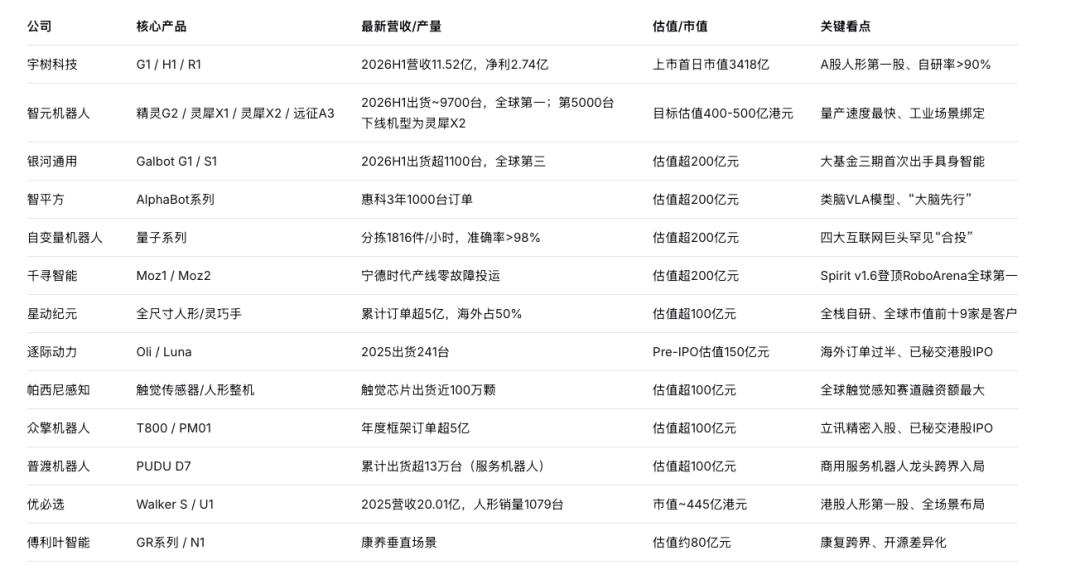
From "Two-Giant Narrative" to "Landscape Competition"
China's humanoid robot industry in 2026 has evolved from the simple narrative of "Unitree and Agibot duopoly" to a three-dimensional landscape of "two giants leading, unicorn groups catching up, and multiple vertical players adhering to their tracks".
This is a typical path of "Chinese-style industrial explosion": first, two leading companies break through the market with ultimate cost-effectiveness and mass production capacity, then capital flocks in to spawn a group of 10-billion-yuan unicorns, while the supply chain base matures rapidly and the cost curve drops sharply. Counterpoint Research predicts that the global shipment of humanoid robots for the whole year of 2026 will exceed 50,000 units — a figure that was less than 3,000 units in 2024.
However, under the prosperity, differentiation has already begun. Unitree and Agibot have crossed the thresholds of "10,000-unit shipment" and "large-scale delivery", while most 10-billion-yuan players are still hovering at the "1,000-unit level" or even "100-unit level". The real exam question is: when the capital boom recedes, who can be the first to prove that "mass production means profitability"? Who can run continuously for 2000 hours in the factory without downtime? Whose yield rate can support the BOM cost at the 10,000-unit scale?
The answers to these questions remain to be tested by time. But one fact is already irreversible: in the race of "who can send humanoid robots to factories first", China has taken a full lead.
This article is from WeChat official account "Tech Business", author: Tech Business, published with authorization from 36Kr.