The sizzling industry that has remained a smash hit for a full decade is now most starved of authentic real-human presence.
After a decade of rapid growth, livestreaming has long evolved into a far more diverse form than its early days, and has even become a familiar way of life for people.
"The 'streamer' is really breaking down" "The 'streamer' is going to tell everyone a story"...
On today's internet platforms, you will find that everyone refers to themselves as "zhubo", a playful homophonic variant of streamer. This term, evolved from the homophone of "anchor/streamer", has almost become a synonym for "I", rising to a new type of first-person pronoun in contemporary times, no matter whether you have ever hosted a livestream or not.
Everyone is a self-identified "streamer", which of course also means that everyone's life is a potential object to be watched and spread. Back in 2016, in the cover special *Addicted to Livestreaming*, *New Weekly* recorded the change of this viewing pattern as follows: "Livestreaming, which moved from professional TV stations to the public, vividly illustrates what 'the medium is the message' means... The boundary of the screen has long been broken, and the trend of communication is moving towards integration."
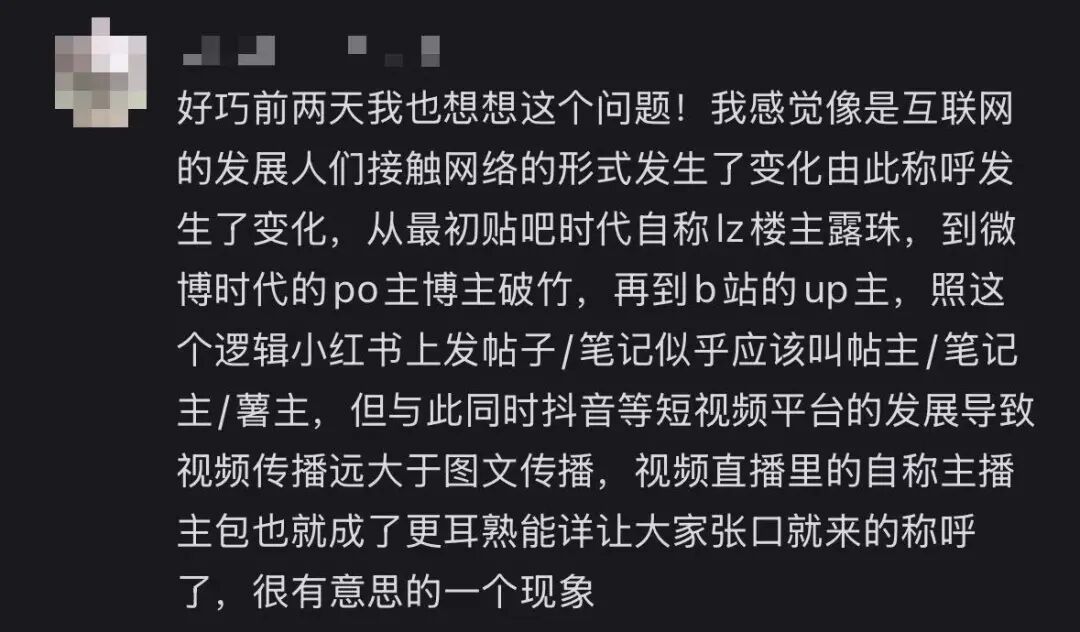
Everyone is a self-claimed "streamer". (Photo/Screenshot from social media)
Ten years later, livestreaming has long had a far richer appearance than it did in the early days, and has even become a familiar way of life for people. It is not only watched as a form of entertainment program, but also has become an important carrier for people's daily activities such as shopping, exercising, and studying.
As livestream content changes at an accelerating pace and the initial novelty fades away, what do people today long to see more in livestreams?
The livestream camera is not only set opposite to life, but also embedded within life
Looking back at 2016, known as the "first year of webcast", the rise of livestreaming was probably an eruption that had been building up for a long time. Before that, show livestreaming and game livestreaming had already accumulated a large number of users. With the popularization of smartphones and the improvement of network conditions, livestream cameras gradually moved away from computer desks, and entered more flexible scenarios such as streets, shopping malls, and travel routes. Mobile livestreaming has greatly expanded the world that can be watched, and gradually changed the people standing in front of the camera. They can be celebrities between shooting breaks, as well as ordinary people eating and wandering around the streets.
The emergence of livestreaming may have truly changed people's inherent perception of "what is worth watching". A person no longer needs to have a complete finished work first to have the opportunity to meet the audience. Freshness, boredom, or abstract content can all become reasons for being watched. In the huge online world, you can easily find any kind of life that is happening right now.
Data from the China Internet Network Information Center (CNNIC) shows that as of June 2016, the scale of China's webcast users reached 325 million; by December 2025, this figure was about 814 million, accounting for 72.3% of all internet users. In 2024, three departments including the Ministry of Human Resources and Social Security released a public notice, officially recognizing the occupation of webcast host as a new state-recognized profession.
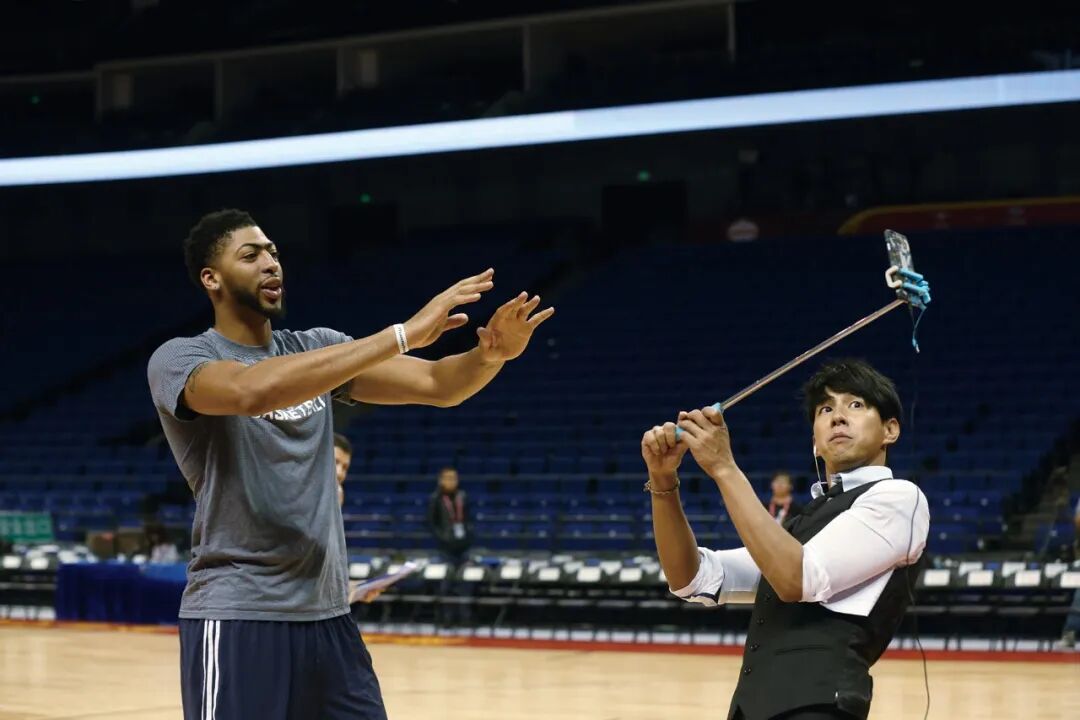
October 8, 2016, Shanghai. At the Mercedes-Benz Arena, Anthony Davis, No.23 of the New Orleans Pelicans, hosted a livestream via Weibo during the 2016 NBA Global Games China. (Photo /NBAE/CFP)
It is not just simple "watching and gifting", daily transactions are also embedded in front of the camera. Livestream e-commerce quickly became the most booming red ocean for a period of time. In 2019, Li Jiaqi and his iconic "OMG, buy it!" became a phenomenal topic. Although years later, he once suffered a public backlash for the line "Is it really that expensive?", in 2025, he still took the first place in the "TOP 50 Livestream E-commerce Hosts" list of the "2025 Hurun Top 100 Influencers by Commercial Value" with an estimated annual GMV (Gross Merchandise Value) of 175 billion yuan. The second place went to Dong Yuhui, another livestream host with a distinct personal style.
In 2020, Luo Yonghao, who was in debt after a failed business venture, also announced that he would enter the livestream e-commerce sector. At the end of his first livestream, he picked up a shaver and shaved off his signature beard, completing a sufficiently dramatic live demonstration for the product. Today, this long-running "True Legend of Paying Back Debts" story has also come to an end.
For a long time, product selling itself has become a watchable program, and livestream e-commerce is even gradually rising to become the mainstream sales method. When you walk into offline stores, you will find that there is always a clerk in the corner hosting a livestream facing the mobile phone camera. The *2025 White Paper on the Development of the Livestream E-commerce Industry* shows that the GMV proportion of brand self-operated store livestreams has exceeded 50%.
Even if you have never followed any specific host, when clips of livestreams spread to your WeChat Moments, office, and dining table... a whole set of catchphrases may quickly embed into your daily life, such as "dear family members", "all girls", "link is up", and so on. The livestream camera is not only set opposite to life, but in many cases, it is right inside life. Ten years ago, the livestream that *New Weekly* mentioned in its special report as "thriving with celebrities" now seems to be replaced by a kind of livestream with no celebrities at all.
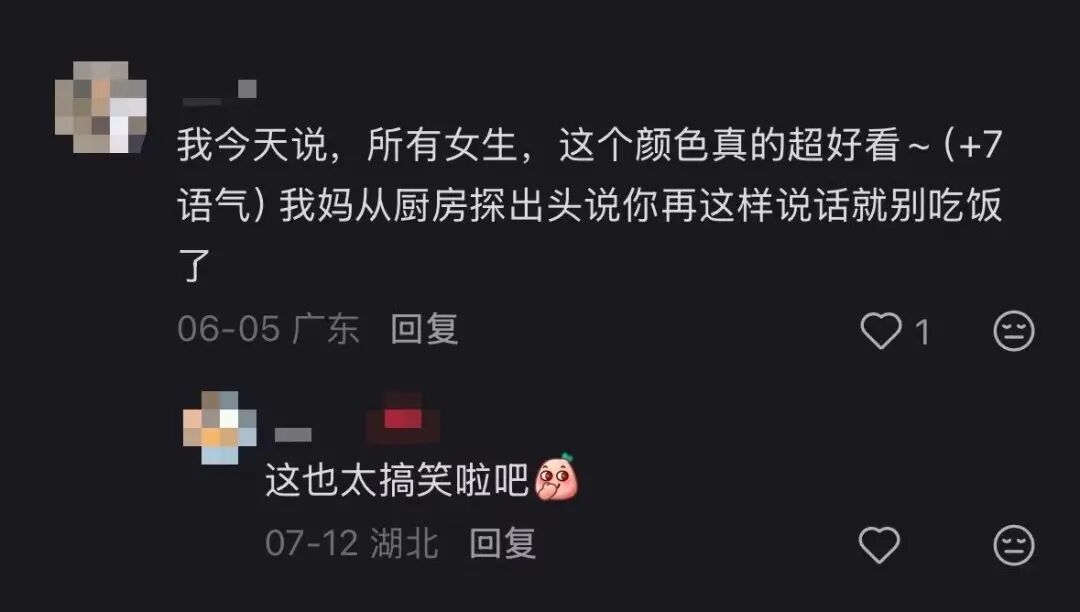
Catchphrases "influenced" by livestreaming. (Photo/Screenshot from social media)
Every single device is its own parallel universe
Since 2025, "group livestreaming" has become a new and fast-growing livestream track. It is a group livestream format where multiple hosts appear on camera together, mainly performing dance, singing and other shows. Compared with regular livestream rooms, group livestream stages have more professional directors, lighting engineers, camera operators, and on-site moderators... The group livestream members are both teammates and competitors to each other. The audience decides the performance content, interaction methods, performance order, standing position, number of stage appearances and other details by sending virtual gifts.
This is easily reminiscent of the talent show variety shows in the past. After talent show variety shows were suspended in 2021, the idol industry suffered a huge impact, and trainees had to take other paths such as going overseas to seek new opportunities. But the audience always needs new emotional sustenance, and group livestreaming seems to have naturally become a substitute. The formats of group livestreaming such as PK, ranking, and public performances are almost the "vertical screen version" of the old talent show variety shows.
Every night, countless group livestream hosts go all out in front of the mobile phone camera, which makes people can't help but miss the old talent show variety shows on TV that called for "vote for idols" and competed for audience ratings. The wildly popular group livestreaming has also provided materials for a wider range of entertainment fields. During that period, almost half of the entertainment industry learned the "leg-sweeping dance" that went viral.
You may find that many times, a suddenly popular new livestream track is just "old wine in a new bottle". The fitness livestreaming that suddenly exploded in 2022 was the same case. Liu Genghong's fitness livestream turned the song *Compendium of Materia Medica* into a familiar workout soundtrack for many people. "Liu Genghong boys" and "Liu Genghong girls" followed the videos to do shuttlecock exercises, finished their daily check-ins, and even posted practice clips to "hand in homework" on overseas social platforms.

"The entire internet is full of 'Liu Genghong girls'." (Photo/Screenshot from social media)
On the other hand, more serious and functional content has also been brought in front of livestream cameras. Knowledge-based hosts such as "Fan Deng Reading", "Zhang Chaoyang's Physics Class", and "Infinite Xiaoliang" have also attracted a lot of attention. The report *Learning Without Boundaries, Gathering Right Here — Short Video Livestreaming and Knowledge Learning Report* released by the Intelligent Media Research Center of the School of Journalism and Communication of Tsinghua University shows that as of November 2023, there were a total of 4.73 million science experiment related videos on Douyin. The total duration of these videos exceeds 16.29 million minutes, which is equivalent to 362,000 classes. The massive cloud courseware resources have realized the sharing of courseware resources across time, regions and industries, lowering the threshold for knowledge sharing.
Livestream rooms of different tracks are blooming everywhere, forming a truly "decentralized" livestream ecosystem. The *2025 White Paper on the Development of the Livestream E-commerce Industry* shows that the GMV driven by top streamers has dropped to 10.66%. Traffic no longer only pours into a few livestream rooms, but is scattered across countless constantly updating "tracks".
Open everyone's mobile phone, the algorithm-pushed world varies wildly from person to person. Every single device is its own parallel universe.
In the AI era, the scarce "real human vibe"
However, the end of real human performances eventually points to "virtual". The general trend of AI has also swept the livestreaming field, and the people in front of the camera may no longer be real humans.
On April 16, 2024, JD's digital human "Purchasing Director Dong Ge" completed its livestream debut, with more than 13 million viewers in the livestream room within 40 minutes. By the first quarter of 2026, the number of livestreams hosted by JD's digital humans had increased 10 times year on year. On Bilibili, "Mu Jimeng", who calls herself "AI Angel", has already chatted with the audience as an AI virtual host. AI hosts have begun to have names and personalities, and have derived their own livestream memes, becoming "idols" that are followed by fans.
But on the other hand, the potential risks of digital human livestreaming are also obvious. In December 2024, someone used an AI-synthesized image of "Zhang Wenhong" to livestream and sell protein bars, selling more than 1,200 units, and many elderly people believed it was real and rushed to place orders. The infringement issues related to AI images have also always been full of controversies.
In 1956, sociologists Donald Horton and Richard Wohl proposed the theory of "parasocial interaction": the audience will develop a one-way, long-distance sense of intimacy with the media figure, the other party does not know you, but you feel that they understand you. The phrase "dear family members" in the livestream room may also be a portrayal of this one-way interaction. Now, distinguishing between real and fake has almost become a required course for everyone's media literacy.
If before the emergence of AI livestreaming, people were still reflecting on and warning about the "emotional labor" pressure faced by human hosts, then in the new context, AI hosts that can be mass-produced have brought new discussions.
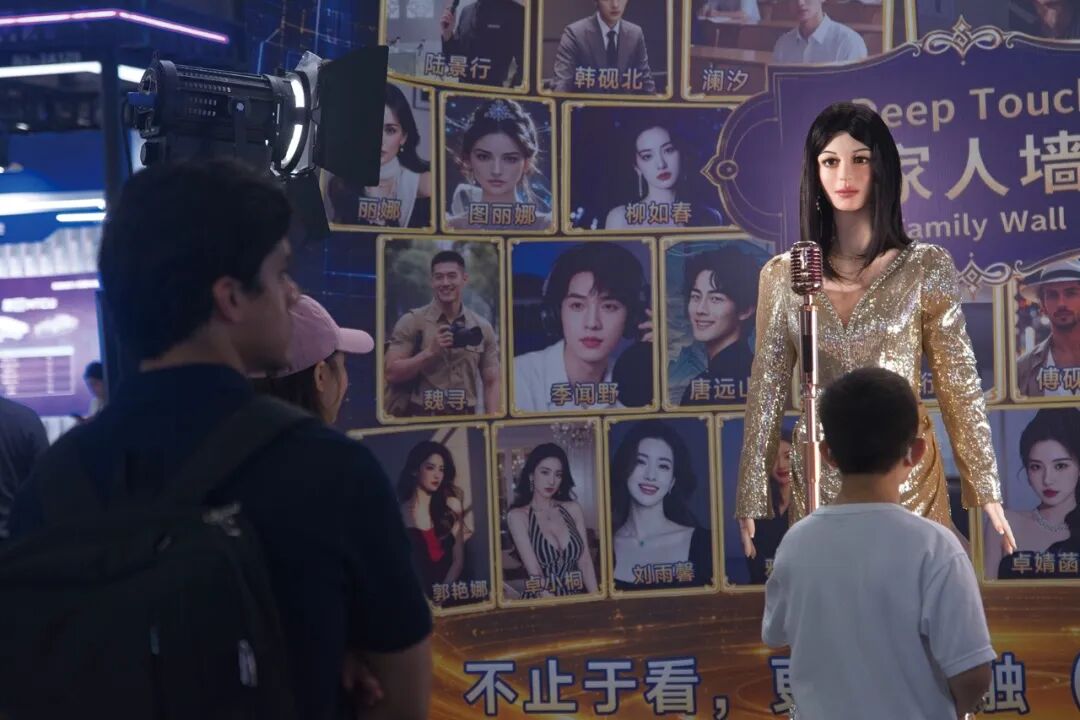
August 12, 2026, at the 4th Shanghai Embodied Intelligent Robot Industry Exhibition 2026, the humanoid robot on the booth of Shanghai Xinfu Technology Co., Ltd. is hosting a webcast. (Photo /rex/IC)
Dong Chenyu and Ye Zhen put forward the concept of "relational labor" in their paper *Being a Host: A Digital Ethnography of Relational Labor* — the labor of livestream hosts has long gone beyond performing emotions, but is continuously maintaining various relationships, and even after the livestream ends, the relationship is still "being billed". AI hosts that are tireless, never get into public scandals, and can keep smiling in thousands of livestream rooms at the same time, are almost tailor-made to be the opposite of "relational labor".
When perfect performances can be mass-produced, "perfection" itself starts to depreciate. The "average face" in AI videos more or less makes people feel uncomfortable. After all, at present, "real human vibe" is the greatest compliment, and real images and real expressions have become quite scarce.
In the first half of 2026, a livestream room that looked most like a performance unexpectedly became popular because it had no fixed script. By a small river ditch in Shouguang, Shandong Province, the four characters of master and disciples from the livestream group "Westward Journey Heroes" started their livestream with only a mobile phone and a stand. They waded through water, picked up stones, made fire to cook, and had about 8,000 online viewers in their first livestream. More than 10 days later, the real-time online number of viewers of this livestream room exceeded 100,000. Netizens called it the "2026 version of *Journey to the West*", jokingly saying "It's suspected that the white dragon horse's dash cam has leaked", and clips of this livestream spread all over the internet.
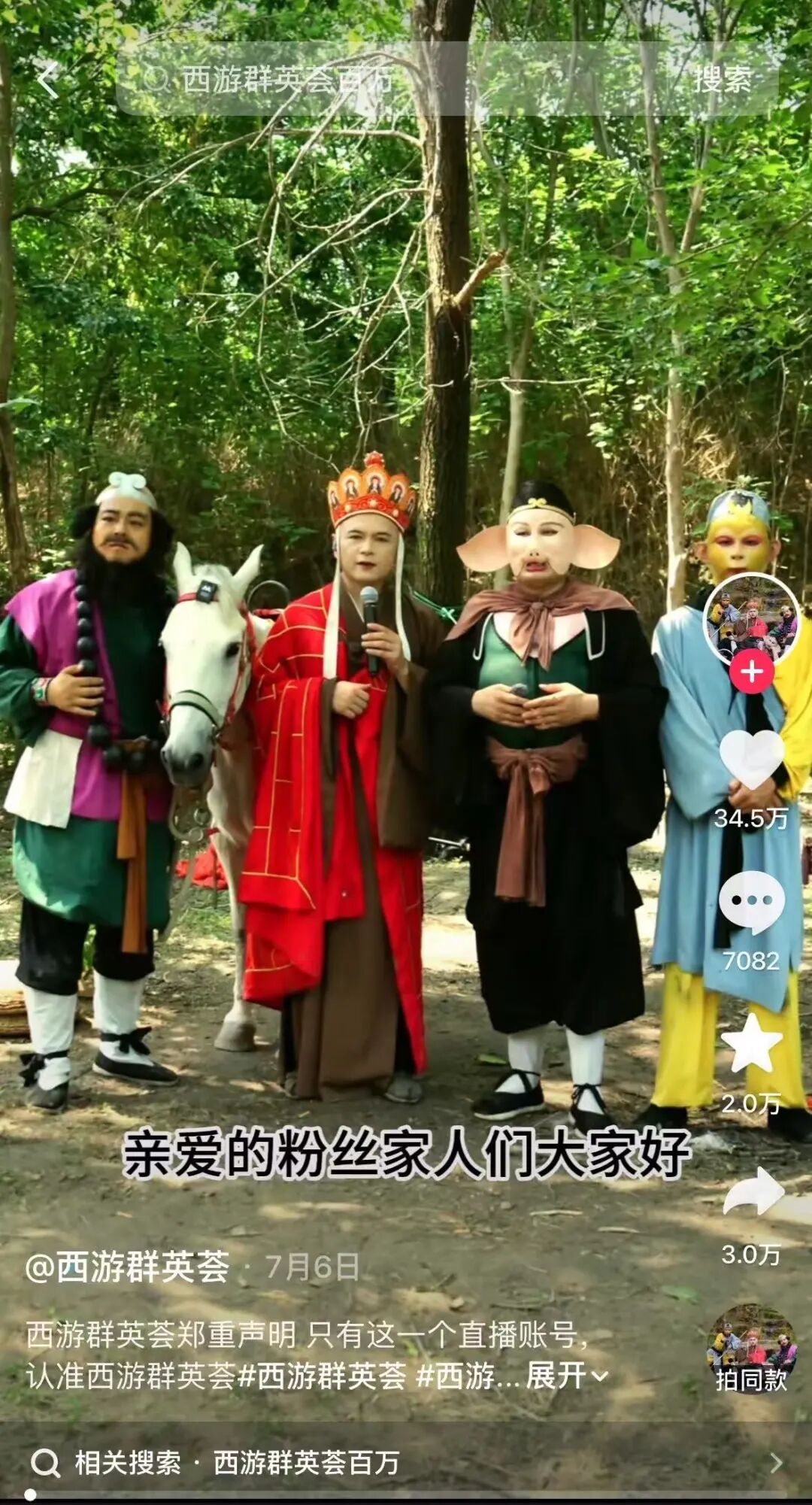
The four master and disciple characters of "Westward Journey Heroes". (Photo/Screenshot from social media)
The creator of this livestream room mentioned that they only set a general framework before each livestream, and more than 80% of the rest of the content is improvised. For example, when a strong wind blows and bends a tree branch, the four of them will immediately turn it into "a demon wind is coming". The widely spread line "Did I ever ask you to save me?" was also improvised by the actor in front of the camera.
In an era of accelerating technological progress and increasingly fierce content involution, everything that is slow and real is gradually highlighting its value. After all, in a life where everyone is performing, the boundary between virtual and real has long become more and more blurred.
In 2016,