A high-performance electric marine power system company has secured nearly 100 million yuan in Series A financing, with its overseas revenue increasing by 450% | 36Kr Exclusive
Source / Enterprise
This article is about 3000 words, with an estimated reading time of 8 minutes
Author | OU Xue
Editor | YUAN Silai
36Kr has learned that ExploMar, a high-performance electric marine vessel power system enterprise, has recently completed a Series A financing of nearly 100 million yuan. This round of financing is jointly led by Delian Capital, Changshu Guofa, and Suzhou Venture Capital, with participation from 37 Interactive Entertainment, and existing shareholder DCM Ventures has participated and increased its investment for three consecutive rounds. Potential Capital acts as the exclusive financial advisor. The proceeds of this round of financing will be mainly used to strengthen the global channel network, deploy overseas electric boat experience centers, and improve the construction of overseas service and spare parts centers.
Founded in 2021, ExploMar focuses on high-performance electric marine power systems, and its products have been delivered to more than 20 countries around the world. Its founder Dong Jiang once led the commercialization of multiple new energy vehicle models from 0 to 1 at Yutong Bus, Sunlong Bus and REFIRE, with 14 years of experience in the industrialization of new energy vehicles. The core team has full capabilities of independent R&D of the three core electric technologies (battery, motor, electric control) at the underlying level, marine engine and propeller matching, and global channel construction.
Different from the explosive development path of new energy vehicles "from 0 to 1", the electrification process of marine power systems lags far behind. After decades of development, the global fuel outboard engine market has formed a stable pattern dominated by Japanese and American brands such as Mercury and Yamaha. However, in the high-performance field (above 50 horsepower), the penetration rate of electrification remains very low so far.
Why does the technical transfer seem logical but the actual implementation is so difficult? Dong Jiang analyzed to 36Kr that the real difficulty of high-performance electric outboard engines does not lie in whether the motor can reach 300 horsepower, but in how to achieve continuous high-power output under limited weight and extreme working conditions while ensuring the performance and reliability of the whole vessel.
"The hull is highly sensitive to weight. The power system needs to run at high load for a long time, and also faces the challenges of seawater corrosion, waterproof sealing and complex sea conditions." Dong Jiang explained. More importantly, the final power performance is not only determined by the motor. There is a high degree of coupling between the motor, reducer, propeller, hull line and hydrodynamic resistance. It is like putting the engine of a heavy truck into the body of a sports car, and ensuring that it runs stably and durably.
ExploMar did not choose the simple path of "converting fuel engines to electric ones", but carried out forward R&D of software and hardware from scratch.
The team reconstructed the three-electric and control system suitable for water working conditions, broke through the technical bottleneck of high-performance reducers, and realized the matching of fluid resistance data of hundreds of ship models worldwide with the propeller end performance.
At present, the company has accumulated more than 100 independent patents, with products covering 70 to 1200 horsepower, which can be adapted to vessels of 4 meters to 24 meters, forming a standardized skateboard chassis delivery scheme from single unit to multi-unit combination.
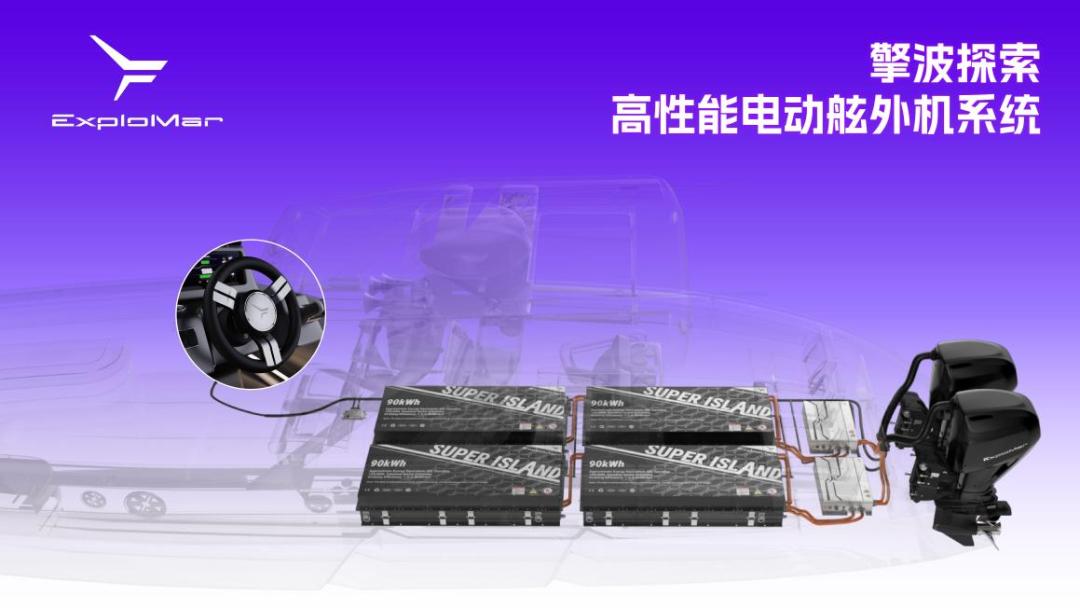
ExploMar high-performance electric outboard engine system (Source / Enterprise)
For the intelligentization of marine vessels, ExploMar has a rational judgment. Dong Jiang believes that for the entertainment scenarios targeting leisure users, "unmanned driving" is not an absolute demand at present, but "assisted driving" and "operation networking" have clear commercial value.
The Smart Captain system launched by ExploMar provides novice users with safety assistance functions such as in-situ turning in narrow waters and suppressing "porpoising". In particular, "porpoising" — when the thrust-to-weight ratio of the hull reaches a critical point, the hull will jump uncontrollably like a wild horse, which occurs within 0.7 seconds and the amplitude will diverge rapidly. ExploMar achieves millisecond-level identification and active suppression through torque management and adaptive trimming system.
In addition, the Smart Fleet system for B-end commercial operations solves the service pain point of "having to wait for a tugboat when the engine breaks down at sea" in the era of fuel engines through remote tracking, OTA upgrade and fleet management, greatly improving operational efficiency.
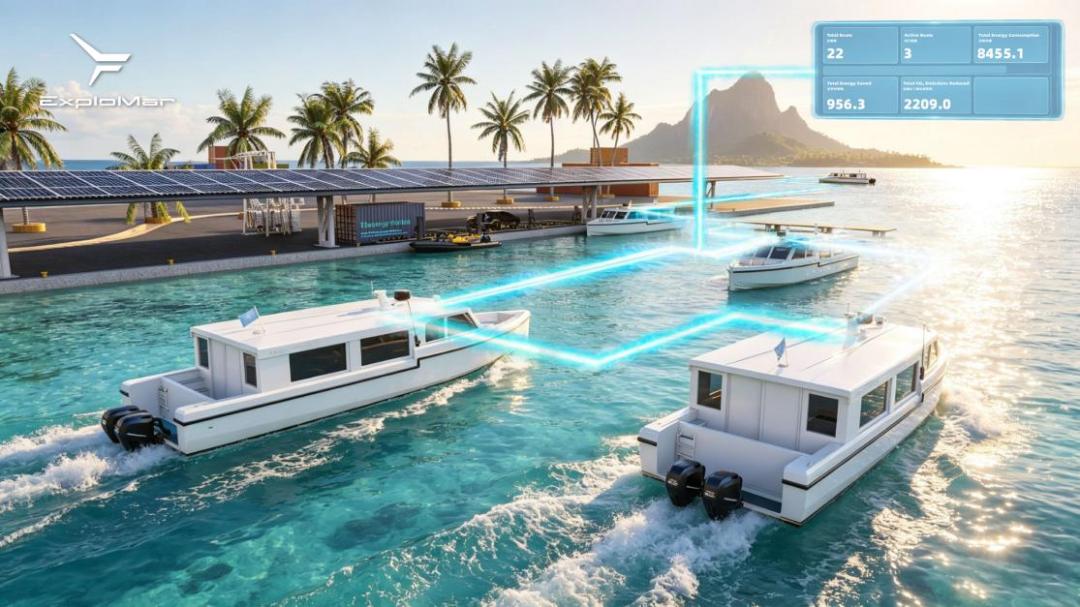
Intelligent functions related to the company (Source / Enterprise)
In the first half of 2026, ExploMar's overseas revenue increased by 450% year-on-year, and the amount of formal orders in hand has exceeded 100 million RMB.
In addition, in Dong Jiang's view, the economic account of marine electrification has been feasible: a 300-horsepower fuel outboard engine is priced at about 300,000 yuan, and a 600-horsepower one is as high as 800,000 yuan, but its high-load service life is only 500-1000 hours, with fuel consumption as high as 100 liters of gasoline per hour. The electric system built relying on China's mature new energy vehicle supply chain has overwhelming advantages in service life and energy consumption cost.
"In the high-performance marine vessel category, the price parity between fuel and electric power is expected to be achieved in 3 to 5 years." Dong Jiang judges that this is the result of the superposition of three forces: policy and regulation promotion, the leap of user acceptance and the manifestation of operational cost advantages. The industrial inflection point of marine electrification will come soon.
The following is an excerpt of the dialogue between 36Kr and Dong Jiang, founder of ExploMar (edited):
36Kr: How much of the experience from new energy vehicles can be reused in marine electrification?
Dong Jiang: Many people think that marine electrification is a simple transfer of new energy vehicle technology, but the actual differences are far greater than the similarities.
The similarities lie in the development ideas, tool chains and part of supply chain resources, such as the high-voltage platform architecture and the logic of vehicle-grade E/E electrical architecture. But the differences are decisive. First of all, the marine power system is in high-load working conditions for a long time, which is not the case for automobiles, which puts forward extremely high requirements for thermal management and system durability. Secondly, seawater corrosion and waterproof sealing are extreme environments that automobiles do not need to face.
More critically, the automotive power system is relatively independent, while the motor, reducer, propeller and hull line of marine vessels are highly coupled. Our power system is equivalent to a "skateboard chassis", which needs to adapt to thousands of ship models all over the world. This requires massive fluid data matching and algorithm iteration, and we cannot simply copy the experience of automobiles. We spent nearly three years on forward R&D to overcome these engineering barriers that cannot be taken shortcuts.
36Kr: In the overseas market, ExploMar is facing century-old fuel giants and local electric startups. What is your differentiation strategy?
Dong Jiang: There are mainly two types of competitors. One is the traditional fuel giants, who are doing "fuel to electric conversion". Limited by the original architecture, it is difficult for their products to achieve qualitative breakthroughs in power density and energy density. The other type is overseas electric startups, most of which focus on the local market and have shortcomings in supply chain cost control and multi-region service network construction.
Our core differences lie in three points: First, full-stack independent forward R&D, from the underlying software to the motor, reducer and thermal management are all independently defined, not restricted by upstream suppliers, leading in performance and iteration speed. Second, we have the engineer dividend and cost advantage brought by China's new energy industry chain, which is extremely competitive globally. Third, and most importantly, the global channel and service network we are building. The marine industry has the property of "non-time compressibility", which requires solid deployment of local teams, spare parts warehouses and experience centers. This system capability constitutes our long-term moat for the future.
36Kr: What is your market share? What are your main customers?
Dong Jiang: Since the official commercialization in 2025, our global shipment volume has ranked top two in the high-performance electric outboard engine field. The main customers include regional agent channels in units of countries, as well as KA customers of OEM ship manufacturers. In terms of end scenarios, our delivered cases not only cover many fuel-prohibited areas such as Lake Chiemsee in Germany, Lake Balaton in Hungary, and Norwegian fjords, but also come from the urgent demands driven by economic benefits such as island transportation, inland river ferries, aquaculture, cultural tourism, and work boats. In the landed ferry scenario in Nigeria, operators can achieve better economic benefits within the first year; if calculated based on a 10-year life cycle, a single 300-horsepower electric engine can create more than 1 million US dollars of economic value. This logic also applies to our hotel shuttle project in Maldives, salmon farming project in Chile, government procurement project in Thailand, etc. — the superposition of short-term return and long-term compound interest enables rapid penetration across regions and scenarios with solid underlying commercial logic.
Views of Investors:
Delian Capital said: The electrification and intelligentization of marine power systems are replicating the verified industrial path of new energy vehicles, which is a highly deterministic generative replacement. ExploMar has accurately occupied the mid-to-high horsepower outboard engine segment with the highest value and deepest barriers: For B-end operation scenarios, the full life cycle economy of fuel-to-electric conversion has been realized, and de-fossilization means direct cost reconstruction; For C-end users, quietness, zero emission and intelligent control form an experience generation gap that fuel solutions cannot provide. Relying on China's new energy vehicle industry chain and the independently developed forward three-electric architecture and E/E architecture, the company has systematic leading advantages over European and American competitors. The founding team has more than ten years of experience in new energy product definition and mass production landing, with capabilities in R&D, supply chain and global commercialization. We are optimistic that ExploMar will grow into the definer of global marine electrification power systems.
Changshu Guofa said: ExploMar has built a system-level technical barrier based on forward development for water scenarios and full-stack independent R&D of software and hardware in the field of marine electric power. Its products have been delivered to hundreds of ship models and scenarios first, and the actual operation data continuously feeds back product optimization, forming a closed loop of "delivery - data - iteration", which further strengthens the first-mover advantage in the market. As a benchmark enterprise of water electrification in Changshu, this round of financing will help it continue product upgrading and global expansion, so that the zero-carbon power of "Changshu Smart Manufacturing" can sail to broader waters.
Lin Xinhhe, Managing Partner of DCM Ventures said: Through continuous innovation and policy support, new energy marine vessels are currently at the key node from "demonstration application" to "large-scale replication". Driven by the dual wheels of technological breakthroughs relying on power batteries and low-carbon development, the expansion of the new energy marine market is not only an inevitable choice for green transformation, but also a blue ocean with high growth potential.