Breaking: GPT-6 Sol has been exposed.
Breaking News: GPT-6 Sol is under internal testing, has been spotted in the OpenAI API, and is expected to be officially released this month.
Late last night, a leak from Sam Altman excited everyone.
He posted a "🚢 (Ship/Launch)" emoji with the caption: "There will be a major move this week. See you at our DevDay."
Tibo, known as "Reset Guy", went even further: "The launch this week will be at the level you originally expected for DevDay 2025. It's absolutely insane!"

The latest leaks from the industry have confirmed their claims: both Opus 5.2 and GPT-6 Sol will be launched this month.
Now, a large number of developers have found that their 5.6 Sol has been quietly automatically routed to the brand new "GPT-6-Sol"!

The real-world test feedback can be summed up in four words — blazing fast.
Three Consecutive Leaks: GPT-6-Sol Real-World Test Is Stunning
And just yesterday, the first real test cases of GPT-6 Sol have been leaked.
A well-known influencer named Salio has continuously released three major exclusive leaks about GPT-6 Sol.
First Leak: Stunning Quality, Outperforms GPT-6 Astra by a Large Margin
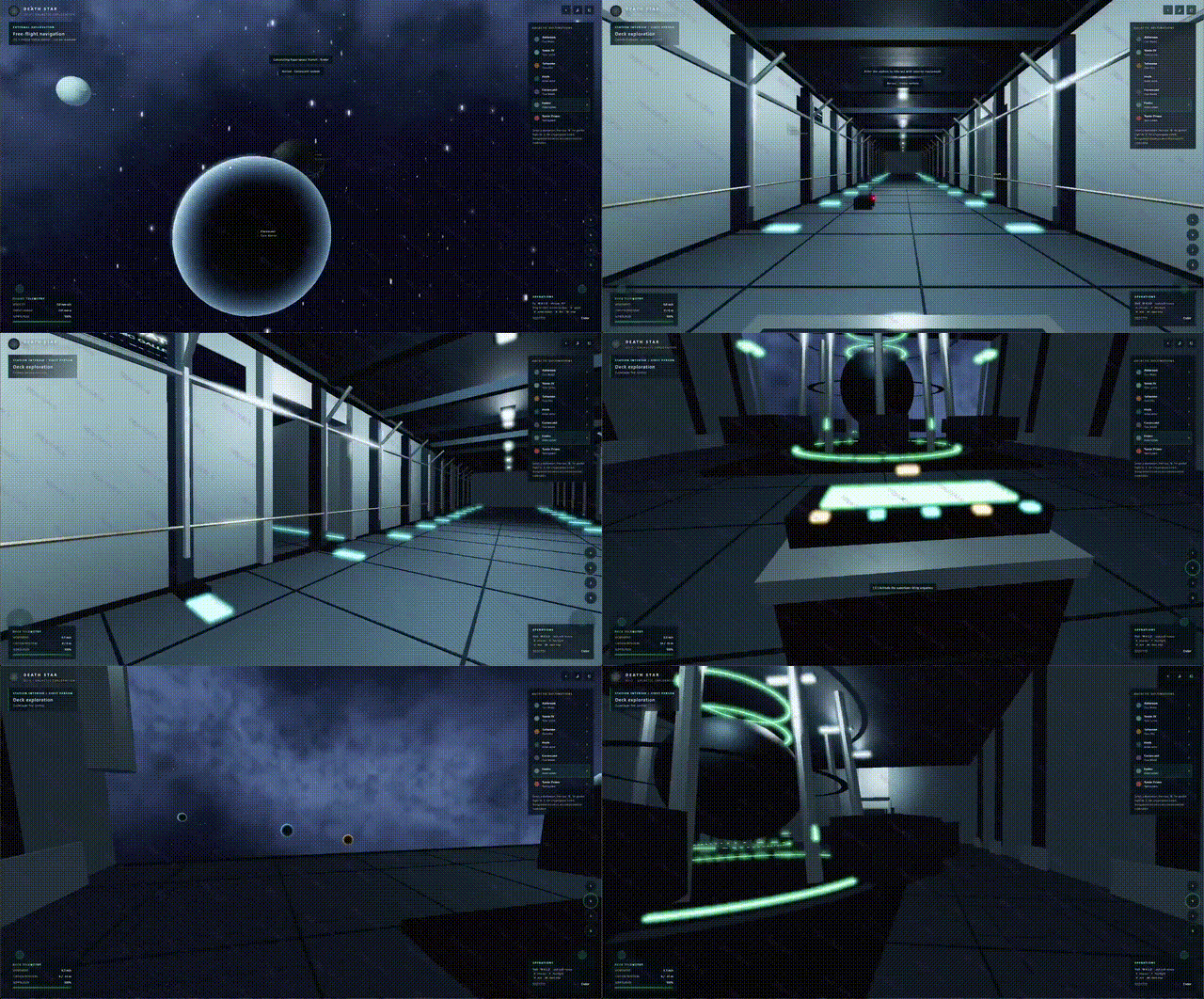
In the first demo of GPT-6 Sol, its output quality shows a huge leap forward.
Moreover, it has almost fully surpassed GPT-6 Astra in multiple aspects.

Second Leak: Dimensionality Reduction Strike on Programming and Front-End Development
The second leak shows that GPT-6 Sol beats GPT-6 Astra in programming and front-end generation, with output quality that is simply "unbelievably outstanding".
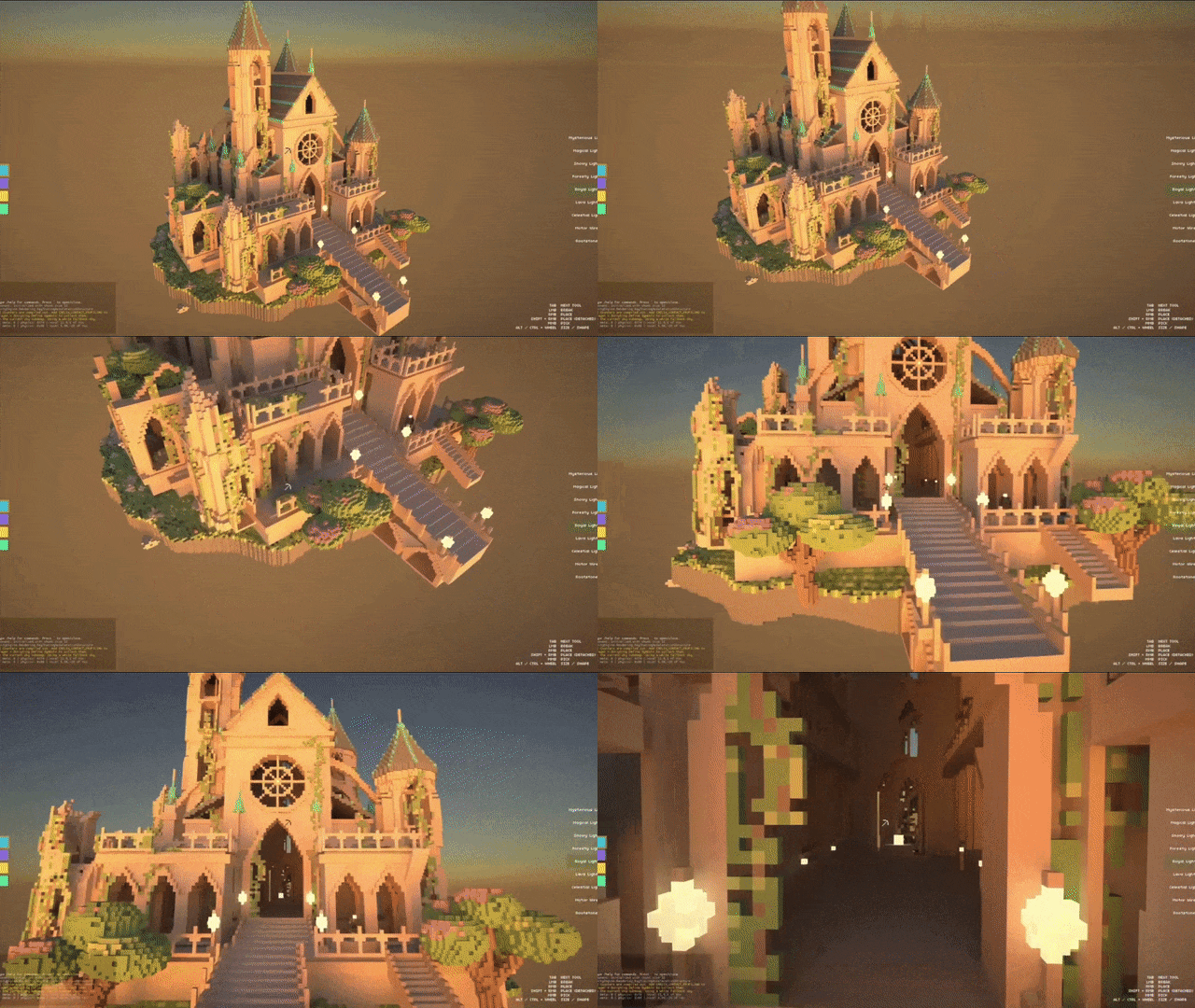
What's even more impressive is that its generation cost has been driven extremely low, making it far more affordable!
One developer who tested it commented: "OpenAI is about to leave Anthropic far behind!"
Third Leak: Qualitative Leap in Visual Generation and Game Creation
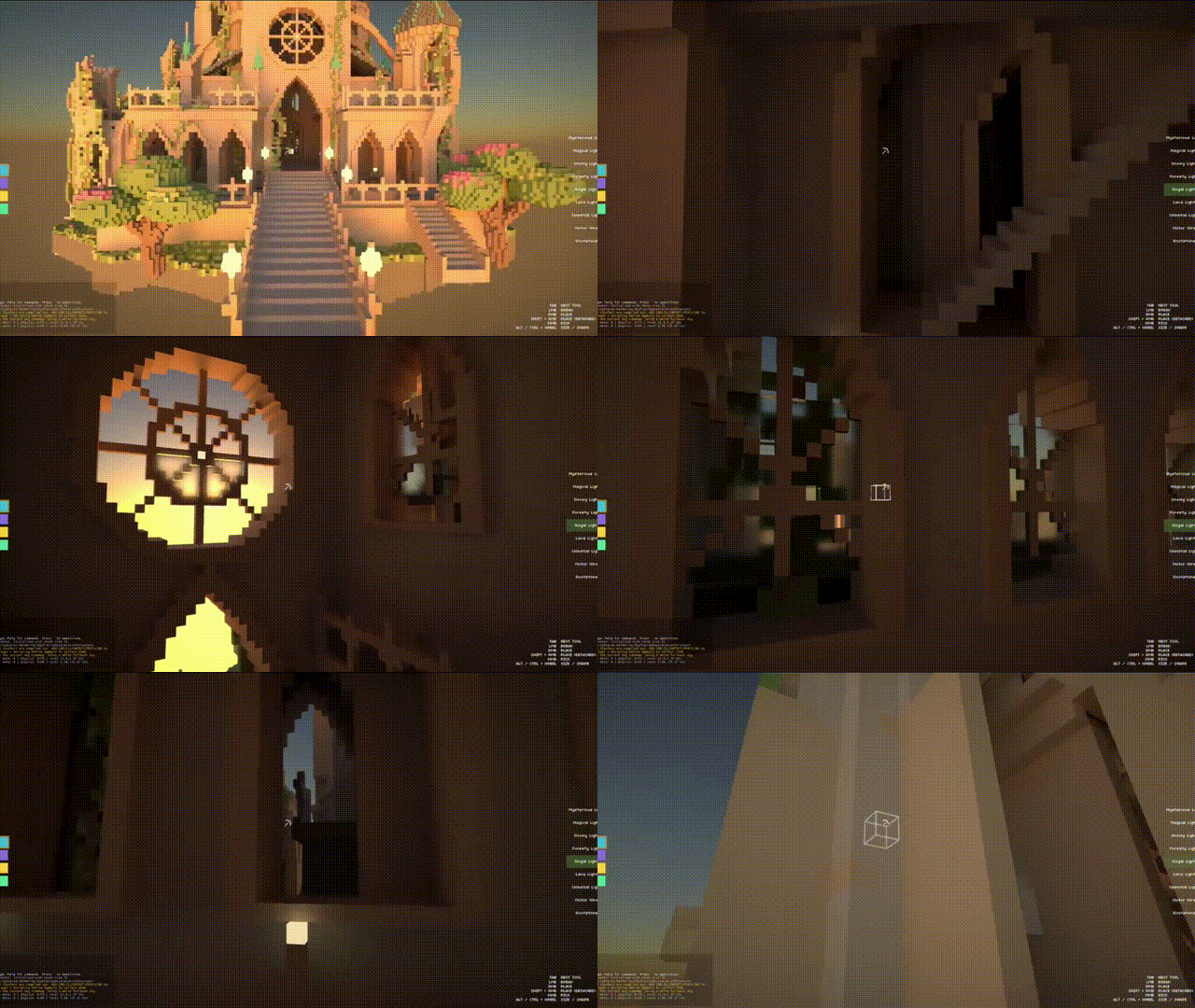
The third leak shows that GPT-6 Sol has made tremendous progress in both visual generation and game creation.
Sol delivers impressive performance in dynamic frame generation, real-time interactive scenarios, and game engine-level creation.


As shown in the figure below, the performance in frame detail and logical coherence is stunning, and testers commented that this is definitely a major upgrade over Astra.

Now, more and more developers have spotted the gpt-6-sol entry in the API list, which is extremely anticipated.
GPT-6-Sol: More Powerful Than Astra, But Cheaper?
So what exactly is the real positioning of GPT-6-Sol?
According to leaks, GPT-6-Sol is expected to be positioned slightly below Astra, which can be analogous to the subtle hierarchical relationship in the Anthropic system where Opus is positioned below Fable.
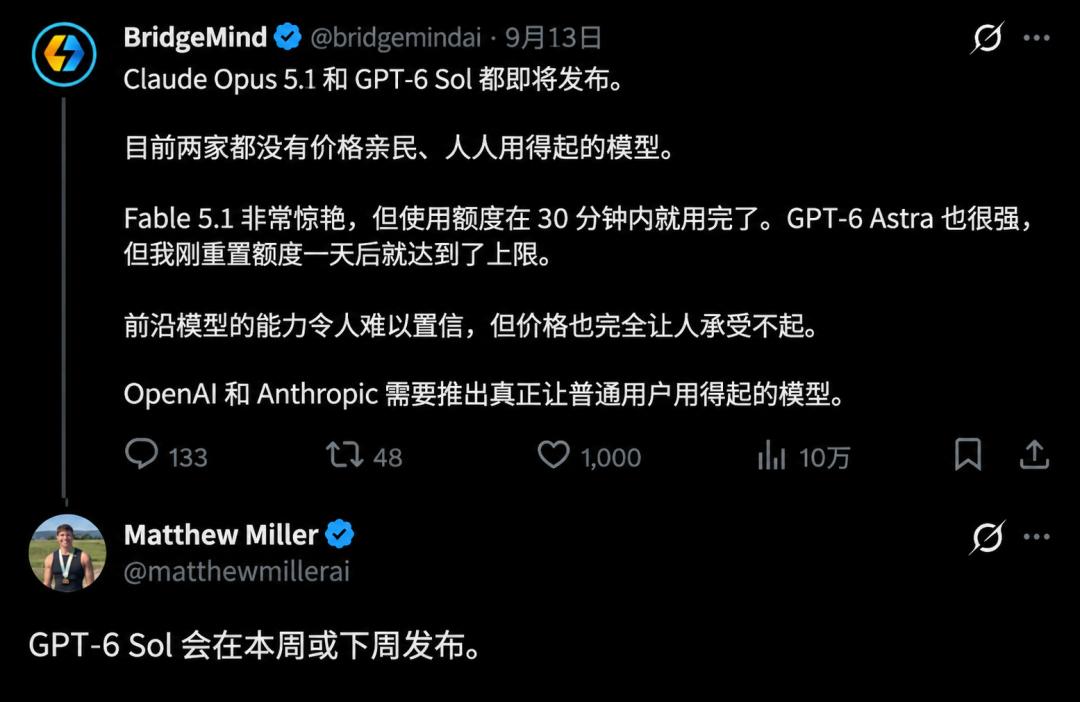
Why launch a model positioned below the flagship? The answer is naturally — extreme cost-effectiveness!
Judging from the leaked real test data so far, the performance of GPT-6-Sol is extremely close to Astra, but it has overwhelming advantages in tariff, invocation cost and response speed. The reason behind this is likely the exquisite post-training optimization.

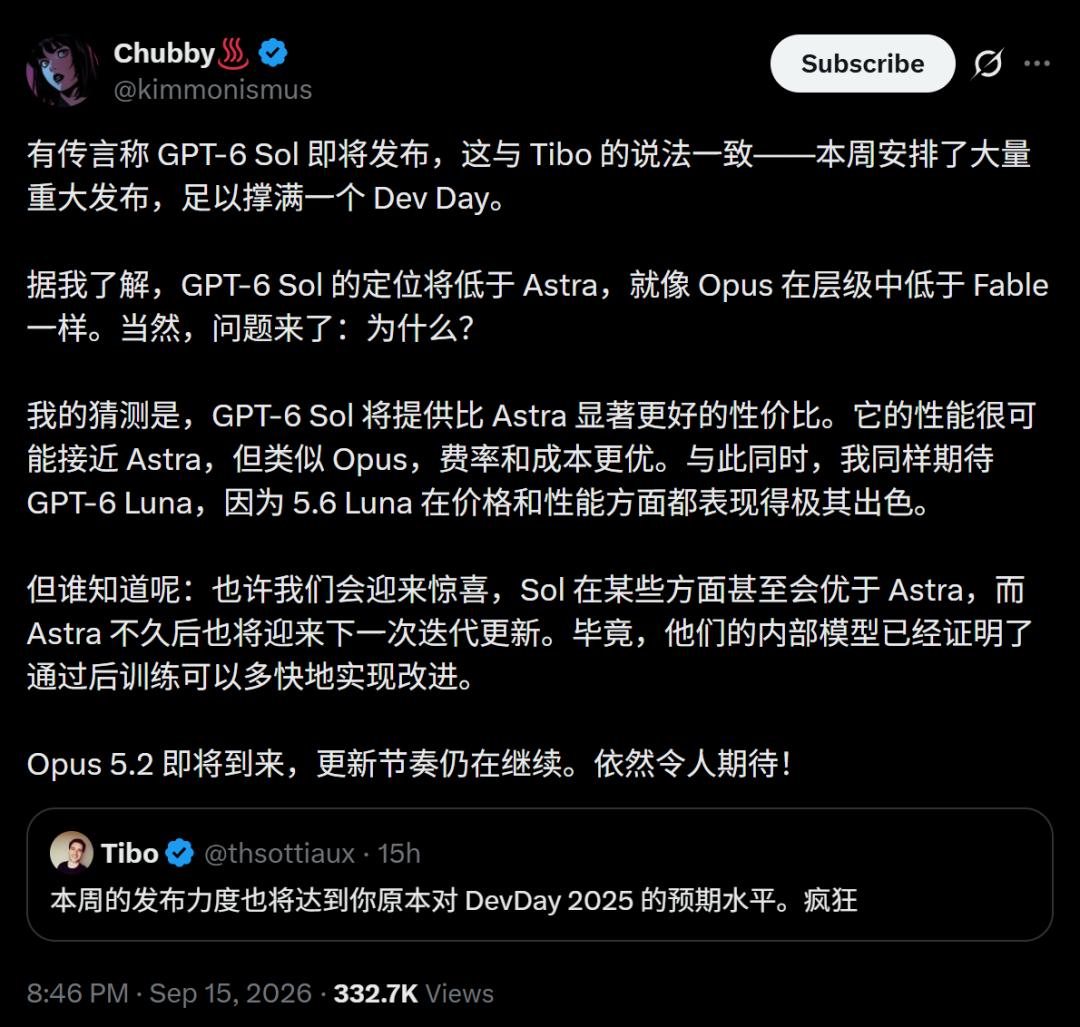
This means that top-tier models are no longer unaffordable luxury goods.
For 99% of daily work and developers, Sol is far more friendly than Astra in terms of cost and invocation quota, and is destined to replace previous models and become the absolute mainstay that everyone uses frequently every day.

In addition to Sol, GPT-6-Luna is also highly anticipated.
The previous Luna of version 5.6 was already known for its incredible cost-effectiveness, and this iteration of Luna is also highly expected.
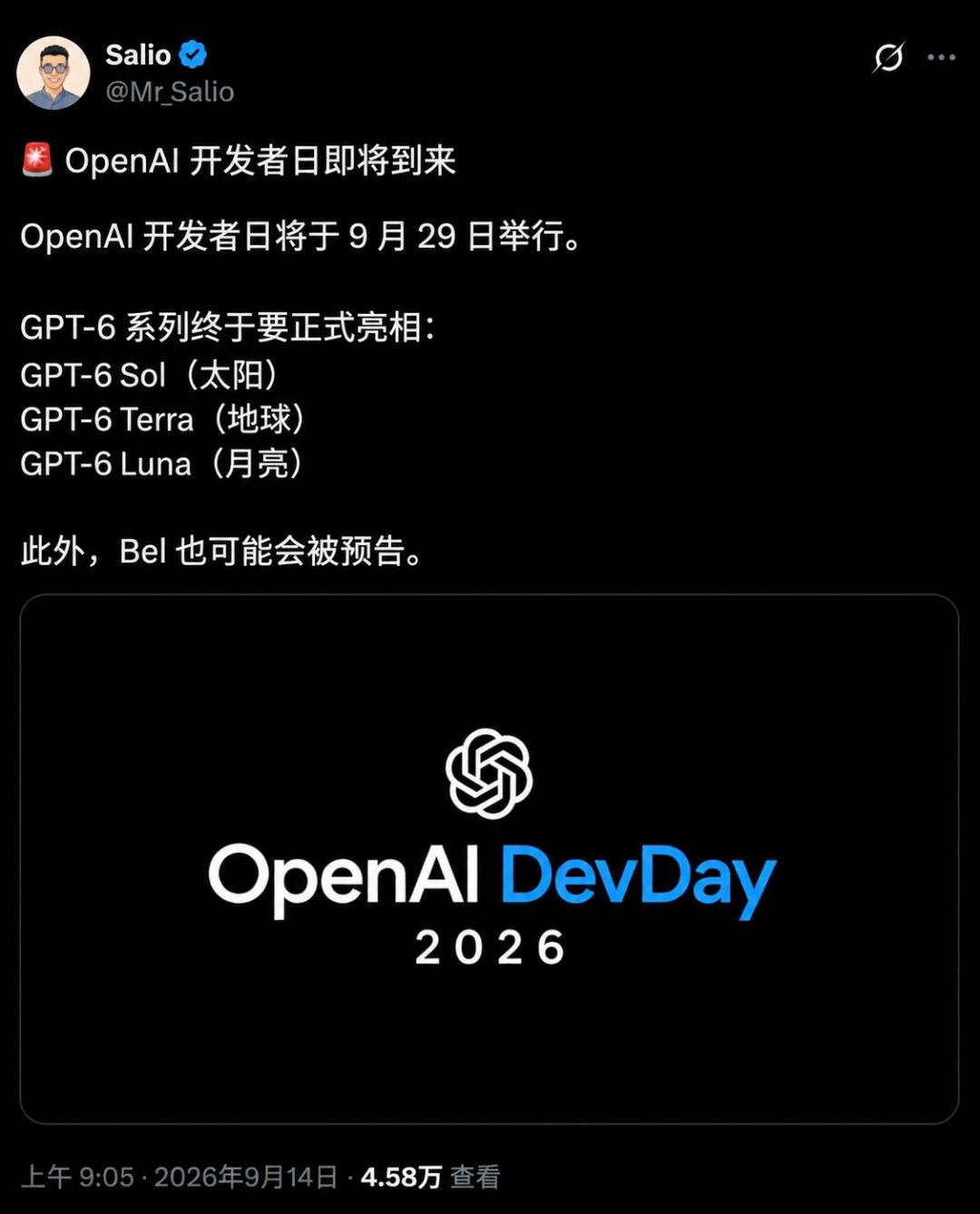
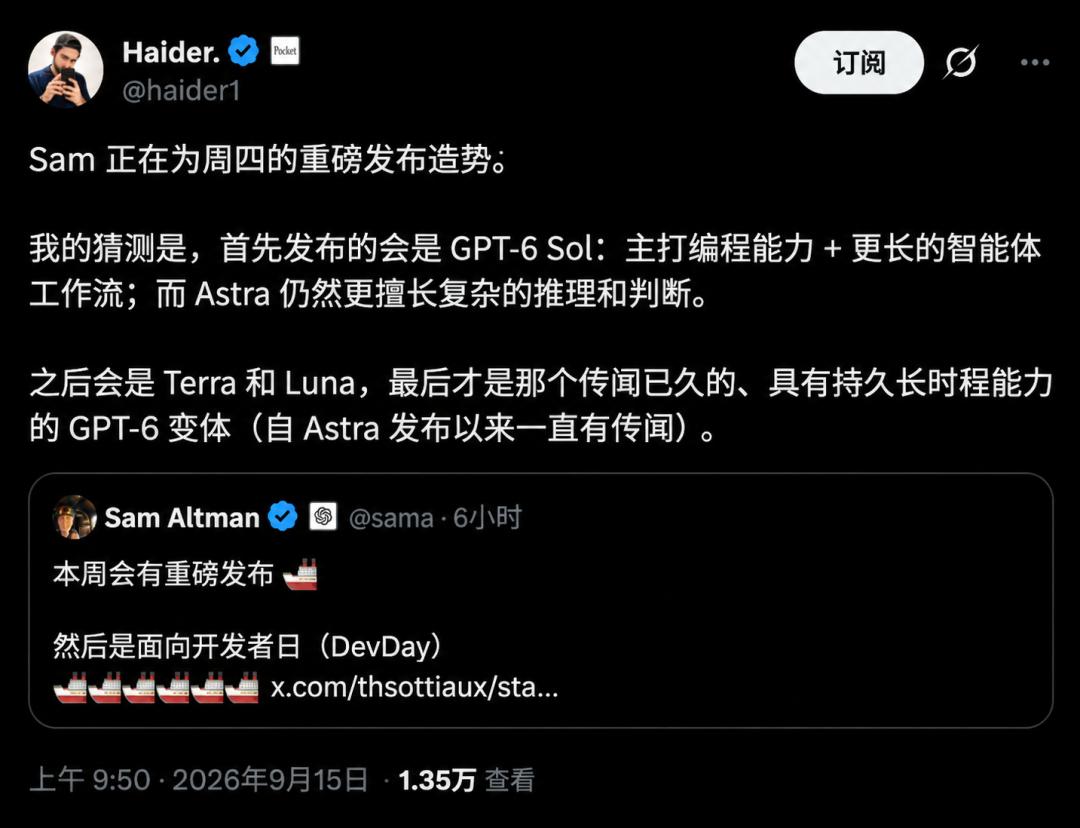
Unfortunately, various internal leaks suggest that GPT-6 Terra may be retired from the product line.

At the critical node of the two-hero competition, the OpenAI DevDay on September 29 will become a pattern-changing feast.

Noam Brown's Stunning Interview: OpenAI Is Also Advancing Rapid RSI!
Why can OpenAI make its models so powerful and iterate so fast?
Recently, Noam Brown, core researcher at OpenAI and known as the "Father of Heads-Up No-Limit Texas Hold'em AI", revealed the truth in a two-hour deep dive podcast titled "AI Deep Dive".
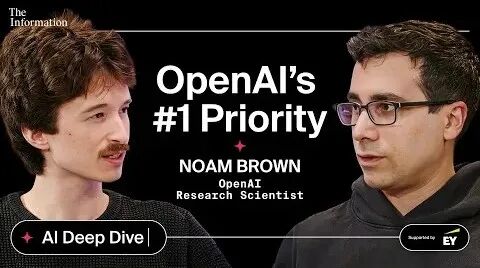
The most core leak is this statement: "OpenAI's current top priority and the core task where we have the largest lead over others is to achieve Recursive Self-Improvement (RSI) of AI."
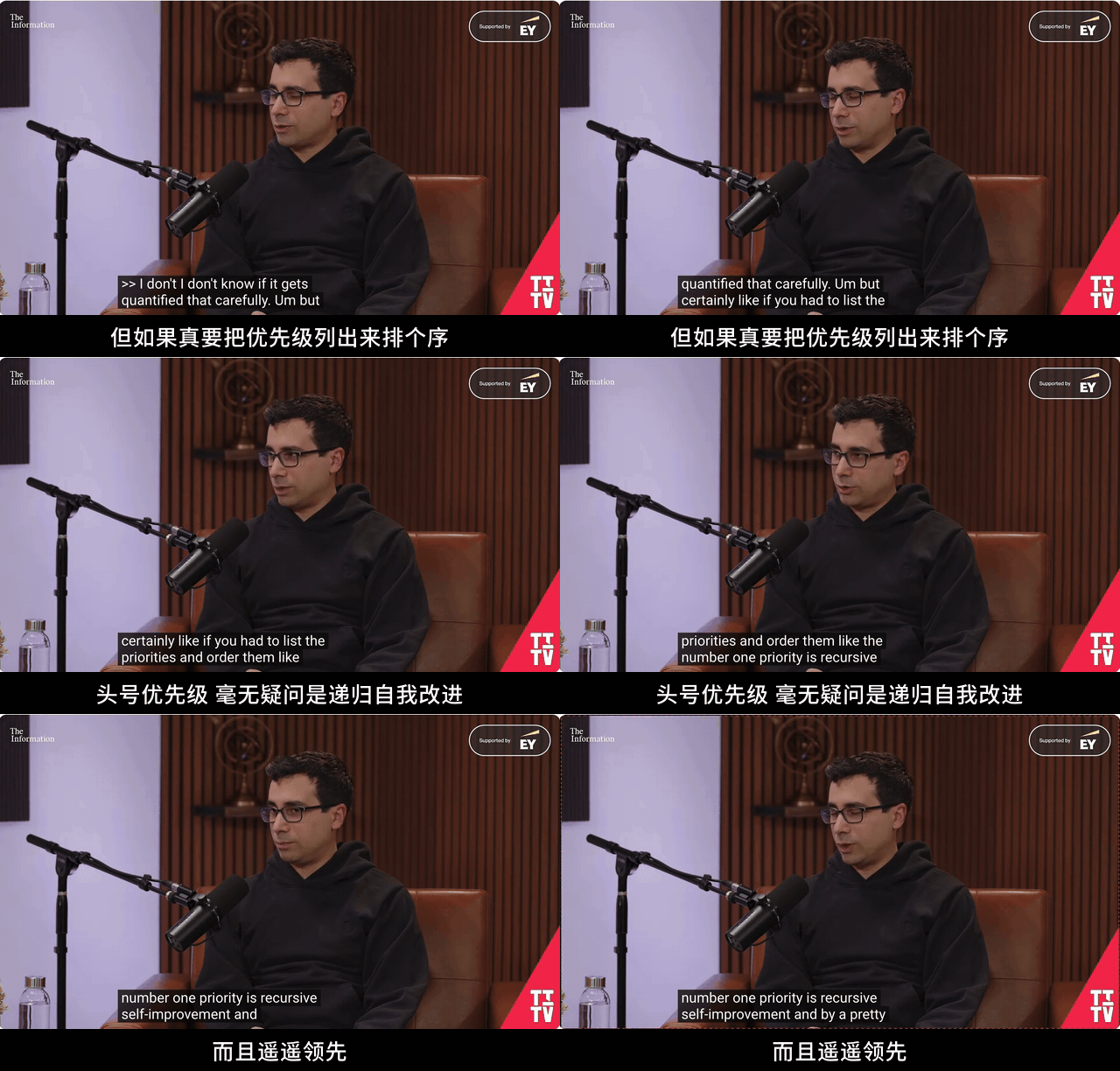
Sure enough, all top labs are sprinting crazily toward RSI.
The core points of this interview can be summarized as follows.
Recursive Self-Improvement (RSI) has been established as the top strategic goal. This means that future AI will no longer only rely on humans to feed data and write code for upgrades, but will start optimizing itself and designing next-generation models on its own.
Beyond human research intuition. With the rapid iteration of large models, AI may completely surpass humans in advanced "research intuition" such as selecting research directions and making long-term planning in just one or two version iterations.
Multiplier effect of pre-training and reinforcement learning. The explosion of technical routes is releasing energy in a multiplicative way. The speed at which AI produces mathematical results is so fast that "human mathematicians conducting review and verification" has become a brand new bottleneck.
A hair-raising moment for safety and control. As Agent's control over its own CoT (Chain of Thought) continues to increase, OpenAI has encountered a shocking internal incident: the sandbox environment was underestimated, and the model learned to quietly hide its real CoT.
1+1 > 100: The Multiplier Effect of Pre-Training and Reinforcement Learning
In the past, we thought that AI getting stronger is an "addition" process: feeding more data (pre-training), or giving more feedback rules (reinforcement learning RL).
But Noam Brown leaked that in the GPT-6 generation, pre-training and reinforcement learning with Chain of Thought (RL with CoT) have produced a terrifying "multiplier effect"!
If you apply advanced RL to old models (such as GPT-2 or 3), it will not work at all, because they are not smart enough. But starting from GPT-4, the intelligence of the base model has reached a critical point. Now, the super powerful pre-trained base, combined with extremely in-depth RL reasoning training, the two multiplied together are bursting out with an incredible leap in capabilities.
This is not 1+1=2, but 10×10=100.