Commercial lawn mowing robot secures tens of millions in financing, reshaping golf turf operation and maintenance with L4-level autonomous driving | HardKr Exclusive
Author | HUANG Nan
Editor | YUAN Silai
36Kr learned that commercial lawn mowing robot company "Laifeng Robotics" has recently completed tens of millions of yuan in angel round financing, with the investor being Yuda Capital. The raised funds will be mainly used for the construction of overseas sales and service teams, as well as the R&D and promotion of follow-up high-difficulty products such as green mowers and rough mowers.
Founded in 2022, the Laifeng Robotics team targets the golf course turf operation and maintenance scenario, and launched L4-level commercial lawn mowing robots that cover all business links of fine maintenance including fairway trimming and rough area treatment on golf courses. Its first product, the golf fairway mowing robot Boulder F1, was officially released in September 2025, and has been sold in markets including China, South Korea and Japan, while accelerating certification and channel layout in European and American markets.
Currently, Laifeng Robotics is also one of the few B-end lawn mowing robot companies that obtained the U.S. FCC certification before the FCC ban.
In recent years, as consumer-grade courtyard robots have rapidly entered households to meet the demand for lightweight, single-person operation. In contrast, there is a clear gap in the large-area commercial lawn sector: for large-scale commercial scenarios such as golf courses and municipal green spaces, a complete closed-loop automated operation solution is still absent. Traditional lawn mowing equipment can only complete basic mowing, and under complex terrain and high-frequency operation conditions, it is highly dependent on manual labor, which leads to high labor costs and prominent shortcomings in operation efficiency.
Among various commercial lawn mowing scenarios, golf courses are a special case. According to the 2025 Global Lawn Equipment Industry Report by PW Consulting, the golf track accounts for about one third of the global commercial lawn equipment market, making it the largest single-point commercial market, while it also has the most stringent standards for turf maintenance. According to the engineering calculation of overseas championship-level courses, a standard 18-hole course covers a total area of about 648,000 square meters, of which the fairway area is nearly 240,000 square meters, and the conventional industry operation requires mowing maintenance at least once every two days.
This feature of large-area, high-frequency and highly repetitive outdoor operations makes the golf scenario highly compatible with robotic operations. But for a long time, its automation transformation has faced an implicit threshold.
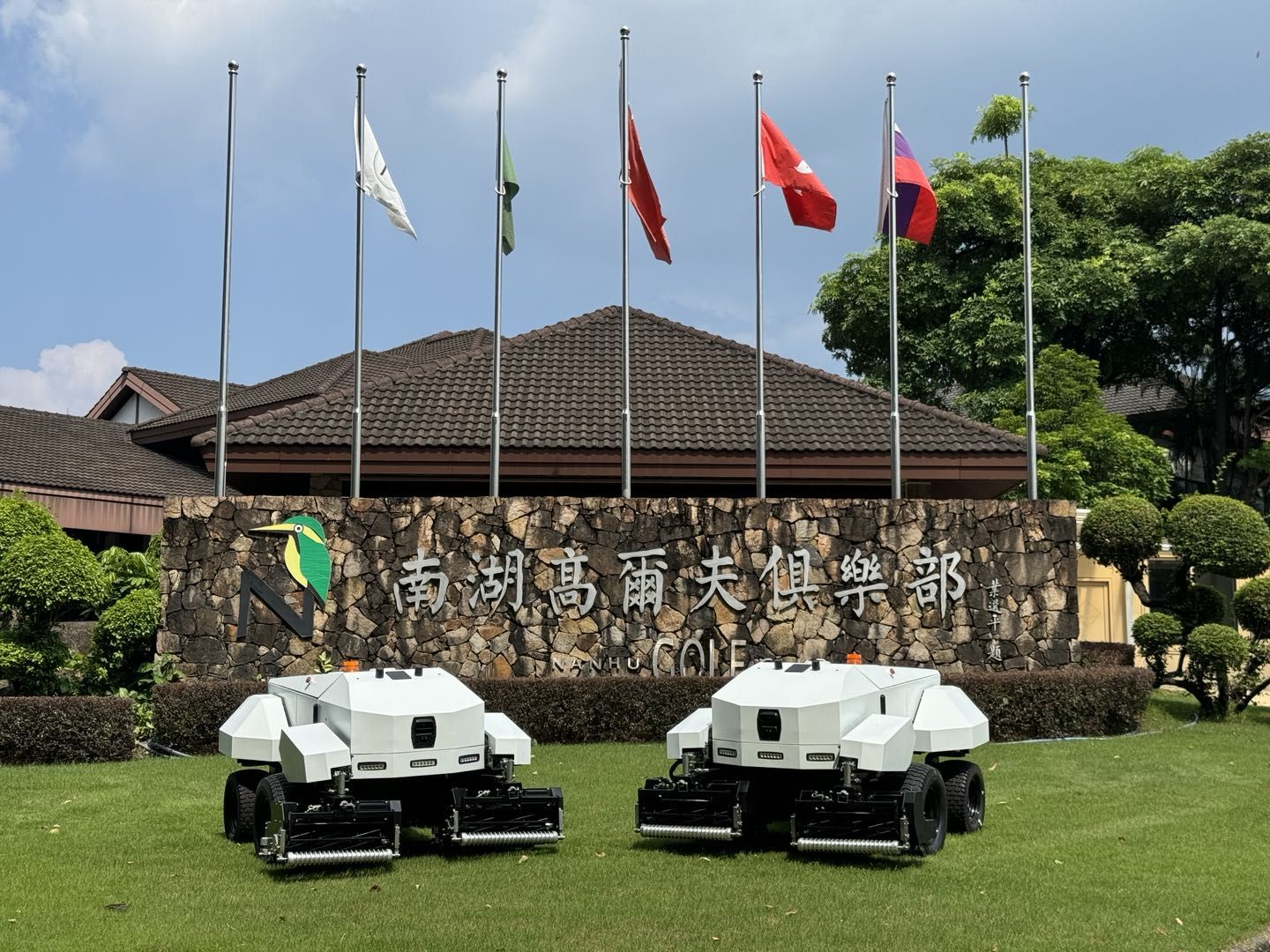
Commercial lawn mowing robots focused on golf scenarios (Source/Enterprise)
"A single lawn maintenance involves multiple areas, fairways account for about 40%, rough grass accounts for 40%-50%, and greens account for about 10%; at the same time, the mowing frequency varies in different areas: fairways are mowed once every two days, rough grass once a week, and greens need to be mowed every day. Therefore, fairways and greens are currently areas with high operating costs," introduced LIU Yuxuan, Founder and CEO of Laifeng Robotics. "Different enterprises have vastly different requirements for mowing accuracy, body weight and movement logic, and it is difficult to use a set of standardized equipment to meet all needs. As a result, general lawn mowing robots can hardly enter the core operation links of golf scenarios."
Under the traditional operation mode, fairway mowing relies on large manned equipment. Since the course needs to be open during the day, the manned equipment can only complete the operation before business hours, and the operation window is strictly limited to 5 a.m. to 9 a.m. This means that a large piece of equipment must complete all fairway mowing work within three or four hours. In order to cover a sufficient area in a limited time, the equipment has to be made larger, wider and more expensive.
The Laifeng team's idea transformation is to liberate the operation time from the "human window" to an "all-weather window" through L4-level end-to-end autonomous driving technology.
Its first commercial robot product, the Boulder F1, has a mowing width of 1.55 meters and a total weight of about 1 ton. It can automatically leave the charging pile at night, cross the course roads to enter the fairway area, operate in shifts according to the schedule, and automatically return to charge after seven or eight hours. The whole process does not require any manual intervention, and covers the mowing volume of traditional large equipment for 4 to 5 hours.
"Our logic is similar to the replacement of fuel vehicles by new energy vehicles — we realize electrification and intellectualization at the same time, with lower cost, and choose the more difficult but higher mowing quality requirement reel mower as the breakthrough, because golf courses only prefer reel mowers," LIU Yuxuan told 36Kr. In the North American market, a Boulder F1 is priced at about 120,000 to 140,000 US dollars, while the selling price of traditional manned mowing equipment is about 140,000 US dollars. In addition to equipment procurement costs, one robot can replace one mower operator. Calculated by salary plus insurance, it saves nearly 40,000 US dollars in labor costs every year, and the total cost of use over 5 years drops by more than 50%.
However, the implementation of L4-level autonomous driving on golf courses is far from a simple technology migration.
The operation environment of golf courses poses three challenges to the autonomous driving system. The first is the mowing stability under all working conditions. With the changes of seasons, rainfall and night dew humidity, the mowing working conditions vary significantly. Equipment that performs normally during dry days may frequently encounter problems in the night dew environment. The Laifeng Robotics team has invested a lot of engineering verification on the stability of mowing effect to ensure consistent cutting quality under all weather conditions.
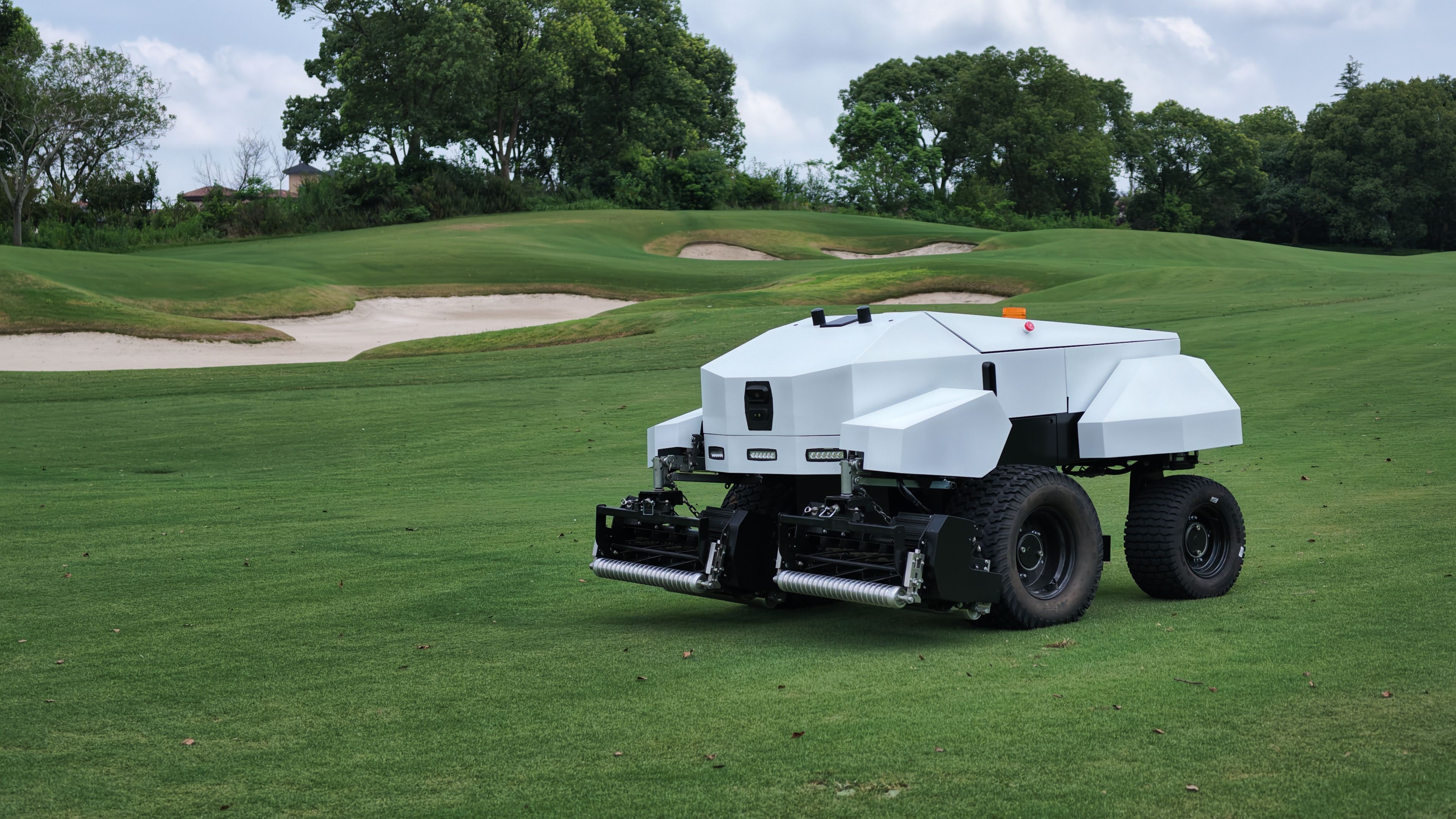
The first commercial robot product Boulder F1 (Source/Enterprise)
The second is the cross-course capability of the scenario. Golf courses cover a large area with many obstacles, and occlusions such as trees and tunnels will cause the RTK signal and laser positioning system to fail. The Boulder F1 adopts a three-in-one fusion solution of RTK, vision and LiDAR. When both satellite signal and laser positioning are unavailable, it can still guide the vehicle to complete full-course coverage through the AI system of vision and laser.
The third is the obstacle avoidance capability under high-speed operation. The maximum traveling speed of Boulder F1 reaches 2.8 m/s. For small, low and tiny targets such as the edge of sand traps, stumps, stones and small on-site facilities in the course, Laifeng has completed scenario-based special training on the AI perception and recognition model to ensure that the equipment can still stably capture and identify various small obstacles during high-speed operation.
Specifically at the product level, Laifeng Robotics' existing algorithm platform can support different scenarios such as fairways and rough grass at the same time. The main body of the whole machine does not need to be modified, and the scenario switching can be completed only by replacing the cutter set. Aiming at the operation requirements of different grass species in various regions, for example, warm-season grass in the southern United States is suitable for heavy reel mowers, and cold-season grass in the northern United States is suitable for light reel mowers. Laifeng is equipped with multiple reel cutter sets of 5-inch, 7-inch, light and heavy types, which can realize rapid hardware adaptation.
In terms of the overseas market expansion rhythm, Laifeng Robotics implements phased expansion by region, and currently takes Europe as the core market.
LIU Yuxuan pointed out to 36Kr that the golf industry in Europe is mature. After years of market cultivation by traditional lawn equipment manufacturers, course operators have a higher acceptance of the automated mowing operation mode; at the same time, the local market is continuously facing the pressure of labor shortage in turf maintenance and rising labor costs year by year. Local agents also have very clear demands for cost reduction and efficiency improvement. Both end customers and channel partners have strong willingness to cooperate for intelligent robot solutions.
The North American market plans to officially start large-scale layout next year. In the Asian region, the company has completed full-cycle on-site pilot verification in multiple golf courses, and after actual measurement and polishing through a complete operation season, it has basically realized normalized autonomous operation and maintenance of robots.
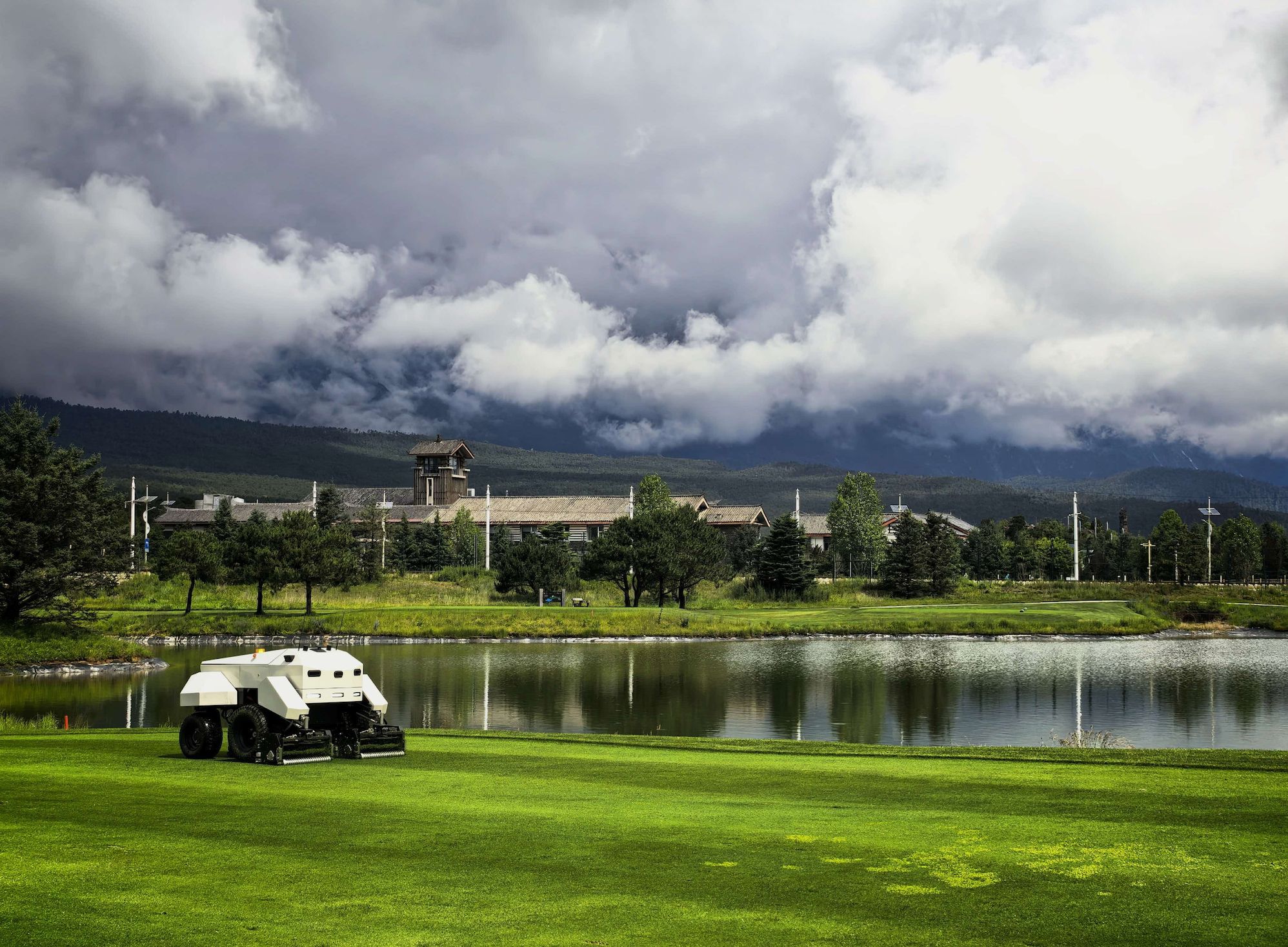
The whole process requires no manual intervention (Source/Enterprise)
Although golf mowing robots show clear cost reduction value, the track is still on the eve of large-scale explosion. Some unmanned mowing robot companies in the European and American markets have achieved certain commercial implementation in low-demand rough grass areas. The whole market requires long-term investment in technology implementation, channel construction and new product iteration.
For Laifeng Robotics, the Boulder F1 is just the starting point. Whether it can successfully complete the R&D of core models such as green mowers and realize multi-region overseas commercialization will be the key test for the company's subsequent development.
The following is the excerpt of the interview between 36Kr and LIU Yuxuan, Founder and CEO of Laifeng Robotics (slightly edited):
36Kr: Golf courses consist of multiple operation areas. What is Laifeng's product matrix planning? From a single product to a complete solution, what is the company's long-term goal?
LIU Yuxuan: Turf maintenance on golf courses involves three core areas: fairways, rough grass and greens, and the mowing frequency and accuracy requirements of different areas are significantly different.
At present, Laifeng has released and mass-produced the fairway mowing robot Boulder F1, and will successively launch unmanned mowing robots for rough areas and green areas later, forming a complete unmanned turf mowing solution covering all scenarios of golf courses.
Our goal is to become one of the few companies in the world that can provide full-scenario unmanned mowing solutions for golf courses.
Traditional equipment suppliers in the current market usually provide a product portfolio of fuel-powered, manned mowers, while Laifeng provides a complete unmanned solution from fairways to greens, from hardware to cloud scheduling. This is also why many professional golf equipment agents in Europe and the United States are willing to cooperate with Laifeng: their customers are migrating from traditional fuel equipment to automated solutions, and Laifeng's product matrix exactly matches this demand.
36Kr: When multiple robots are deployed on the course to form a fleet, how does the platform realize unified management? How do multiple machines cooperate to assign tasks and handle equipment anomalies?
LIU Yuxuan: The core challenge of multi-machine cooperation does not lie in the capability of a single machine, but in how to make the entire fleet operate efficiently as a system. We solve it from three levels.
The first is the unified spatial data base. The high-precision map of the course is shared by all robots. Each machine operates under the same coordinate system, and the position, status and task progress are synchronized to the cloud platform in real time. Users can see the real-time position, current task, battery status and operation coverage of each machine in the background. If a machine encounters an obstacle on the path, it will report to the cloud immediately, and the system will automatically synchronize it to all online machines. Other machines will directly bypass the area when planning the path, without each machine having to discover and deal with it separately. This is essentially a dynamically updated semantic map, on which robots continuously superimpose new environmental information during operation.
The second is multi-machine scheduling and right-of-way management. There are connecting channels between roads, fairways and greens in the course. When multiple machines operate at the same time, there will be intersections on the roads. Our scheduling system will assign operation areas and time windows to each machine, and perform time window avoidance at the path planning level to avoid deadlocks of multiple machines on the same road section. Even if two machines meet on a narrow road, the system will decide who passes first and who pulls over to wait according to the task priority and current position. This logic is similar to the scheduling idea of unmanned delivery fleets, except that the scenario is changed from urban roads to the unstructured road network inside the course.
The third is the operation replacement mechanism, which is a key link in multi-machine cooperation. If a machine cannot continue to operate due to blade jamming, sensor abnormality or other reasons, the system will detect the operation interruption, automatically evaluate the remaining task volume, and schedule a standby machine or a machine that has completed the current task from the fleet to take over the mowing operation of the unfinished area. The replacement is not simply "changing to another machine to mow again", but precise to the operation grid: the platform knows which areas have been mowed, which have not, and which have been half mowed, so the replacement machine only needs to continue the unfinished part without repeated operations.
The value of this cloud operation and maintenance system is that it realizes "managing a fleet". The daily operation, path planning, anomaly reporting and replacement scheduling of robots are all automatically completed by the system. People only need to make decisions when receiving anomaly notifications, such as confirming whether to detour, whether to suspend operations in a certain area, and whether to send personnel to deal with it on site. As a result, the capacity utilization rate of the entire fleet is greatly improved, and the stability of output is also guaranteed.