Zhipu and MiniMax drastically slash sales expenses.
The financial report for the first half of 2026 reveals an abnormal phenomenon: both Zhipu AI and MiniMax have achieved revenue growth of more than 100%, but their sales expenses have declined simultaneously.
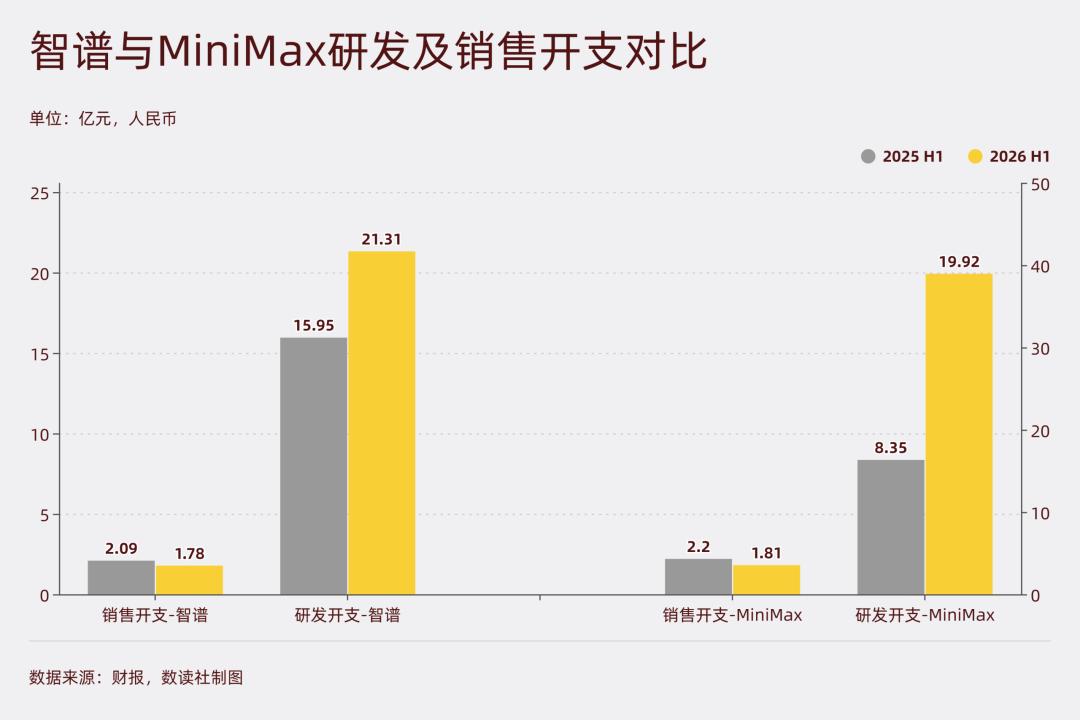
Zhipu AI recorded a revenue of 954 million yuan, a year-on-year increase of 399.7%, but its sales and marketing expenses did not rise but fell, decreasing by 14.8% year-on-year to 178 million yuan.
MiniMax also delivered a similar result. Its revenue reached 786 million yuan, up 283.1% year-on-year; sales and distribution expenses decreased by 17.9% year-on-year to 181 million yuan.
Soaring revenue coupled with falling sales expenses — a curve that cannot be plotted in traditional industries or the SaaS sector, reveals a shift in the growth engine of large model companies.
From "Human-Promoted Model" to "Model Self-Sales"
The decline in sales expenses is not the result of "cost-cutting", but a change in the growth logic.
Zhipu AI's confidence in cutting sales expenses stems from the change in customer acquisition methods on its platform.
In the first half of last year, the bulk of Zhipu AI's revenue still came from the localized deployment of enterprise-level general large models — the model was packaged and sold into customers' computer rooms, with each deal ranging from several million to tens of millions of yuan. Revenue recognition relied on delivery and acceptance, and repurchases depended on relationship maintenance. This type of business naturally requires a large sales team to pursue projects and build connections.
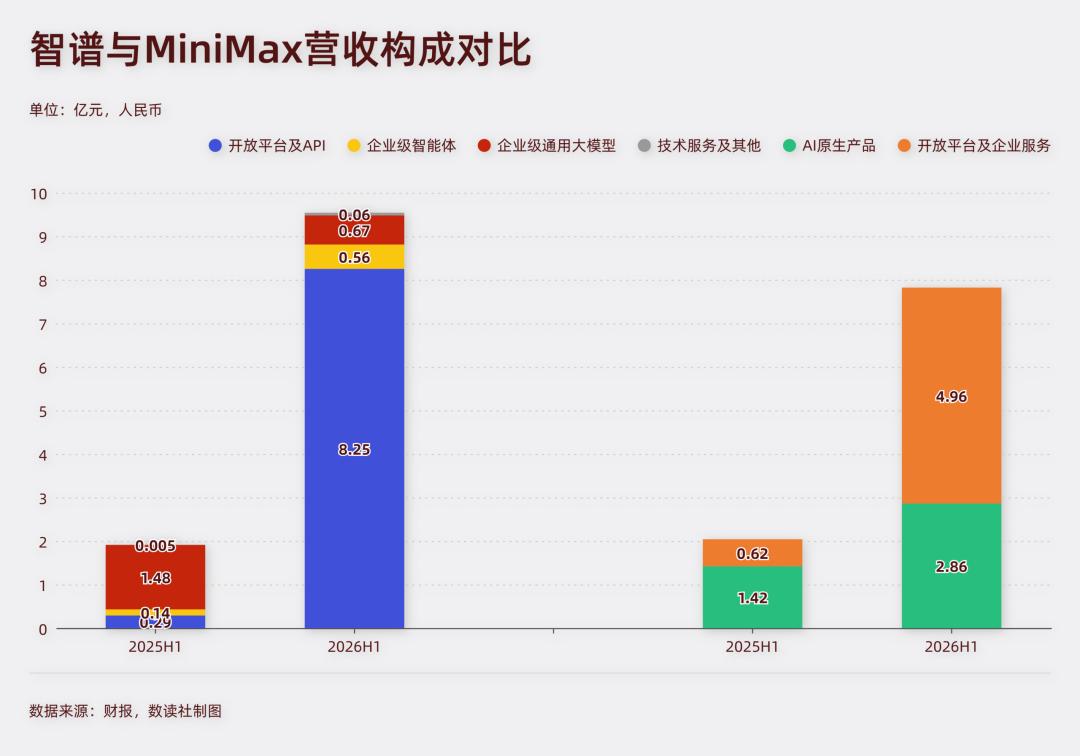
However, in the first half of this year, the revenue from the open platform and APIs skyrocketed from 29.1 million yuan in the same period last year to 825 million yuan, and its proportion in total revenue jumped to 86.5%. Customers no longer need sales staff to visit for promotion, but directly recharge their accounts on the platform based on Token usage on a self-service basis.
As the transaction method changes, the role of sales is naturally diluted. Zhipu AI's statement in the financial report is very straightforward: "Revenue has shifted from one-time recognition to continuous generation, and the Company has for the first time foreseeable recurring revenue."
Zhipu AI's actions after the financial report also confirm this trend: On September 2, Zhipu AI officially settled in Tmall to open an official flagship store, selling GLM Coding Plan subscription packages, with the personal Lite version priced at 118 yuan per month, Pro version at 538 yuan per month, and Max version at 1078 yuan per month.
Selling large model packages on e-commerce platforms was unimaginable in the era of traditional software, but it is happening today. The customer acquisition cost of models is approaching the standard customer acquisition cost of the e-commerce industry.
MiniMax follows a similar logic but takes a different path. In its early days, MiniMax was famous for C-end products such as Conch AI and Xingye, and was often labeled as a "C-end company".
However, in the first half of this year, its revenue from the open platform and enterprise services increased by 703.1% year-on-year to 497 million yuan, accounting for 63.4% of total revenue, surpassing the revenue from AI-native products (287 million yuan) for the first time and becoming the largest source of revenue.
MiniMax's user growth is mainly driven by product strength and word-of-mouth, not by user acquisition campaigns or offline promotion. It attracts developers and enterprises to join independently through the model's own capabilities. It has more than 2 million enterprise customers and developers, 10 times the figure at the end of 2025. Its Token consumption in July reached 20 times that of January, and its ARR exceeded 800 million U.S. dollars in August.
At the performance meeting, MiniMax disclosed that To B business currently accounts for about 80% of its ARR, and To C business accounts for about 20%. The revenue structure that was dominated by the C-end just one year ago now has the B-end as the absolute main force. The speed of this structural adjustment cannot be achieved solely by sales-driven efforts.
When a model has strong enough capabilities and low enough inference costs, developers and enterprise customers will actively migrate to it, not because a salesperson made a phone call, but because they will fall behind in competitiveness if they do not use this model. This "organic growth driven by product capabilities" is fundamentally rewriting the sales expense structure of AI companies.
However, the simultaneous optimization of sales expenses by the two companies can also be interpreted as an active strategic choice: to concentrate resources from high-investment, low-marginal-utility offline promotion to model R&D and infrastructure upgrading.
This is not only "the improvement of technical capabilities", but also "the shift of strategic focus and optimization of cost structure", and the two do not determine each other in a one-way manner. The decline in sales expenses is not just the natural result of "no need for promotion when capabilities are sufficient", but also the management's active choice to "spend money in more efficient areas" under the premise of limited resources.
"In-depth Conversion" and "Service Gap"
Sales expenses can be cut together, but the business models behind them are different.
86.5% of Zhipu AI's revenue comes from the open platform and APIs. The advantages of the API business are self-service recharging, pay-as-you-go billing and recurring revenue, but its disadvantages are also obvious: customer migration costs are stratified, and efforts are needed to promote users to convert to in-depth usage.
For developers and small and medium-sized enterprises with shallow usage, switching models only requires modifying a few lines of code. Such customers are the most price-sensitive, the most willing to try new models, and have almost no loyalty. Once competitors launch products with comparable performance but lower prices, this part of revenue may be lost quickly.
But for enterprise customers who deeply embed AI into their core production processes, the situation is completely different.
According to a survey by Zapier, in 2026, among enterprises that tried to switch AI suppliers, only 42% said the process went smoothly, while the remaining 58% encountered failures or costs far exceeding expectations.
The reason is that AI systems involve supplier-exclusive APIs, private training data, custom deployment tools and deep workflow integration, and these elements cannot be migrated painlessly between different suppliers.
In other words, the switching cost of API calls is indeed not high, but once enterprise customers deeply embed the model into their core business, a de facto "technical lock-in" is formed.
This lock-in effect, to a certain extent, hedges the risk of "zero switching cost", making customer stickiness stronger than expected, and also making the action of "streamlining sales" more reasonable.
Zhipu AI's API customers show a "two-way differentiation": shallow customers have extremely low switching costs and may churn with slight fluctuations in price or performance. Deep customers form a strong technical lock-in effect due to private training data, custom deployment and workflow integration.
The Token usage volume of Zhipu AI's MaaS open platform has increased by more than 40 times since the beginning of the year, the number of paying daily active users has increased by 603%, and the average daily usage volume of the top 10 customers has increased by 98 times. These data confirm the trend of deep binding, as leading customers are embedding Zhipu AI's models into their core businesses.
But the real test lies in: after "optimizing high-cost promotion", can Zhipu AI promote the in-depth conversion of customers at a lower cost?
Customers with deep usage needs API stability guarantees, fine-tuning support, industry solution references and community ecosystem feedback. In the past, some of these capabilities relied on the sales team to coordinate, but in the future, more efficient self-service tools, more complete technical documents and a more active developer community are needed to support these demands.
The potential risk for Zhipu AI lies in whether the speed of functional transformation can keep up with the rhythm of customers shifting from "shallow trial" to "deep binding". If the transformation is too slow, before the stickiness advantage of deep customers is realized, the churn of price-sensitive shallow customers will arrive first.
MiniMax's revenue structure has shifted from being dominated by the C-end to the B-end, while its expenses have declined due to organic user growth, which is a noteworthy structural change.
Where did the money saved from the decline in sales expenses go?
If the cut is made to inefficient offline promotion and brand advertising, and resources are tilted to customer success, solution architects, and after-sales technical support teams, this is a precise reallocation — matching higher customer service density with lower customer acquisition costs.
However, if the decline in expenses is a comprehensive contraction, only focusing on organic user growth while ignoring after-sales capabilities, problems will accumulate: B-end enterprise customers, especially large overseas customers, need not only "a good model", but also SLA commitments, security audits, customized fine-tuning and dedicated response. These services are not naturally attached to the API interface, and require human resources to deliver.
Among MiniMax's 2 million global enterprise customers and developers, the number of leading customers who really need on-site services may be limited, but as the proportion of B-end revenue continues to rise, the absolute number of leading customers and the depth of services are both increasing. Sales teams can be streamlined, but delivery and service capabilities cannot be cut, otherwise the higher the revenue, the faster the renewal risk accumulates.
The real risk is not "streamlining sales", but "whether the unnecessary sales expenses are cut, or the necessary customer success capabilities are reduced", which depends on the management details beyond the financial statements, and public information cannot give a definite conclusion at present.
Model as Sales, Sales Goes Beyond the Model
The competition of large model companies has shifted from "selling software" to "selling intelligence".
The sales expense ratio of traditional software companies is usually 20%-40%, requiring sales staff to convince customers "why you need this software".
But the logic of large models is different: customers do not use them because they are convinced, but because they will fall behind in competition if they do not use them. When the intelligence level of a model is high enough, the decision-making cost of adopting it approaches zero, and the value of sales naturally approaches zero.
This explains why the two companies can reduce sales expenses simultaneously while their revenue is still soaring. It also explains why the R&D expenses of the two companies are still more than 10 times their sales expenses. Zhipu AI's R&D expenditure is 2.131 billion yuan, 12 times its sales expenses (178 million yuan), and MiniMax's R&D expenditure is 2 billion yuan, 11 times its sales expenses (181 million yuan).
The core asset of a large model company is not its sales team, but the model itself. Whoever can push the model to a better experience level in a shorter time can acquire more customers at a lower customer acquisition cost. The decline in sales expenses is not only the natural result of the improvement of model capabilities, but also the management's active strategic choice to tilt resources to R&D.
Large models no longer need sales staff as they used to. Or to put it another way, they barely need sales staff in the traditional sense. When customers shift from "whether to use AI" to "how to maximize value with AI", the role of sales changes from "convincing customers to sign contracts" to "helping customers succeed", which is more like a combination of engineers, consultants and sales staff.
This means that the function of sales is gradually shifting from pre-sales to in-sales and after-sales. OKRs are shifting from user volume to user retention. The model itself is the best salesperson, and human staff are more like serving the customers attracted by the model.
This article is from the WeChat Official Account "Shudu She", written by Hou Yu, and published with authorization from 36Kr.