Song Xuwen, Partner of CloudHill Capital: Quantum Computing: Advancing Engineering and Industrialization in Parallel, the Inflection Point is Approaching | 36Kr 2026 Industrial Future Conference
In 2026, industrial investment has entered a deep-water zone, where capital, technology and industry are accelerating their integration. The old investment logic no longer applies, and new consensus is taking shape. The 2026 Industrial Future Conference focuses on opportunities in the new cycle, and jointly explores the future of the industry and the birth of the "Light of China". From September 9 to 10, the 2026 Industrial Future Conference hosted by 36Kr was held in Yizhuang, Beijing, with the theme of "Above the Deep Water, Resonate for New Birth". Representatives from state-owned capital platforms, industrial investment funds, corporate CVCs, innovative enterprises, and experts and scholars gathered together to focus on the industrialization of future industries such as quantum technology. The conference conducted in-depth discussions on perspectives of cutting-edge technologies and industries at the current stage, intensively demonstrated breakthroughs in technical routes including superconductivity, photonic quantum and ion trap, and shared a large number of specific industrial scenarios, industrial system construction, and prospects of heterogeneous computing, to jointly explore the future of technology industrial investment.
The following dialogue is edited and organized by 36Kr:
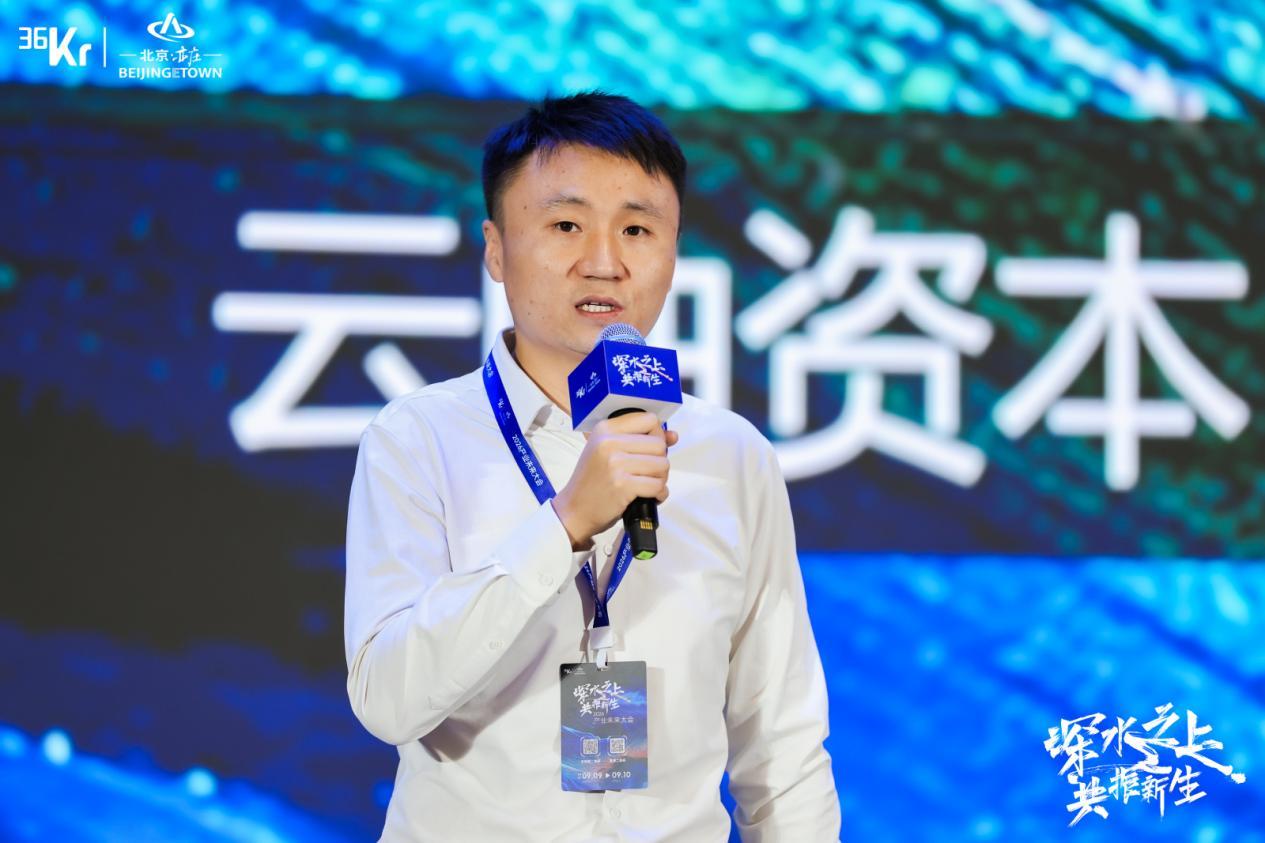
Speaker: Song Xuwen, Partner of CloudX Capital and Head of the Frontier Technology Group
Song Xuwen: Good afternoon everyone! Thanks to 36Kr and Yizhuang for the invitation! CloudX Capital is a leading technology industrial investment service institution in China. Founded 12 years ago, we have long been deeply engaged in the investment and financing business of technology enterprises, and have helped technology enterprises in various fields complete more than 120 billion yuan of financing. We mainly provide financial advisor services, and also operate a direct investment fund that has invested in a total of 20 to 30 companies.
CloudX Capital is also an institution that made layouts in frontier technology fields such as quantum computing quite early. We started to serve quantum computing enterprises as early as 2019, and have successively served 6 to 7 of them so far, including Origin Quantum, Unitary Quantum, Turing Quantum, Tunneling Intelligence and others. At the same time, along the quantum computing industrial chain, we keep attention on the upstream supply chain, downstream ecology, software, algorithms and other links, and extend horizontally to other quantum technology fields such as quantum precision measurement and quantum security.
Next, I will share the industry observations in the quantum computing field from the perspective of capital. Compared with the perspective inside the industry, we are more optimistic. Only by fully recognizing the upper limit of the future development of quantum computing can the capital leverage be used appropriately. We will also pay more attention to overall and trend changes, as well as the right time points. For investment, these are more critical than technical details. At the current stage, the relationship between different technologies and teams is not either-or or life-and-death. From the investment point of view, sometimes "fuzzy correctness" is a more appropriate measurement.
The theme of my sharing today is "Quantum Computing: Simultaneous Advancement of Engineering and Industrialization, Inflection Point is Approaching". In the past year or more, the popularity of quantum computing in the capital market has continued to rise, which in turn promotes the accelerated development of the whole industry. From the perspective of industrial consensus, we are now passing the NISQ (Noisy Intermediate-Scale Quantum Computing) stage, standing on the eve of large-scale fault-tolerant computing, or witnessing breakthroughs of fault-tolerant quantum computing in partial problems. In the past, people generally believed that it would take a very long time for quantum computing to truly move towards general-purpose computing; but now, whether upstream hardware systems, midstream ecological suppliers, or downstream industrial customers are all accelerating their entry into this track, we can actively see that engineering and industrialization are advancing side by side.
We have summarized the latest trends of quantum computing as follows.
First, the underlying quantum hardware technology routes. Regarding the disputes over technical routes, although there were some basic conclusions in previous years, such as confirming one, two or three routes as the most mainstream ones, we have seen some new breakthroughs in recent period that are also worthy of attention. We believe that the underlying technology routes of quantum computing are far from the convergence stage, and there are still opportunities for overtaking on curves. In the future, different quantum computing routes may coexist in a heterogeneous way.
Here we list the representative companies, advantages and disadvantages of several main routes of quantum computing. At present, superconducting quantum is temporarily in a leading position in terms of overall industrial maturity and large-scale progress, which is beyond doubt. Its advantages include fast operation speed, easy chipization, and relatively complete supporting facilities that have been gradually formed in the upstream industrial chain, wafer-level manufacturing, chip interconnection and low-temperature systems.
Starting from the experiment announced by Google Willow at the end of 2024, the industry has stepped into the eve of the large-scale error correction cycle. In the 2026 practice of IBM and the University of Chicago, the logical qubits of superconducting quantum have begun to participate in real calculations. For superconducting quantum, the key points lie in whether the error correction cost can be further reduced with the expansion of scale, and whether modular interconnection can break through the original bottleneck of scalability — for example, IBM released a design of connecting two low-temperature system modules in parallel this year, where multiple quantum computing processor architectures can be installed in one system. These are all very meaningful attempts.
For superconducting quantum, most people now do not doubt that general-purpose quantum computing can be realized with this route, and we have full confidence in this point. More noteworthy issues are whether the error correction overhead from physical qubits to logical qubits can converge, whether the overall system cost after multi-chip expansion, including low temperature, packaging and thermal load management, can be controlled within the industrially acceptable range, and in addition, long-time operation capability is also a relatively challenging part for superconducting quantum.
For the ion trap route, the quality of quantum qubits, especially the fidelity, is one of its major advantages. Meanwhile, it has a long coherence time, which means the quantum lifetime can be maintained for a relatively long period. In addition, qubits in the same trap can easily achieve full connection, and perform stably in some specific operations. In terms of capital benchmarking, the market value performance of international ion trap quantum computing companies also has exemplary significance.
The difficulty still lies in the scalability challenge. The industry initially doubted whether it is difficult to realize engineering when the number of qubits in a single ion trap reaches a certain level, and whether the traditional laser-based addressing, manipulation and readout methods will become very complicated?
In the exploration of ion trap scaling, some representative foreign companies integrate control circuits into silicon chips and use microwave to control gate operations. IonQ's modular distributed expansion further breaks the scaling limit of single ion trap. Judging from the progress of some manufacturers, the ion trap shows good error correction capability, and the large-scale fault-tolerant breakthrough may follow closely after the superconducting route, and the ion trap route will show new strong momentum again.
In terms of neutral atoms, from the perspective of the capital market and the activity of entrepreneurial teams, this year it is a well-deserved dark horse, and the route with the highest increase in popularity. The natural advantage of atoms is that the physical scale can quickly reach thousands of neutral atom array arrangements with reconfigurability. Many domestic and foreign companies have completed basic operations to a certain extent, providing physical support for the subsequent deployment of large-scale error correction codes. This route itself also has strong potential for low-overhead error correction. The qLDPC high code rate error correction code and other technologies promoted by neutral atom representative companies may greatly improve the error correction efficiency compared with the traditional surface code.
Of course, neutral atoms also have inherent problems, which the industry is gradually solving, including the problem of atom loss after scale expansion, how to make timely remedies in multi-depth computing circuits, and how to control large-scale optical systems after array expansion... Some engineering difficulties are being broken through.
At the whole system level, we expect that around 2027, some domestic and foreign neutral atom companies will make great progress in realizing basically demonstrable logical qubits.
Photonic quantum has always been a distinctive quantum computing route. Photons have long coherence time; compared with other routes that require extremely low temperature environment, most of its subsystems can run at room temperature, and are naturally suitable for long-distance network transmission, and compatible with mature integrated photonics processes. The challenges are still the existing problems, such as the weak interaction between photons that makes photonic quantum manipulation and two-qubit computing difficult, and the loss accumulation after the expansion of large-scale optical systems. These are also the problems that academia and industry are continuously solving. Recently, a domestic team has made good breakthroughs in photonic quantum fault-tolerant computing by generating GKP error correction resource states and introducing non-linear modules.
Photonic quantum also has distinctive characteristics in the industrialization progress. Other routes usually complete the whole machine first, finish the transformation of logical qubits, and then gradually promote the commercialization of general-purpose computing; photonic quantum has natural advantages in special problems such as boson sampling from Day 1, and its commercialization path is an interleaved superposition relationship. In the short term, some photonic quantum companies have been able to enter the commercial closed loop in special-purpose machines; in the medium term, through the large-scale manufacturing of photonic chips, and the improvement of physical-level loss and detector efficiency, it will gradually move towards the stage of fault-tolerant general-purpose computing. At the same time, photonic quantum can naturally act as infrastructure, serve as the transmission system between different quantum computers, and as the infrastructure of quantum internet, it can also be industrialized independently. We also observe that the business characteristics of some photonic quantum companies are indeed diversified, not oriented to a single general-purpose computer.
The changes of the following routes are also worthy of attention from the industry and investors. For example, semiconductor spin, represented by the silicon-based spin route, has made gratifying progress in recent period. The biggest advantage of semiconductor spin comes from its manufacturing system. Once the demand for quantum computers reaches ten thousand levels of physical qubits in the future, and we need to manufacture them from the physical level, the semiconductor spin route which mainly relies on electrical control and is naturally compatible with some mature semiconductor manufacturing processes will have the highest efficiency and avoid detours.
Meanwhile, because the size of spin qubit is very small, if the market needs a more miniaturized, intensive and inclusive quantum computer in the future, the high-density characteristic of semiconductor spin may become its unique competitive advantage.
The challenges of semiconductor spin lie in the fidelity of multi-qubit operation, and the challenges of deep coupling with the interest targets of existing semiconductor production lines, which we can clearly perceive, and its development depends on the investment of the semiconductor industry in this field. In the next stage, it is expected that the silicon-based spin route will become more mature in wafer-level consistency, as well as in real high-density full-system packaging and output. Recently, the HRL Laboratory acquired by IBM launched a highly integrated silicon-based quantum processor unit architecture, which has attracted great attention.
Another more cutting-edge route is topological quantum. Other quantum computing routes need to realize error correction after the qubits are manufactured. The topological route suppresses the error rate from the source at the bottom physical level through topological protection, and reduces the error overhead in the whole link. From the perspective of resource efficiency, it may be the ultimate form worthy of investment; but compared with other routes, it is still in an earlier stage: internationally, led by Microsoft, it is conducting exploration from theory to preliminary engineering, including complete verification of topological states, quantum information reading and overall reliability. Compared with other routes, it takes a longer way to go. There are also some teams in China, including the company led by Academician Ding, that have officially started their exploration in topological quantum.
Now, the industry has reached certain consensus on the end-state of the development of different quantum computing routes. First, can the number of physical qubits truly represent the development maturity of quantum computing? People are gradually realizing that it is difficult to equate it with the real computing capability. As the circuit depth increases, noise will accumulate exponentially. Error correction is a huge bottleneck. If we cannot prove that error correction can be "more and more accurate" with the expansion of scale, subsequent calculations may have no practical significance.
Considering the cost, how many extra physical qubits are needed to realize the mapping of one logical qubit is ultimately an economic account. The core of competition between different technical routes in the future has gradually shifted from the scale of physical qubits to the overall logical computing capability, including: whether the improvement of error correction scale can continuously reduce logical errors; whether the unit error correction cost can decrease; whether the sustainable logical operation depth can be further improved and positively correlated with the expansion of scale — these three core elements will determine whether a route can become a truly usable logical computing unit.
From another perspective, in the short and medium term, each technical route has its own strengths. It is difficult to say that one route can fully dominate all the indicators we care about and achieve winner-take-all, including the natural physical quantum scale, operation speed, fidelity, coherence time, system scalability, error correction difficulty, the width of specific problems that can be solved, and the compatibility with existing manufacturing processes.
Now there is a new trend abroad: the future quantum computing system is most likely not a whole machine based on a single quantum computing route, but a whole machine formed by heterogeneous integration of quantum computing units with different functions to complete different tasks. Analogous to the division of labor of CPU/GPU/DPU, we believe this trend is very likely to happen, and the optimal qubits can be dynamically selected for different functions. For example, several existing mainstream routes are suitable for high-speed processing problems; other differentiated routes are more suitable for information storage; in terms of quantum communication and transmission, photonic quantum has natural advantages.
At present, industry practices are carrying out modular packaging of QPUs of different technical routes to break through the performance boundary and scalability bottleneck of a single system; at the same time, through interconnection between different modules, a larger-scale, heterogeneous and high-efficiency system can be realized. The interconnection between different quantum modules itself is a very difficult task, which involves a series of compatibility problems such as quantum state transmission and entanglement of different quantum hardware systems, and interface conversion.
The above content is about the most basic quantum hardware computing units. The second trend is that starting from this year, when people talk about quantum computing, they no longer only focus on the quantum computing whole machine. The whole ecology of quantum computing has begun to be truly active, and more people are trying to bring quantum computing into real business problems, although it is still in the early stage.
Just like car manufacturing, in the past, various countries invested a lot of resources and capital in the competition for quantum supremacy to build a car with very complete functions. But the industry did not think much about what kind of road this car can run on in the future, and most of the test runs were carried out in non-real environments. Now we clearly feel that a large number of companies have joined the work of paving roads; although the large car has not been built yet, at least people riding bicycles and electric vehicles can run on the road for trial first, which proves that the road from the start point to the end point is accessible and supports actual daily commuting back and forth.
Whether through quantum simulators or in some specific problems, the end-to-end quantum ecology is emerging, which is a very good phenomenon. This ecology can be regarded as a two-way interaction process: on the one hand, the quantum computing hardware-side computing power which is relatively niche and has high professional barriers is made into callable, analyzable and verifiable computing units; on the other hand, the application side clarifies what kind of problems can be truly solved by quantum computing and generate value. In the past, many problems demonstrated quantum advantage were artificially designed; for real problems, many companies on the application side are also working hard to design good algorithms, develop corresponding circuit designs, and compile them into computing tasks that quantum computing power can support.
The whole link from the application problem described in natural language to the start of work of qubits has a very long path. In the past, this task might be solved jointly by a number of industrial experts, quantum computing industry experts and suppliers, and each task was like a new experiment or a special research project. When the task characteristics or parameters are changed, the next task cannot be repeated directly — it is not as convenient as we finish a calculation with classical computing and directly input the next problem, and the gap at present is still very large.
In order to pave this road, first of all, we can see that the development of the application side is indeed accelerating. The actual application cases of quantum computing that the industry can see have some common features: they are generally based on the hybrid architecture between existing quantum hardware and classical computing, use real business data or real molecular systems, and require end-to-end result analysis. Specifically, the problems processed mainly fall into three categories:
The first category is problems that are not naturally quantized, but with the expansion of scale, conventional computing is difficult to carry, including some combinatorial optimization problems.
The second category is problems with native quantum states, including quantum simulation in drug discovery and materials. The computing power will expand completely linearly with the number of qubits, and can match the depth of the problem as it expands.
The third category is that quantum computing can be applied to some high-dimensional pattern discovery to capture high-order computing structures that classical methods are difficult to capture.
The algorithms used to solve these problems in the past were more like a continuous debugging and testing process by experienced technicians. Now many teams have turned the quantum algorithms for real problems into services, and this service has at least two layers of progression: on the one hand, the basic quantum algorithm capabilities are made into functions that support repeated calls, without writing the quantum circuit from scratch every time; on the other hand, inspired and resonated by the development of large AI models and Agents, some teams directly promote the Agentization of quantum application implementation workflows, which are packaged as