Bao Jie, Founder, Chairman and Chief Scientist of Corevision: A Decade of Industrial Practice, Quantum Sensing Chips Open the "Perception Portal" to the Material World for Physical AI | 2026 36Kr Industrial Future Conference
On September 9, the 2026 Industrial Future Conference hosted by 36Kr kicked off in Yizhuang, Beijing.
As the most focused quantum-themed session of this year's Industrial Future Conference, scientific research institutions and quantum enterprises including Beijing Academy of Quantum Information Sciences, China Telecom Quantum, Boson Quantum, MegaQ, and Origin Quantum, as well as dozens of industrial capital institutions, jointly discussed the next-stage path for quantum technology to move from the laboratory to industrial applications.
Amid a series of discussions all centered on quantum computing, Bao Jie, Founder, Chairman and Chief Scientist of Quantum Vue, delivered a distinctive and unique speech titled "Quantum Sensing Chips: Unlocking the 'Sensing Entry' of the Physical World for Physical AI".
The speech answered another highly concerned question in the industry: how quantum helps AI understand the real physical world. From quantum dot "artificial atoms" and particle-type spectroscopy paradigm, to AI4S material R&D and city-level smart water systems, this speech demonstrated an industrial path for quantum measurement and sensing to evolve toward physical AI.
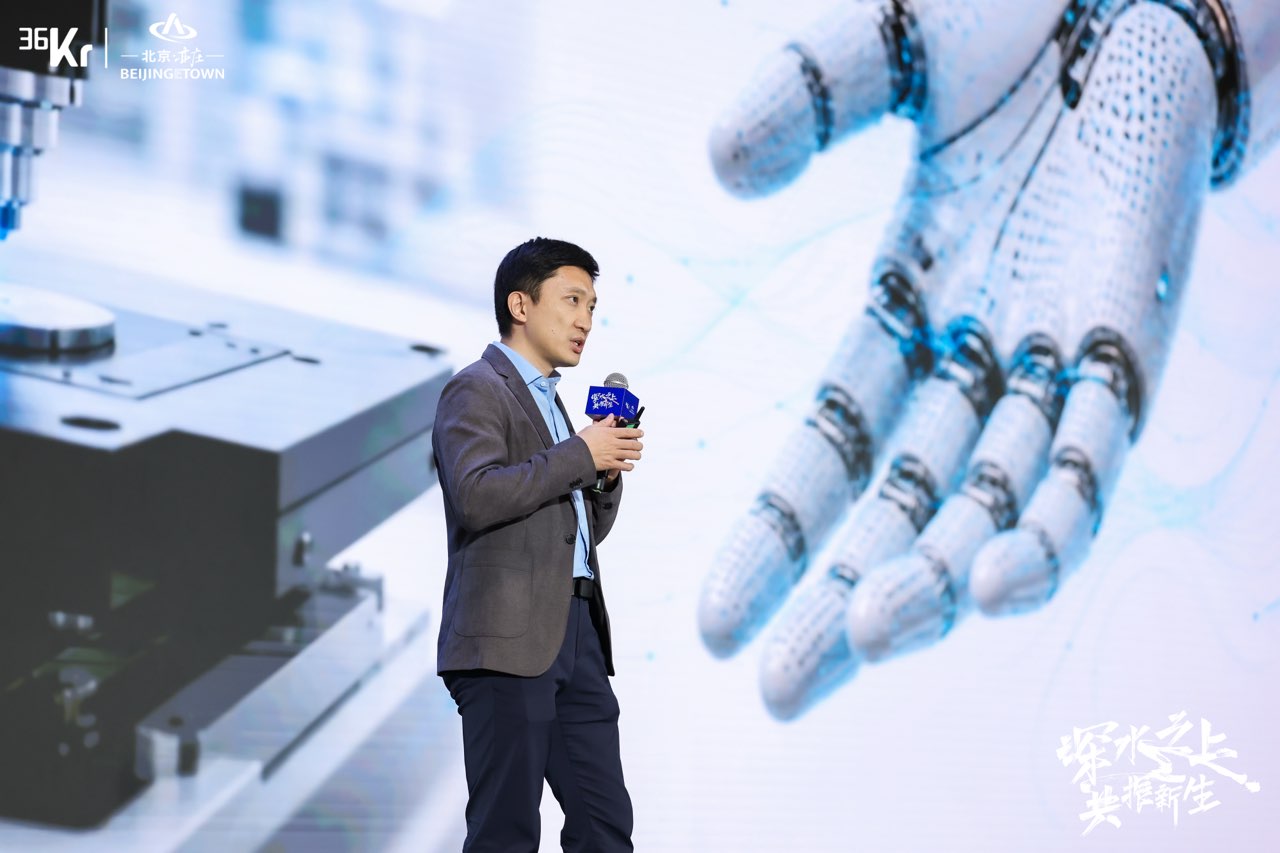
Quantum Sensing Chips: Unlocking the "Sensing Entry" of the Physical World for Physical AI
To understand the real environment, predict environmental changes and support decision-making, physical AI first needs to obtain reliable information about the real world. The real physical world is not a static, simple collection of objects, but a complex system composed of matter, space, time and various interactions: water quality changes, substances migrate, equipment operates, and the environment is also affected by weather, flow and human activities. Even with continuously improving computing power, models still rely on on-site measurement to grasp what is happening in reality.
Quantum computing can expand computing capabilities for certain problems, but it cannot replace continuous observation of the real environment. A model can deduce how pollutants may migrate in a river, but it cannot determine what is in the water at the moment, where the change occurs, and whether the situation has improved after treatment only through deduction. Computing helps models deduce possibilities, while sensing helps models grasp the real state.
What Quantum Vue aims to solve is exactly this connection layer between physical AI and the real physical world: reading information from the interaction between light and matter, converting it into measurable and analyzable data through quantum dot spectral sensing chips, and then providing a basis for AI to understand the environment and judge changes.
Reading material information from a beam of light and converting this information into the basis for AI to understand the real environment, the integration of quantum and artificial intelligence is forming an industrial path at the sensing link. In the speech titled "Quantum Sensing Chips: Unlocking the 'Sensing Entry' of the Physical World for Physical AI", Quantum Vue demonstrated the complete logic of this path: based on the principle of the particle nature of light, using quantum dot "artificial atoms" as the material carrier, transform spectral measurement into deployable chips and sensors to continuously provide physical world data for AI.
This path has been extended to large-scale applications. According to the disclosure of Quantum Vue, its water system-related applications cover 26 provinces and municipalities, with more than 100 cooperating government and enterprise units, and obtain more than 1 billion water quality data points every year. Tracing back to the upstream, the spectral principle innovation supporting these applications started in 2015, and the AI material R&D platform has been under construction since 2016. Quantum provides sensing capabilities for AI, and AI helps quantum material R&D. After about ten years of continuous advancement, the two have formed a system from R&D to application at Quantum Vue.
Physical AI Needs Data, and Data of the Physical World Is Extracted by Sensing
To understand how quantum empowers AI, we first need to look at the data requirements of physical AI. For AI to understand the real environment, predict its changes and support decision-making, it needs to master both physical laws and on-site states. A model can deduce how substances migrate in a river, but what is actually in the water, how the state is changing, and whether the situation has improved after treatment still need to be measured. This is also the importance of sensing to physical AI: it is not an additional link outside the model, but the basis for the model to maintain contact with the real world. Without continuous and reliable observation, it is difficult for the model to judge whether its deduction is consistent with reality, and it is also difficult to verify whether the action produces the expected effect.
Different tasks require different levels of information. Ordinary images can show the appearance and spatial position of objects, but for many material identification tasks, appearance alone is not enough. The system also needs to know what substances the measured object contains, what state it is in, and how these characteristics change over time.
Therefore, what physical AI needs is not only to "see objects", but also to obtain information on material composition and state through sensing, so that AI can obtain real, continuous on-site data that can be used for analysis and verification.
Reading Material Information from Spectra: Quantum Dots Bring a New Measurement Paradigm
Light provides an important way for this kind of measurement. After light comes into contact with matter, processes such as absorption, reflection, scattering or luminescence will change the light intensity distribution at different wavelengths. These changes are related to the composition and state of the substance. Recording the light intensity distribution at different wavelengths gives a spectrum; by analyzing the spectrum, the relevant information of the measured object can be extracted, so the spectrum is often compared to the "fingerprint" of matter. The task of the spectrometer is to read this set of distributions and then analyze the measured object accordingly.
For more than a hundred years, spectral technology has always developed along the "wave nature" route: using wave effects such as refraction, diffraction, and interference to split light of different wavelengths, and then measure them separately. What Quantum Vue proposes is another route — the particle nature spectroscopy paradigm, which is specifically reflected in the transformation of the spectral resolution mechanism: from using wave effects to split light, to using the interaction between photon energy and the quantum energy level of materials for coding. This directly connects quantum principles, quantum materials and quantum sensing measurements, and also provides a new implementation method for spectral analysis to evolve from instruments to micro sensors.
In 2015, as the first author and sole corresponding author, Bao Jie published a research on colloidal quantum dot spectrometers in the world's top academic journal Nature, creating a particle nature route that uses quantum dot material response coding and computational reconstruction of spectra, shifting the important link of spectral resolution to the interaction between photons and quantum materials.
Light of different frequencies corresponds to photons of different energies. Whether a photon can be absorbed by the material and what the absorption response is, is related to the allowed electron transitions in the material. By designing the quantum energy level of the material, its response to photons of different energies can be adjusted. The "from wave to particle" mentioned in the speech points to this transformation of the measurement mechanism — from relying on wave effects for spatial light splitting, to using photon absorption and electron transition to encode spectra.
To turn this principle into a device, the key lies in quantum materials. Quantum dots are semiconductor particles with a size of only a few nanometers. The movement of carriers such as electrons is confined in a very small space, forming an energy level structure with quantized characteristics. This "quantum confinement" enables the optical properties of materials to change with conditions such as size and composition. Quantum dots are therefore often called "artificial atoms": people can regulate the interaction between their energy levels and light through material design.
Different quantum dot materials can form different spectral responses. The same beam of light passes through these material units and leaves measurement signals of different intensities; combining multiple sets of signals, the algorithm can reconstruct the original spectral distribution. Each material undertakes part of the coding task, and multiple materials cooperate with the algorithm to complete spectral resolution. In this way, part of the work that originally relied on the light splitting space is transferred to the response design and computational decoding of nanomaterials, opening up a path for the chipping of spectrometers.
This innovation has also influenced subsequent research. A review of reconstructed spectrometers published in eLight in 2025 pointed out that the 2015 colloidal quantum dot work has significantly promoted related fields and driven the design of computational spectrometers based on low-dimensional materials. From the continuous exploration of the material coding and computational decoding routes in academia, to Quantum Vue's promotion of it into industrialized devices, the principle innovation has gradually extended to the development direction of sensing technology.
From Material Response to Sensing Chips: Principles Must Undergo Engineering to Become Capabilities Quantum dot spectral measurement provides a new principle path, but the principle itself is not equal to a product that can be deployed on a large scale. To make the material response stably converted into spectral information, a series of engineering problems such as material preparation, device integration, signal reading, algorithm reconstruction and measurement calibration need to be solved.
First of all, the designability of materials brings challenges to R&D and manufacturing. The size, morphology, composition and synthesis conditions of quantum dot materials interact with each other, and it is necessary to find a combination that meets the target in a huge parameter space. Professor Bao Jie introduced in the speech that Quantum Vue introduced AI into this process about ten years ago. According to the company, the team built a precision synthesis platform for quantum dots in 2016, and with the support of key projects of the Beijing Municipal Science and Technology Commission in 2018, expanded the system to a hundreds-dimensional parameter space, and promoted independent algorithm control, continuous and stable preparation, and unmanned operation. This platform starts from the target performance and experimental constraints, the system arranges synthesis experiments according to the target performance and experimental constraints, monitors the results such as absorption and luminescence online, and then the algorithm adjusts the next exploration according to the feedback. Experimental data continuously enters the model, enabling the system to identify key factors and select more information-worthy experimental conditions. This is an early practice of AI for Science in quantum material R&D, specifically belonging to AI for Materials: AI participates in material design, synthesis and exploration, providing support for materials and processes required for quantum sensing.
To further form a usable sensing chip, high-consistency preparation, array processing, chip packaging, standardized calibration and mass manufacturing are also required. The material response must be repeatable, the micro units must be accurately integrated, and the device also needs to establish the corresponding relationship between the measurement signal and the spectral information. Quantum Vue continues to advance around these links, connecting principles, materials, manufacturing and data standardization, and gradually forming sensing tools that can be deployed on a large scale.
From Optical Signal to Material Information: How Sensing Data Is Formed
The role of the quantum sensing chip is to convert the information formed by the interaction between light and matter into readable and analyzable data. Its basic process is: Light first interacts with the measured substance, carrying its composition and state information; quantum dot materials then form differentiated responses to these spectral information; the detector converts the light intensity change into an electrical signal, and the algorithm reconstructs the spectrum according to the calibrated response relationship. Combined with the corresponding calibration and analysis model, the system further extracts information related to the material composition or state. The changes in the physical world are thus converted into data available for AI through sensing and computing.
Sensing capabilities can also be extended from light intensity measurement to spectrum and spatial imaging. Light intensity records the magnitude of the signal, spectrum presents the distribution at different frequencies, and imaging further gives the spatial position of these features. Coupled with continuous time recording, the data can describe where the material state changes and how it evolves over time. According to Professor Bao Jie, the Quantum Vue team has realized these three levels of functions in the quantum dot system, and the real observations obtained from this can provide samples for model training, and provide a basis for verifying predictions and evaluating action results.
This empowerment is not only reflected in the information dimension, but also in whether the data can be obtained continuously and extensively. With smaller volume, sensors can enter more sites; with faster response, they have more opportunities to record short-term anomalies and state transitions; with cost suitable for large-scale deployment, a sensing network covering different locations can be formed. Professor Bao Jie compared this sensing network to "skin", emphasizing the demand of physical AI for extensive and continuous sensing. The chipping path brought by quantum principles is transformed into deployment conditions through engineering manufacturing, which in turn affects the data coverage, timeliness and richness of AI.
Realizing Large-scale Verification in Water Systems: From Continuous Sensing to Intelligent Judgment
The water system is the earliest and most mature application scenario for Quantum Vue's quantum dot spectral sensing technology. According to public media reports, its water system-related applications cover 26 provinces and municipalities, with more than 100 cooperating government and enterprise units, and obtain more than 1 billion water quality data points every year. Focusing on surface water, drainage pipe networks, water conservancy, groundwater and water supply, the sensing terminals convert on-site water quality changes into continuously observed data. Water quality changes are continuously recorded through on-site measurement, and then combined with information such as water volume, water level, pressure, meteorology and equipment operating status to form multi-dimensional observation of the real system.
In the physical AI architecture for water systems demonstrated in the speech, these observations are further associated with river networks, pipe networks and facility structures, and combined with professional models such as hydrodynamics, water quality and engineering constraints to support anomaly diagnosis, risk prediction, scenario deduction and scheduling scheme comparison. Spectral sensing provides evidence of material changes, other sensing information supplements operating conditions, physical models help explain and deduce, and AI carries out analysis and judgment on these bases.
For example, for the same increase in water quality indicators, its source and propagation process need to be judged in combination with the upstream and downstream positions, flow direction, rainfall, and gate and pump status. The new round of measurement after treatment can test the effect of the previous judgment and measures. Quantum sensing provides an entry for material information in this process; spatiotemporal correlation, physical laws and continuous feedback allow this information to further serve AI's understanding of the complex environment. The terminal network that Quantum Vue has been running for ten years and the continuously accumulated data provide a realistic basis for this application architecture.
From Quantum Material R&D to Physical AI: Forming a Two-way Empowered Industrial Path
Quantum Vue's practice has made the two-way empowerment of quantum and AI have a clear engineering connection: AI assists in the development of quantum materials, quantum materials support sensing chips, chips continuously acquire material data in the real environment, and the data then serves AI's understanding and judgment. Quantum Vue made forward-looking layout and continuous R&D ten years ago, connecting principle innovation, quantum materials and large-scale sensing, and forming a quantum-AI integration system that has been put into operation.
A number of investors who listened to the speech on site said that Quantum Vue's value in the capital market lies not only in the quantum dot spectral sensing technology itself, but also in its ability to continuously transform original technology into industrial applications: starting from the original spectral measurement principle, supported by AI-assisted material R&D and chip engineering, and verifying the deployment capability and data value of sensing technology through real scenario applications.
This means that what Quantum Vue has accumulated is not a single water service product or a certain type of sensor, but a set of underlying sensing capabilities that can be extended to multiple industries. As physical AI moves from the digital space to the real environment, the acquisition of material information will become an important link connecting the model and reality. The technology, devices, applications and data foundation formed by Quantum Vue in the past ten years will provide a solid foundation for its further expansion to directions such as embodied intelligence, aerospace information, and medical health, and continuously transform technological advantages into replicable and scalable industrial growth.