Roundtable: Implementation · The Emergence of Quantum Computing Scenarios — If Quantum Computing Power Becomes Available Tomorrow, Who Will Be the First to Pay | 36Kr 2026 Industry Future Conference
In 2026, industrial investment has entered a deep-water zone, with capital, technology and industries integrating at an accelerated pace. The old investment logic no longer applies, and a new consensus is taking shape. The 2026 Industrial Future Conference focuses on opportunities in the new cycle, and jointly explores the future of industries and the birth of the "Light of China". From September 9 to 10, the 2026 Industrial Future Conference hosted by 36Kr, with the theme of "Above Deep Waters, Resonate for New Birth", was held in Yizhuang, Beijing. Representatives from state-owned capital platforms, industrial investment funds, corporate CVCs, innovative enterprises, experts and scholars gathered together, focusing on the industrialization of future industries such as quantum technology. The conference conducted in-depth discussions on current cutting-edge technologies and industrial perspectives, intensively demonstrated breakthroughs in technical routes such as superconductivity, photonic quantum, and ion trap, shared a large number of specific industrial scenarios, industrial system construction, and the prospects of heterogeneous computing, and jointly explored the future of technology industrial investment.
The following dialogue is edited and organized by 36Kr:
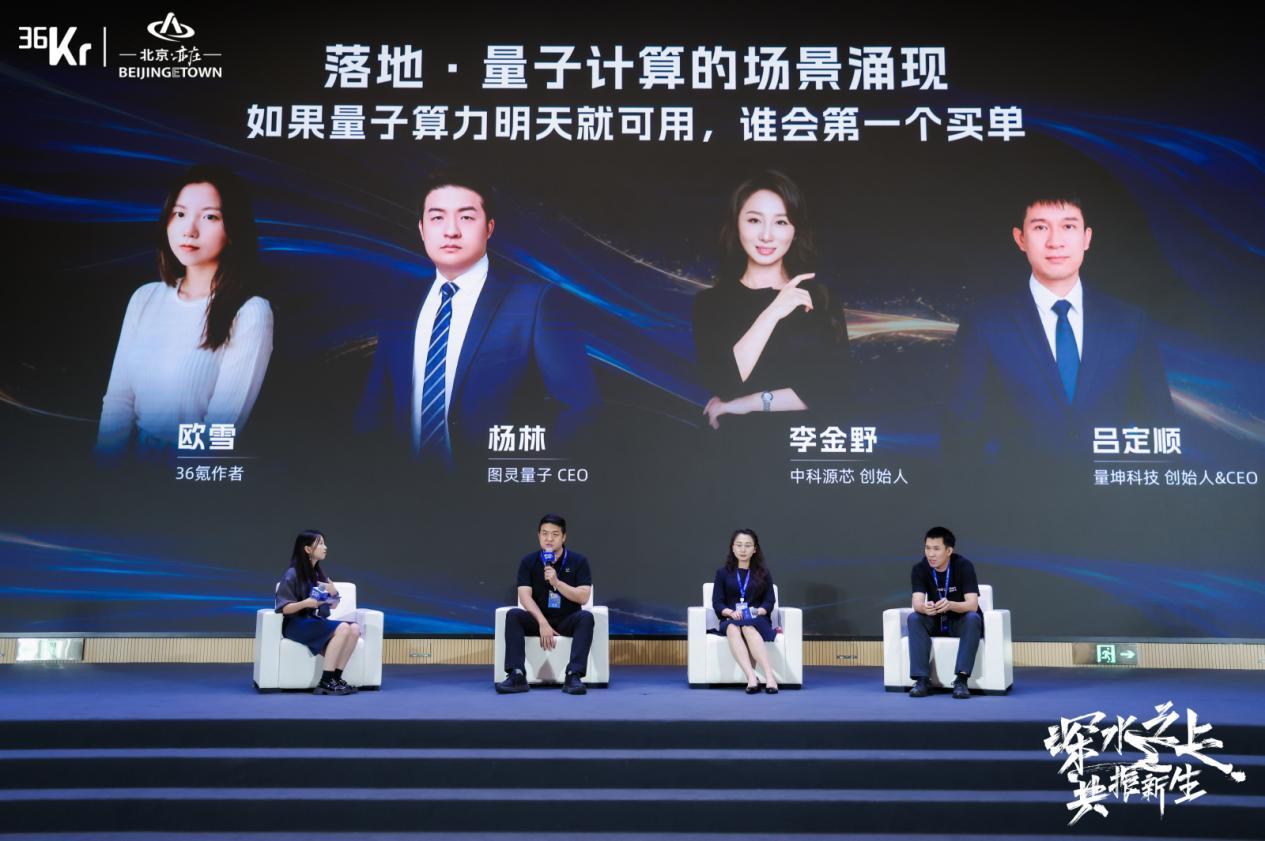
Ou Xue | 36Kr Author (Host)
Yang Lin | CEO of Turing Quantum
Li Jinye | Founder of Zhongke Yuanxin
Lü Dingshun | Founder & CEO of Liangkun Technology
Ou Xue: Hello to all friends on site and online! I'm Ou Xue, author from 36Kr. It's my great pleasure to meet you all again this afternoon.
We have heard a lot of topics about quantum computing throughout the whole day. The topic we are going to talk about now may be a concern for many people, that is, the implementation of application scenarios.
In 2026, quantum computing is at a very delicate position. There is good news that more and more enterprise users are willing to spend money on quantum computing, and even the expenditure of some enterprises exceeds that of governments and scientific research institutions. There is also not so good news that the current spending scale is still limited, because the current implementation of quantum computing is still in the exploration stage, and there is a certain distance from large-scale application.
Today we are going to talk about the most practical thing: if quantum computing power is available tomorrow, who will appear in front of us all with a budget? Today we have invited three guests to the scene, and their allocation is very interesting. Strictly speaking, they are not competitors, but three interlinked roles in the same industrial chain. Some develop complete machines and directly face customers, some build platforms to connect computing power and industries, and some sell key upstream devices. Therefore, in the commercial application scenarios of quantum computing, who will pay real money may have completely different perceptions from the perspective of the three guests. It is precisely because of the different perceptions that the discussion is very interesting.
First, let's ask the three guests to introduce themselves, and briefly talk about what their companies are doing now and who they are doing business with.
Yang Lin: Good afternoon everyone, I'm Yang Lin from Turing Quantum. Our Turing Quantum was founded in Shanghai in 2021, and it is a photonic quantum computing enterprise incubated by Shanghai Jiao Tong University. We focus on integrated photonic quantum, and are committed to the development of complete quantum computing hardware machines, as well as commercial delivery and industrial implementation.
After 5 years of development, Turing Quantum has initially completed the full-stack R&D chain capability from chip tape-out, chip packaging, component processing, complete machine integration to software and hardware platform construction, which is also the feature of our Turing Quantum.
At present, on the product side, the company has developed three generations of complete photonic quantum computing machines, and our third-generation complete machine will be released in Shanghai this Saturday. At present, on both the product side and the commercial side, we have actually carried out early communication and commercial delivery with a large number of customers. Including in some key industry application fields, we are now promoting the delivery of complete machine hardware, the construction of quantum-classical hybrid computing centers, and the operation of computing power cloud platforms, using various business models to try to promote the early commercial implementation of quantum computing.
Li Jinye: Thank you for the invitation of the organizer, thank you host. Good afternoon everyone, I'm Li Jinye from Zhongke Yuanxin. Our company was founded in 2023 in Beijing Yizhuang National Information Technology Application Innovation Park. It is a cutting-edge high-tech optoelectronic enterprise founded by a PhD team from the Chinese Academy of Sciences, focusing on the R&D, production and sales of high-performance thin-film lithium niobate modulators, integrated transceiver components and high-speed optical interconnection devices.
The products independently developed by our company in IDM mode mainly include: various types of thin-film lithium niobate modulators (such as intensity/phase/IQ/DPIQ), integrated coherent optical receivers, multi-channel integrated transceiver components, integrated optical frequency combs and so on. The relevant technologies and products are mainly applied to customers in the fields of quantum computing, communication networks, data centers, microwave photonics and other fields. At present, the company's related products have completed mass installation for a leading quantum computing enterprise, the delivery of space-borne integrated optical frequency combs, and the delivery and application verification of multi-channel integrated modules for microwave optical radars. This is the general technical situation of our company.
Lü Dingshun: Hello everyone, I'm Lü Dingshun from Liangkun Technology. Compared with the previous two companies, Liangkun Technology is relatively new, and it was established in the Economic Development Zone only in January this year. The original intention of its establishment is to use the integration of quantum computing, artificial intelligence and high-performance computing to promote the real implementation of quantum computing and solve problems in actual scenarios.
Although it has not been established for a long time, we have completed the development of two versions of Quantum-HPC-AI Integration V1 and V2: V1 was released at WAIC in Shanghai, and V2 was released at HICOOL. The core is to uniformly connect the major domestic superconducting quantum computing power, quantum simulators and simulator computing power, as well as intelligent computing AI models, HPC and other resources at the bottom to form our computing power layer.
At the algorithm layer, we have continued to develop a lot of advanced algorithms. The most concentrated achievement is that we recently ran a protein molecular simulation of 12,600 atoms released at HICOOL - an implementation application close to actual scenarios, with an efficiency 200-300 times higher than that of IBM, which can be used as a technical benchmark in the industry. At present, Liangkun Cloud can already provide simulation of about 300 atoms, and the speed of ten-thousand-level atoms is still being optimized.
The application layer is more project-oriented. We have very few BD staff, only 1 person, who is docking with the needs of 30 to 40 customers, and is actually too busy to handle all the work. Transformation itself is a funnel, but in the fields of chemical engineering, biomedicine, and semiconductor materials, we have at least two customers in each field that have a close cooperative relationship, and some have even reached the stage of negotiating contracts and down payments. This is our overall progress.
Ou Xue: Thank you for the introduction of the three guests, and everyone has a general perception of what the three enterprises are doing. Next, let's take a closer look at the customer profile and willingness to pay. First, the question is for Mr. Yang. Turing Quantum has been very close to industries such as finance, pharmaceuticals, and energy in the past two years. If quantum computing power matures tomorrow, which industry do you judge will be most interested in coming to you?
Yang Lin: In fact, people's concern about the field of quantum computing basically comes from the outbreak of its large-scale parallel computing power, but strictly speaking, quantum computing is not applicable to all application scenarios. Now there is a common consensus that the four major application scenarios, including quantum simulation, combinatorial optimization, password decryption, and quantum artificial intelligence, are the most likely to realize the first application of quantum computing. Or the quantum algorithms that we know currently have acceleration effects are likely to be covered in these four major directions.
From these four major directions to infer high-value scenarios and industries, we are currently more optimistic about biomedicine, financial technology, artificial intelligence, as well as materials, electric power and other fields, which we think are of more industrial promotion value.
These industries have been carrying out POC cooperation with leading enterprises and key customers in related industries since the early days of Turing Quantum, when our first-generation complete machine completed functional preparation. For example, in the algorithm scenarios of biomedicine and other industries such as molecular structure generation and sequence prediction, whether it is quantum simulation algorithms or combinatorial optimization algorithms, they can be applied in the early stage in these scenarios.
If according to the assumption you just mentioned, that large-scale fault-tolerant quantum computers arrive tomorrow, we think that in the scenario of quantum artificial intelligence, it is possible to give birth to not only the industries I just mentioned, but also new industry forms. For example, under the background of large-scale biomedicine, with the help of general-purpose fault-tolerant quantum computers, it is possible to produce a brand-new biomedicine industry and system completely different from the current pharmaceutical industry, as well as new business forms.
We are all looking forward to the future general-purpose quantum computing being able to create a new trillion-level market. This is our greatest imagination space for quantum computing, such as the ultimate computing power and the underlying computing capability for the future, to create brand-new industries and markets similar to large models and embodied intelligence, and promote greater scientific and technological development and the transformation of the whole social life.
Ou Xue: I think the imagination behind the new business form is still infinite. Next, I would like to ask Mr. Li. Today your company is the only one on site that does not directly make quantum computing complete machines, but quantum computing is actually inseparable from the products of your company. Our current customers cover a lot of fields. From the perspective of the company's delivery notes, have you seen which customers have placed orders with real money, and can you share with us the change curves of some orders and repurchase rates?
Li Jinye: As you said, our company mainly makes thin-film lithium niobate optoelectronic devices and does not make quantum computing complete machines, but our thin-film lithium niobate modulators are indispensable core optoelectronic units for quantum computers in some technical routes such as photonic quantum and ion trap. In other words, we are the link of "selling water" / "selling shovels" for quantum computing complete machines.
In the past two years, relying on the thin-film lithium niobate IDM integrated platform, we have launched products such as thin-film lithium niobate modulators, transceiver components, and integrated modulation phase-shift modules. The customers who have achieved substantial commercial orders are mainly leading quantum computing enterprises, aerospace research institutes, national key laboratories and university scientific research institutions. Different application scenarios have great differences in the photoelectric indicators and environmental adaptability requirements of devices, so we adopt the "customized R&D + flexible production" model to match the differentiated indicator requirements of each customer's system.
From the perspective of order scale, the company's overall order scale this year is about more than 20 million RMB, and the orders in the past two years have maintained a steady upward trend. Customer repurchase also presents clear phased characteristics: once downstream customers complete the finalization verification of the system scheme and technical route, they will enter the stage of small batch continuous repurchase. The finalized scenarios set high access thresholds for device consistency and long-term stability. At the same time, customers' stable repurchase demand, as well as their trust in product indicators and consistency, in turn drive us to complete the process solidification and product finalization of corresponding devices.
Objectively speaking, the current thin-film lithium niobate technology has made key breakthroughs and is entering the first year of accelerated implementation and application. The overall market size is determined by the overall market of downstream application industries. We look forward to the support of the national "15th Five-Year Plan" strategy, the explosive growth of cutting-edge application fields such as quantum computing, AI data centers, aerospace, which will drive the coordinated development of the upstream optical device supply chain and the entire optoelectronic integration ecosystem.
Ou Xue: Indeed, from the upstream perspective, the entire order logic is indeed different. Next, I would like to ask Mr. Lü. You are taking the AI for Science + quantum integration route. Directly facing industries with high R&D intensity such as lithium batteries. After dealing with customers, do you think they have some misunderstandings or expectations about quantum computing?
Yang Lin: Frankly speaking, there are still misunderstandings. I remember that at the very beginning, we talked with a teacher who studies solid-state batteries at the Institute of Physics. He said that an enterprise told him that quantum computing could accelerate his research in some way, and asked me to help him judge it. As a person in the industry at that time, I was really embarrassed. It was not right for me to say it couldn't work, and it might go against the objective reality if I said it could work.
But from the perspective of our real customers, most of the customers I have come into contact with do not care whether you use quantum computing or not. They care more about whether you have developed better formulas or materials for the positive electrode, negative electrode, and electrode. That is the first practical demand.
The second demand is that it is absolutely impossible to make them understand quantum computing. Don't expect downstream application manufacturers to understand such advanced technologies. They can't even understand AI, let alone quantum computing.
Our final conclusion is: for these customers, we need to spend a lot of time converting their needs into things that we can do, and finally deliver a result that satisfies them. It's the same when we talk to pharmaceutical customers. We say we are great at this and that, but they will say what you are so great at has nothing to do with them. They can't see the long mapping process between your excellent technology and their specific needs.
The lithium battery industry is the same. When we are actually solving lithium battery problems, we use the integration of AI and quantum to do it, and we want to give them a solution. Customers actually don't care whether the nickel content is 80%, 50% or 30%. That's what we face when we face real customers. We won't say that when we face investors, but when we face real customers, we need to judge when quantum can solve their problems according to their actual needs, which is more realistic.
Ou Xue: It does show that there is still a certain mismatch between real demand and upstream technology. Next, it naturally leads to the second round of topic: what is the actual progress of the current related application scenarios? The question is first for Mr. Lü. Your current process of AI for Science preliminary screening + quantum precise calculation + experiment mixed flow has actually formed a closed loop, which seems to be the closest to industrial application at present.
What step has the current closed loop reached? If it is still in the verification stage, what are the stuck points? Can you share with us? What stage do you think the closed loop has reached now?
Lü Dingshun: In the general environment of AI for Science, with the emergence of quantum, we can call this generation the Fourth Paradigm ++. I think a major difference is that quantum provides higher resolution and higher precision data here. On the whole, especially for the calculation of some transition metal oxides, the calculation was not accurate enough before, so there is room for improvement in calculation accuracy.
These data can be fed to the AI model to improve the performance of the model, which is expected. The difficulty lies in what we are doing now - no matter AI for Science or not - it is actually a virtual environment, just like I tell you how to cook, but I don't cook it myself, I just tell you that you can cook so many dishes in this way.
So next we will hand over the plan to the experimental partner for verification. This process is currently separated, and we do not complete the closed loop ourselves, but hand it over to them. After finishing it, we found a new problem: many customers are unwilling to hand over the basic formula to us, out of the consideration of IP protection and technical secrets, which is one of the stuck points. In addition, how to price such new things - pricing is a minor issue, and security is very important.
The verification cycle is another matter: I tell you how to cook, you give me feedback after cooking, and I go back to correct my model. And it's not a one-time thing, it needs closed-loop feedback. This closed-loop feedback completely depends on the frequency of communication and trust between the two sides, which is one of the stuck points in our process of serving real customers.
Another point is price. Business needs to talk about money, which is a very important factor and also an influencing factor.
Ou Xue: Mr. Li, for the real progress of downstream applications, I think the upstream may have more perception from the orders. So I would like to ask when photonic quantum computer manufacturers purchase devices from you, do they usually place orders in batches or just carry out some sample tests?
Li Jinye: For quantum computing customers, there is currently a dual-track order mode of "mass production + customization