Roundtable: Leap · Deep AI Current, Value Surge — In the Deep Water Era of AI, From Model Competition to the Emergence of Industrial Value | 36Kr 2026 Industry Future Conference
In 2026, industrial investment has entered a deep-water zone, where capital, technology and industries are accelerating their integration. The old investment logic no longer works, and a new consensus is taking shape. The 2026 Industrial Future Conference focuses on opportunities in the new cycle, and jointly explores the future of industries and the birth of the "Light of China". From September 9 to 10, the 2026 Industrial Future Conference hosted by 36Kr was held in Yizhuang, Beijing, with the theme of "Resonant New Birth Above Deep Waters". Representatives from state-owned capital platforms, industrial investment funds, corporate CVCs, innovative enterprises, experts and scholars gathered to focus on the industrialization of future industries including quantum technology. The conference conducted in-depth discussions on current cutting-edge technologies and industrial perspectives, intensively demonstrated breakthroughs in technical routes such as superconductivity, photonic quantum and ion trap, shared a large number of specific industrial scenarios, industrial system construction practices and the prospects of heterogeneous computing, to jointly explore the future of sci-tech industrial investment.
The following dialogue is sorted out and edited by 36Kr:
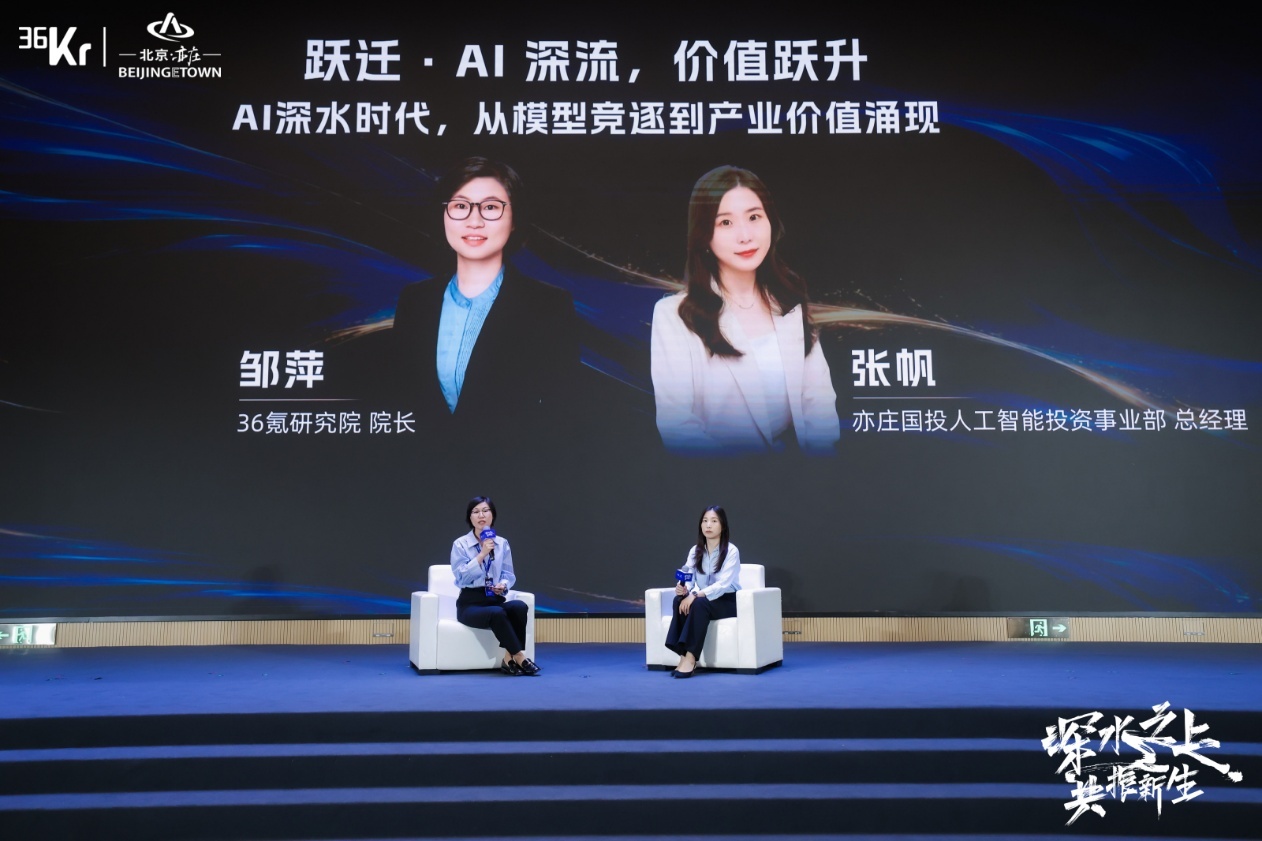
Dialogue Guests:
Ms. Zou Ping, Dean of 36Kr Research Institute
Ms. Zhang Fan, Deputy General Manager of the AI Investment Department of E-Town Capital
Zou Ping: Good morning everyone, I am Zou Ping from 36Kr Research Institute. As several previous leaders mentioned, this year is the starting year of the 15th Five-Year Plan, and the central government and local governments have successively issued the Outline of the 15th Five-Year Plan, clarifying the industrial directions for key development in the next five years.
Among them, the leaders also mentioned that quantum technology has been clearly included in the six major future industries, which not only reflects the improvement of its industrial positioning, but also means that quantum technology will accelerate its transformation from laboratories to industrialization in the next five years.
In this process, state-owned capital has become an important leading force for fostering new quality productive forces. Today we are also very honored to invite Ms. Zhang Fan from E-Town Capital to discuss with us the future industrialization path of quantum technology from the perspective of patient capital and regional industrial ecology cultivation. Welcome, Ms. Zhang Fan.
Zhang Fan: Thank you, Dean Zou, and thank 36Kr for the invitation. E-Town Capital has carried out some explorations in the field of quantum investment in the past two years, and I am very glad to communicate with many representatives of invested enterprises and industry peers on site today.
Zou Ping: Ms. Zhang, we also observe that as quantum technology is incorporated into the modern industrial system, Beijing, Shanghai, Shenzhen, Hefei and other cities have successively introduced special support policies and set up relevant industrial funds, and the industry competition is gradually emerging. At the same time, it also brings the risk of homogeneous layout. From the perspective of E-Town Capital, in the national quantum technology industry map, how does Yizhuang clarify its own differentiated development path to avoid homogeneous competition? Especially in making up for the shortcomings of the industrial chain and building an industrial system with Yizhuang characteristics, what core layouts and practices have been carried out at present?
Zhang Fan: Yizhuang has the most complete integrated circuit industrial chain and high-end manufacturing capacity in China, which is exactly the important industrial foundation for the development of quantum computing, especially quantum computing hardware. Therefore, Yizhuang's development orientation is very clear: we are not building a quantum industrial park from scratch, but relying on the existing industrial foundation to provide good industrial soil for the development of the quantum industry. At present, we focus on key links such as complete machine manufacturing, key components, test and verification, and large-scale mass production.
Zou Ping: You just mentioned that in the process of developing quantum technology, Yizhuang does not start from scratch, but promotes the integrated development of quantum technology and the regional industrial ecology based on existing resource endowments and industrial foundations. We also observe that Yizhuang is promoting the "two-wheel drive" development strategy of artificial intelligence and quantum technology. We know that artificial intelligence was first written into the government work report in 2017, and "AI+" was written into it again in 2025. In August of the same year, the "AI+" action plan was also proposed.
The industrialization path of artificial intelligence is gradually becoming clear. In contrast, quantum technology is still in the stage of engineering exploration, and the technical routes have not yet fully converged.
Ms. Zhang, for the quantum technology field, how does E-Town Capital formulate its investment strategy? In the process of project selection, do you pay more attention to the technological leadership and engineering capability of the enterprise, or the potential for deep synergy with Yizhuang's leading industries? How do you make a comprehensive judgment on this?
Zhang Fan: First of all, I very much agree with the point you just mentioned.
At present, artificial intelligence has entered a stage of rapid commercial realization. Some AI enterprises we invested in had a total annual operating revenue of only tens of millions of yuan last year, while their revenue in a single month this year has exceeded the total level of last year. Similar situations are not isolated cases, and the growth rate of enterprises has also significantly exceeded our expectations.
However, quantum technology is still in a relatively early stage, the technical routes are not yet fully mature, and commercialization has just started. As Teacher Jin shared earlier, there are still many things to do in the next kilometer. Therefore, in terms of investment strategies in the quantum field, there are certain differences between us and mature industries such as artificial intelligence. First of all, from the perspective of investment stages, the market usually has an impression of large state-owned capital investment institutions like E-Town Capital that they prefer to invest in mature projects or Pre-IPO stage projects, and participate in investment after enterprises reach a certain scale. But in the quantum field, our investment strategy is relatively aggressive, we will start layout from early stages such as angel round and Pre-A round, and grow together with enterprises. This is an important feature of us in the investment stage.
In addition, regarding the project evaluation criteria, I think we mainly focus on the following aspects:
First, the team capability. We first pay attention to whether the team has the determination to truly promote technological innovation and industrial development. Because many entrepreneurial teams in the quantum field come from the achievement transformation of universities and scientific research institutes. At the same time, we also pay attention to whether the team has long-term accumulation in its technical route or professional field, and whether the enterprise's equity structure, equity incentive mechanism and other aspects can support the sustainable development of the team.
Second, the technical capability. The choice of different quantum technical routes, as well as the performance of relevant technical indicators, including patent layout and technical protection capabilities.
Third, a point we are very concerned about, is the engineering transformation capability. Some teams may have achieved good results in the laboratory environment and published a large number of papers, but whether they can truly achieve engineering implementation is an important factor determining the industrialization of quantum technology. Quantum technology itself is a highly interdisciplinary field, which cannot achieve breakthroughs by relying on a single discipline, but requires the combination of hardware, software and system capabilities.
Finally, we will also pay attention to whether the enterprise can fully integrate into Yizhuang's industrial ecology, and whether it can achieve faster and better development by relying on the local industrial foundation. In general, we mainly conduct comprehensive evaluation from the above dimensions.
Zou Ping: Therefore, when E-Town Capital invests in quantum technology projects, it not only pays attention to short-term financial returns, but also pays more attention to the whole life cycle growth of enterprises from the early development stage to the mature stage.
At the same time, we will also focus on investigating the technological advancement and engineering capability of enterprises, as well as whether they can form deep synergy with Yizhuang's existing advantageous industries.
Zhang Fan: Yes.
Zou Ping: Borrowing your point just now, Yizhuang has a relatively complete integrated circuit industrial chain and high-end manufacturing capacity, which is also an important foundation for the development of quantum computing hardware. Have we taken the initiative to promote the hard synergy between these invested projects and Yizhuang's leading industries? Are there any actual implemented cases that can show us the effect brought by the support of Yizhuang's characteristic industries, such as shortened R&D cycle and reduced supply chain cost? Can you share some specific cases with us?
Zhang Fan: Industrial empowerment and industrial synergy are the core advantages of Yizhuang, and also our important capabilities. Here I share a case of cross-field synergy. The newly released Liangkun Technology is a quantum algorithm enterprise we invested in that focuses on AI+ application algorithms. Guoqi Zhilian is a national-level intelligent connected vehicle innovation platform in the Economic Development Zone.
At present, in the field of intelligent connected vehicles, especially autonomous driving, an important challenge is that a large amount of data needs to be transmitted between the vehicle end and the cloud, including intelligent driving parameters, cockpit data and so on. Traditional encryption methods may face potential security risks in the face of the improvement of quantum computing capabilities in the future. Based on this demand, we promoted the cooperation between Liangkun Technology and Guoqi Zhilian. Liangkun Technology applies technologies such as quantum random generation and quantum key distribution to automotive scenarios, realizing full-link quantum security protection from local generation of vehicle-mounted keys, to vehicle-end communication encryption, and then to intelligent driving data transmission. More importantly, this cooperation is not only at the simulation verification or laboratory stage, but has passed the actual verification of the vehicle test link of Guoqi Zhilian, and has the potential for further large-scale promotion in the future.
I think this is a good case of industrial synergy.
On the one hand, Yizhuang has a good industrial foundation, for example, as a national-level high-level autonomous driving demonstration zone, it has rich resources in the field of intelligent connected vehicles; on the other hand, we have industrial platforms such as Guoqi Zhilian, as well as innovative enterprises such as Liangkun Technology. Through industrial resource connection and ecological synergy, we combine quantum technology with the automotive industry to promote the real implementation of the "quantum + automotive" application scenario. There are many similar cases, and many application scenarios and related cases were also released in the previous session.
Zou Ping: From the perspective of E-Town Capital, we will not only provide financial support for these projects, but also accurately connect them with some industrial chain resources, talent demands and some so-called fast-opening scenarios, so as to achieve efficient collaboration between upstream and downstream for these projects.
At the same time, we also see that all leaders have released the Quantum Constellation Physical Community. Through the aggregation of physical carriers, we can also realize the clustered development of the quantum technology industry, so as to achieve the ultimate synergy effect between upstream and downstream.
Zhang Fan: Yes, maybe we can talk about the deal over a cup of coffee at noon.
Zou Ping: Finally, please make a forward-looking prediction. In the next 3 to 5 years, the domestic quantum technology industry will most likely shift from the eve of engineering to the industrialization verification period. In this very critical transformation stage, what should our state-owned capital adhere to most, what risks need to be guarded against, and what specific sub-tracks will E-Town Capital focus on in the quantum technology field in the next stage?
Zhang Fan: As a state-owned investment institution, E-Town Capital is currently continuously paying attention to the cutting-edge field of quantum technology.
First, we will adhere to long-termism and not be influenced by short-term market hotspots. At present, quantum technology has received widespread attention, including multiple directions such as the competition for the number of quantum bits and the exploration of technical routes. As an investment institution, we will treat this technical field with a prudent and open attitude. No matter what kind of technical route we face, we insist on focusing on the essence of technology. In the end, quantum technology still needs to find clear application scenarios and form a complete industrial chain closed loop to realize long-term industrial value.
Second, adhere to ecological thinking and do not make independent investments. I think the quantum industry cannot be driven by one or two star enterprises alone. It also needs industrial chain synergy from the upstream to the midstream and then to the downstream algorithms. Only when the entire industrial ecology matures gradually can enterprises in the industrial chain achieve common growth. This is also a relatively important point.
Zou Ping: What other risks do we need to guard against, and which sub-tracks in quantum technology should we focus on in the next stage to expand and consolidate the existing industrial advantages?
Zhang Fan: I think the risks are divided into three aspects:
First, the risk of technical routes. As an investment institution, we will make certain layouts in different technical route directions, especially maintain diversified exploration in the early stage of industrial development. Then we will make dynamic adjustments according to the milestone development process of each technical route.
Second, the risk of valuation foam. In the process of investment, we need to guard against some enterprises that only carry out market speculation around concepts. We need to understand this industry more deeply, so as to truly discover and support these high-quality enterprises.
Third, the talent risk. Quantum technology requires compound talents, and its entrepreneurial and R&D threshold is even higher than that of the artificial intelligence field. It is not enough to write a line of code or understand an open source model to start a business, but long-term accumulation is required. Therefore, team building, talent stability and the internal talent training mechanism of enterprises are also very important.
Regarding the investment focus of the next stage, we will focus on the three links of "complete machine traction, upstream foundation building, and downstream empowerment" around the industrial development direction of the Economic Development Zone. In terms of complete machines, first, we will support the complete machine enterprises in the zone in multiple rounds, and second, we will lay out other complete machine routes. In the upstream aspect, first, we will lay out the domestically scarce quantum production lines. We have advantages in the integrated circuit industry, which is also one of our differentiated competitive capabilities; second, we will lay out upstream equipment, because these links have high strategic value. In the downstream aspect, we will invest in some application enterprises that integrate computing power + AI algorithms, and quantum-classical computing hybrid service platforms.
This is our investment strategy.
Zou Ping: You also talked about talents just now, and we are also helping some invested projects to recruit talents and set up talent mechanisms. Before this conference, our research institute also interviewed many enterprises related to quantum technology. From their common problems, talent ranks first, and capital is not their biggest concern. Their biggest concern is where to recruit talents, and how to retain them, make good use of them, and integrate them into the company's strategy after recruiting them. From this dimension, please help everyone and relevant quantum technology enterprises to clear their doubts from your perspective, and point out a path for them on how to better recruit talents, make good use of talents, and cultivate these talents. You also mentioned just now that it is not a mechanism that needs to be done particularly well at a single point, but to cross multiple scientific fields and have comprehensive capabilities.
Zhang Fan: Let me make an advertisement. In the field of talent cultivation, the Beijing Integrated Circuit Industry-Education Integration Base is located in our Economic Development Zone. It is jointly built by the Economic Development Zone, Tsinghua University, Peking University, and the Institute of Microelectronics of the Chinese Academy of Sciences. It adopts a dual-tutor training mechanism, with school teachers as well as industry teachers from key enterprises in the Economic Development Zone. It has trained hundreds of master and doctoral students, mainly for the integrated circuit and microelectronics fields. What we need for quantum is actually such compound talents. If you have needs in this regard, you can also pay attention to the Beijing Integrated Circuit Industry-Education Integration Base.
Zou Ping: Enterprises related to quantum technology present at the scene, if you want to recruit accurate compound talents, you can go to the industry-education integration base for a walk at noon or after the meeting, maybe you can find the talents we want to focus on cultivating.
Thank you very much, Ms. Zhang. From differentiated positioning to investment layout, and then to clustered development, we can also see that Yizhuang does not start from scratch in the development of quantum technology, but gives full play to our existing resource endowments and industrial foundations, so that quantum technology can truly take root in Yizhuang's soil.
Thanks again for Ms. Zhang's wonderful sharing! Thank you all for listening!
Host: Thank you very much for the wonderful dialogue between the two teachers, please go back to your seats.