Computing Power, Robotics, Simulation and Capital: Who is Defining the Next Decade of Physical AI? | Review of the 10th Global ICT Summit
When artificial intelligence evolves from "seeing, listening, speaking, thinking" to "acting, executing, delivering", how to bring AI into the real world and create industrial value has become a common proposition for the technology and industry sectors.
On September 12, 2026, the 10th Global ICT Industry Summit was successfully held at the Hangzhou International Expo Center. With the theme of "AI Born for the Real Economy", this summit further focuses on real scenarios: how to make AI accessible, stable in operation, and continuously create value?
It is reported that the summit is exclusively titled by Xixiang Technology, co-organized by six institutions including Yuanqiao Asset, Iluvatar Corex, 51Vision, Jack Technology, Innuovo, and Agile Robotics, supported by China Europe International Business School, undertaken by the Zhejiang Branch of CEIBS Alumni Association, and co-hosted by China Merchants Bank Hangzhou Branch.
"In the past decade, AI has realized seeing, listening, speaking and thinking in the digital world, and the next decade will focus on solving the problems of action and execution," said Zhou Xiaole, initiator of the summit and chairman of Yuanqiao Asset, in his opening speech. Physical AI is not a simple large model, but the comprehensive implementation of computing power, perception, control, scenarios, data and ecology.
The following are the core insights and cutting-edge judgments shared by 6 summit guests around AI's technological breakthroughs, scenario implementation and investment opportunities.
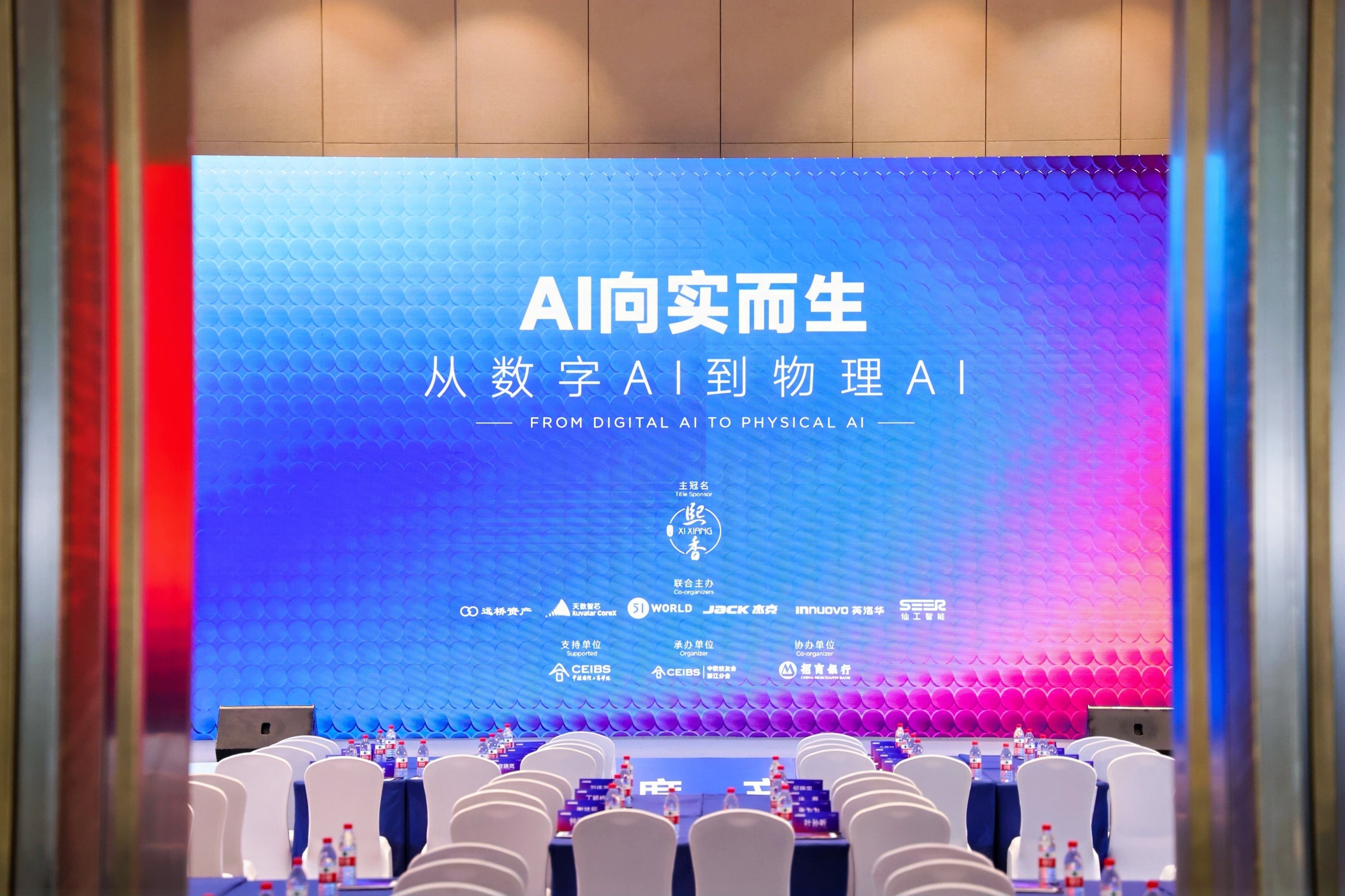
Scene of the 10th Global ICT Industry Summit
AI Evolution, Brain-inspired Mechanism and Autonomous Intelligence
Speaker: Jin Yaochu, Academician of the European Academy of Sciences and Director of the Department of Artificial Intelligence of Westlake University
Academician Jin Yaochu has long been deeply engaged in evolutionary optimization, swarm intelligence and evolutionary developmental artificial intelligence, exploring the integration mechanism of "evolution-development-learning". At the summit, he started from the history of artificial intelligence development, reviewed the "three rises and two falls" that artificial intelligence has experienced in the past, sorted out the three major schools of connectionism, symbolism and behaviorism, as well as basic methods such as discriminative and generative models, supervised learning, reinforcement learning and unsupervised learning.
He put forward three important trends in AI development.
First, from mobile intelligence to embodied intelligence: embodied intelligence is not only in the form of robots, but endows AI with the capabilities of perception, interaction and autonomous learning, making autonomous general artificial intelligence possible;
Second, from large models to agents: large models are passive, while agents can perceive the world, take actions, collaborate and improve themselves;
Third, from deep learning and large models to brain-inspired mechanisms: especially spiking neural networks, integration of evolution, development and learning. The human brain has about 86 billion neurons with a power consumption of only about 20 watts. In contrast, the power consumption of current large models is several orders of magnitude higher than that of the human brain; large models are basically fixed after training, while the human brain can be dynamically reconstructed, and development and plasticity are very critical. These capabilities of the human brain that are far better than large models prove the necessity of researching brain-inspired mechanisms in the future.
"Embodied intelligence still has a long way to go before it can achieve fine operations and real applications, and the world model is far from sufficient. Closed-loop real-time feedback correction must be added," said Academician Jin Yaochu. At the application level, AI is entering fields such as industrial optimization, AI for Science, medical health, and scientific research automation, but risks related to safety, privacy, fairness, transparency and accountability must be paid attention to.
Physical AI Needs a "Brain That Can Be Built Into Devices and Run Applications Smoothly"
Speaker: Guo Wei, Vice President of Iluvatar Corex and General Manager of the End-side Business Unit
Guo Wei focuses on the computing power base of physical AI. He believes that physical AI also requires strong computing power on the end side, and the core contradiction on the end side has always been computing power, power consumption, cost and real-time performance. Therefore, general architectures that are compatible, flexible, scalable, and can adapt to rapidly changing models and algorithms are more applicable.
In contrast, dedicated architectures are not useless. Fixed algorithms such as ISP are suitable for hardware acceleration, but if the algorithm itself is uncertain, the risk of dedicated acceleration is very high. NVIDIA improves visual real-time performance through ISP accelerators, while Iluvatar Corex adheres to the general GPU architecture, covering cloud, edge and end, with products aligned with the international mainstream ecosystem.
In addition, the physical AI tool chain is changing extremely rapidly, and VLA, world models, simulation, and inference frameworks are iterated almost every month. Chip companies are essentially "shovel sellers". In the era of variable algorithms, general architectures can better support customers to "dig for gold".
In terms of industry practice, localized deployment of cultural expo, and the combination of industrial CV and large models are all realistic directions for the implementation of physical AI.
Whether a Dish Can Be Stably Served: A Tangible Inspection Standard for Physical AI
Speaker: Li Ming, the exclusive title sponsor of the summit, Founder and CEO of Xixiang Technology
Li Ming brought the perspective to the dining table. He believes that AI is moving from the two-dimensional virtual world to the three-dimensional physical world, and catering production is one of the most concrete and vivid scenarios of physical AI. Founded in 2013, Xixiang Technology has implementation scenarios including container kitchens for CNPC drilling teams, emergency support in Rongjiang, Guizhou, smart back kitchens, smart dining cars, and home kitchens.
The oil, salt, heat control and procedures in Chinese food are being transformed into controllable and repeatable production processes through algorithms, automated equipment and digital management. However, it is not simple for robots to cook. Every step, including grabbing oil bottles, positioning, grasping, path planning, controlling oil pouring amount, heat control, and anti-collision, needs to be broken down into a large number of subtasks.
Li Ming said that Xixiang Technology does not pursue unlimited generality, but realizes local generality in constrained scenarios similar to autonomous driving. The real value of home robots is not only cooking, but also cutting vegetables, washing vegetables, washing dishes and cleaning pots. The ultimate goal is to let robots take care of people according to their real physical conditions just like mothers.
All Companies Will Be Robotics Companies in the Future
Speaker: Zhao Yue, Chairman of Agile Robotics
At the beginning of his speech, Zhao Yue put forward the view that the future robot world will be as diverse as the biological world, and there will be no only humanoid robots. All companies will be robotics companies in the future. Since no company can produce all robots, the platform must solve the contradiction between diverse supply chains and personalized customer needs.
Based on this judgment, Agile Robotics positions itself as a platform company with machine brain as the core. Their definition of "brain" is: large model + "cerebellum" + neural network, in which the large model is responsible for task perception and decomposition, the "cerebellum" is responsible for real-time control, and the neural network is responsible for multi-sensor connection.
At present, the Agile Robotics platform can support more than 400 hardware brands, more than 2000 robot configurations, and nearly 3000 customers. Its core goal is to lower the three major thresholds for robot use —
- In terms of development threshold, by building a set of systems and supply chains, customers can customize robots more easily;
- In terms of access threshold, the online platform aims to play a role similar to Taobao and JD, allowing customers to directly select and configure robots online;
- In terms of use threshold, Agile Robotics uses simulation tools, modular tools and AI assistants to allow workers to arrange tasks by themselves.
With the continuous explosion of real demand for robots in B-end production scenarios, Zhao Yue believes that robot products will eventually move towards free, cost-effective customization, and even realize "Web Control" in factories: enterprises upload robot design files and scenario descriptions, then they can download small models and controllers to make robots work.
Under this vision, the strategic closed loop planned by Agile Robotics is to form an ecosystem similar to the high mountain water cycle, from controllers to platforms, model distillation, and then to database precipitation, so that there will be no threshold for the use of robots in all industrial scenarios.
Before Humans Reach Mars, Physical Simulation Will Arrive First
Speaker: Wang Chenkang, Executive Director and Assistant President of 51Vision
In the era of digital AI, the monopoly of giants is obvious, but the terminal forms of physical AI are highly dispersed. Wang Chenkang said that in the past development process of autonomous driving technology, virtual world training accounted for more than 90%, and real road data only accounted for about 1%. In contrast, the world model behind current embodied intelligence has not yet converged, and real-world data is scarce with low collection efficiency.
"8 hours of data collection may only yield 2 hours of useful data, and even a large amount of data is junk data. The more real the data is, the more important it is." Based on this industry pain point, Wang Chenkang said that 51Vision is laying out first-person perspective, multi-modal, lightweight and standardized data collection to improve data efficiency, and exploring crowdsourced data modes.
From autonomous driving to embodied intelligence, 51Vision will also set its sights on the low-altitude economy, space and even Mars exploration simulation in cooperation with the National Deep Space Exploration Laboratory, build a complete Mars digital resource library, restore the real surface material characteristics, and allow unmanned vehicles and UAVs to carry out autonomous detection, collaborative inspection and simulation experiments in the digital world.
"Investment Expectation = Winning Probability × Odds"
Speaker: Xu Yuanling, Partner of Yuanqiao Asset Management
At the end of the summit, Xu Yuanling brought the perspective back to the capital market. She pointed out that the number and amount of equity financings in the first half of 2026 reached a peak in recent years, AI accounted for about 34% of the total investment scale, and about half of the new unicorns are AI-related, but the proportion of AI in IPOs is not large, indicating that AI is still in the early stage of the industry.
"The essence of investment decision-making is expectation, that is, winning probability multiplied by odds, and the dilution ratio should also be considered." She believes that since the marginal cost of AI increases with the increase of users, the logic of "high odds, low winning probability" in the mobile Internet era is no longer applicable in the AI era, and the winner-takes-all situation may not necessarily appear. A better strategy is to improve the winning probability and odds through enhanced cognition.
She proposed that the winning probability of a track depends on the "right time, right place and right people" of policy, industry and capital; the winning probability of an enterprise depends on the "four-wheel drive" of technology, business, ecology and capital.
She also reminded that early high valuations may be poison. Technology enterprises may be diluted by 50% to 80% after the angel round, while 80% of the listed companies have a market value of less than 10 billion yuan, and 60% less than 5 billion yuan. The final return may not be as satisfactory. Through the investment research and judgment of Iluvatar Corex and the AI industry map, she shared the layout strategies of different cycles, and emphasized the importance of in-depth industry cultivation for AI value realization with the formula of "30% technical capability + 70% industry capability".