Enterprise Case Sharing: Yunmao Quantum | 36Kr 2026 Industry Future Conference
In 2026, industrial investment has entered a deep-water zone, where capital, technology and industry are integrating at an accelerated pace. The old investment logic no longer applies, and a new consensus is taking shape. The 2026 Industrial Future Conference focuses on opportunities in the new cycle, and jointly explores the future of the industry and the birth of the "Light of China". From September 9 to 10, the 2026 Industrial Future Conference hosted by 36Kr, themed "Above the Deep Water, Resonate for New Birth", was held in Yizhuang, Beijing. Representatives from state-owned capital platforms, industrial investment funds, corporate CVCs, innovative enterprises, as well as experts and scholars gathered to focus on the industrialization of future industries including quantum technology. The conference conducted in-depth discussions on current cutting-edge technologies and industrial perspectives, showcased breakthroughs in technical routes such as superconductivity, photonic quantum and ion traps, and shared a large number of specific industrial scenarios, industrial system construction, and the prospects of heterogeneous computing, to jointly explore the future of technology industrial investment.
The following dialogue is organized and edited by 36Kr:
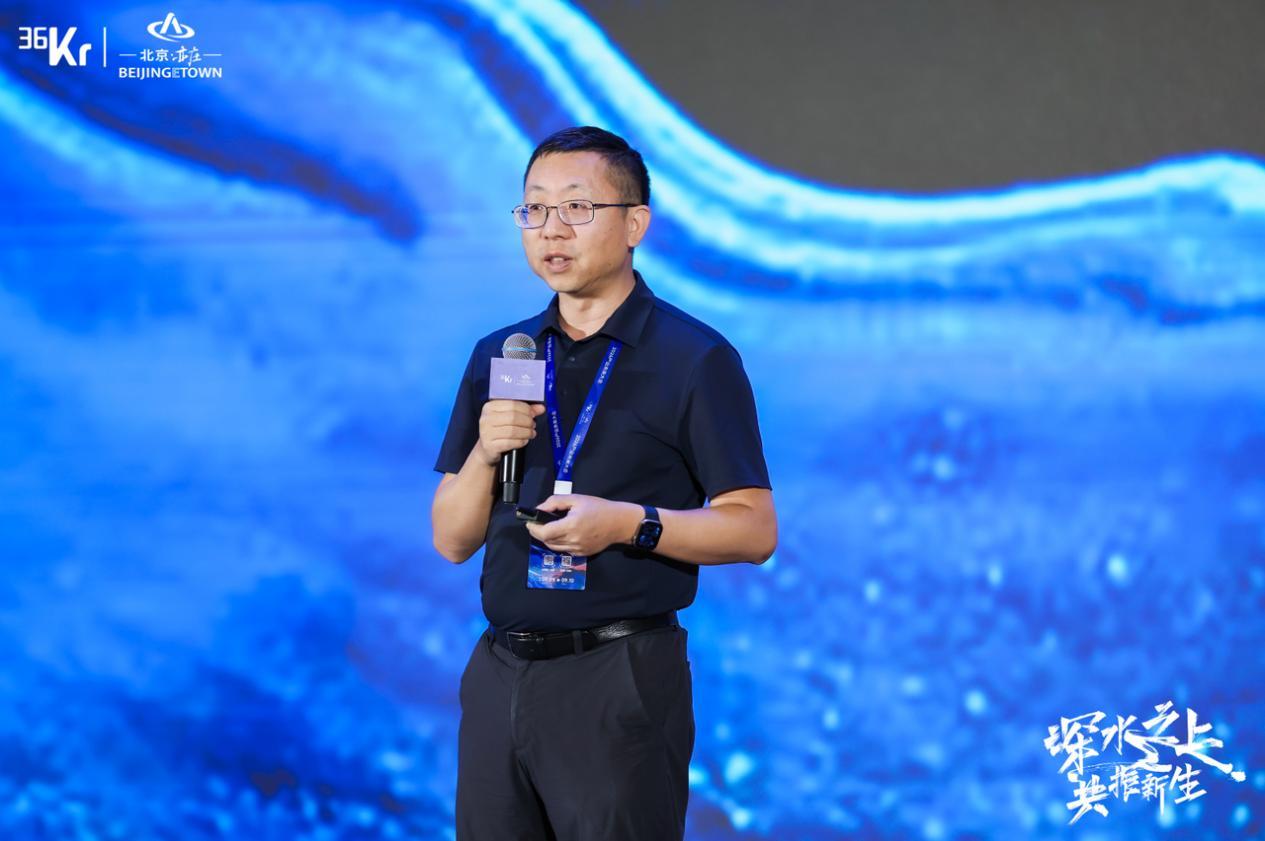
Speaker: Dr. WANG Yunyu, Chairman of Yunmao Quantum
WANG Yunyu: Hello everyone. The title of my speech today is "Building the Foundation of Quantum Computing Manufacturing". We are Beijing Yunmao Quantum, an enterprise focusing on cutting-edge scientific and technological equipment for future industries, whose main R&D content covers next-generation materials, processes and equipment.
Today I will not focus on specific process parameters and technical details. Instead, I hope that through this sharing, you can get to know us, and understand what role we hope to play in the quantum computing industrial ecosystem.
We believe that the industrialization of quantum computing requires not only excellent algorithms, architectures and quantum chips, but also increasingly strong underlying manufacturing capabilities, and we hope to be part of this process.
Quantum Computing is Entering the Era of Engineering
In terms of large-scale quantum processor chips, take IBM's entire quantum computing chip roadmap as an example. Enterprises like IBM have a very clear roadmap for chip design and manufacturing. They used to continuously pursue the number of physical qubits, but now they are also starting to develop towards high-quality qubits, and even more focus on the interaction between chips in the future.
In the past, quantum computing was mostly used to solve scientific problems: whether quantum qubits can be realized, whether better manipulation can be achieved, and whether better performance can be obtained. With the continuous development of quantum computing towards engineering, a new problem has become increasingly important: can we make good quantum devices stably and manufacture them in a repeatable way?
When quantum chips begin to pursue larger scale, higher consistency and higher reliability, manufacturing itself has become a very important foundational capability for industrialization.
Manufacturing is a Critical Foundation for the Industrialization of Quantum Computing
This is a diagram of the semiconductor industrial chain. Semiconductor chip manufacturing, a crystallization of human technology, has a very clear industrial chain layout: from upstream materials and equipment, to chip processing, then to packaging and testing, and finally to terminals and systems.
The final performance of a chip is not directly reflected at the chip and system level. Many key issues are determined from the very bottom layer. The quality of underlying processing already determines the quality of devices. Once results of poor consistency, poor repeatability or even failure occur, the causes often lie in the underlying layer.
For example, Intel is a leader in the chip industry. Back when it developed to a certain stage, it handed over the material and equipment links to another company, Applied Materials. This example illustrates the trend of advanced manufacturing: division of labor and cooperation across the industrial chain brings high efficiency. Intel used to manufacture even the equipment by itself at the very beginning, but later it found that if it did everything from chip design and chip manufacturing to chip equipment manufacturing and chip material R&D, the efficiency would be too low. Therefore, professional matters should be left to professional companies. For example, the growth of thin films, and how to realize the manufacturing of devices with different structures. These underlying links are often the key to determining the success or failure of end products.
Our Positioning: The Underlying Manufacturing Platform of the Industrial Chain
We hope to do some basic manufacturing support links at the very bottom of this chain. What we hope to solve is not just a single thin film or a single layer of material, but to provide support for the manufacturing capability that ensures the stability of quantum computing.
For example, silicon is used as the material for integrated circuits, silicon carbide and gallium nitride are used as compound semiconductor materials, and diamond and gallium oxide are the next-generation semiconductor materials. Superconductive materials and new-generation optical materials are the main materials for quantum computing chips. To make good quantum chips, the manufacturing of these new materials must be done well. The quality, uniformity, interface state, defect control and other properties of these new material thin films may all affect the performance of the entire quantum device.
In addition, superconducting chips have moved towards large-scale manufacturing similar to the CMOS process, which requires a series of manufacturing methods, and the yield of each process will determine the quality of the devices.
Therefore, we believe that a truly valuable manufacturing platform does not solve the problem from 0 to 1, but quickly transforms these innovative materials and structures into stable and manufacturable processes. Then through feedback from device verification, we finally turn what can be made in the laboratory into something that can be manufactured stably in engineering, which we believe is the greatest value of a manufacturing platform.
Enable Quantum Computing Innovation to Have a Manufacturable Foundation
We believe that quantum computing will eventually move from today's technical exploration to real engineering and industrialization. In this process, professional manufacturing capabilities will become increasingly important. We hope that professional companies and the professional industrial chain can take on this work. Yunmao is willing to help quantum computing enterprises of different technical routes realize the chip manufacturing of new materials, new processes and new devices through advanced process manufacturing capabilities and equipment. Yunmao hopes to gradually build an open and scalable quantum computing manufacturing platform, so that every quantum computing innovation can have a reliable manufacturing foundation.
That's all for my sharing. Thank you everyone!