Enterprise Case Sharing: Ising Intelligence | 36Kr 2026 Industry Future Conference
In 2026, industrial investment has entered a deep-water zone, where capital, technology and industry are integrating at an accelerated pace. The old investment logic no longer applies, and new consensus is taking shape. The 2026 Industrial Future Conference focuses on opportunities in the new cycle, and jointly explores the future of the industry and the birth of the "Light of China". From September 9 to 10, the 2026 Industrial Future Conference hosted by 36Kr with the theme of "Above the Deep Water, Resonate for New Birth" was held in Yizhuang, Beijing. Participants from state-owned capital platforms, industrial investment funds, enterprise CVCs, innovative enterprises, and experts and scholars gathered together to focus on the industrialization of future industries such as quantum technology. The conference conducted in-depth discussions on current cutting-edge technology and industrial perspectives, focused on demonstrating breakthroughs in technical routes such as superconductivity, photonic quantum, and ion trap, and shared a large number of specific industrial scenarios, industrial system construction, and prospects of heterogeneous computing, to jointly explore the future of sci-tech industrial investment.
The following dialogue is edited and organized by 36Kr:
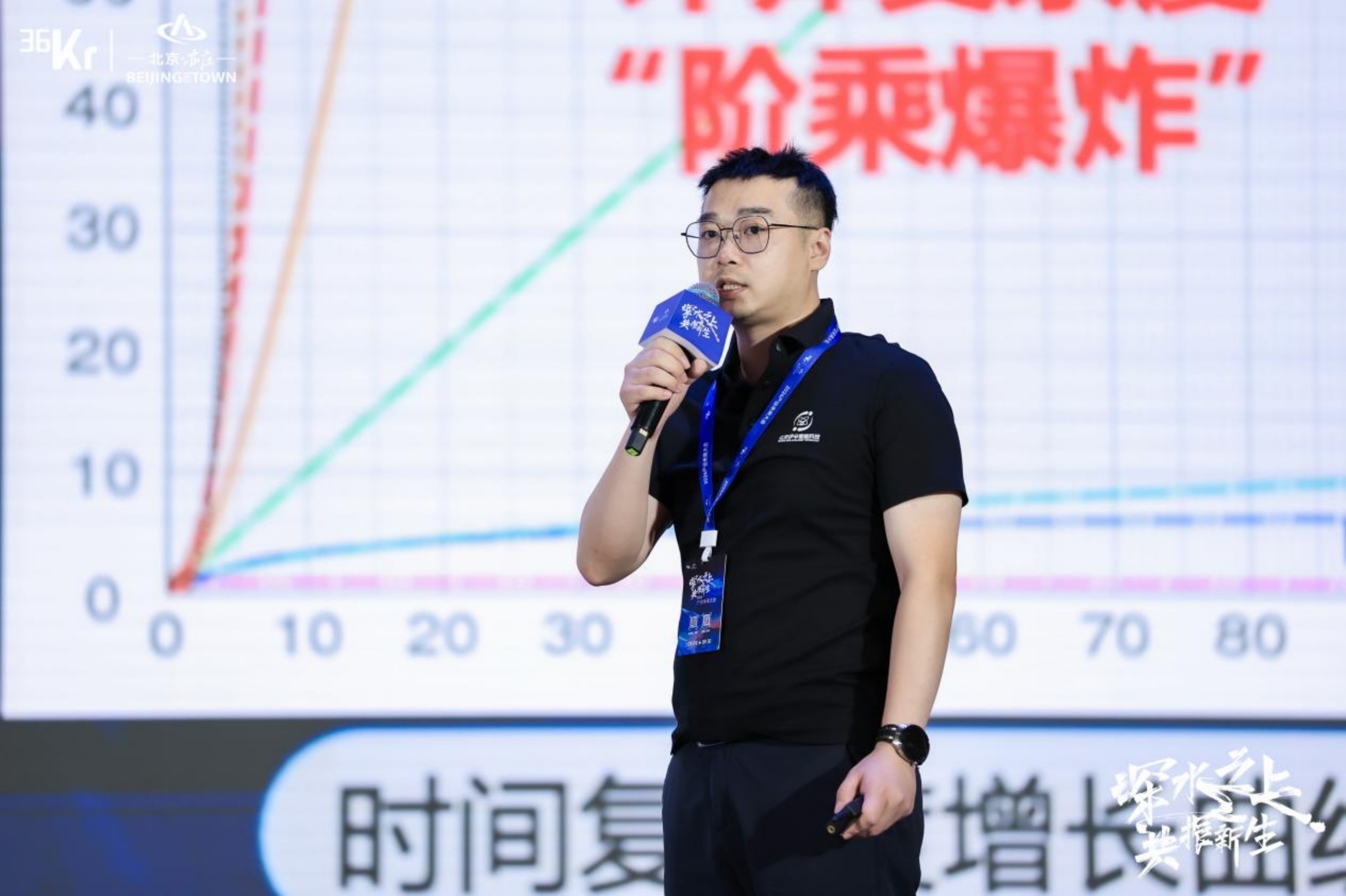
Speaker: Dr. Xiao Ye, CEO of Ising Intelligence
Xiao Ye: Dear friends and peers, good day to all of you! We are a company based in Yizhuang that specializes in developing Ising machines. As we all know, adders are designed specifically for addition operations, and multipliers are made for multiplication operations. An Ising machine is a dedicated device built to solve the Ising model. After solving the Ising model, it can act as a dedicated operator for solving large-scale combinatorial optimization problems. Combinatorial optimization problems are common in many fields, such as drug R&D, finance, and circuit design, all of which contain a large number of such problems. Traditional computers usually struggle to solve this type of problem, as most of them belong to NP-hard problems.
Let's take a very simple example: the Traveling Salesman Problem. If you travel on business frequently, you may have encountered similar scenarios in real life. The problem refers to finding a route that covers all target cities with the minimum mileage or time. If you need to visit 3 cities, the possible routes are A→B→C or A→C→B. For 6 cities, there are only 60 possible routes, which is very easy to solve. But once the number of cities reaches more than 20, the number of possible routes exceeds the total number of water droplets in the Pacific Ocean. When the number of cities reaches 60, the number of possible combinations of this problem is larger than the total number of observable atoms in the universe. At present, traditional computers do not have an efficient and accurate method to solve this type of optimization problem with combinatorial explosion.
Since traditional computers cannot solve such problems, people naturally turn their attention to new computing paradigms. The Ising machine is exactly such a new computing paradigm. Essentially, an Ising machine is a physical system that conforms to the Ising model. As long as a system meets three specific rules, it is a physical Ising system. If we can manipulate such a system, we can use it for computing, which means the Ising machine is essentially based on the idea of analog computing.
Of course, there are different technical means to construct a physical Ising system. You can build an Ising system with superconducting quantum methods, with all-optical methods, or with optoelectronic methods as we do. After constructing the Ising system, we can use it for computing. This logic is very clear: every physical system follows a specific physical law, and can be used to solve a specific mathematical problem.
Let's take a very simple example: the free fall of a small ball follows a quadratic law, so we can design an experiment to solve a quadratic problem. For example, we use a stopwatch to time 1 second, and use a ruler to measure the distance the small ball travels in 1 second of free fall. The value we read from the ruler is exactly the calculation result of 1/2*G*1². Similarly, we can use this physical system to get the calculation result of 1/2*G*N² through physical experiments. There is no logical operation involved in this process at all, and we get the answer to the mathematical formula directly from the results of physical experiments.
By analogy, the free fall system follows the quadratic law, so it can solve quadratic problems. The Ising system follows the Ising law, so it can solve the Ising model. Solving the Ising model has many advantages: we can convert the NP-hard TSP model mentioned earlier into the Ising model, so as to use the physical system to accelerate the calculation. Because of this feature, Ising machines have unique inherent advantages in solving large-scale optimization problems.
For this reason, many sci-tech powers around the world, including the United States, Canada, the European Union, and Japan, have launched a large number of support plans for Ising machine research. There is a company called D-Wave in the Americas that develops superconducting Ising machines. It has been listed on Nasdaq, and its current market value has reached nearly 8 billion US dollars.
However, foreign Ising machines, whether their platforms or products, are usually banned for use in China, especially in the Chinese mainland. Therefore, we are committed to developing a domestic technical route for Ising machines. Previously in the world, there were only all-optical Ising machines and superconducting Ising machines. Our company was spun off from a key national laboratory project of the Institute of Semiconductors, Chinese Academy of Sciences. Our R&D team has tackled key underlying scientific principles for the past 10 years, and published a large number of papers, including many papers in the Nature family of journals.
On the basis of these researches, we have successfully proposed a new technical route for Ising machines: the optoelectronic Ising machine. The basic architecture of our optoelectronic Ising machine builds an optoelectronic closed-loop feedback link, which can convert actual industrial problems into the Ising model — the language that Ising machines can understand. Then we write the model into our physical system through FPGA, and let the physical system evolve naturally.
The animation on the right demonstrates the actual operation process of the Ising machine. The bottom diagram shows the energy evolution process: our physical system takes about 10 to 100 milliseconds to evolve from a high-energy state to the energy ground state. At this point, we can extract the light pulse readings from the optoelectronic system, which serve as the solution to the problem — and the solution is usually of very high quality.
Our project has won many honors and project grants. For example, in 2022, we won the highest award in the National Disruptive Innovation Competition held by the Ministry of Science and Technology, and we have received grants from many national projects in the past few years.
In 2024, under the guidance of the Yizhuang Management Committee, we were spun off from the Institute of Semiconductors to establish this company, and we have also purchased all relevant patents.
Since our company was established in 2024, we have developed many first-generation products. For example, the large cabinet on the far left is developed for industrial scenarios, which supports full connection of more than 4000 spins. The small device in the middle is our all-in-one research machine, designed for universities and scientific research institutes.
Our cloud platform has also been launched. The SDK and API on the cloud platform have been fully developed, which allows users to use our Ising machines smoothly.
During the R&D process of Ising machines, we found that everyone knows there is a Scaling law in the AI field, and Ising machines also have their own Scaling law. As the spin scale of the Ising machine increases, its comparative advantages over traditional computers in computing time and computing quality will be significantly improved. Because Ising machines do not overcome complexity from the algorithm level, you can see that under the node of 10,000 spins, our Ising machine can achieve a computing power improvement of 2 to 4 orders of magnitude compared with traditional computers, and the solution quality will get better and better.
At present, we have achieved a scale of more than 4000 spins, which has been deployed offline in the customer's computer room. We will launch a 10,000-spin product by the end of this year. The biggest feature of our product is that our machine can run stably for 1.5 hours in a single operation. During this period, customers can continuously upload their large-scale optimization problems and get the answers within the order of hundreds of milliseconds. After 1.5 hours of operation, the system will automatically adjust its parameters for about 2 to 3 minutes, and then resume calculation for another 1.5 hours. This is a major advantage of our product: extremely high stability. The power consumption of our machine is only 1600 watts.
Our company has joined Beijing Quantum-Electronic Integration Industrial Innovation Center Co., Ltd., which is a company in Yizhuang dedicated to application exploration. We hope to promote the development of related industries on this platform.
To make it easier for users to use Ising machines, we have also developed some Agent products. Users can input their business scenarios through natural language, and the Agent will help complete the modeling and call the Ising machine more conveniently. After our cloud platform went online, we recently held a competition in cooperation with the Chinese Optical Engineering Society. The participating teams have completed millions of API calls using our platform. To be honest, seeing so many teams and groups using our Ising machines and the products we developed, our team feels very fulfilled.
Let me share some benchmark cases of participating teams. For example, the first prize winner is the joint team of China Mobile and Liangguan Zhiyuan. They used the Ising machine on the cloud platform to solve the traffic light control problem, and they even carried out a field experiment. The experimental results show that they can increase the traffic flow during non-peak hours by more than 5%. This work was also reported by People's Daily.
The second case: one of our machines has been running continuously on the internal network of a bank for more than half a year, and the bank has used our machine to calculate a large number of optimization problems. One of the cases is combined with the currently popular Agent technology, where they use the Ising machine to optimize Skill selection. They have submitted this work to several journals, and the total views of the related papers are very impressive, exceeding 10,000 times.
In addition to these customer cases, our company is also conducting application exploration in many fields, including logistics, energy, and drug R&D. We have found that the advantages of our Ising machines over traditional computers have been reflected in many scenarios. For example, if we use our Ising machine in a port, the operating cost of a specific scenario can be reduced by 5%. This result is very exciting for us, because the cost of our machine is relatively not high, and this 5% cost reduction has reached the threshold of recovering the hardware cost within three years. For the promotion of any new computing paradigm, the input-output ratio on the customer side needs to be greater than 1, and at present, if we only consider our cost, the input and output of this single scenario have almost reached a balance. If we find the second and third applicable scenarios in the port industry, we believe we can take the lead in launching commercial promotion.
As for our future development plan, essentially, Ising machines are operators just like GPUs. From image display to cryptocurrency mining, to supporting the rapid development of AI today, GPUs are 1 to 2 orders of magnitude faster than traditional devices in matrix computing from the perspective of first principles. Today, Ising machines have been verified in some complex scenarios to have computing power improvement over GPUs. Therefore, we believe that in the foreseeable future, Ising machines will definitely become a part of the heterogeneous computing system.
If we want Ising machines to work collaboratively with CPUs, GPUs, NPUs, TPUs and general-purpose quantum computers in the future, we need to build a supporting ecosystem in the previous stage. That is to say, we will create a number of benchmark cases in the next one or two years, and these benchmark cases will attract more partners to build the ecosystem together. This is our general plan.
At the end, there will be a promotional video of our company, which summarizes the content shared earlier. (Play the video)
This report is now over. Our 10,000-spin Ising machine is currently in internal beta testing. If you have applicable scenarios, welcome to contact us.
Thank you all!