Keynote Speech: Breaking Boundaries · Quantum Computing Marches into the Deep Waters of Industrial Application — The Next Mile of Quantum Computing | 36Kr 2026 Industrial Future Conference
In 2026, industrial investment has entered a deep-water zone, where capital, technology and industry are accelerating their integration. The old investment logic no longer applies, and a new consensus is taking shape. The 2026 Industrial Future Conference focuses on opportunities in the new cycle, to jointly explore the future of industries and the birth of the "Light of China". From September 9 to 10, the 2026 Industrial Future Conference hosted by 36Kr was held in Yizhuang, Beijing, with the theme of "Above the Deep Water, Resonate for New Birth". Representatives from state-owned capital platforms, industrial investment funds, corporate CVCs, innovative enterprises, as well as experts and scholars gathered together, focusing on the industrialization of future industries such as quantum technology. The conference deeply discussed cutting-edge technologies and industrial perspectives at present, intensively demonstrated breakthroughs in technical routes including superconductivity, photonic quantum and ion trap, and shared a large number of specific industrial scenarios, industrial system construction, and prospects of heterogeneous computing, to jointly explore the future of sci-tech industrial investment.
The following dialogue is sorted and edited by 36Kr:
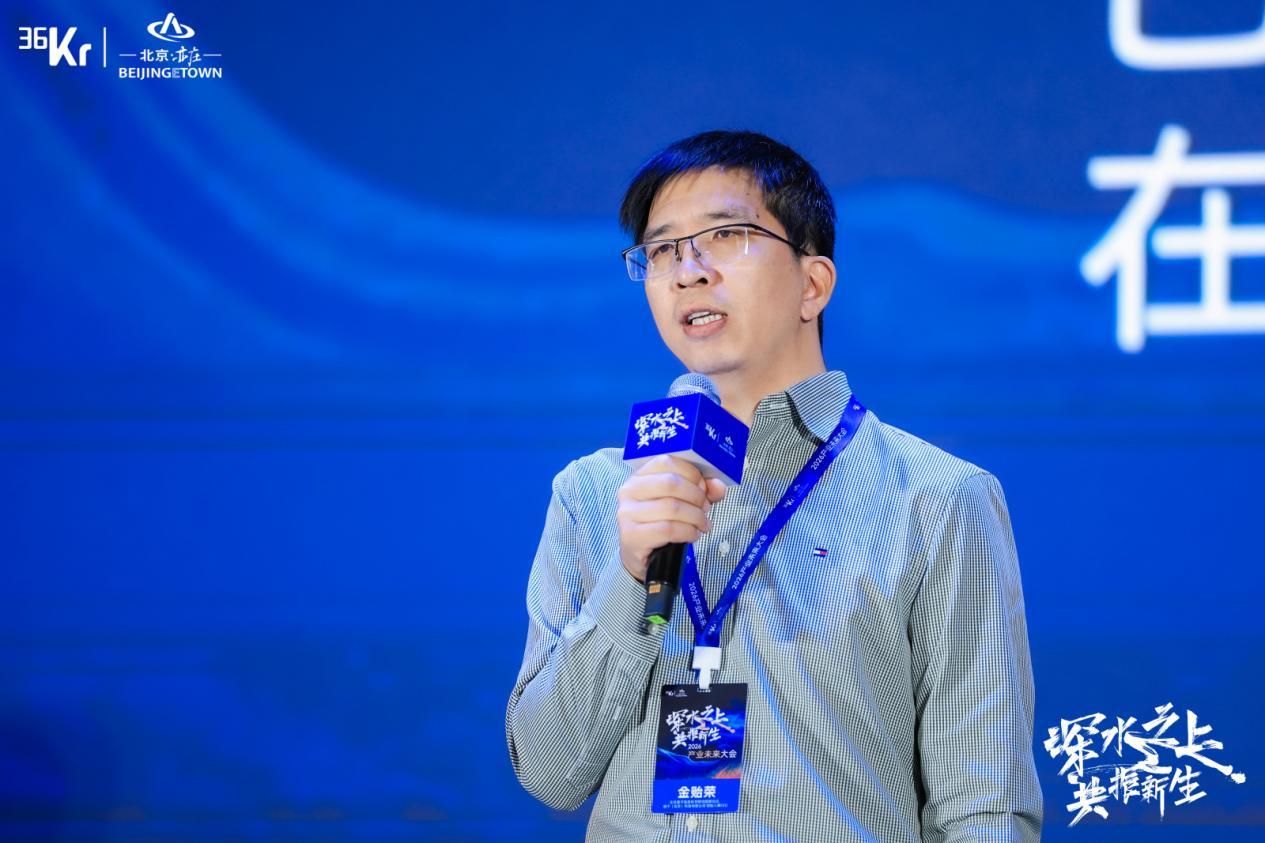
Speaker: Jin Yirong, Researcher of Beijing Quantum Research Institute, Founder of Coherent Technology
Jin Yirong: Distinguished leaders, dear guests, thank you very much for the kind invitation from the Economic Development Zone Management Committee and 36Kr. It is my great honor to share my ideas and views on the future industry of quantum computing with all of you here. My name is Jin Yirong, from Beijing Quantum Research Institute. I am currently the head of the Ecological Team, and also the founder of Coherent Technology.
The title of my sharing today is "Quantum Computing Enters the Deep Water Zone of Industry: The 'Next Kilometer' of Quantum Computing".
I will try to break down my views and perceptions on quantum computing itself and its future industrialization path by answering the following eight questions.
The first question: Why do we need quantum computing?
A very straightforward answer is that quantum computing has exponential acceleration capability and is a disruptive technology. But I don't think this really answers the question. In the past decades, our existing classical computing capabilities have achieved leapfrog development, forming a multi-processor heterogeneous collaborative computing ecosystem dominated by CPU and GPU, which has solved a large number of difficult problems, brought huge improvement of productivity, and formed a huge trillion-level industry. At the same time, with the rapid development of artificial intelligence, our computing paradigm has also undergone a transformation, shifting from the original equation-driven mode to the data-driven mode. However, neither of them can solve a type of problem, that is, the high-dimensional computing problem, which is called "dimension disaster" in classical computing, because the difficulty of these problems often grows exponentially with the scale of the problem.
The second question: Why can quantum computing solve this type of problem?
The information processing unit of quantum computing has changed from the classical bit to "qubit". Due to the superposition and entanglement properties of quantum mechanics, a large number of combined qubits can construct a high-dimensional computing space that grows exponentially. If we can encode the problem into such a super high-dimensional space, combine it with good algorithms, and use quantum interference to increase the measurement probability of useful results, we can hopefully get the solutions to these high-dimensional difficult problems quickly. In addition, we have proved that quantum computing can theoretically solve all computable problems, so it is a general-purpose computing method. Just like classical computing, it can solve various different problems on the same set of hardware through programming.
The third question: What kind of problems in the real world belong to this type of problem?
I roughly divide these problems into three categories.
The first category: Problems of quantum system simulation. Such problems as drug molecules, new materials, catalytic reactions, and many basic quantum many-body physics problems all fall into this category. As early as the 1980s, the legendary physicist Feynman noticed that classical computing would encounter "dimension disaster" when solving quantum many-body problems. At this time, using the method of quantum mechanics to solve these quantum problems is obviously the most direct and natural approach.
The second category: Combinatorial optimization problems. With the increase of combinatorial variables, the possibility of combinations will explode. For example, when we play Rubik's Cube, from the 2nd-order Rubik's Cube to the 3rd-order, 4th-order, 6th-order Rubik's Cube, the number of possible combinations grows extremely fast. At this time, global optimization among so many combinations will become an almost impossible task. In reality, financial portfolio optimization, transportation and logistics optimization, power grid and communication network routing optimization and other similar problems all belong to this category.
The third category: Problems with specific mathematical structures, such as prime factorization, discrete logarithm over elliptic curves and other problems. These problems are characterized by an exponential explosion of solution space as the problem scale grows, but the results are very easy to verify. Therefore, such problems are often regarded as ideal problems for information encryption. Currently, the most widely used RSA cryptography and elliptic curve cryptography in Internet applications are built based on these mathematical problems. It can be seen that quantum computing is expected to show advantages in a very wide range of application scenarios, and at the same time pose a huge threat to the existing encryption system.
The fourth question: How can we turn the dream of quantum computing into reality? What stage of development are we at now? What are the main challenges at the present stage?
In the past, we spent nearly 40 years and finally found some relatively suitable qubits in some real physical systems, including ion trap systems based on natural particles, neutral atoms, photonic quantum systems, etc., as well as artificial solid-state quantum systems, including superconducting quantum computing, silicon-based semiconductors (two-dimensional electron gas), topological systems, etc. The accuracy of manipulation and readout has also been greatly improved, and the scale is also continuously expanding. From the initial pure scientific exploration, to seeing the hope of application, up to today, we have been able to achieve entanglement manipulation accuracy of more than 99.9% at the scale of over 100 qubits, quantum error correction has broken through the break-even point, and we can collaborate with classical computers to calculate the molecular structure of tens of thousands of atoms. We have finally entered the initial stage of engineering and industrialization. Next, we will meet greater and obviously more magnificent challenges, that is, how to make these not-so-perfect quantum computing create value in real application scenarios, and at the same time make qubits more and more perfect. This is exactly what the "next kilometer" of quantum computing is going to do.
The fifth question: Why are engineering and industrialization the themes of the "next kilometer" of quantum computing?
In the past, we constantly refreshed various records in the laboratory, created more qubits, achieved higher quantum gate fidelity, demonstrated quantum superiority and so on. But real practical application scenarios do not care about these at all. They only care about two issues: First, whether the introduction of quantum computing can really solve problems more efficiently; second, whether quantum computing and quantum computing power can be delivered stably. Neither of these two issues can be solved through the scientific research mode, but must be solved through engineering and industrialization. Because scientific research is essentially a game of exploring new principles and new methods, continuously expanding the capability boundary, that is, a game of lengthening the long board, while engineering is a tough battle of continuously mending the short board; industrialization is the process of continuously extending outward and touching application scenarios. Engineering and industrialization are not as elegant as scientific research, but they are the only way to bring scientific and technological progress into reality.
The sixth question: How can we do a good job in this "next kilometer"?
Some people think that we should first build a larger-scale, higher-fidelity quantum computer. I think what we need to do well in this "next kilometer" is far more than that. There are several things we must do well:
First, improve the stability of quantum computers, so that they can give consistent results for a long time. I think this is more valuable than briefly improving high fidelity;
Second, improve the "delivery" capability of quantum computing power. Building good quantum computing hardware does not mean that problems can be solved. A complete system of hardware, software and algorithms must be built to enable quantum computing to reach application scenarios and create new value.
Third, build a brand-new industrial system to realize large-scale stable delivery and continuously reduce the unit cost of quantum computing power.
Fourth, realize the efficient collaboration between quantum computing and classical computing, and form a brand-new multi-computing power integrated application ecosystem.
By achieving these points, I believe we will not be far from the large-scale commercial implementation of quantum computing.
The seventh question: What role does our Coherent Technology play in this process? What are we doing? What do we want to become? How do we interact with other quantum enterprises and application parties?
From the very beginning of its establishment, Coherent Technology has set the vision of "changing the world with quantum computing" and kept practicing it. As a quantum start-up born out of superconducting quantum computing hardware, we are advancing from doing a good job in quantum measurement and control to building a complete quantum computing machine, and further to building a good quantum computing platform and computing power service. We are committed to promoting the delivery of quantum computing power from a large number of hardware, turning it into a capability that can truly solve industrial problems. Our goal is to become the "NVIDIA" in the quantum computing era. We will build the future quantum-classical integrated computing power base. However, we will not do the work of the "last kilometer". We will work with a large number of excellent downstream application enterprises to jointly catalyze and build a prosperous quantum computing application ecosystem.
The last question: How far is the future of quantum computing? In what form will it eventually change the world?
Many people think that quantum computing is still not perfect, and it is still far from solving high-value problems. This is not surprising, because even though we are reluctant to admit it, the vast majority of people tend to think in a linear way. Based on my years of observation in this industry, my perception is that its development speed even exceeds the imagination of those entrepreneurs and researchers who are fighting on the front line. Up to now, I still have a very deep impression on the words that Michel Deverot (who is now the chief scientist of Google Quantum AI and also the winner of the 2025 Nobel Prize in Physics) said in a quantum computing outlook more than ten years ago. He said: "Quantum error correction gives us hope that we may one day really be able to build quantum computers, but that must be the task of the next generation. However, in the past two decades, we have witnessed so many new advances that make me believe it will happen in my lifetime." My feeling now is very similar to his feeling at that time.
Quantum computing leverages the strong exponential law from the bottom of physics, superimposed with the Moore's Law-like effect endowed by human industrial capabilities, which will make the capability of quantum computing grow in a double-exponential way. This law was first put forward by Hartmut Neven, the leader of Google Quantum AI. It seems very slow at the beginning, but once it breaks through a certain critical point, it will surge in an unimaginable way, catching everyone off guard.
In addition, many people think that once quantum computing matures, classical computing will step down and no longer have a place to play. I think this is a very alarming prediction. As mentioned earlier, quantum processors have problems that they are good at solving, but they also have areas that they are not so good at. This statement also applies to classical processors such as CPU and GPU. In the future, when facing more complex computing problems, multiple processors will definitely be needed to solve them collaboratively. With the maturity and popularization of quantum computing, classical processors will not exit the historical stage. On the contrary, due to the birth of new application scenarios, the demand for them will be more vigorous, but they will no longer be the leading role.
Finally, to sum up in one sentence, the next kilometer of quantum computing is to bring quantum computing power into the real workflow, which requires the joint efforts of a much larger community than now. It not only requires scientists, but also the joint efforts of the government, quantum enterprises, investors and industrial application enterprises.
Thank you for listening!
Host: Thank you Mr. Jin Yirong for your wonderful sharing. Please take your seat in the audience.
If quantum computing is still on the eve of engineering, the AI industry has sailed into the deep-water zone of the verification period. In the same deep water, different stages have different answers. Next, let's invite Ms. Zou Ping, Dean of 36Kr Research Institute, and Ms. Zhang Fan, General Manager of Artificial Intelligence Investment Department of Yizhuang State Investment, to bring an in-depth dialogue on "Leap · Deep Flow of AI, Value Surge". Let's give them a big round of applause!