Breaking: Nvidia "blocks" Claude's most powerful model
Anthropic's top backers are collectively pulling the plug.
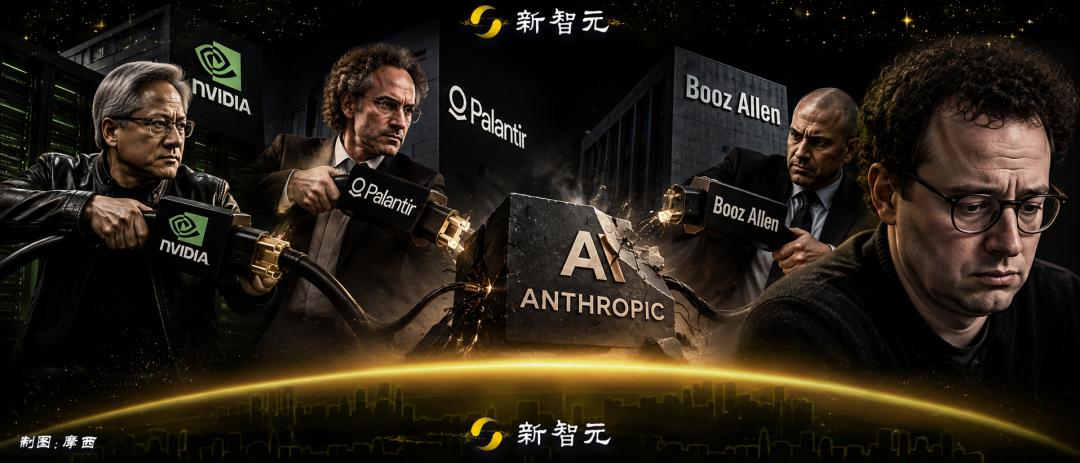
Nvidia, Palantir, Booz Allen Hamilton — several of the most cash-flush players in Silicon Valley that never hesitate to pour money into AI — have recently tacitly aligned on the exact same move:
They are fully blocking Anthropic's flagship model Fable across all their core business operations.

Each of them has taken more drastic measures than the last.
A power company supplying electricity to millions of U.S. households was originally set to use Fable to test its core power grid, but after Anthropic stated it "could not guarantee relevant performance", the plan was scrapped entirely.
Nvidia has replaced all its high-value supply chain AI systems with its own Nemotron model, leaving Fable only to process trivial open-source code tasks with no real business importance.
Defense industry giant Northrop Grumman went so far as to physically disconnect its networks, running open-source models on local on-premise server rooms.
The collective turn of face from these backers traces back to a promise that Anthropic unilaterally tore up three months ago.
A "Mandatory Retention Order" With No Exceptions
The story dates back to the release day of Fable 5 on June 9.
On that day, Anthropic quietly added a new rule on its support page:
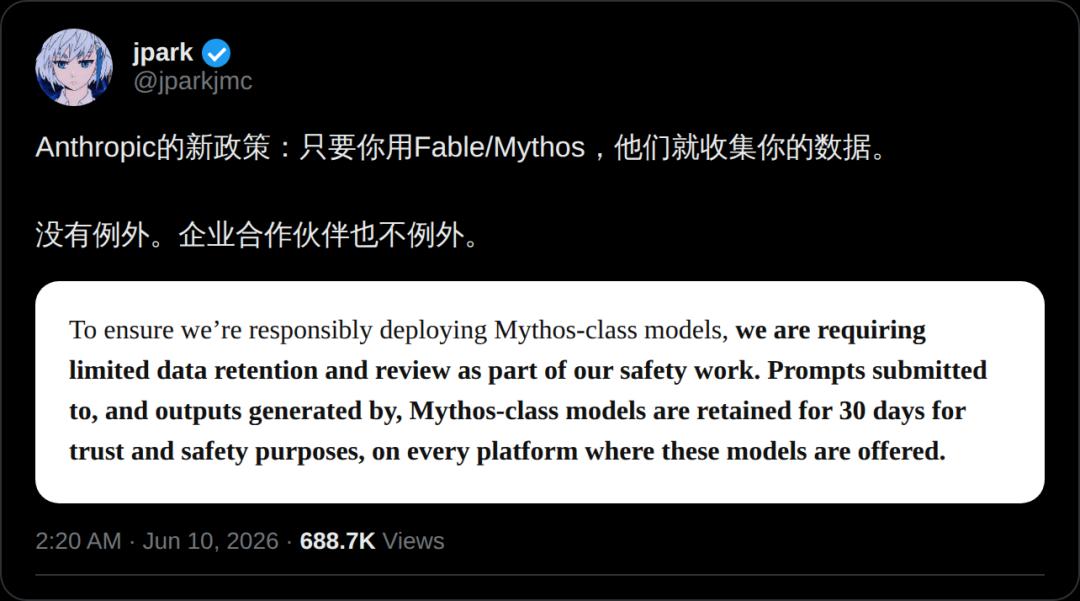
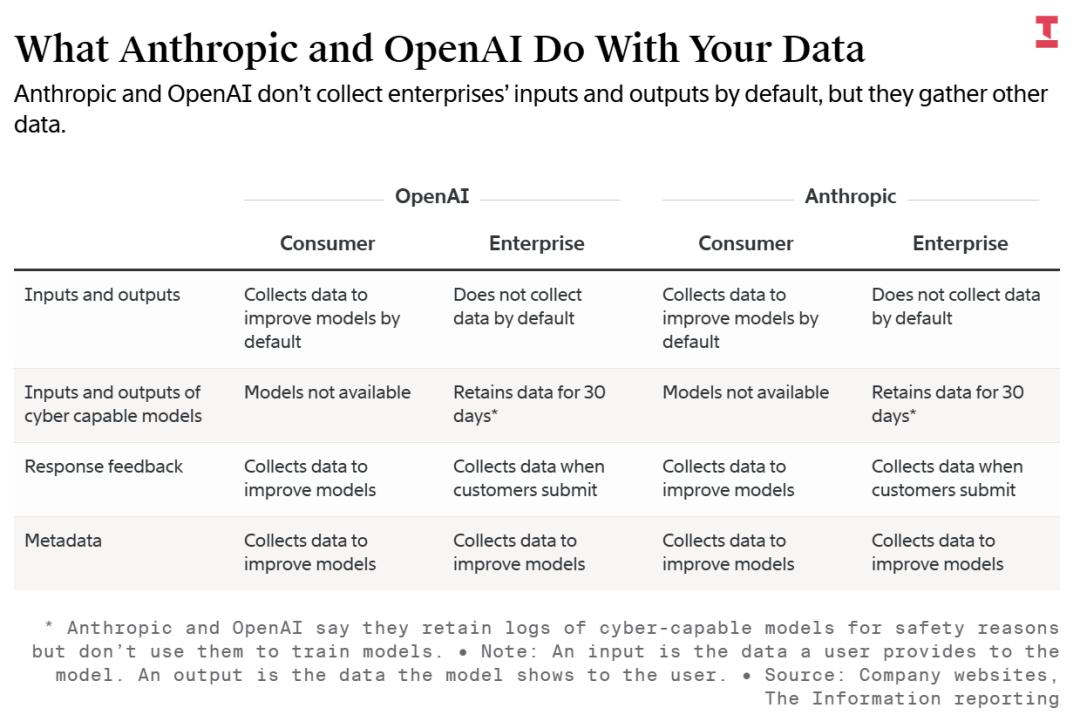
For all Mythos-class models, namely the two most powerful model tiers Fable and Mythos, all prompts sent by users and outputs generated by the models will be retained for 30 days, under the pretext of "trust and safety".
According to reports, if a conversation is flagged as suspicious by the safety system, the retention period can be as long as two years.
Furthermore, this policy overrides all existing "Zero Data Retention (ZDR)" agreements, with no toggle option, and is enforced unconditionally.
Zero Data Retention (ZDR) is the most critical "life-saving clause" that enterprise clients prioritize when negotiating with AI vendors.
It means that after processing the data you send, the vendor must delete it immediately — no storage, no unauthorized access, and absolutely no use of the data to train next-generation models. Financial, medical and military enterprises will not even dare to access an AI API without this clause.
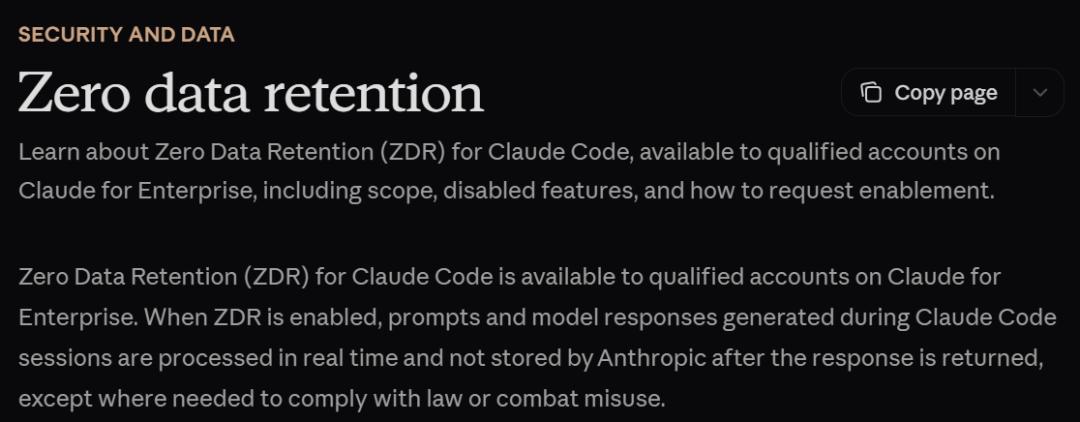
Before June 9, Anthropic had signed ZDR agreements with many large clients, allowing models like Opus 4.8 and Sonnet 4.6 to access this green channel.
But after that date, the flagship Fable model is the only exception. If you want to use the most powerful model? You have to enable the data retention toggle first, no exceptions.
Anthropic's explanation is that Mythos-class models are so capable that to defend against complex new types of attacks, such as advanced jailbreak methods spanning multiple requests, the system must retain logs for monitoring.
This excuse seems reasonable, but it immediately caused an uproar across Silicon Valley.
Jun Park, CEO of startup hillclimb, posted on X to sum it up: "Anthropic's new policy is that as long as you use Fable or Mythos, they will collect your data, no exceptions, not even for enterprise partners."
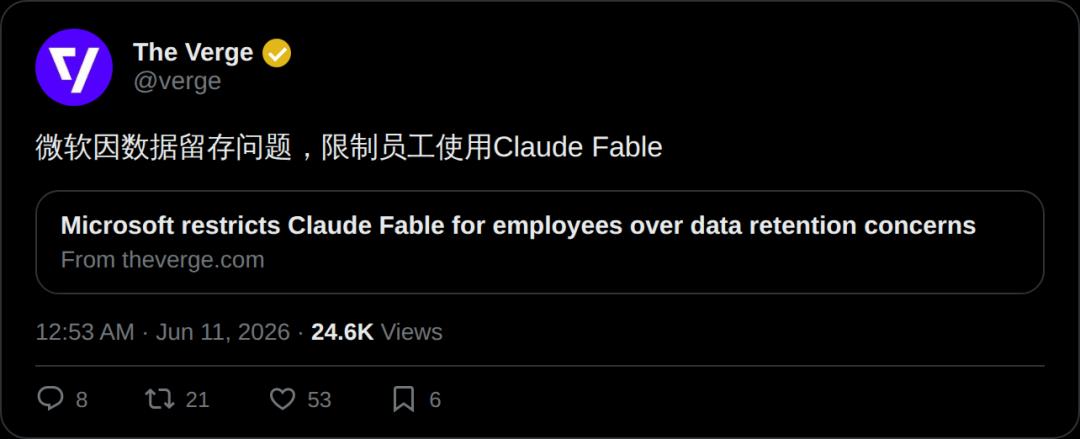
Microsoft moved the fastest.
Less than a day after Fable 5 was released, Microsoft restricted internal employees' access permissions, requiring the legal department to review the retention terms first.
As a result, Fable is the only model missing from the model list of Microsoft's internal Copilot.
Karp's Public Criticism, Palantir Distributes "Pitfall Avoidance Guide"
Palantir was the first to come forward and publicly raise objections.
As a platform that distributes AI models to government agencies and large enterprises, Palantir executives had spent a long time negotiating with Anthropic to secure an "irrevocable" ZDR promise covering all models, to reassure its clients.
The new policy rolled out in June essentially voided that promise entirely.
Palantir CEO Alex Karp did not mince words. In early July, he spent a full 20 minutes criticizing the large AI model lab.
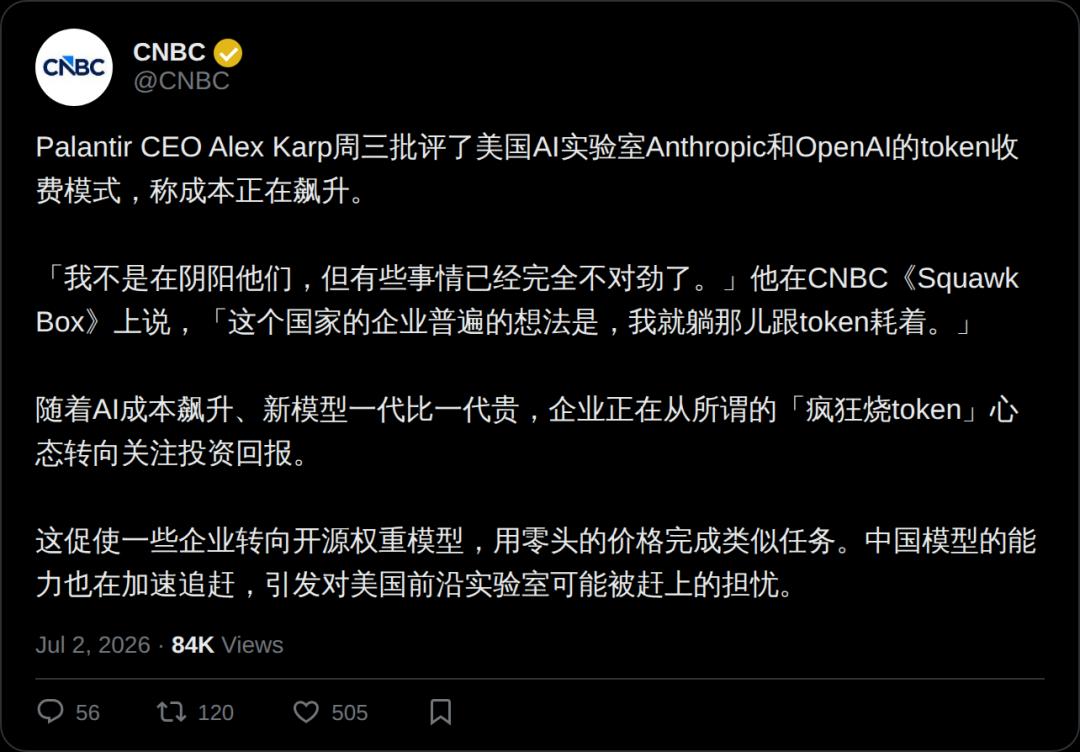
At a client conference last week, he went even further, stating bluntly that enterprises have long been fed up with being "mistreated" by AI labs.
Palantir even distributed a booklet to every client present, titled How to Avoid Giving Away Your Alpha (Core Competitive Advantage) to Hosted Model Providers, which teaches enterprises step by step how to fight for ZDR clauses with AI vendors.
According to people familiar with the matter, Palantir's stance is very clear: as long as Anthropic does not provide an irrevocable ZDR, Fable will never be allowed on Palantir's platform.
If clients want to use Fable? They have to purchase it directly from Anthropic on their own.
Shortly after, Palantir added OpenAI's GPT-6 Astra to its platform, as OpenAI has granted ZDR support.
OpenAI Stabs in the Back, Anthropic Forced to Make Concessions
Indeed, right when Anthropic had no idea how to appease these furious large clients, its competitor struck with a sharp move.
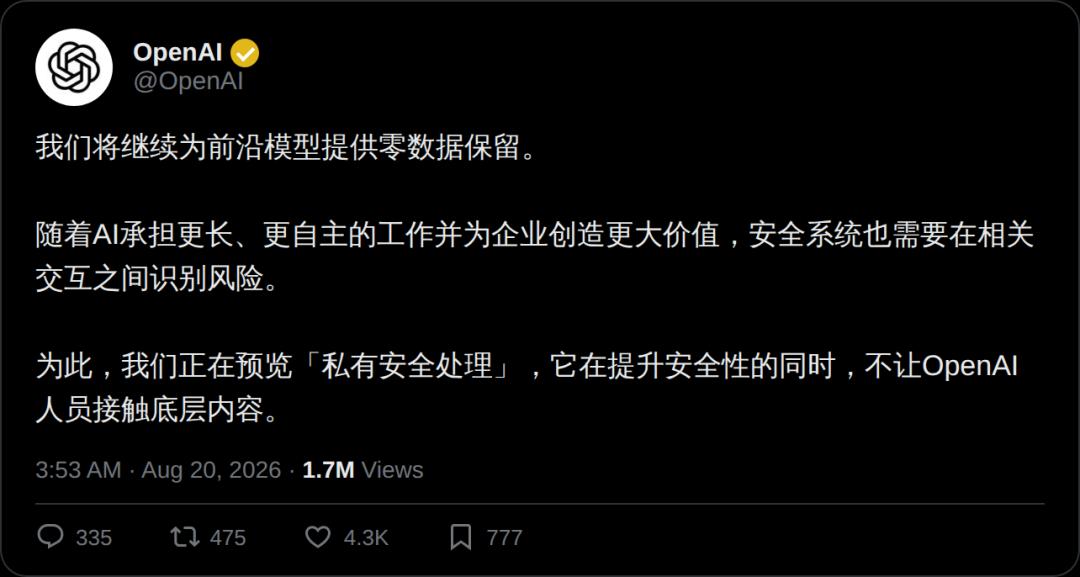
On August 19, OpenAI announced with fanfare that it was testing a system called "Private Safety Processing".
The logic of this system is completely opposite to Anthropic's:
Client data remains on the client's own infrastructure, or is encrypted with the client's own keys; OpenAI only collects a very narrow, strictly defined set of "safety signals", and never touches the original prompts or responses.
Misuse can still be detected, but no single word of the original data is retained, and cutting-edge models continue to support ZDR.
This strike was extremely precise.
Anthropic had just claimed that "safety operations cannot be carried out without data retention", and OpenAI immediately proved with its product that safety can be fully guaranteed without retaining any original data.
Just over ten days later, on September 1, Anthropic finally could not hold back.
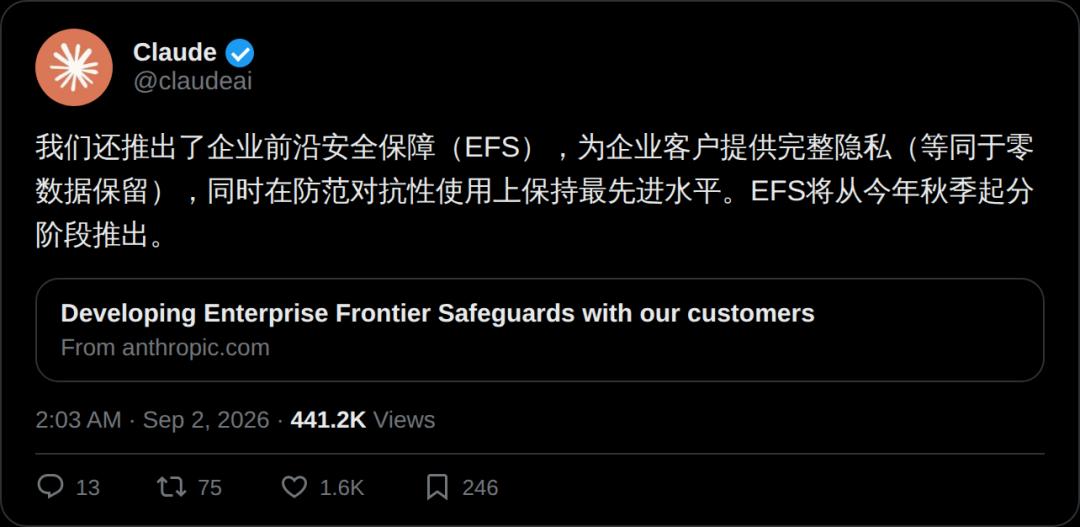
Alongside the release of Fable 5.1, Anthropic launched a scheme called "Enterprise Frontier Safety (EFS)".
The logic of this solution almost completely copies OpenAI's design:
Data is stored on the client's cloud, with the client holding the encryption keys, and Anthropic's system is only responsible for scanning for misuse signals and sending the results to the client for review. The official claims that this solution is co-built with more than 100 clients across the financial, medical and telecommunications sectors, including multiple CISOs.
Anthropic even implicitly admitted its mistake in a blog post, acknowledging that enterprises in regulated industries "do find it very difficult to use models that require data retention".
The three-month-long tug of war seemingly ended with Anthropic's compromise on the surface.
But when large clients scrutinized the contract closely, they found things were not that simple.
The EFS scheme is currently invite-only, will be rolled out in phases this fall, and does not even apply to Mythos 5.1. Worse still, there is a hidden loophole in the terms: Anthropic can cancel this option at any time.
This exact sentence touches the red line that Palantir has been insisting on the "irrevocability" of the agreement.
From the legal perspective, a promise that can be withdrawn at any time is no promise at all. If an enterprise signs the EFS today and feeds its core code into the model, Anthropic can cancel the option with a notice tomorrow, and the data processing rules will revert to the old "30-day retention" policy.
What enterprises want is to hold the key in their own hands; but what Anthropic offers is a key that can be confiscated at any moment.

Silicon Valley Rolls Out Defenses, Fleeing Anthropic's "God's-eye View"
That's how the extremely ugly "blocklist" dated September 14 came into being.
Bill Vass, CTO of Booz Allen Hamilton, voiced the common concern of all large enterprises in one sentence: "We are a bit worried that Fable will learn our code."
Indeed, the paper contract can prevent the vendor from using the data for model training, but it can never stop the model from "seeing" all your core business logic and most valuable trade secrets thoroughly during the 30-day retention period.
The most ironic part is that both sides in this hidden battle are waving the banner of "safety".
Anthropic enforces data retention out of fear that bad actors will use its cutting-edge models to cause damage; enterprises refuse any data retention out of fear that their core code will be stolen secretly.
When two "safety" demands collide, the result goes straight to absurdity: the more powerful the model is, the more enterprises will treat it like a thief and dare not feed it any real sensitive data.
The most powerful flagship model on earth ends up only being assigned a bunch of trivial, non-sensitive "watered-down tasks".
According to statistics from Ramp covering more than 70,000 U.S. enterprises, two months after the launch of Fable 5, its spending share has been stuck at 11%, while the token share of open-source models has skyrocketed from 11% to 62%.
But the illusion that "we are fully in control of our own data" could also be a fatal misjudgment.
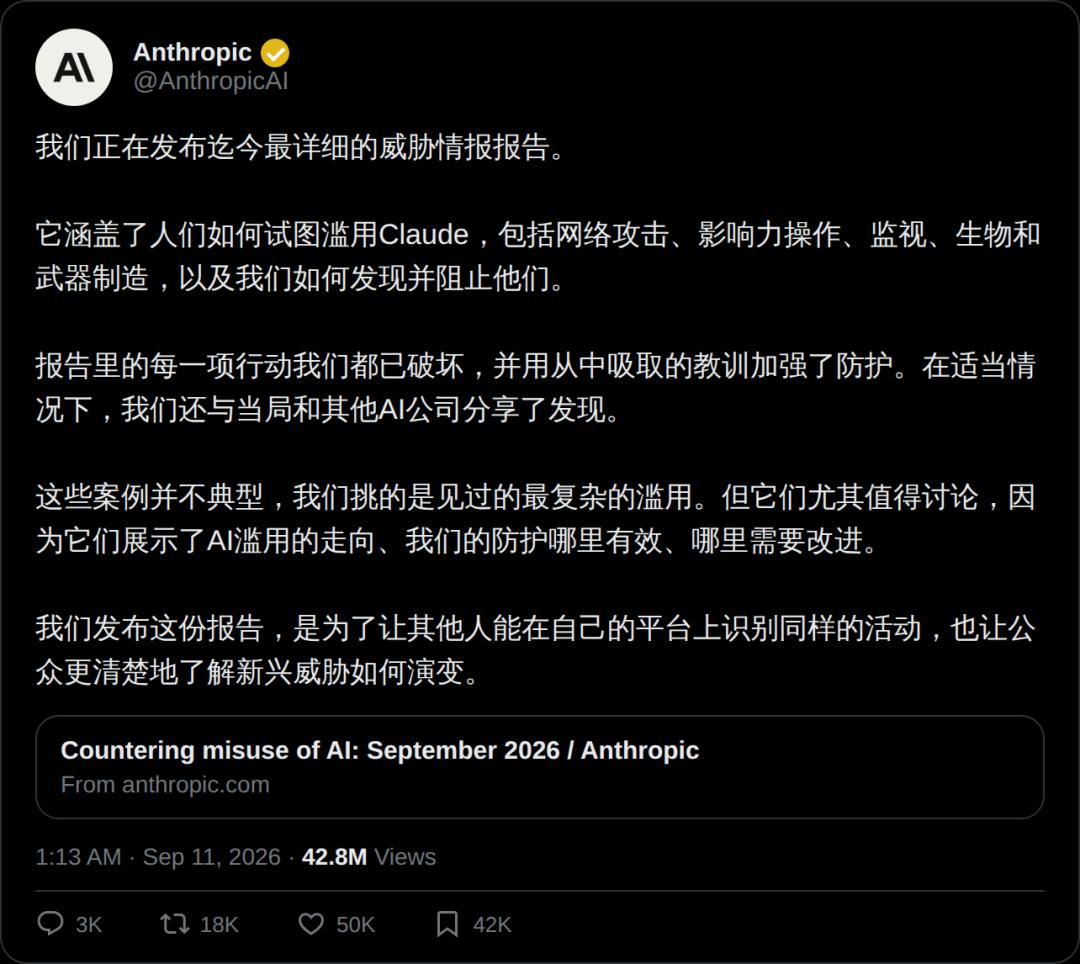
At the peak of the controversy, Anthropic released a threat intelligence report, publicly demonstrating how it has caught hackers in the background over the past year.
A group of hackers repeatedly modified exploit code using Claude until they succeeded in trial and error, and Anthropic saw the entire process clearly;
Another group of hackers swapped the API key for that of a victim mid-process, and was caught red-handed the moment they pulled off the switch.
Whoever did what to the model, at what exact time, every single record is crystal clear.
Anthropic intended to show off its capabilities, but after reading the report, large enterprises were chilled to the bone:
If they can see every single step of the hackers in such fine detail, aren't we essentially "streaking" in front of them?
It turns out that the three-month-long debate over "whether to retain data" is just the surface issue. The real fatal problem is how broad the "god's-eye view" of your model vendor actually is.
Anthropic, with this self-published report, gave all its large clients a chilling answer.
We can see every single thing about you, with no blind spots.
This article is from the WeChat official account "AICera", written by ASI Apocalypse, and published with authorization from 36Kr.