The second-generation Doubao phone is coming. Can it bypass the "ecosystem wall" that the first generation encountered?
The second-generation Doubao phone is coming. On September 16, the Nubia NaviX Ultra will be officially released, and reservations are now open. Different from the technical preview version last year, this generation is equipped with the first consumer version of the Doubao mobile assistant.
According to *Kechuangban Daily*, this version is built on the Doubao App, focusing on optimizing experiences including interaction, task execution, local memory and retrieval. At the interaction level, the exclusive AI key on the side of the phone is equipped with fingerprint authentication capability. After identity verification, users can call the assistant to perform tasks without secondary unlocking.
In December last year, the first-generation Doubao phone, the Nubia M153, was launched at a price of 3499 yuan. The first batch of about 30,000 units were sold out on the same day. The highest quotation on Xianyu once soared to 36,000 yuan, with a premium of more than ten times. There was even a business of "renting Doubao phones" at 50-79 yuan per day at that time.
But this carnival lasted for less than a week: WeChat popped up a notification saying "abnormal login environment", the Taobao App for ordering food was forced to log out, banking Apps were forced to exit... Some commented that the Doubao mobile assistant ran into the "ecological wall" built by Internet giants over decades.
The starting gun for the release of the second generation is about to go off, and a question worth thinking about is: have the "remaining problems" and "unsolved problems" of the first generation been resolved?
Can the second-generation Doubao phone knock on the door of Internet Apps?
The previous first-generation Doubao phone adopted the GUI simulated click route, which is equivalent to the AI "looking" at the screen like a human, recognizing the text, buttons and images on the page, and then completing operations through swiping and clicking.
In December last year, the Doubao mobile assistant also explained the situation of "abnormal WeChat login": "Doubao mobile assistant does not have any hacking behavior. INJECT_EVENTS is a system-level permission, and the technical implementation relies on Android system-level permissions with stricter usage restrictions." However, this hand that replaced humans to reach out to various Apps lost more independent operation space after multiple applications collectively "closed the door".
To truly realize practical functions such as the AI helping users reply to WeChat messages with one click, automatically place food delivery orders and complete payments, the permission opening of Internet platforms cannot be avoided. This "ecological wall" is still the core test that the second-generation Doubao phone has to face.
In addition to the GUI of the first generation, the second generation begins to adopt more protocols such as MCP and A2A for calling. Wang Xiangfeng, a professor at the School of Mathematical Sciences of East China Normal University, told reporters that MCP/A2A is a necessary but not sufficient condition for ecological collaboration. His main research directions are learning optimization, multi-agent learning, and the intersection of large models and operations research optimization.
"MCP solves Agent-Tool connection, and A2A solves Agent-Agent collaboration, but it requires active adaptation from the application side. The first generation was blocked by permissions, which essentially means that the ecosystem is unwilling to cede control, and the protocol does not solve the problem of 'whether calling is allowed'. Cross-application collaboration also requires operating system-level reconstruction." Wang Xiangfeng told *Kechuangban Daily*.
The technical route has changed from "breaking the window" to "knocking on the door". The second-generation Doubao phone wants to knock on the "permission door" of various Apps, which is still a problem of ecological collaboration. At this year's World Artificial Intelligence Conference, the counter for the second-generation Doubao phone was enclosed by glass, and only a few media were demonstrated functions such as search, information aggregation, message sending and image modification. It is still unknown whether it can support applications such as WeChat, Alipay and Meituan.
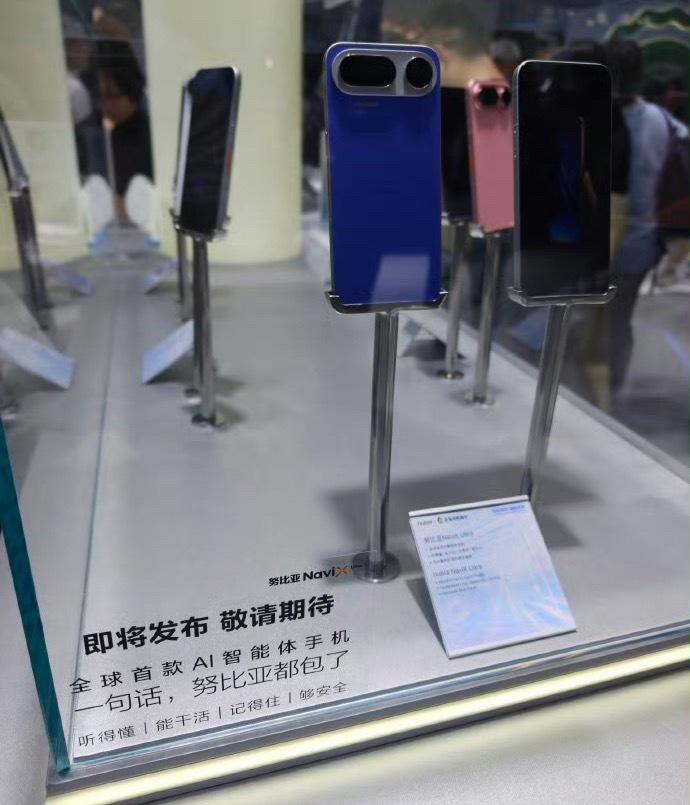
It is worth noting that in the recently released consumer version of Doubao mobile assistant, Doubao launched the Screen Automation Execution Protocol (SAEP), and simultaneously launched a 30-day rule publicity period.
According to this protocol, third-party applications can independently declare their operation boundaries, clearly allowing or rejecting the AI assistant to perform screen automation operations within their own applications. The Doubao mobile assistant side stated that it will fully respect the wishes of developers and will not perform automated operations on third-party applications that clearly reject related operations.
"We expect to jointly build an open and standardized mobile AI application ecosystem with partners" is the statement released by Doubao Assistant this time. However, if applications such as WeChat and Alipay choose not to open interfaces, or only open "query" permissions instead of "transaction" permissions, the second generation's "AI does things for you" capability will degenerate into "AI helps you find information". This is an ecological game involving the interests and territories of all parties.
Zhan Mulei, senior chief analyst at Omdia, once said in an interview that the dilemma faced by Doubao AI phones is highly universal. In essence, it is a commercial game between AI Agents trying to take over the user entrance and super Apps defending their traffic sovereignty. This is the "entrance battle" that all mobile phone manufacturers must face when promoting AI implementation.
However, different from the time when the first generation was released, in July this year, the Cyberspace Administration of China for the first time publicly announced the filing information of generative artificial intelligence services on the mobile terminal, including seven manufacturers including Nubia.
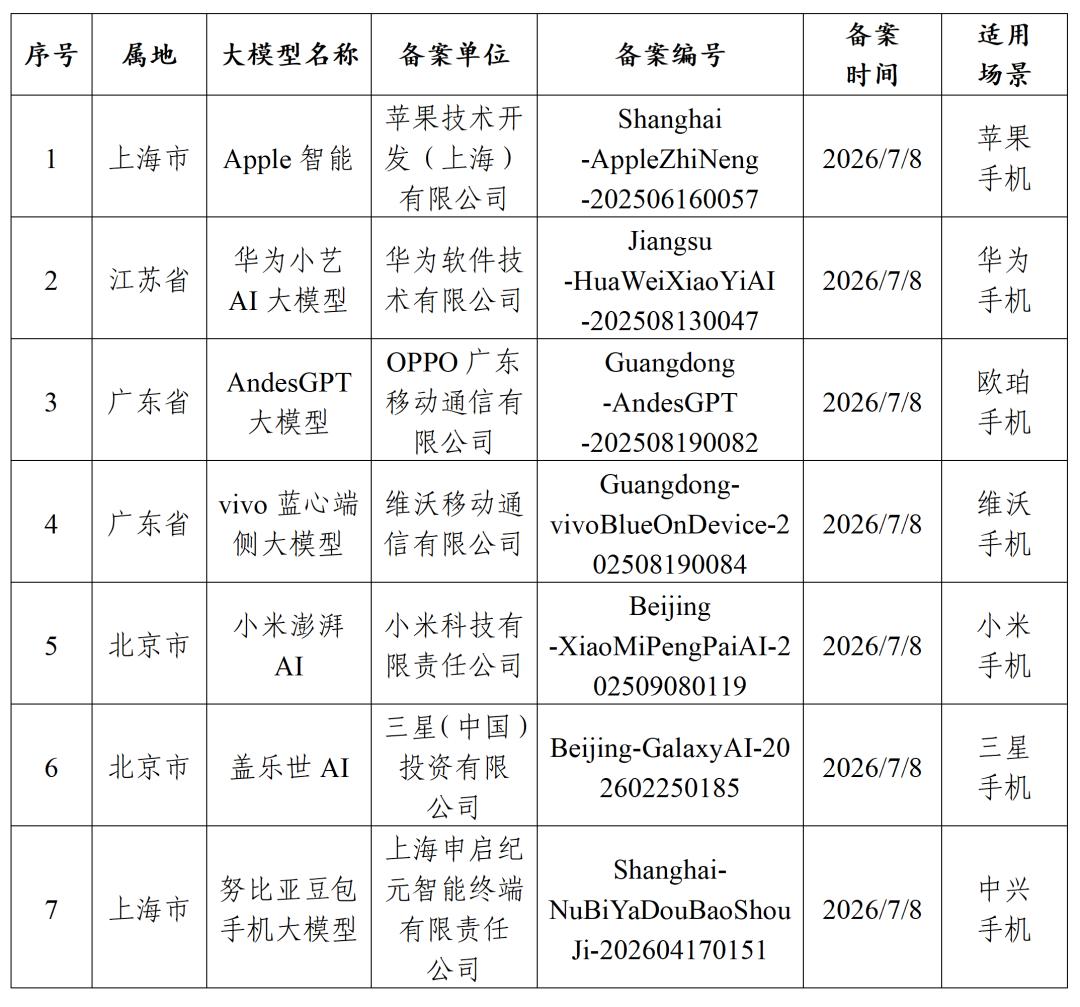
Image source: Announcement on Releasing the Filed Information of 7 Mobile Terminal Generative Artificial Intelligence Services from Cyberspace Administration of China Website
How far is the AI phone from "active service"?
One of the cores of the agent phone is active service. "But real active service requires: perceivable status, predictable demand, and judgeable intervention timing. At present, active prediction is still in the academic research stage." Professor Wang Xiangfeng judged.
"Active agents have higher intelligent awareness, such as intention understanding, long-term memory, and controllable security boundaries. Of course, more importantly, if it can be well trained for growth, autonomous planning is also very important. But the bottlenecks are multi-modal perception and power consumption on the device side, fault tolerance rollback of cross-App long tasks, privacy compliance and security. In addition, the personalized needs of different users are also very critical." Zhang Yi said.
For the problem of long-context retrieval on the device side, Zhang Xiaolu, Deputy Director of CIC Insight, believes that the DRAM space of mobile phones is extremely precious. To efficiently maintain hundreds of thousands of tokens of users' historical behavior memory in limited memory and achieve millisecond-level recall, breakthrough end-side KV Cache quantization and storage compression algorithms are required.
In addition to the second-generation Doubao phone, StepStar also launched its own terminal brand and AI agent phone at this year's WAIC. Many products have been launched one after another. Does this mean that 2026 is the "first year of agent phones"? Wang Xiangfeng's judgment is that the "first year of agent phones" in 2026 is valid in industrial narrative, and the technical maturity is relatively optimistic. The current more accurate positioning is the inflection point from proof of concept to early commercial use, and it still takes three to five years to achieve perfection.
Will the release of the second-generation Doubao phone greatly change the valuation of the production chain?
Zhang Yi, CEO and chief analyst of iiMedia Research, believes that this expectation is a bit too high, "but the combination of AI and mobile terminals will indeed accelerate the differentiation of the industry. For example, the transformation from 'having the AI concept' to the implementation of end-cloud collaboration and Agents will be a transformation opportunity."
Zhang Yi also said that in the future, the value weight will shift upward to the scheduling of model systems, memory bandwidth and other links. The key on the chip side lies in heterogeneous scheduling, power consumption and whole machine integration. The core signal is that AI phones must achieve end-cloud hybrid, and capital will concentrate on the direction of truly implemented end-cloud collaboration.
A major contradiction of current AI phones is: cloud large models have stronger capabilities, but there are user privacy and security issues; end-side models are more secure, but they are limited by mobile phone computing power and memory bandwidth, making it difficult to support the smooth operation of large-parameter models.
Reporters learned from insiders that both the previous technical preview version and this consumer version adopt the end-cloud collaboration solution. In principle, Doubao mobile assistant always gives priority to end-side processing. However, limited by the current industry technical capabilities, for complex tasks that must rely on cloud processing, data will be processed according to the principle of minimizing cloud upload. The overall end-cloud collaboration solution has not changed so far.
But does end-side operation solve the security problem? Professor Wang Xiangfeng's answer is that it does not solve it fundamentally, but changes the risk structure. He said that data does not leave the hardware, eliminating the risk of round-trip to the cloud; but local Agents can still be injected by prompts, misused or overstepped authority. Permission governance should shift from "whether connected to the Internet" to hierarchical authorization: independent execution for low risks, confirmation required for medium risks, mandatory manual takeover for high risks and full-link audit.
This article is from the WeChat official account "CLS AI Daily", author: Wang Nai, published by 36Kr with authorization.