Just after finishing the main operator of V4.1, is it about to "change career"? The late-night monologue of a senior operator engineer at DeepSeek
In the past six months of the booming large model development, the macro narrative has become increasingly extreme: on the one hand, founders are constantly making bold claims that they will subvert everything, on the other hand, there are sensational doomsday threats. When the heavy hammer of change hits the front line of AI development, those who push the upper limit of model capabilities with code, what on earth are they experiencing?
At the wee hours of last night, Liu Shengyu, a Machine Learning Systems (MLSys) engineer at DeepSeek, published a long article on his personal platform titled "I Had to Bury My Talent Yesterday".
Different from the common unemployment anxiety, the author is a top engineer who has just delivered the core operator for DeepSeek V4.1. In other words, he is the person who built the AI engine with his own hands, but after witnessing the model breaking into professional fields, he has to admit that he is being rapidly replaced by AI and is forced to "change career".
The People Who Support DeepSeek's Computing Power Base
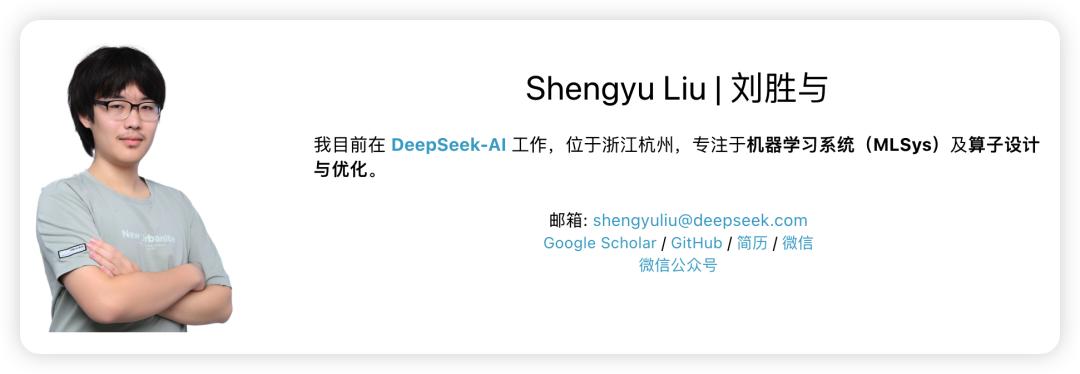
The author Liu Shengyu, a member of the 2021 Turing Class of Peking University, once served as the captain of the Peking University Weiming Supercomputing Team, and represented the university in the International Collegiate Supercomputing Competition SC23.
During his time in school, he dived deep into the underlying architecture of Transformer and CUDA programming, and participated in the research and development of the large model inference framework under the guidance of his supervisor. After joining DeepSeek during his undergraduate years, he quickly became a core force in the optimization of underlying infrastructure and high-performance operators.
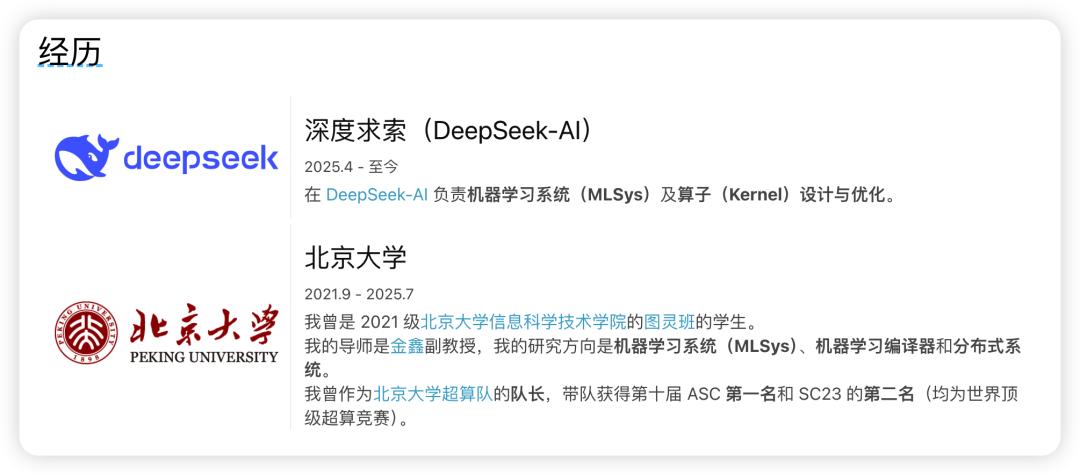
In the R&D system of large models, algorithm scientists are responsible for defining the network architecture, while system engineers (MLSys) are the "foundation construction team" that makes these huge networks run efficiently on physical hardware. Liu Shengyu's core work is exactly to go deep into the very bottom of the GPU architecture, squeezing the full performance of each generation of computing chips and memory bandwidth.
Specifically, Liu Shengyu's main technical contributions include:
• February 2025 ·Open source of DeepGEMM operator library: Deeply participated in the optimization of the underlying FP8 extreme performance GEMM operator, laying a hardware acceleration cornerstone for the efficient training and inference of the DeepSeek series models;
• April 2026 ·Upgrade of DeepEP V2 expert parallel communication library: Aiming at the communication bottleneck of next-generation model architecture and Mixture of Experts (MoE), deeply participated in the reconstruction of communication operators, significantly reducing the overhead of cross-node and cross-card data exchange;
• September 2026 ·Delivery of core operators for DeepSeek V4.1: Independently took charge of and implemented the main Attention operator of the model (MQA attention with head dim = 512), which directly supported the performance leap of V4.1 in small model and efficient inference scenarios.

It can be said that it is their extreme control over the underlying hardware that has built DeepSeek's technical moat across all generations of models in terms of strict cost control and efficient computing power utilization. Currently, the improvement of Infra capabilities is also the core competitiveness of domestic models such as Zhipu AI that can continuously reduce training and inference costs under limited computing power conditions.
However, the irony and cruelty of technological change are just unfolding at this point.
"The One Who I Hope to Overthrow Me Is Myself"
For a long time, writing high-performance GPU operators has been regarded as one of the "crafts" that human programmers are hardest to be replaced in.
It not only requires mastery of the upper-level high-performance computing logic, but also requires engineers to be extremely familiar with the micro-architecture details of GPU and memory hierarchy, and even dig deep down to the level of underlying PTX assembly and SASS machine code, analyze the cause of hardware pipeline stalls, and perform complex register allocation and shared memory scheduling.
But the current reality pointed out by Liu Shengyu in the article is that "AI has become a master of operators".
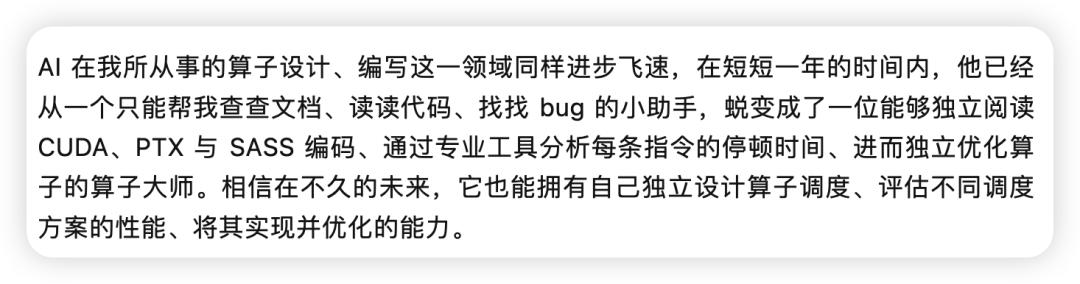
Liu Shengyu infers that in the next six months to one year, the ability of AI to autonomously evaluate scheduling schemes, design and implement end-to-end extreme operators will most likely catch up with or even surpass top human engineers.
"AI can think 300 tokens in one second, type a line of command in half a second, and write a full piece of code in twenty seconds, but I can't; AI can continuously improve in terms of model depth, thinking intensity, tool invocation volume (frequency of interaction with the environment), and even parallelism, but I can't."
What follows is a cruel technical paradox: The more extreme the engineers optimize the underlying operators, the more efficient the training and inference of the model will be; the faster the iterative evolution of the model, the shorter the cycle for them to be surpassed and replaced by the model.
Since you know clearly that you are accelerating your own replacement, why do you still go all out?
The mental journey Liu Shengyu presented is extremely real.
On the one hand, it comes from the pure technical dopamine — writing operators is like playing a game for him. The moment he invents a new technology, sees the operator performance soar, or even outperforms the official operators of chip giants, the sense of achievement is no less than that of a speedrunner breaking the world record.
But the deeper motivation lies in the sobriety and calmness when facing the general trend of technology: even if he stops now or even slacks off, the models of other teams around the world will still advance at an accelerated pace, and eventually sweep over without any suspense.
He wrote: "I certainly hope I will not be overthrown by the revolution, but if I have to be, I hope the one who overthrows me is myself."
In fact, this sense of "being replaced" perceived by Liu Shengyu is also a technical trend that is being accelerated at the chip and system software layer. Automation of operator and software-hardware stack development is no longer a theoretical idea: there are already clear cases in the industry.
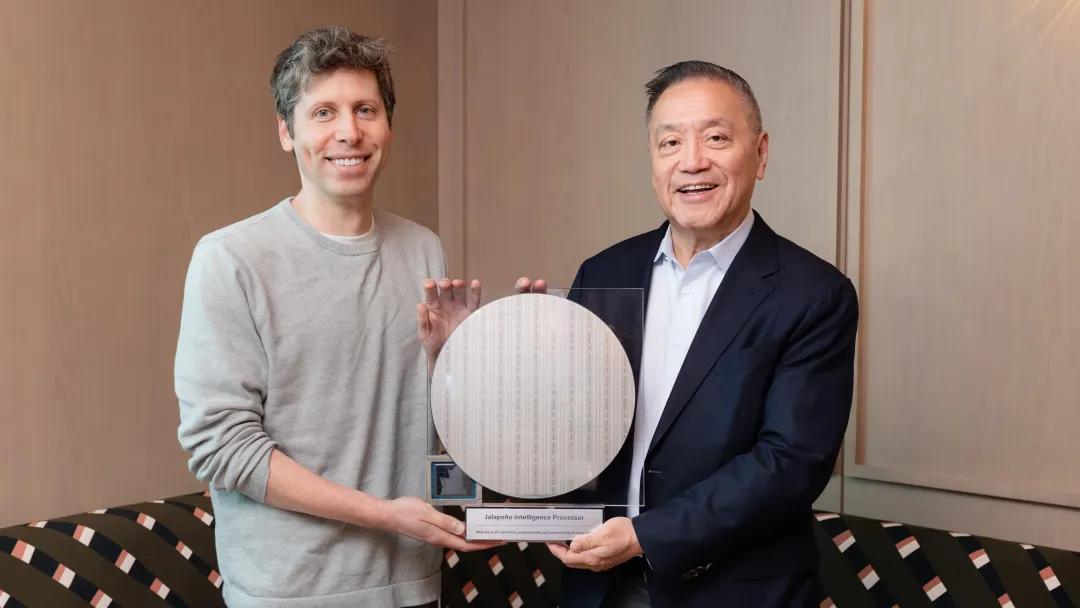
In our previous report "Use Astra+Codex to Kill CUDA! OpenAI's 9-Month AI Chip Development Strikes Back Against Nvidia GB300", we mentioned that in the process of advancing its custom AI chip (codename "Chili Pepper"), OpenAI scaled up the use of Astra and Agent tools to directly participate in operator generation and compilation stack construction, compressing the development cycle that originally required dozens of senior underlying experts to spend several months into a very short period of time.
Earlier, Nvidia and Cursor announced a more engineered experiment: a multi-Agent system automatically optimized 235 CUDA operators for Blackwell B200 within three weeks, with a geometric mean performance improvement of 38%, and 19% of the tasks achieved a speedup of more than twice.
From handwriting underlying assembly to using reinforcement learning and model generation to drive automatic operator tuning, the evolution speed of system engineering is exceeding everyone's initial expectation.
However, this sober deduction does not eventually lead to the widespread panic about "unemployment", but a more precise career judgment — "career transition".
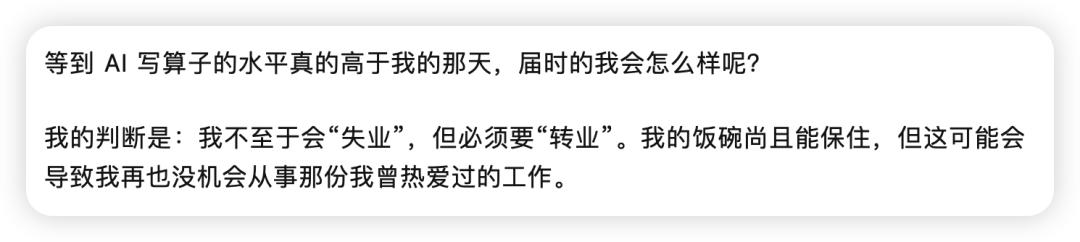
In Liu Shengyu's view, top engineers, with their own vision, engineering judgment and intelligence, can still stay at the table of this era, but this does not mean that work can remain the same. The so-called "career transition" does not mean leaving the field of computer systems to find another way out, but that the paradigm of producing operators has completely changed. Liu Shengyu vividly calls this transformation becoming the "mecha pilot" of the Agent.
In this new role, the "mecha" refers to those AI Agents that have ultra-high code throughput, can independently analyze instruction stalls and batch optimize performance in large quantities.
Instead of handwriting underlying instructions line by line, human engineers step back and become "pilots" — with their understanding of upper-level model requirements, cognition of the physical characteristics of underlying hardware, and control of global system engineering, they issue instructions, set boundaries and evaluate solutions for Agents.
Although the job is preserved, the pleasure of polishing code by hand as a craftsman is also stripped away.
As Liu Shengyu lamented in the article: In order to adapt to the needs of the industry, I am bound to give up the direction I loved before and turn to an unknown new direction... I have more gears in my hands, but fewer beats in my heart.
Deep Hidden Worries: The Collapse of Engineering Foundation
Apart from the transformation of personal roles, Liu Shengyu further extended his perspective to the torture of the future of the entire computer engineering education and technology society.
In current university and scientific research training, people are constantly facing the most real and most widespread speculative temptation:

This easily accessible efficiency shortcut is quietly draining the core capabilities of developers: code organization, system construction, forward-looking design and abstract capabilities, which originally need to be honed in countless failures and debugging processes.
For whether these capabilities will be eliminated by the times, Liu Shengyu put forward a sharp comparison and deduction: Will it gradually become marginalized like the old "writing x86 assembly", or become an eternal cornerstone like "understanding the entire computer system"?
If it is the latter, the proliferation of AI will not bring technological prosperity, but a huge systemic risk. In his long article, Liu Shengyu spoke out the hidden worries of front-line developers:
"A person with very poor engineering ability, after being equipped with AI, can produce low-quality messy code several times faster than before, which will bury various hidden troubles for the system and make the world more sloppy."
When the barrier of handwritten code is easily erased and the underlying engineering is gradually hollowed out, the game rules of the entire technology ecosystem are also qualitatively changing. Liu Shengyu also put forward a very insightful question:
"In the future society, will power be more important than technology or intelligence?"
Based on this judgment, he deduced two extreme directions for the future society:
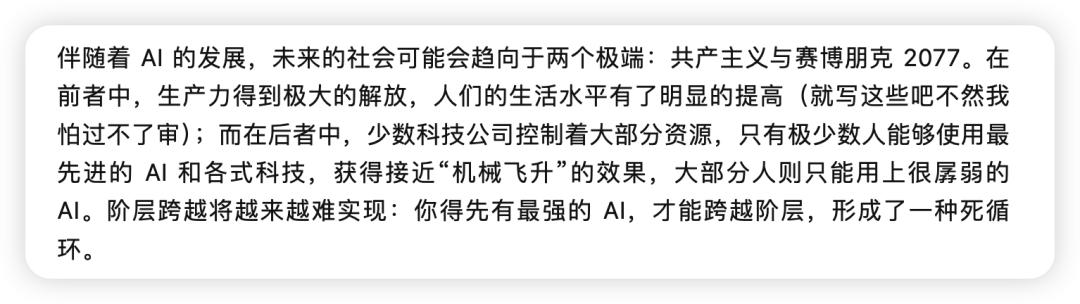
Such thinking also anchors his deep motivation to stay in the trench even after losing the simple pleasure of handwriting operators:
"This is why I chose and insisted on staying at DeepSeek: We research powerful, fast, and inclusive artificial intelligence and make it open source, which may pull the world back a little from the 2077 end."
This Is Not Just One Person's Monologue
After the long article was published, it triggered an extremely enthusiastic response in the technology circle, and even attracted many scholars and senior developers to join the discussion.
Liu Shengyu's assertion in the article that "AI is breaking through operator development" was soon directly confirmed by peers in the comment section. A reader named "Hulu" admitted that he is currently using Codex to develop Attention operators for domestic chips, "Apart from that it cannot make the final decision on the solution, it can help me complete everything else, fast and well."

Deeper questioning comes from the academic circle. A doctoral supervisor from the School of Computer Science of Nanjing University also left a comment: "I believe that the taste of system design can be guided by RL with feedback signals, it's just a matter of time before everyone figures out the data construction and training methods, then it will be really over."
