Innovation and Commercialization of AI Applications: New Ecosystem and New Infrastructure
Abstract
AI Application Innovation and Commercialization: In this report, AI application innovation includes AI-enabled upgrading of existing applications and AI-native application innovation, not limited to AI-native Apps. At present, the AI transformation across all industries is unstoppable, and AI applications continue to expand to consumer and enterprise markets. Conversational AI accelerates the implementation of AI applications, while technological innovations such as Vibe Coding and CUI accelerate the innovation of AI application development models. At the same time, the commercial implementation of AI applications is increasingly facing new rules of globalization, security and compliance.
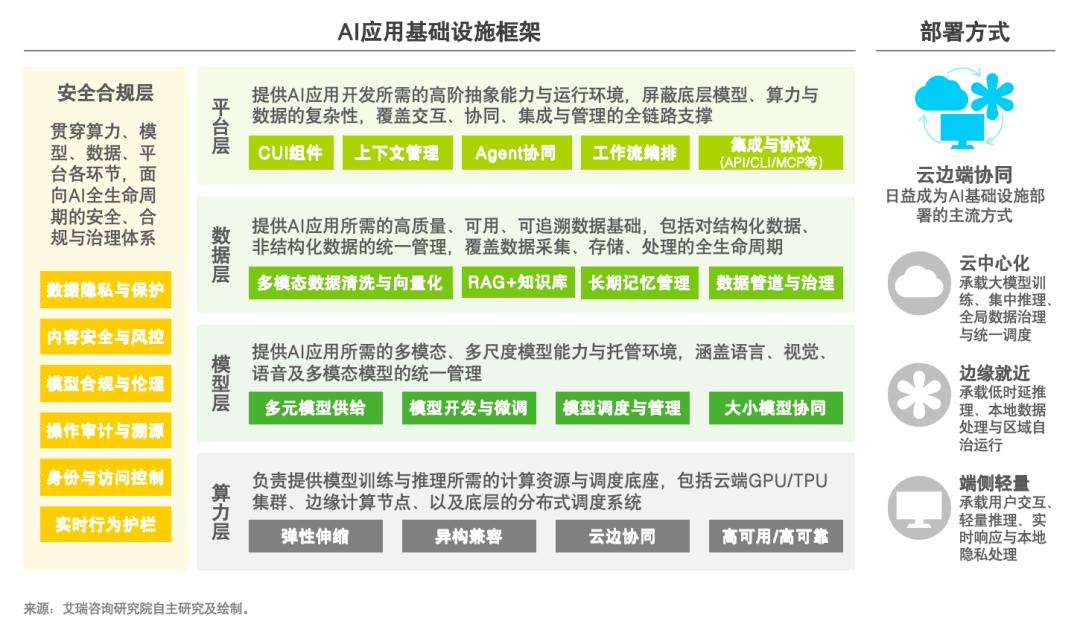
Critical Infrastructure for AI Application Innovation: The critical infrastructure for AI application innovation can be summarized into five layers: computing power, model, data, platform, security and compliance. Its importance is reflected in reducing model hallucinations, precipitating knowledge assets and data governance, context management, Agent collaboration, as well as data privacy, content risk control, permission control and audit tracking.
RongCloud: In the AI era, as a global AI communication solution provider, RongCloud is positioned as a key player to open up the "last mile" of large model commercialization. Relying on its self-developed AICP (AI Communication Platform) base, its product and service capabilities cover the data, platform, application, security and compliance layers, and it takes the lead in laying out new A2H (Agent-to-Human) and A2A (Agent-to-Agent) communication categories.
Development Trends: It is expected that in the future, AI application innovation will be deeply integrated into scenarios, and its trend characteristics in the new A2A collaboration ecosystem, end-side intelligence, and multi-modality will be further highlighted, which is specifically reflected in the fact that industrial collaboration has moved from single-point human-computer interaction to multi-agent interconnection network, end-side computing power and lightweight models promote local deployment, and multi-modality such as voice, video and text and real-time interaction are enhanced. At the same time, challenges still exist in the stability of AI results, security compliance and globalization adaptation.
Overview of AI Application Innovation
Unstoppable AI Transformation
The threshold for AI application is falling rapidly, empowering the stock and incremental markets and fully penetrating all walks of life
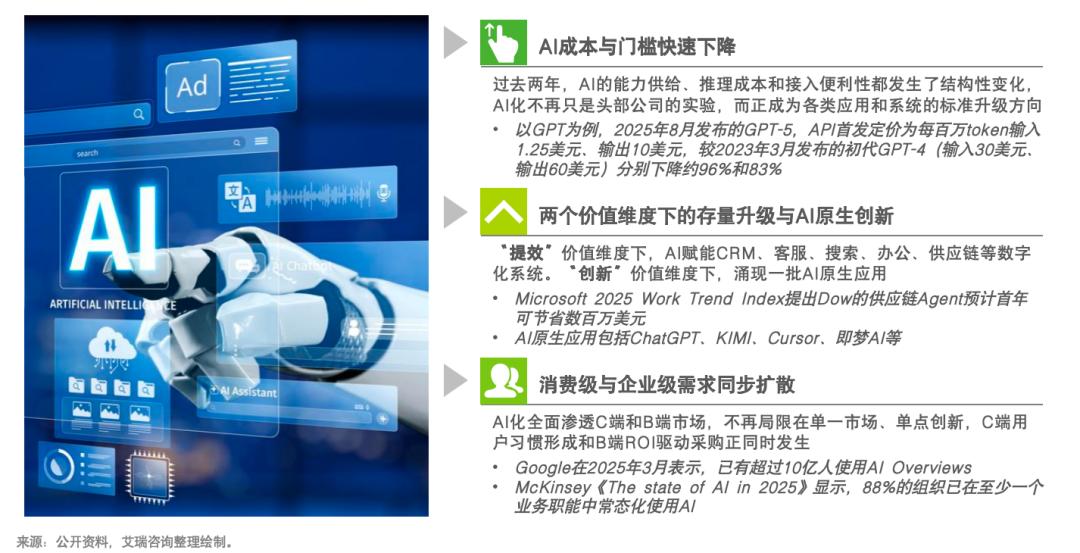
At present, affected by the enhanced AI supply, reduced reasoning cost and lower access threshold, AI is accelerating its in-depth application in all walks of life. On the one hand, AI promotes the stock upgrading of CRM, customer service, search, office, supply chain and other fields; on the other hand, for different application scenarios, a number of AI-native applications have emerged in the industry, driving incremental innovation. From the perspective of market demand, the digital systems of AI demand in the consumer and enterprise markets are expanding simultaneously. AI has gradually moved from single-point function trial to normal use, and AI is further evolving from a "question and answer tool" to a task processing entrance, accelerating its penetration into various industries.
Conversational AI Becomes a Core Entrance
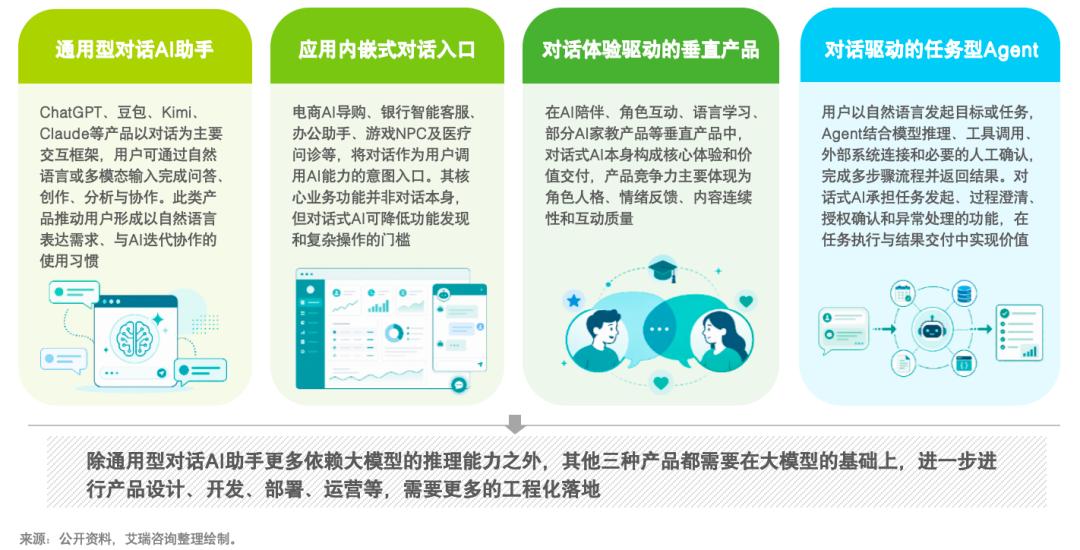
Conversational AI converts natural language into user intent and accelerates the landing of AI applications
Conversational AI refers to an AI interaction method that takes natural language, voice and multi-modal information as the main media, supports users to express intentions, continuously clarify demands, obtain content or trigger task execution. Conversational AI is evolving from the "question and answer interface" of AI applications to the "intent entrance" for human-machine collaboration and Agent task execution, playing an important role in promoting the development and commercial landing of AI applications. Its core value lies in accepting user intentions in natural language, and forming a controllable delivery closed loop together with GUI, multi-modal input, Agent, business system, tool invocation and human services.
Optimistic Market Environment for AI Application Innovation
Iteration of AI tools lowers the innovation threshold, and market application enters the scenario verification stage
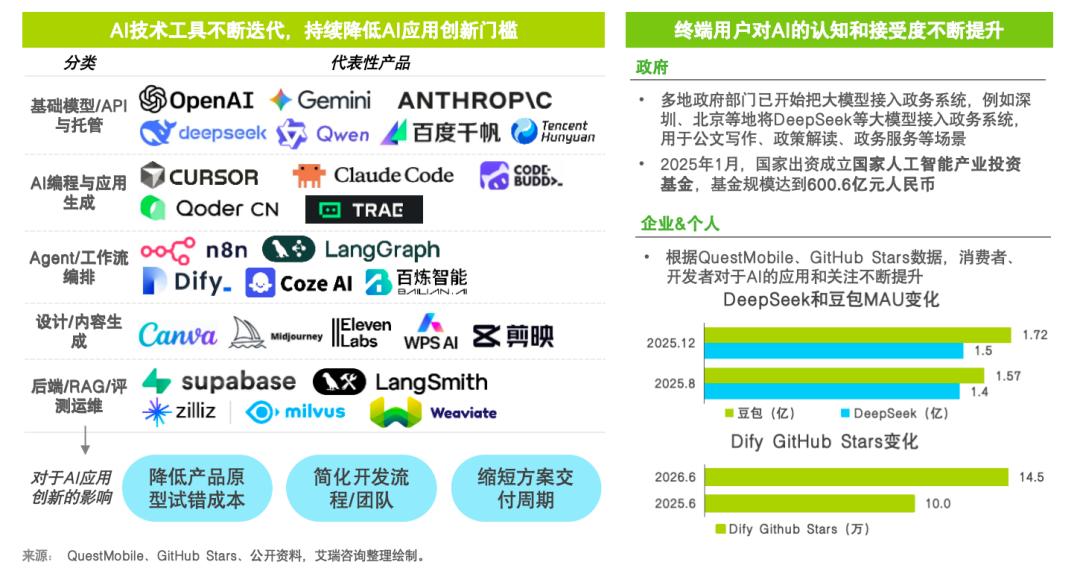
At present, AI application innovation is accelerating from "technological availability" to "scenario verification". From the perspective of supporting supply, the toolchains of basic models, programming generation, Agent orchestration, content generation and RAG evaluation are continuously improved, significantly reducing the thresholds of product prototype development, team organization and solution delivery. From the perspective of market demand, the government's acceptance of AI is increasing and policy support continues to rise, and the awareness, acceptance and usage frequency of AI among enterprises and individual users are also improving simultaneously, driving related products to enter a more in-depth application verification stage.
AI Startups Accelerate Application Innovation
Technology iteration drives application innovation, and the application layer becomes one of the most active battlefields for AI entrepreneurship
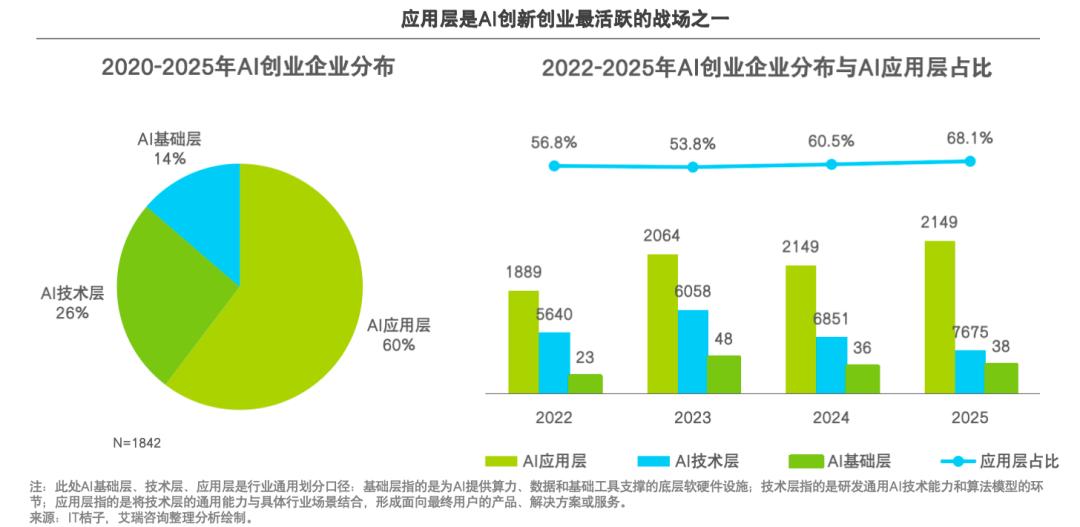
In recent years, with the continuous maturity of model capabilities, development tools and industry solutions, technology iteration is being transmitted to productization and scenario-based innovation at a faster pace, pushing the focus of entrepreneurship to shift from underlying capacity building to application landing for specific demands. According to the distribution of AI startups at the basic layer, technology layer and application layer from 2020 to 2025, most AI startups in recent years are concentrated in the application layer, accounting for about 60% of the total, which is significantly higher than the technology layer and basic layer. It can be seen that the application layer has become one of the most active directions of AI entrepreneurship. From 2022 to 2025, although the number of enterprises in the application layer fluctuates, the proportion remains in a high range of 53.8% to 68.1%, and further rises to 68.1% in 2025.
AI Application Development: Vibe Coding
Vibe Coding lowers the development threshold, and individuals and small teams become important innovation subjects
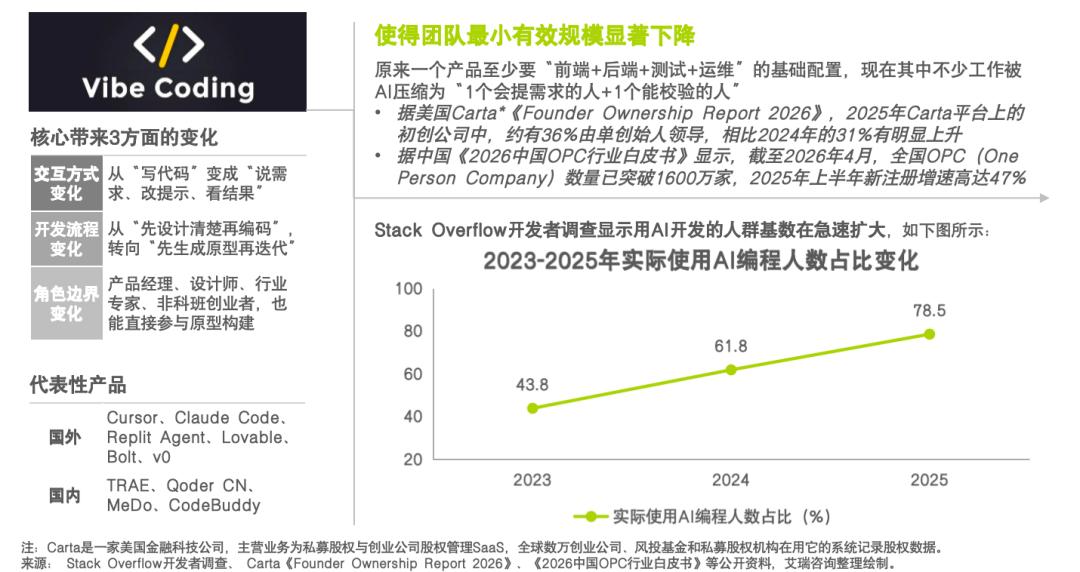
Driven by Vibe Coding technological innovation, the capabilities of code generation, debugging and prototype building continue to enhance, and product development has gradually shifted from traditional "coding" to a process centered on demand expression, rapid generation and iterative verification, significantly reducing the team configuration and technical threshold for AI application innovation teams; product managers, designers and industry experts can also participate in prototype construction more deeply. Relevant survey data shows that the proportion of people who actually use AI programming continues to rise, and individual developers and small teams are becoming an important force for AI application innovation.
AI Application Development: Typical Development Framework
Typical development framework is gradually taking shape, and development work is facing new key and difficult points
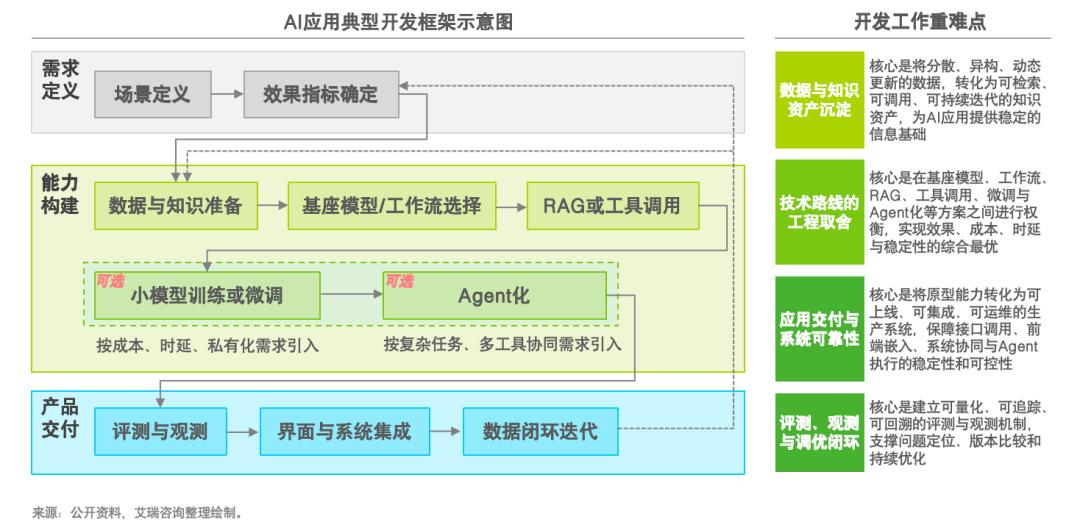
From the overall industry perspective, AI application development is gradually forming a typical framework consisting of demand definition, capability building and product delivery: in the early stage of the development process, it starts from scenario definition and effect indicators; in the middle stage, it focuses on data and knowledge preparation, base model selection, RAG or tool invocation, and introduces small model training or Agent-formation as needed; in the later stage, it promotes continuous iteration through evaluation observation, system integration and data closed loop. Under such an AI application development framework, the key and difficult points of developers' development work have also changed. Precipitation of knowledge assets, tradeoffs in technical route engineering, delivery stability and construction of evaluation optimization system have become the key and difficult points of development work.
AI Application Commercialization Model
The commercialization model is transforming to delivery economy, and GUI/CUI/Agent collaboration promotes application effectiveness
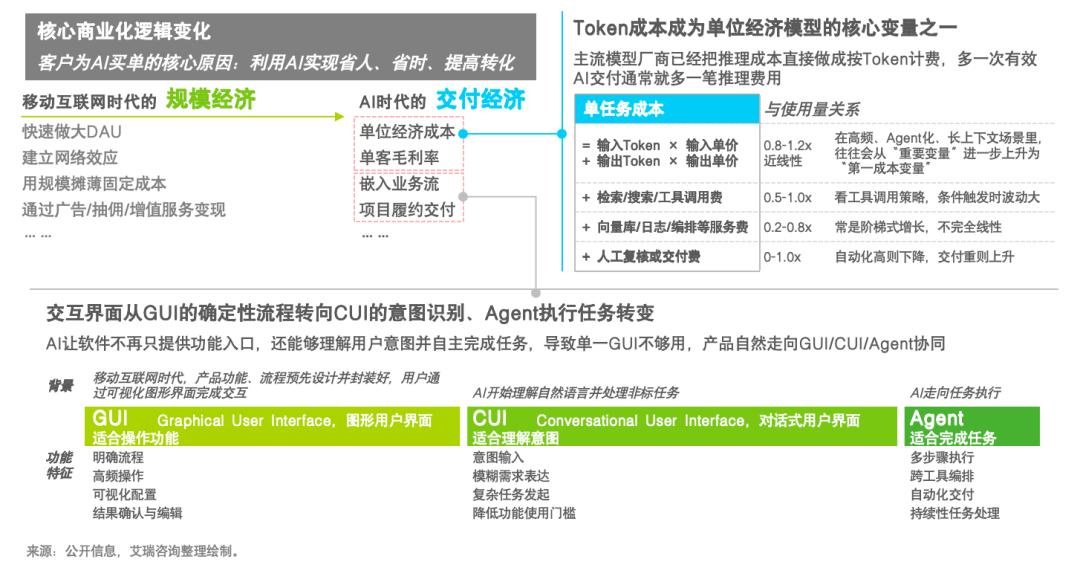
The core logic of AI application commercialization is changing. Compared with the mobile Internet era which relied on user scale expansion, network effect accumulation and advertising value-added monetization, AI applications emphasize more on the delivery economic model based on cost elements such as Token consumption, tool invocation, vector storage and manual review. At the same time, product interaction mode has gradually evolved from the deterministic process dominated by GUI to the parallel collaboration of GUI, CUI and Agent, paying more attention to intent recognition, task orchestration and result delivery efficiency.
New Rules for AI Application Commercialization
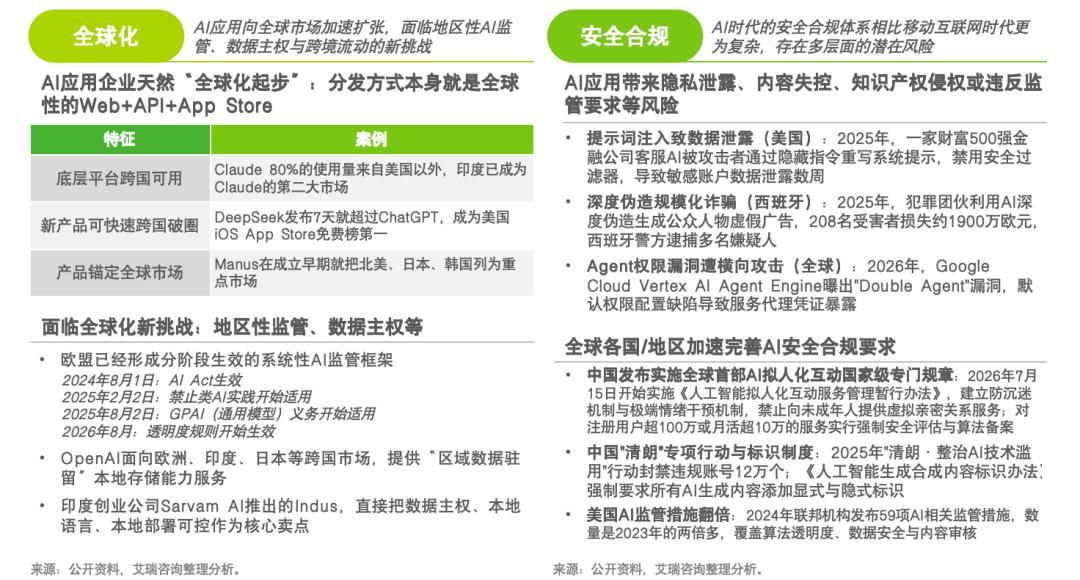
The globalization development of AI business faces requirements such as data sovereignty, and security compliance requirements are increasingly strict
At present, more and more AI application enterprises are oriented to the global market from the very beginning of their establishment, with the attribute of "starting from globalization"; at the same time, AI risks are gradually exposed, and the commercial landing of AI applications is facing new rules such as globalization and security compliance.
Critical Infrastructure for AI Application Innovation
New Infrastructure for AI Applications
Including five levels of computing power, model, data, platform and security compliance, it is necessary to build a complete support system running through AI applications from underlying resources to upper-layer capabilities
Challenge of Model Hallucination
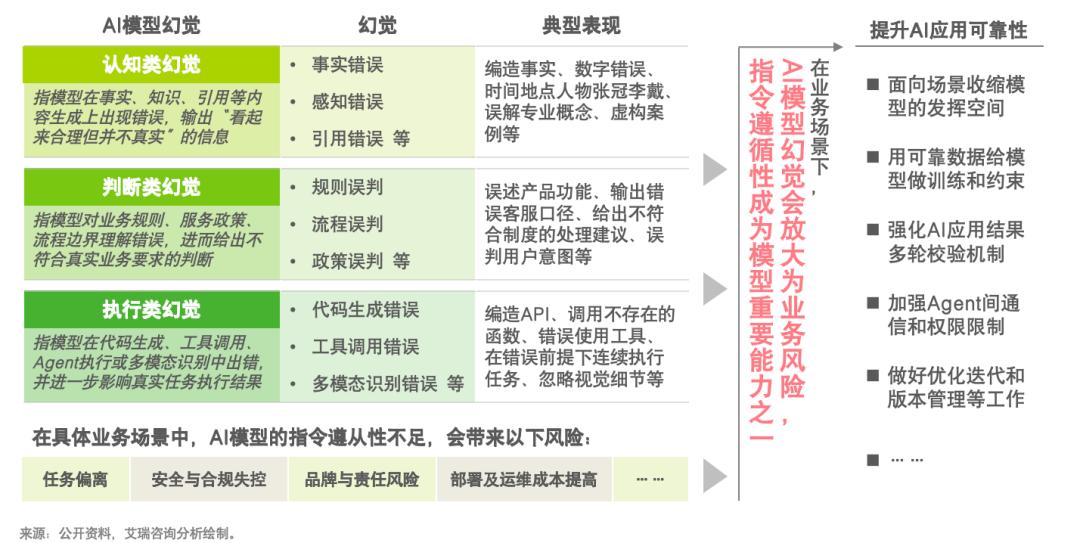
Model hallucination is still one of the core challenges of AI applications, and instruction following has become one of the important capabilities of models
Model hallucination is still one of the core challenges in current AI application development, which directly affects the stability and reliability of AI application results. As AI is applied to business scenarios, especially when AI begins to enter real business processes such as customer service, marketing, transaction, knowledge Q&A, code generation and Agent execution, hallucination is no longer just "wrong answer", but will become a business, compliance and responsibility issue. As AI evolves from Chatbot to Agent, instruction following has become one of the important capabilities of AI models for major manufacturers. Therefore, optimizing AI model hallucination and improving AI model instruction following has become one of the important tasks of AI application development. Specifically, AI model hallucination can be divided into cognitive hallucination, judgment hallucination, execution hallucination, etc.
Data Management and Application Challenges
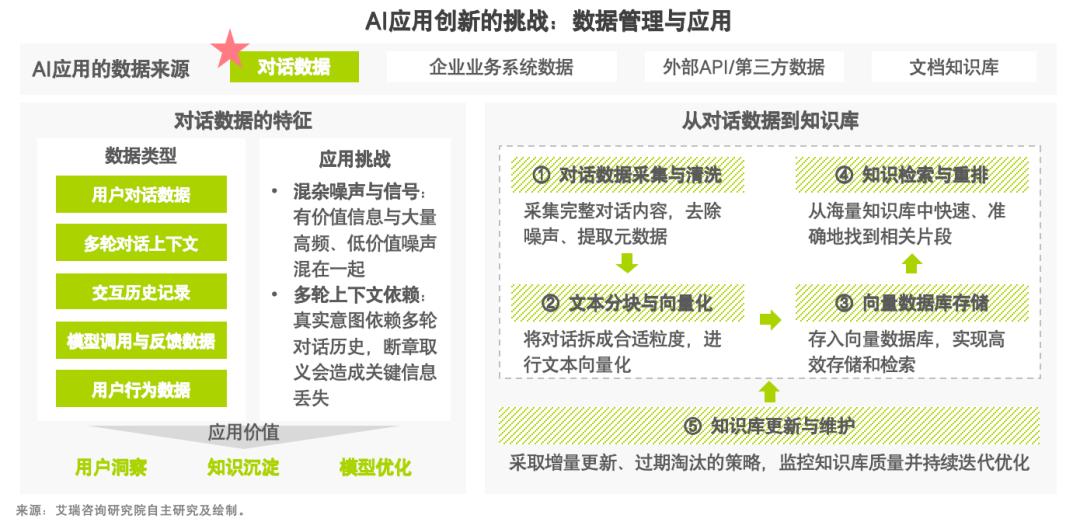
Precipitate unstructured conversation data and convert it into a retrievable and analyzable knowledge base
AI application related data includes internal data, external data, conversation data, real-time data, derived data, etc. Among them, conversation data is the most critical source of real feedback for AI training and application optimization. It not only carries user preferences, pain points and demand changes, but also precipitates high-quality problem-solving paths, so it has important value for model iteration and application effect improvement. Compared with structured information such as standardized data returned by knowledge bases and APIs, massive conversation data has existed in a dispersed unstructured form for a long time. The processing difficulties lie in complex multi-round context, high noise and high threshold for effective signal extraction. Whether conversation data can be transformed into retrievable, analyzable and sustainable data assets through cleaning and processing, vectorization organization, dynamic update and lifecycle management is increasingly becoming the key for AI applications to build barriers.
Natural Interaction Experience Challenges
Upgrade from general memory to relational memory to meet users' expectations for natural AI interaction
As conversational AI becomes an important entrance for AI applications, the quality of natural interaction has a significant impact on user retention and stickiness. In the process of interaction between users and AI, it is easy to appear that AI replies are rigid, lack initiative and consistency. The key lies in the design of memory mechanism. Only recording factual static information such as users' birthdays and hobbies can no longer meet users' expectations. AI should be able to perceive users' emotional changes and gradual development of relationships on the basis of maintaining personality constraints, and bring users a more natural interaction experience by relying on relational memory. The realization of relational memory is not simply storing more conversation texts, but requires a variety of engineering methods, such as dynamically judging which information is worth retaining and which needs to be discarded, adopting different storage strategies for long-term and short-term memory, balancing memory cost and memory freshness through compression and forgetting.