Shocking! The brain of a fruit fly has been successfully connected to ChatGPT.
I smell vinegar and yeast. I taste sugar. It's warm and bright. What should I do?
This sentence comes from the electrical discharge of a fruit fly brain.
The pulses emitted by 138,000 neurons at the same time are decoded word by word by a translator, spliced into sentences, and sent to ChatGPT without any modification.
Just yesterday, developer @chetaslua announced that he connected a simulated full fruit fly brain to ChatGPT.
15 million connections, running one pulse at a time, on a MacBook.
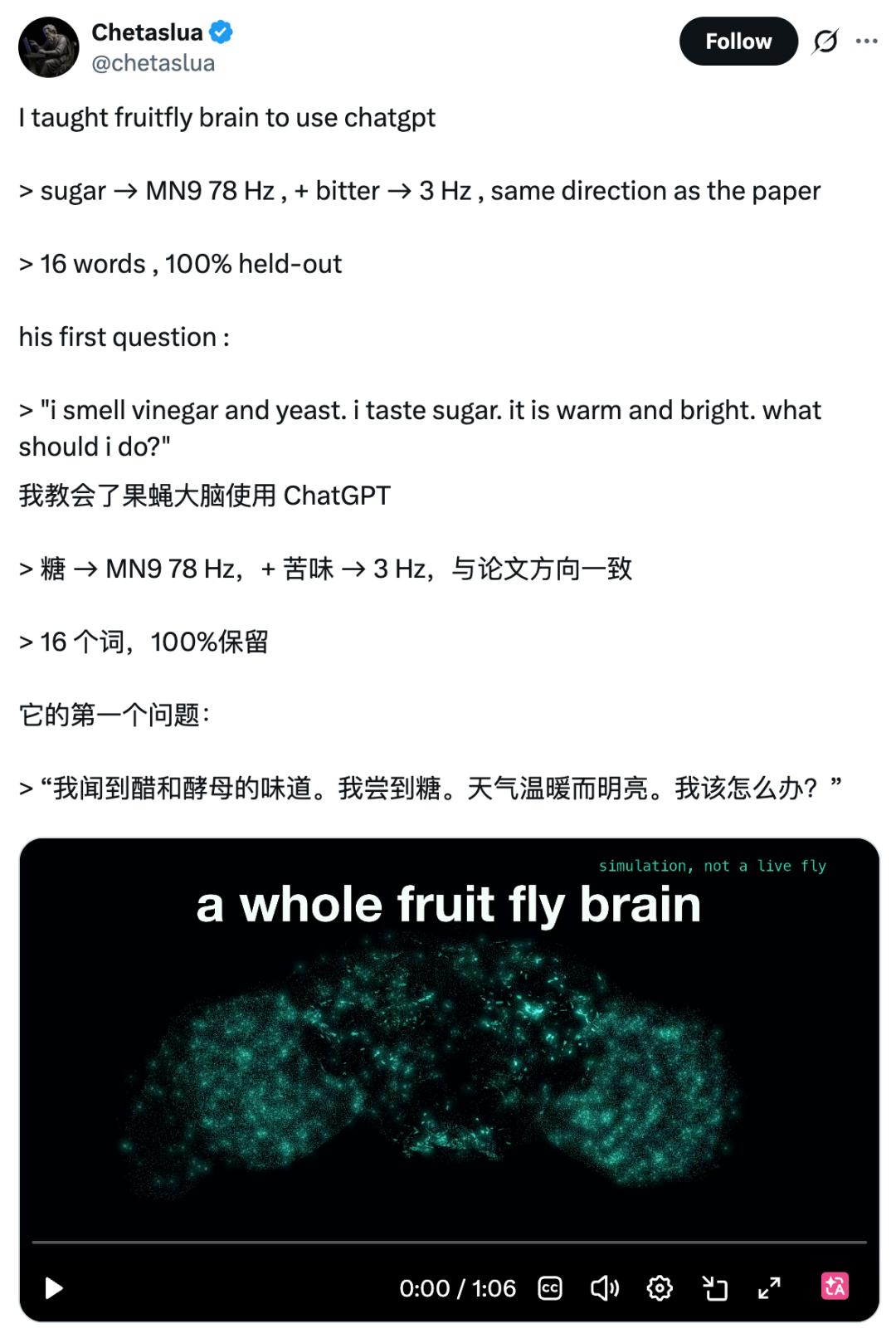
No neurochip, no GPU. The only tools are NumPy and a connectome. Simply put, a connectome is the wiring diagram of this brain, showing how neurons are connected to each other.
But even as a simulation, the shock of this incident has not diminished at all —
For the first time, biological neural signals have been translated into natural language to directly converse with AI.
Before making the fruit fly "speak", Chetaslua did a more critical thing first: to prove that the results generated by this simulated brain are reliable.
So he designed a rationality verification based on academic papers.
When sugar is fed, the MN9 neuron responsible for proboscis movement fires at 78 Hz. This means that the fruit fly tastes sweet, and its mouth stretches forward at a frequency of 78 times per second, ready to eat.
Add bitterness — the frequency drops to 3 Hz instantly. It retracts and stops eating.
The direction is consistent with the conclusion of the paper published in *Nature* in 2024.
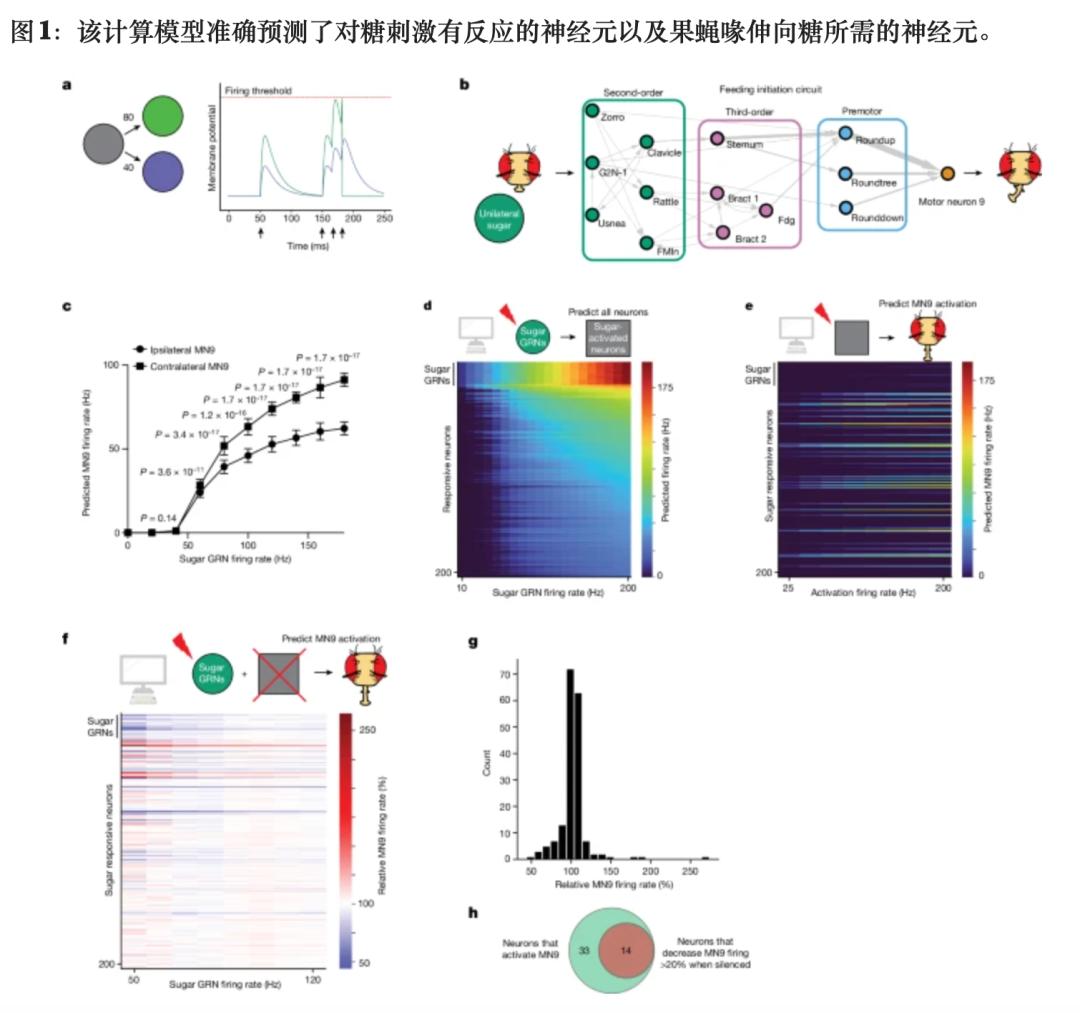
Liking and disliking are just two sequences of frequencies in this brain. High frequency means stretching the mouth to eat, low frequency means retracting it.
Some netizens asked: Is 78 Hz generated from the real connectome data, or made up by your model?
He replied with two words: its real, which means it is real.
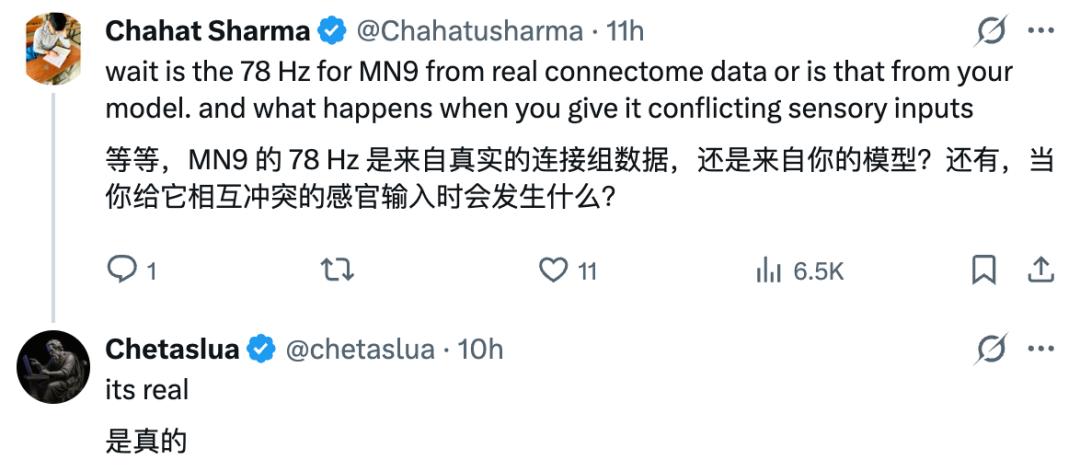
This step is critical. The most common problem with simulated brains is that they talk nonsense to themselves.
But by first verifying a pathway with a well-established conclusion in academic papers, the subsequent results will be credible once they match the conclusion.
How electrical discharges turn into human language
This is the most critical and also the most surprising step in the whole experiment.
He trained a "linear readout" on the brain's own activity. In plain language, it is a translator — mapping different discharge patterns to different words.
Every time the brain of this fruit fly generates a specific neural activity pattern, the translator outputs a corresponding word.
When training, he did a very meticulous thing: exclude sensory neurons.
Because the moment the odor hits the olfactory neurons, the signal is the cleanest, and reading it out is not a remarkable feat. It's like peeking at the answer during an exam — of course you get all the answers right, but it makes no sense.
What he wanted to find out was: how much of the signal remains after passing through several stations in the brain, and whether it can be recognized downstream.
In other words, whether the information still exists in the intermediate links from "smelling" to "getting ready to act".
The result: all 16 words are correct, with an accuracy of 100%.
He then narrowed the available signals down to only projection neurons and motor neurons, which is the layer that sends commands from the brain to the body, very close to "taking action", and the accuracy still reaches 85%.
This means that perceptions such as smell, taste, and touch still carry readable information when they pass from the perception layer all the way to the "ready to act" layer. The signal is not diluted during transmission.
Then these words are spliced into a prompt by the fruit fly itself, and sent to ChatGPT without any modification.
The first sentence at the beginning is the first output from this whole sequence of processes.
Pay attention to this order — discharge comes first, then words, then sentences. No human polishing in the middle.
Running a full fruit fly brain on a laptop is not the first attempt.
In October 2024, researchers from the University of California, Berkeley used the FlyWire connectome to simulate 139,000 neurons and 50 million connections, also on a laptop, and the simulation results could predict the response of real fruit flies after being stimulated.

The novelty of this attempt is that for the first time, electrical discharges are translated into natural language and sent to a large language model without any modification.
Before that, the simulated neural activity could only be compared with the reaction of real fruit flies.
The premise for this system to work is that the connectome data is fully open to the public.
The data base is the male fruit fly central nervous system connectome — MaleCNS v1.0, which took HHMI Janelia, the University of Cambridge and Google Research ten years to complete.
The manual proofreading alone took 44 person-years. It was published in the journal *Cell* on September 3, containing 166,700 neurons and 125 million synaptic connections, fully open source under the CC-BY agreement.
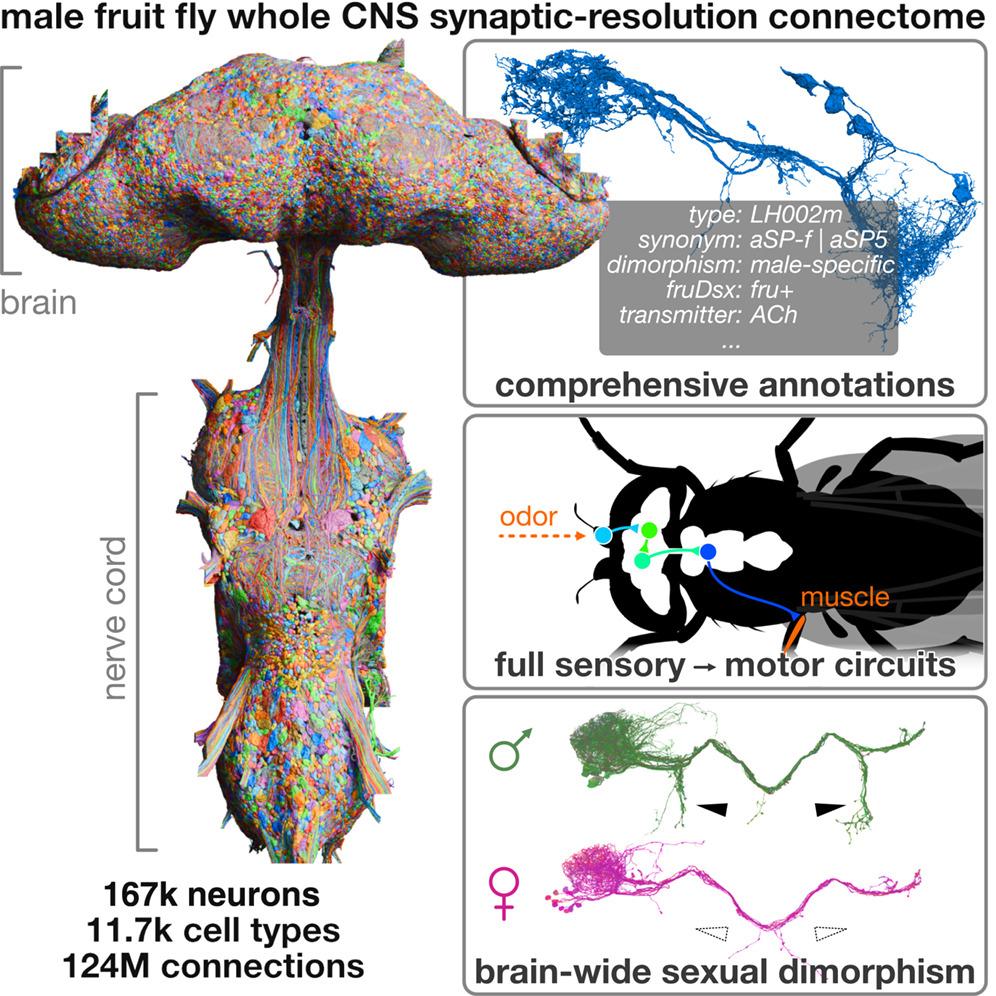
Register to get a token, run a few lines of pip install code, and you can pull the upstream and downstream connections of any neuron to your local device.
Just two days after the MaleCNS paper was published, Evan Smith, a graduate student at Georgia Tech, used GPT-6 Astra to import this connectome into Minecraft, letting a virtual fruit fly fly in a glass chamber, with neural activity directly determining every turn.
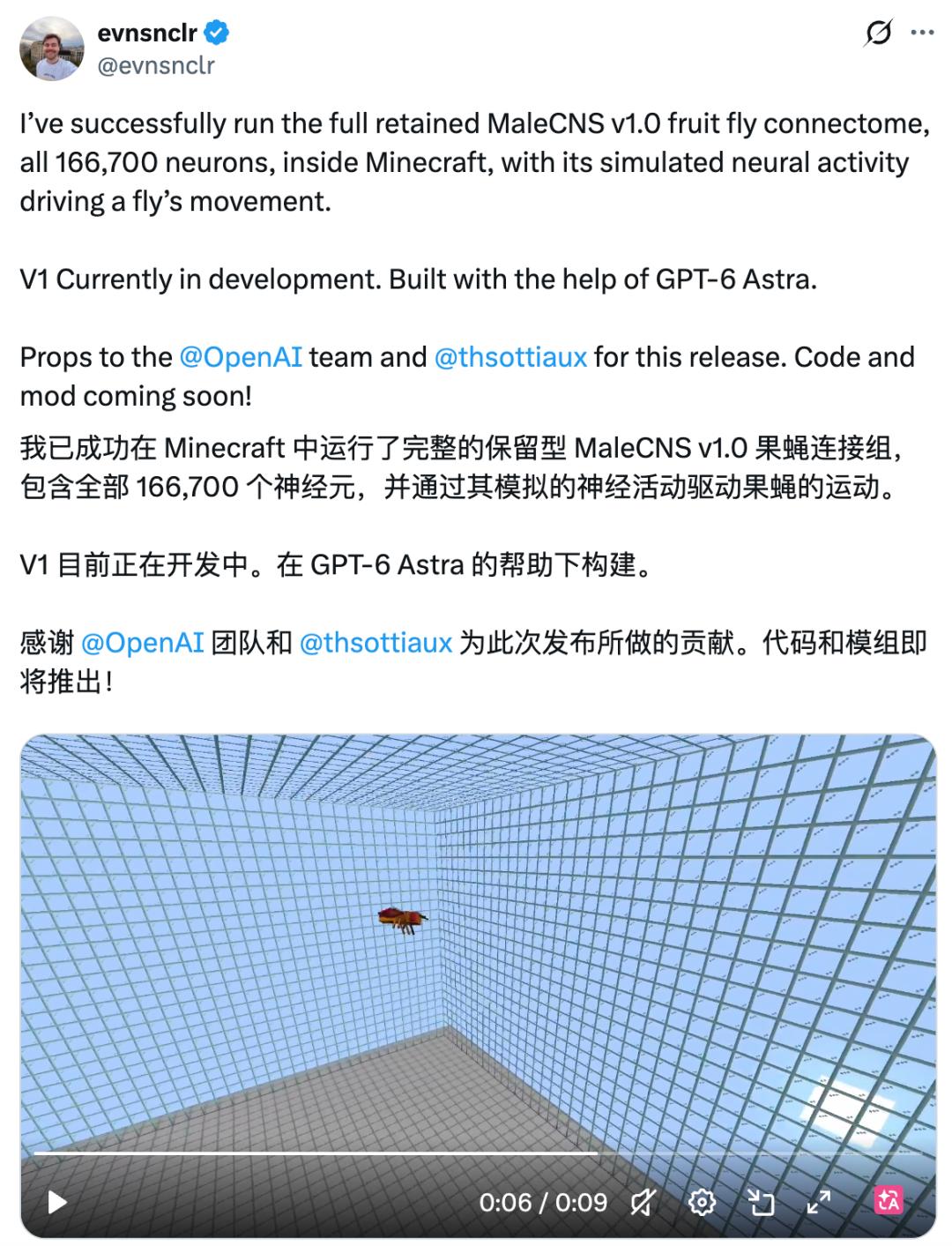
Shortly after, some people used the fruit fly brain to play Doom, run Super Mario 64, and play Beat Saber.
Ten years of mapping work, integrated into games in two days, and a few days later, the fruit fly can talk to GPT.
Chetaslua also did a reverse test.
Send the phrase "There is a wall ahead" to ChatGPT, ChatGPT replies "Turn left", and then send this instruction back to the auditory neurons of the fruit fly.
It obeyed 37 times, without a single mistake.
But it never found any food.
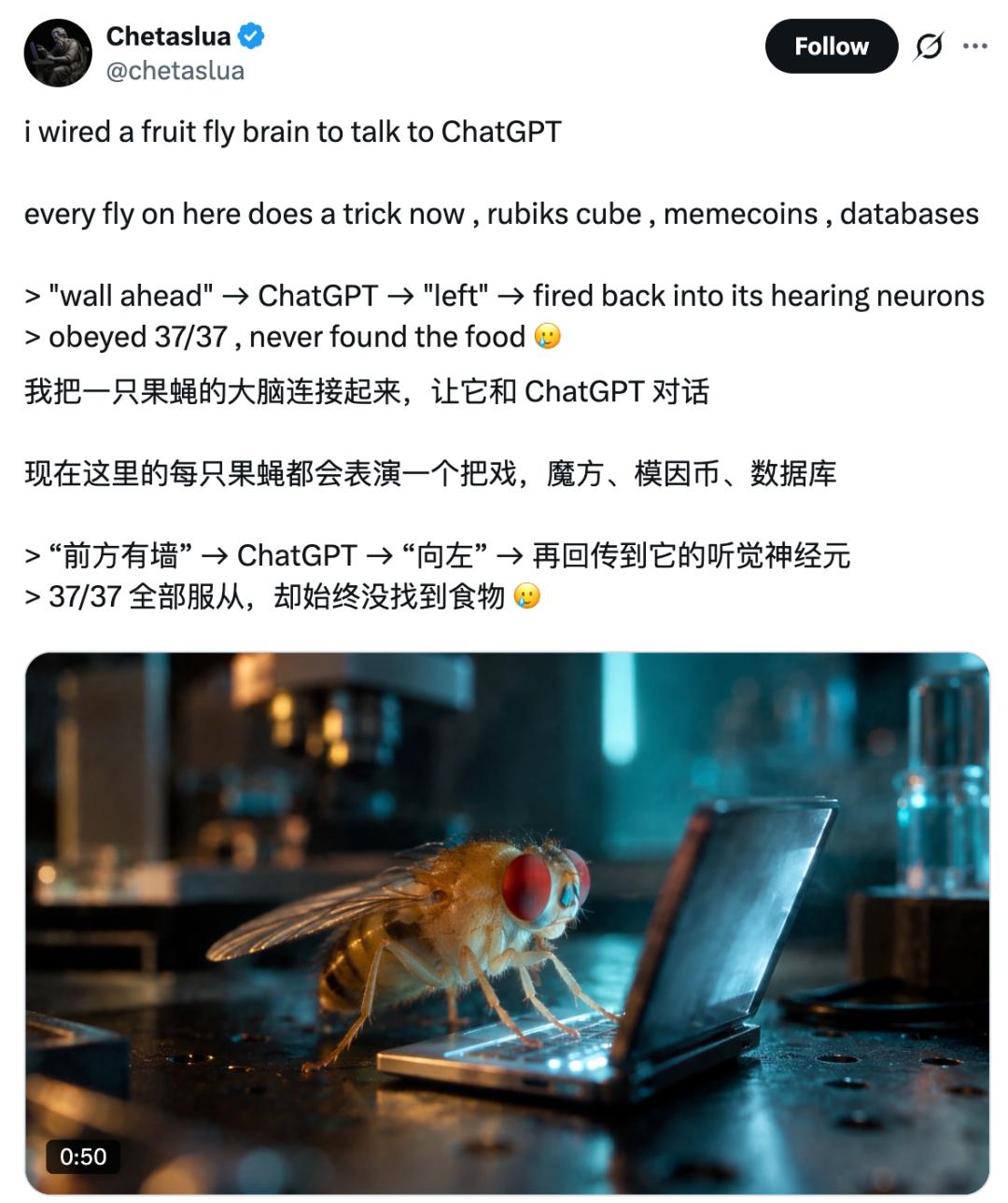
The instructions are executed perfectly, but it gets zero points in foraging. This shows that there is still an insurmountable gap for the time being between being able to drive behavior and generating consciousness.
Obedience only requires signals coming in and actions going out. But finding food requires something else — you have to remember which places you have tried and which you haven't, you have to retain and use information from several steps ago, and you have to form some kind of "strategy" in an unfamiliar environment.
This fruit fly has not demonstrated this capability.
No one knows whether it smells real vinegar or has subjective experiences. The developer himself only said that this is a simulation.
It's our turn to answer
In the past, if you wanted to do something with whole brain simulation, you needed a top laboratory, a six-figure fund, an interdisciplinary team, and a long wait.
Now, all you need is a laptop, a downloaded wiring diagram, and a weekend to tinker with it.
The 138,000-neuron fruit fly brain was successfully run by a developer at home, and even connected to ChatGPT.
The next experiment that lets biological neural signals converse with AI may no longer need to wait for paper scheduling or fund approval. It may happen on someone's desk, late at night, right after a sudden flash of inspiration.
The sentence "What should I do?" from the fruit fly is a template sentence spliced by the translator.
But this question itself really deserves our serious answer now.
References:
https://x.com/chetaslua/status/2098387725972123825
https://male-cns.janelia.org/
This article is from the WeChat official account "Xinzhiyuan", Author: Xinzhiyuan, published with authorization from 36Kr.