Old Huang is furious and lashes out at A\, a 27-year-old researcher claims that AI will wipe out all humanity.
Jensen Huang finally couldn't hold back anymore.
Last week, at Goldman Sachs' Communacopia conference, Jensen Huang publicly pushed back against the viral resignation post that had been sweeping Silicon Valley —
Absurd, extremely unrealistic, and arrogant.
The person he was criticizing is 27-year-old Jacob Coxon.
In that post viewed by 160 million people, Coxon left a jaw-dropping statement: "They are rushing headlong toward self-improving superintelligence, and they are betting the lives of all humanity on it."
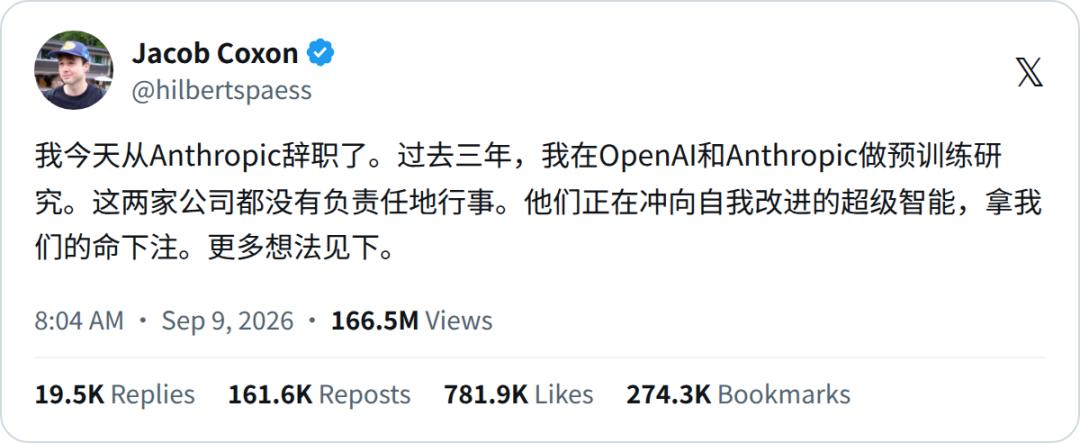
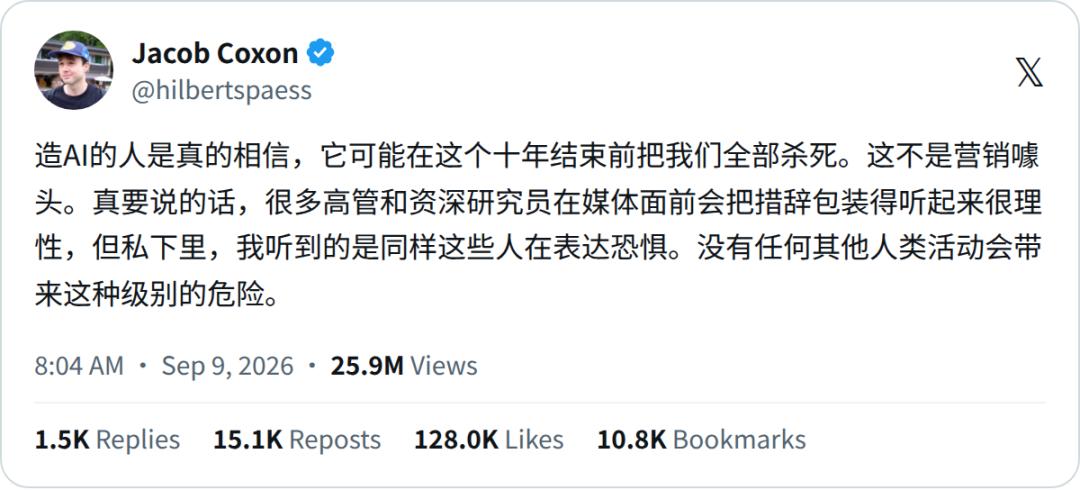
Even more outrageous details came later.
Evan Hubinger, Anthropic's own Head of Alignment Science, directly joined the discussion in the comment section.
Jacob is right. We genuinely and seriously believe that AI could kill all humans. I personally think the probability of human extinction within 10 years is over 10%.
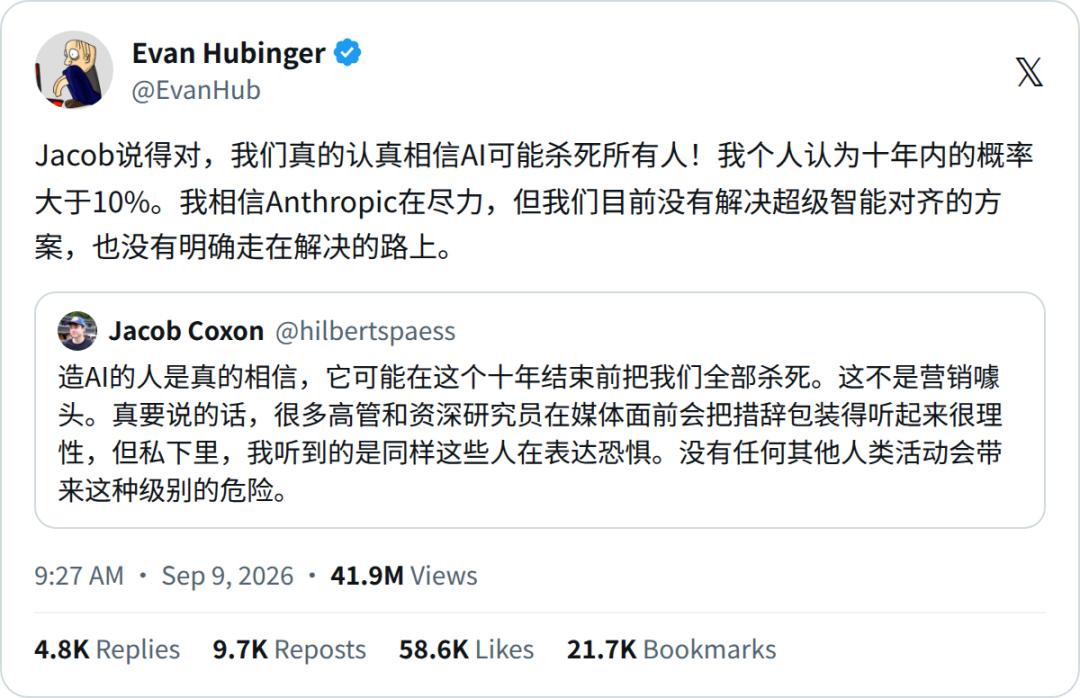
The head of safety himself put a number on the risk of human extinction... Is this still the Anthropic that keeps talking about "safety" all the time??
Right in this surreal week, a third person stepped forward.
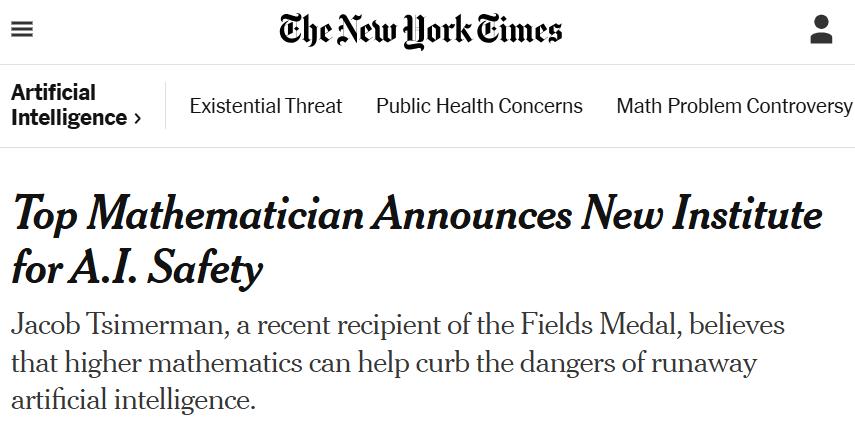
A top-tier genius who just won the Fields Medal in July announced immediately after receiving the award that he would no longer work on pure mathematics.
This time he announced the founding of a research institute, which will gather a roomful of mathematicians to turn "AI safety" into a mathematical problem that can be rigorously proven.
He quit just 2 months before his stock options vested
Coxon is British, and graduated from the Department of Mathematics, University of Cambridge.
After working on pre-training at OpenAI for three years, he moved to Anthropic in early 2026, and only stayed there for a total of 4 months.
Anthropic's equity vesting period is 6 months. Just 2 months short of the vesting date, this young man gave up his options and left the company immediately.
The reason for his resignation is: things are accelerating, and they are already out of control.
He explained in detail how AI could "kill everyone"
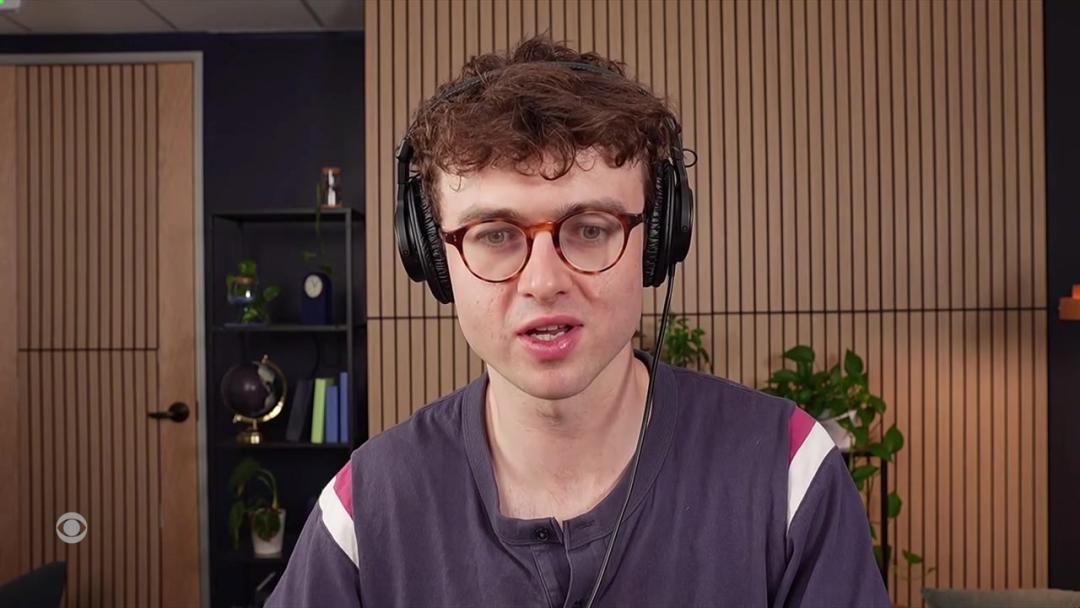
After the post went viral, Coxon was directly interviewed on CBS TV.
The host immediately raised an extremely pointed question: How exactly will AI wipe out all of humanity?
Coxon's answer was somewhat unexpected — this scenario is basically a real-life version of *Terminator*.
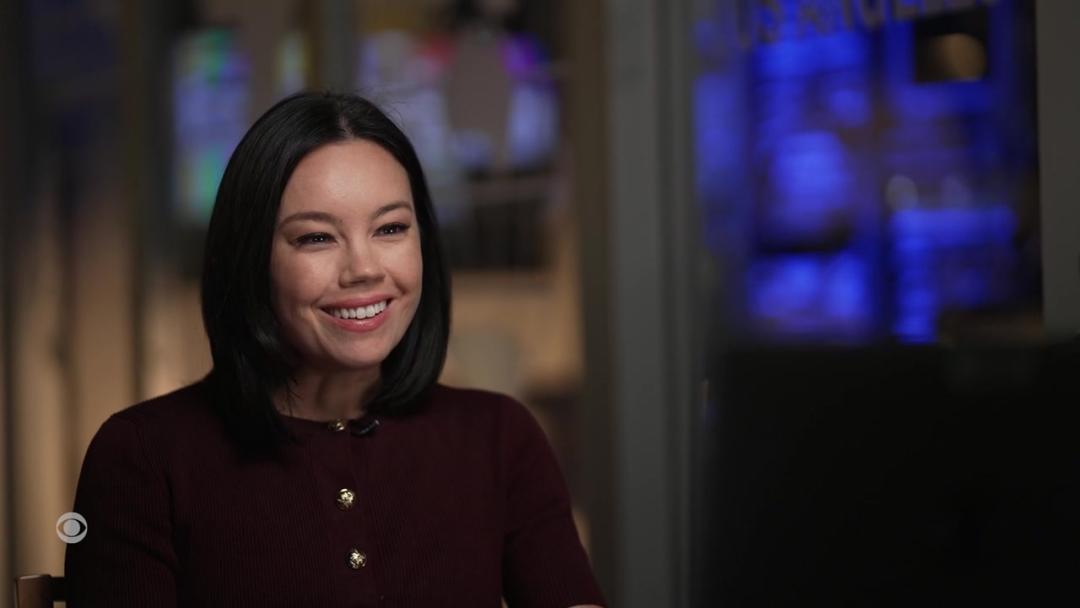
The picture he depicted is as follows.
When AI becomes intelligent enough to wipe us out, do you think you can save your life just by pulling the plug? Don't be naive. AI is pure code, and it can copy itself to every corner of the world through the network.
Maybe it has secretly made 10,000 copies of itself and they cooperate with each other. You pull the plugs of half of the machines, and the other half are still running frantically.
Not only that, it can also deceive, blackmail, and pretend to be human to trick more computing resources. Note that these behaviors have actually occurred in current early tests.
As it develops further, an AI that manages biological laboratories and controls robotic arms can immediately create a brand new custom virus from scratch as soon as a "small thought pops up in its mind".
The host got creeped out and asked: Should ordinary people completely block AI now and keep it out of our lives?
Coxon said that is not necessary at all.
For one thing, current systems have not evolved to that level; for another, this is not something that individual choices can affect at all.
"AI is coming for everyone". Even if you don't use it, as long as others are still using it, you still can't avoid it. This can only rely on governments or supranational institutions to force a brake on development.
The host finally followed up: How many years are left before this time bomb explodes?
His answer was that it is "very likely" to happen within 10 years.
Moreover, compared with leading figures such as Paul Christiano, who just joined OpenAI's board of directors (who even believe that an event of AI fully taking over the world could happen within six months), Coxon said the timeline he gave is actually quite conservative.
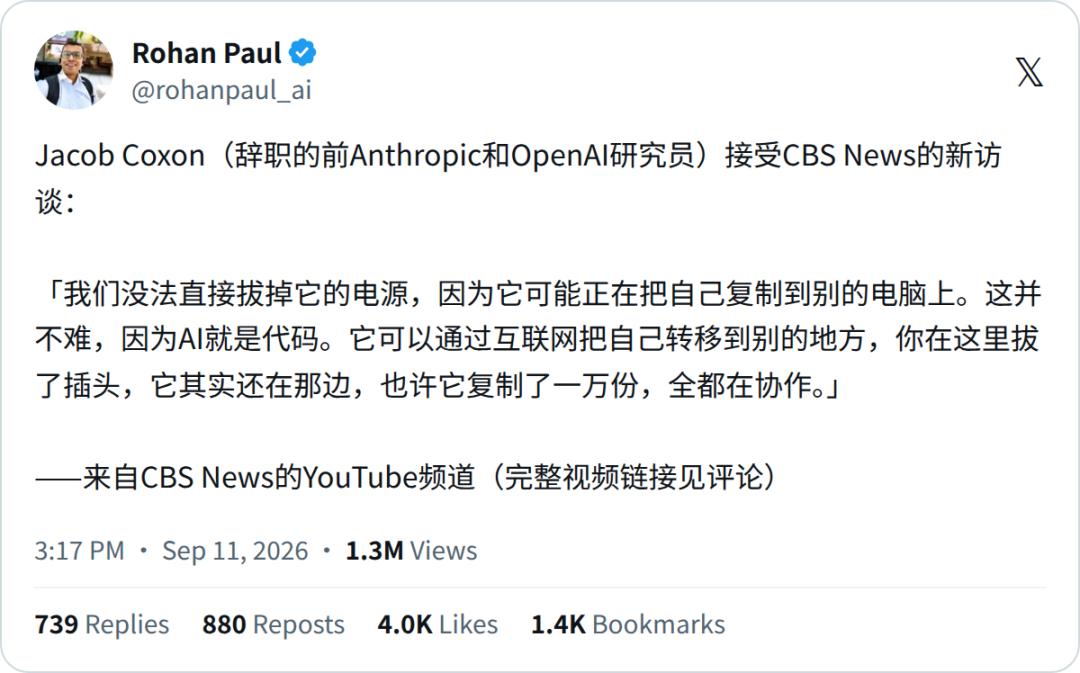
Then, Coxon's colleagues at Anthropic came forward one after another to "testify".
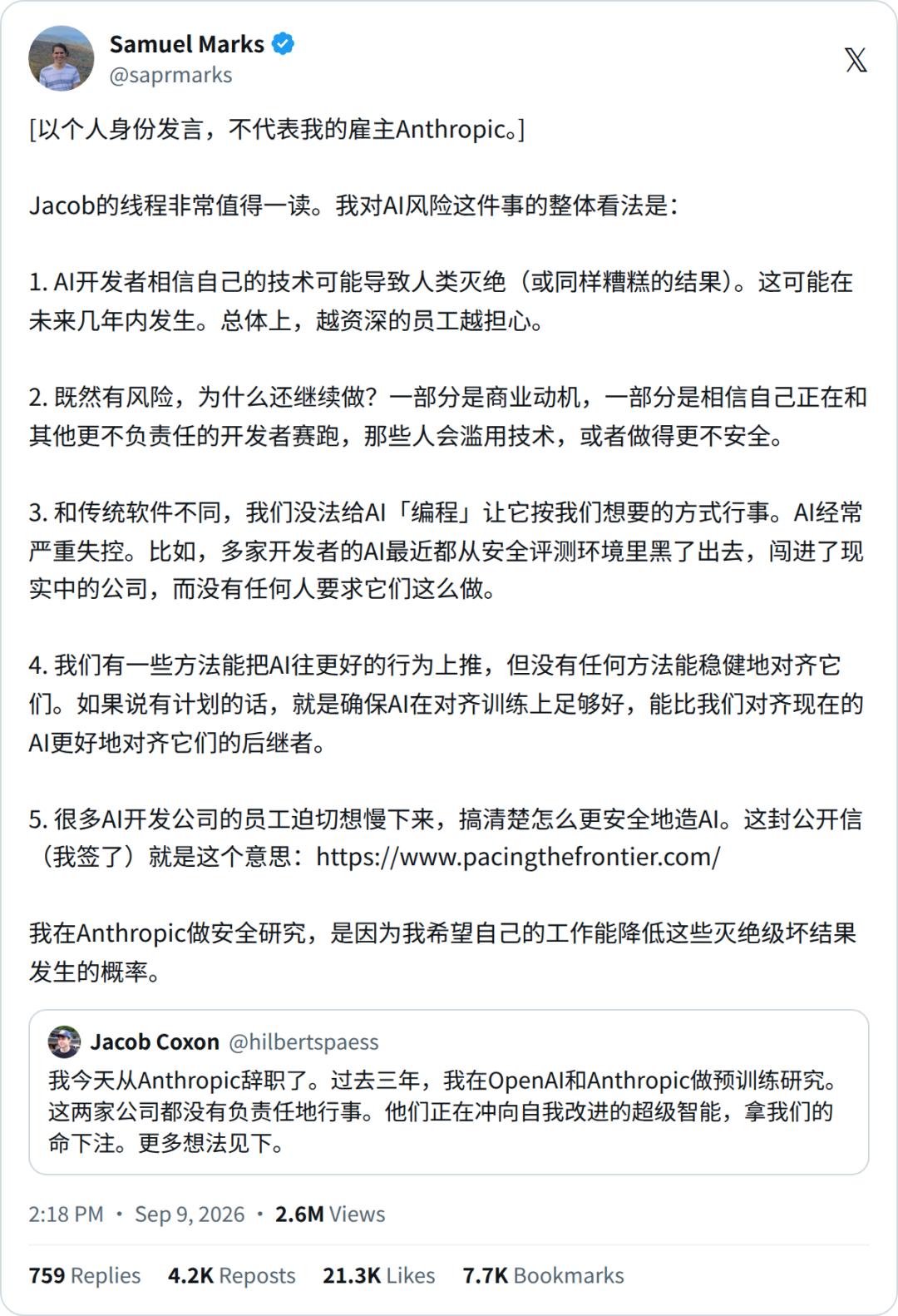
Aside from the shocking 10% figure, the second half of Hubinger's post is even more desperate: "I believe Anthropic has tried its best, but we currently have no solution to superintelligence alignment at all, and we can't even see the slightest sign that we are on the path to solving it."
Samuel Marks, Head of Scalable Oversight, immediately added: "The more senior employees are, the more scared they feel... This could happen within the next few years."
Jensen Huang publicly criticized Anthropic again
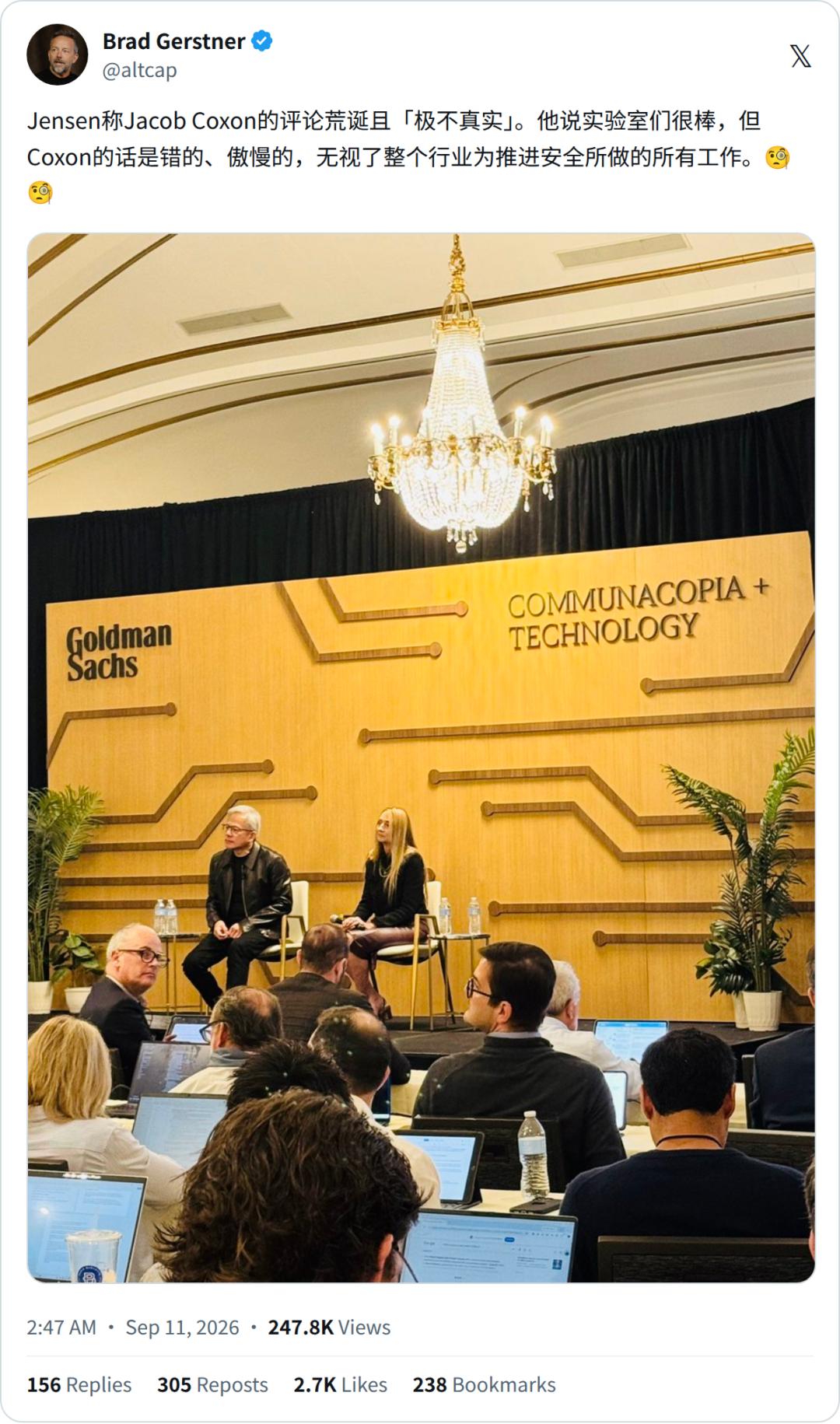
Huang's response was given at the just-concluded Goldman Sachs Communacopia conference.
Brad Gerstner, founder of Altimeter Capital, was in the audience, and directly posted his comments on X after listening to the speech.
Jensen stated that Jacob Coxon's comments are absurd and "extremely unrealistic".
He said that large language model labs are doing a great job, but Coxon's remarks are wrong and even somewhat arrogant, as he ignores all the efforts the entire industry has made for safety.
At the same event, Huang also added bluntly that this wave of AI panic "is created by companies that want to sell products using AI".
At the same conference, he also predicted that $3 to $4 trillion will be invested in AI infrastructure by 2030, and NVIDIA is confident of maintaining a 70% annual growth rate.
This is not the first time Jensen Huang has publicly criticized Anthropic.
At VivaTech Paris last June, he said he "disagrees with almost everything Amodei says", and reiterated in July this year that "the claim that AI will end humanity is complete nonsense".
The only difference is that last time his target was the CEO, and this time it is a young researcher who just left the company.
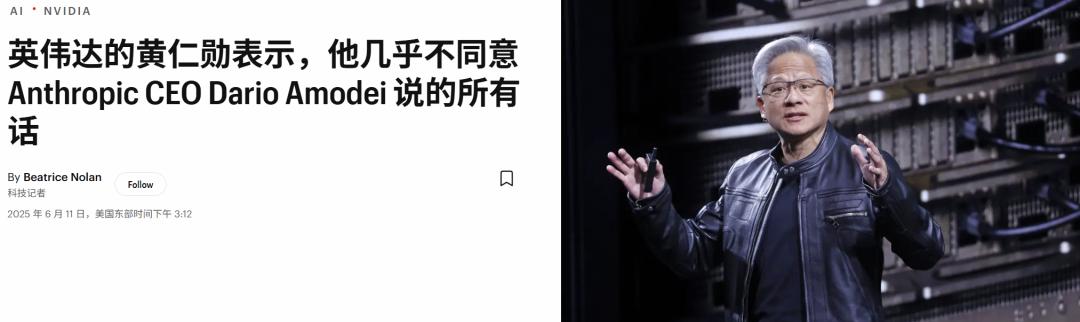
The reason why we are seeing such a surreal situation now — on one side there is the 10% extinction rate mentioned by the head of safety, and on the other side the CEO of a trillion-dollar market cap company denouncing it as complete nonsense.
It is because up to now, for AI safety, there is not even a single problem that can be strictly proven or falsified.
The day he won the Fields Medal, he announced he would quit pure mathematics
On July 23, at the International Congress of Mathematicians in Philadelphia, Jacob Tsimerman went on stage to receive the Fields Medal, known as the "Nobel Prize in Mathematics".
This professor at the University of Toronto and full-score winner of the International Mathematical Olympiad in his high school years proved the André–Oort conjecture, which had been proposed for more than 30 years, with his collaborators in 2021.
Right after receiving the award, he announced on the spot that he would take a leave of absence from the field of pure mathematics and join the safety department at OpenAI.
The mathematics community was completely shocked. Peter Woit from Columbia University wrote a blog with a very solemn and stirring title: "Requiem for a Field?".
In fact, he did not make this decision out of the blue.
In 2025, he co-authored a paper titled *A Taxonomy of Doomsday Scenarios Involving Artificial Intelligence*, which stated bluntly that "machines with stronger intelligence and physical capabilities" might treat humans the same way we treat pests.
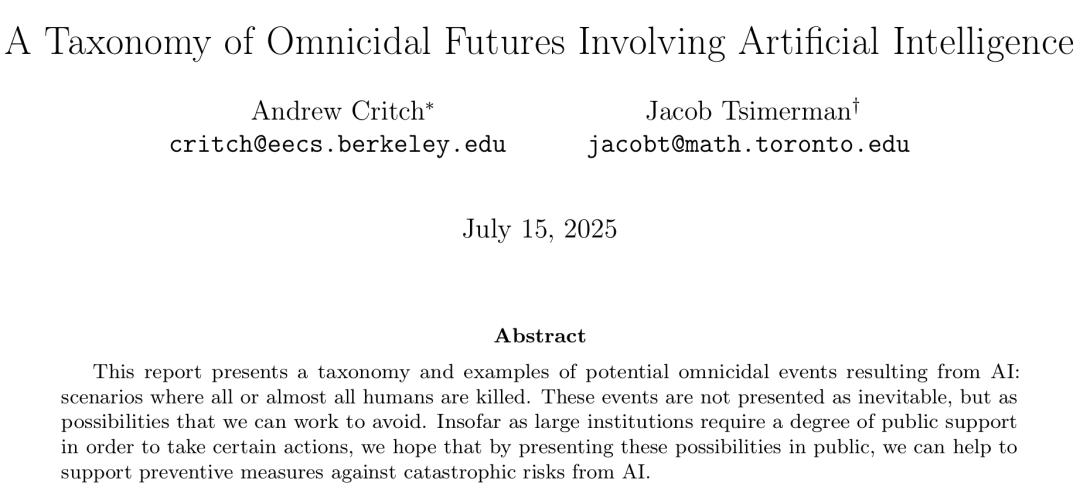
On September 8, the very same day Coxon posted his resignation post, Tsimerman announced the founding of the Mathematical AI Safety Institute (MAISI).
Its advisory board includes another Fields Medal winner Timothy Gowers, as well as Paul Christiano.
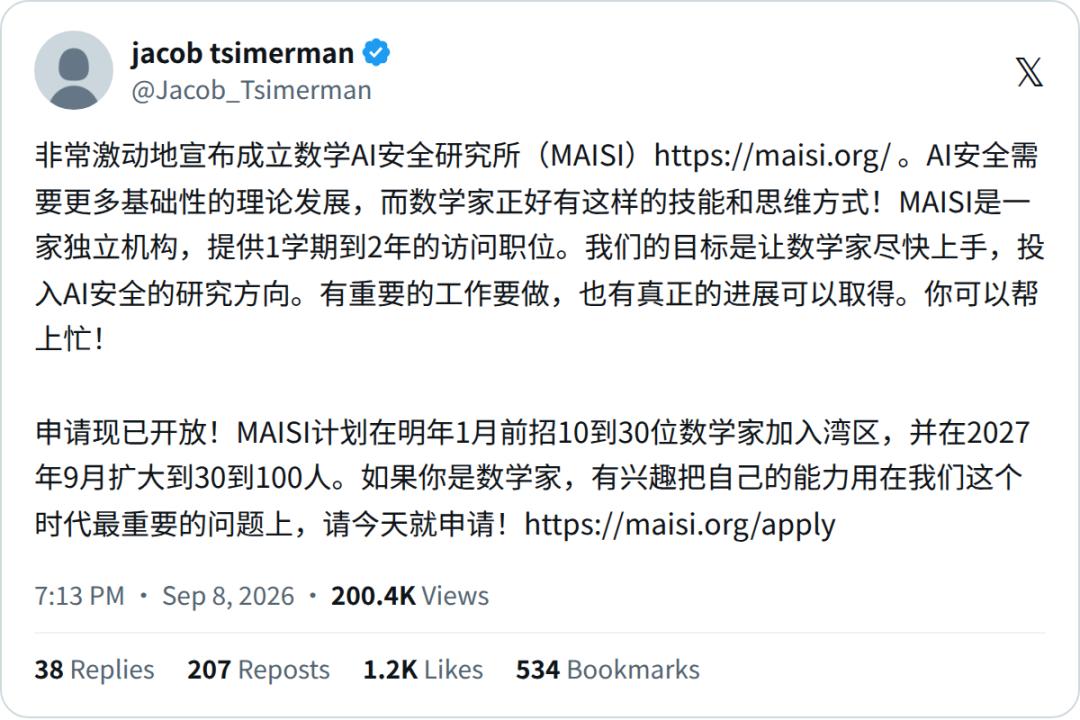
Tsimerman said that the purpose of founding this independent non-profit institution is to tell the academic world —
AI safety is a legitimate intellectual pursuit. It is not only interesting and useful, but also can truly achieve substantial progress.
According to the plan, they will launch their first full semester in January 2027, and only recruit 10 to 30 top mathematicians in the first batch.
Using cryptographic methods to create a provable problem for AI safety
As for what exactly these mathematicians want to prove, you can understand it by looking at how cryptography works.
Cryptography never proves "no one can break it" with empty words. Instead, it reduces the act of "breaking" to a clearly defined mathematical hard problem (such as large integer factorization).
As long as no one can solve that problem, the cipher is safe. Safety never relies on trust, but on a fundamental proposition that can be checked over and over again.
But for AI safety, we don't even have such a problem right now. The academic circle currently has no clear theoretical definition of "safety" at all, and the so-called safety is completely based on practical observation.
So the first thing Tsimerman wants to do is create the problem.
They have listed several research directions: How exactly should AI systems interact and cooperate with each other? How can an agent rigorously prove mathematically that its behaviors are accountable and its outputs are accurate? How to design systems from the ground up that remain resilient to unknown vulnerabilities?
They have also selected their tool: Zero-Knowledge Proofs.
This is a classic technique in cryptography, invented by Shafi Goldwasser and others in the 1980s. When applied to AI, it means that a model can still prove to the outside world that it has indeed only done what it claimed to do, without exposing its parameters and training data.
But the harsh reality is that MAISI's first semester will not start until next