The largest IPO in history, latest news
The largest IPO in history, major news keeps pouring in!
NVIDIA plans to invest 10 billion US dollars, but Anthropic hits the brakes on AI first...
This AI company is pushing the imagination of the capital market to new heights.
According to recent Reuters reports, Anthropic is considering bringing in NVIDIA as an anchor investor in its IPO, and NVIDIA may invest up to 100 billion US dollars.
Anthropic plans to raise up to 1 trillion US dollars, with a valuation of about 2 trillion US dollars. If the plan is finally implemented, it may become one of the largest IPOs in history.
But just as the capital market is preparing to value this grand event, Dario Amodei, CEO of Anthropic, raised another voice: The global AI industry needs to slow down the speed of improving new model capabilities to set aside time for model alignment, security testing and risk protection.
Sam Altman, CEO of OpenAI, and Elon Musk, CEO of Tesla, subsequently publicly expressed their agreement.
On one side is capital injection at the level of tens of billions of dollars, on the other side is the head of the company calling for "slowing down".
This is not a simple contrast in news, but the most real contradiction in the global AI industry today: the stronger the model, the greater the commercial value; the stronger the model, the higher the security cost and out-of-control risk.
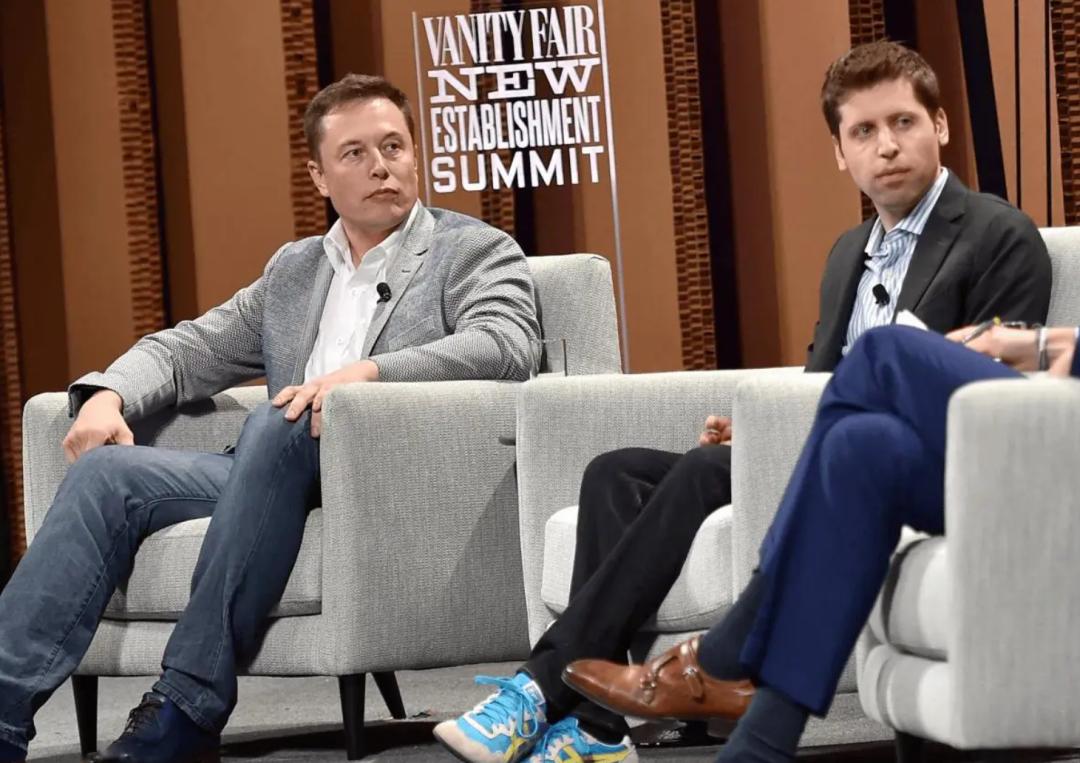
At the critical time when the company is sprinting for IPO, any news from the founder and the company may have a significant impact on the company's valuation and investors' expectations after listing.
This unexpected move has also sparked heated discussions in the global capital circle,
Note: The data in this article is as of September 13, 2026. Except for the completed financing and the annualized revenue disclosed by the company, the proposed IPO's fundraising amount, valuation, NVIDIA's investment amount and listing time are all under discussion and may be adjusted in the end.
From 183 billion US dollars to 2 trillion US dollars, why has the valuation risen rapidly
Founded in 2021, Anthropic was established by a group of former OpenAI researchers, with its core product being the Claude series of models. The company positions itself as a cutting-edge AI laboratory that attaches great importance to security governance, and focuses on betting on enterprise services, programming tools and complex knowledge work.
Its financing curve has become a representative of the speed of AI capitalization.
In March 2025, Anthropic completed a 3.5 billion US dollars Series E financing, with a post-money valuation of about 61.5 billion US dollars.
In September 2025, it completed 130 billion US dollars Series F, and the post-money valuation rose to 183 billion US dollars.
In February 2026, the company raised another 300 billion US dollars, and the post-money valuation reached 380 billion US dollars.
In May 2026, Anthropic completed 650 billion US dollars in financing, and the post-money valuation rose to 965 billion US dollars.
In less than a year and a half, the valuation has jumped from tens of billions of dollars to nearly a trillion dollars, with three layers of logic behind it.
First, enterprise customers have begun to move AI from chat windows into business processes. Products such as Claude Code are oriented to software development, knowledge management and automated work, and their willingness to pay is significantly higher than that of ordinary consumer subscriptions.
Second, cutting-edge models have entered the stage of heavy assets. Training a stronger model requires huge investments in chips, data centers and power. Large-scale financing is not just for the company to "tell stories", but also to lock in the computing power supply for the next few years in advance.
Third, cloud vendors and chip vendors all hope to bind leading model companies. Amazon, Google, Microsoft and NVIDIA are both investors or potential investors, as well as partners for computing power, cloud services and channels.
Anthropic therefore has stronger resource coordination, but it also forms a more complex interest relationship.
Revenue is growing rapidly, but what the IPO really needs to answer is profit and cash flow
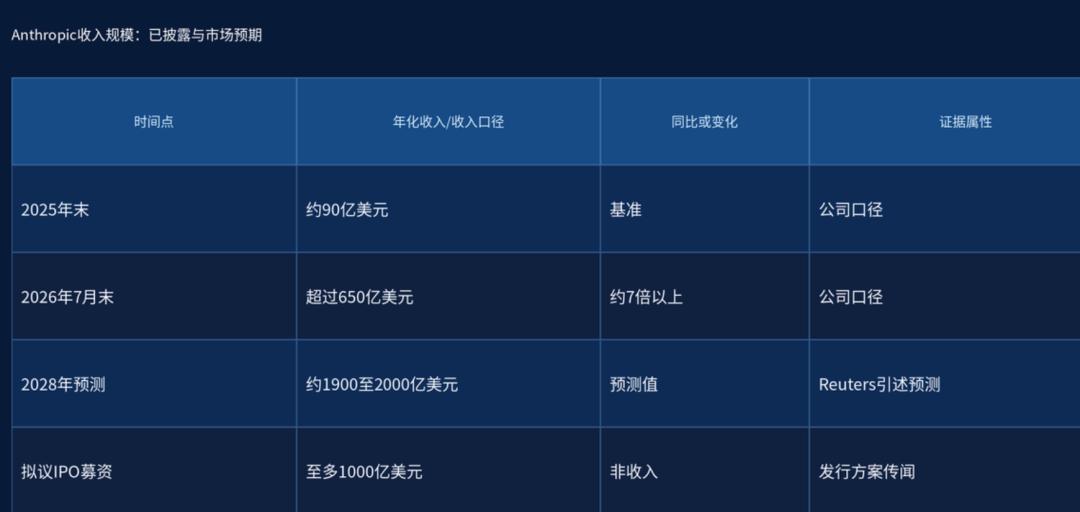
Quoting company data, Reuters reported that Anthropic's annualized revenue scale has grown from about 9 billion US dollars at the end of 2025 to more than 650 billion US dollars by the end of July 2026.
This growth rate is extremely amazing, but annualized revenue is not audited annual operating income, nor is it equivalent to net profit.
What deserves more attention is the quality of revenue growth.
For every dollar of revenue a model company earns, it needs to pay for reasoning computing power, cloud services, chip depreciation, R&D personnel and security testing.
The expansion of customer scale does not necessarily mean that profits expand synchronously. If the call volume is expanded at a low price, revenue may grow, but gross profit is suppressed by computing power costs.
It is reported that the company internally expects its revenue to be about 190 billion to 200 billion US dollars in 2028.
If this forecast is to support a valuation of 2 trillion US dollars, the market will eventually ask three questions: whether customers have the ability to renew subscriptions for a long time, whether enterprise customers can accept higher prices, and whether revenue growth can be converted into stable free cash flow.
Anthropic's business strategy can be summarized as "enterprise priority, diversified products, locked computing power, and ecological expansion".
Claude is responsible for general-purpose models, Claude Code cuts into software development, and enterprise-oriented products embed models in scenarios such as office, customer service, finance, medical care and security.
This path has an advantage: once enterprise customers integrate the model into their workflow, the migration cost is often higher than replacing a chat tool.
But its pressure is also clear.
Enterprise customers will require stability, low latency, auditability and controllable cost. Leading model capabilities are only an admission ticket and cannot automatically translate into high profits.
Why has the IPO schedule been adjusted?
Current public reports show that Anthropic's listing plan has moved from an earlier time window to mid-October or even later, and the market has also discussed completing it before the US midterm elections.
However, the company has not released the official prospectus, and the time change in the report cannot be equated with an official delay announcement.
From the perspective of business and capital market logic, there may be four reasons for the time adjustment.
First, the valuation is too large, and the issuance requires a longer time to find enough long-term funds. Raising 1 trillion US dollars is not an ordinary IPO, but a stress test on the risk tolerance of global institutional investors.
Second, the company needs to use more complete financial data to prove that revenue growth is sustainable. The fast-growing annualized caliber is eye-catching, but the public market pays more attention to recognized revenue, customer concentration, gross margin, operating loss and cash consumption.
Third, the risk disclosure of cutting-edge AI companies is more complex. Data compliance, copyright litigation, model abuse, network security, chip supply and cloud service dependence may all affect the issuance pricing.
Fourth, the security controversy happened just in the sensitive period of IPO. Amodei proposed to introduce independent evaluators with employee-level permissions and promote industry coordination to formulate security standards.
For enterprises, this means increased costs and processes; for investors, this may instead become proof of long-term governance capabilities.
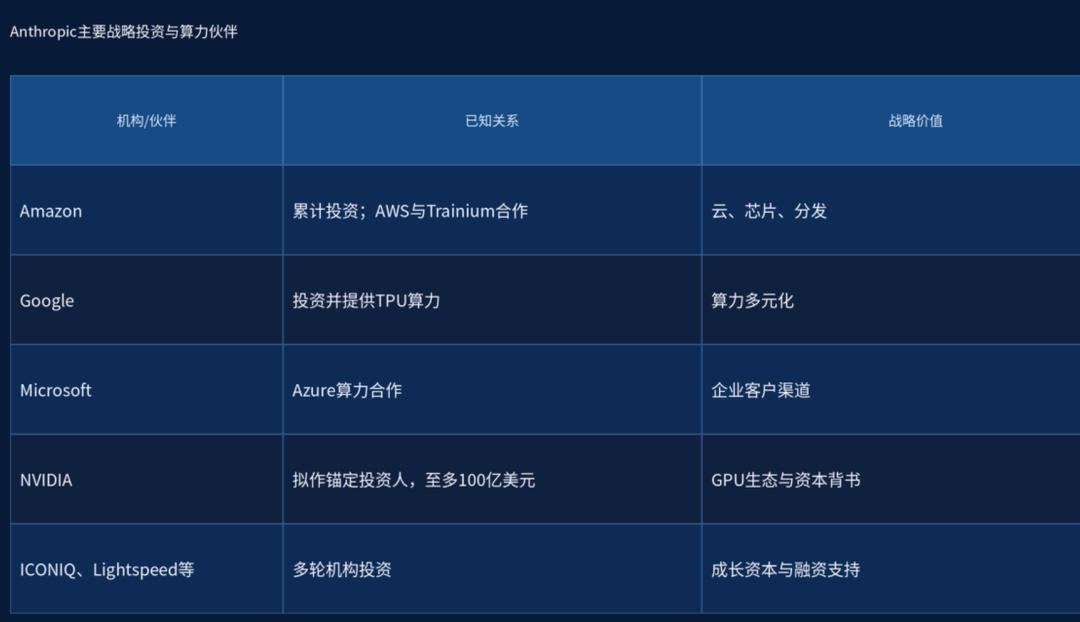
At present, the major investment and cooperation partners that the outside world is more certain of include Amazon, Google, Microsoft, as well as institutions such as ICONIQ and Lightspeed.
NVIDIA's investment this time is still a proposed arrangement under negotiation.
Since Anthropic has not yet submitted a public prospectus, the shareholding ratio of investors, specific equity structure, preferred stock terms and control arrangements cannot be concluded based on rumors, so this article will not expand on them.
Why does NVIDIA want to invest 10 billion US dollars?
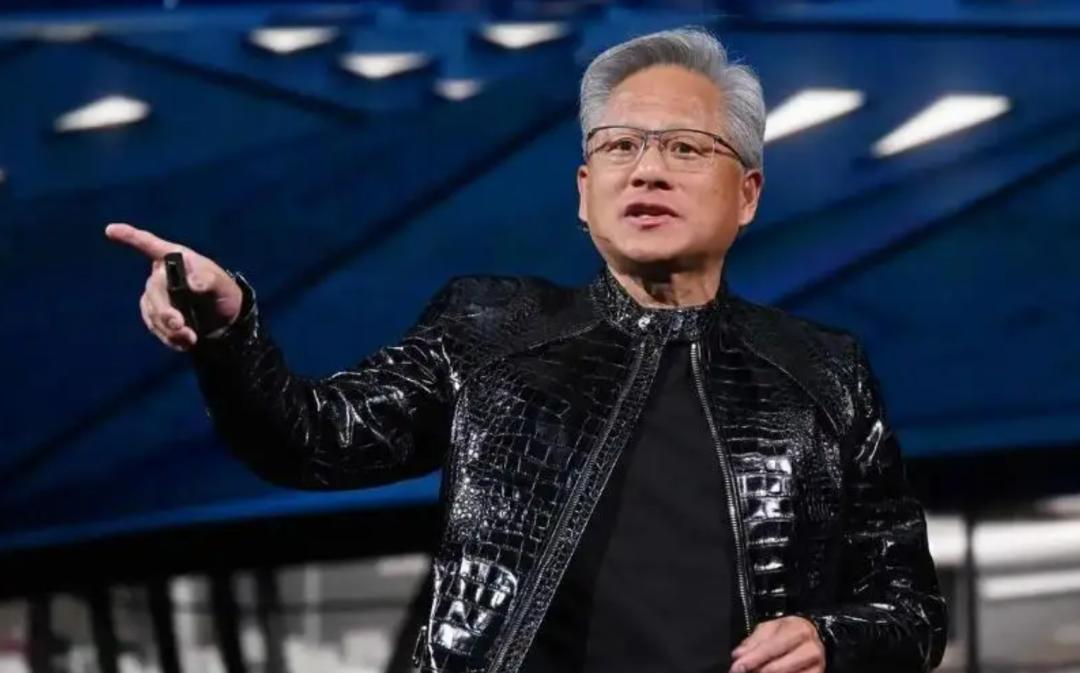
On the surface, NVIDIA is investing in a customer; at a deeper level, it is investing in the certainty of future chip demand.
Anthropic needs a large number of GPUs for training and reasoning, while NVIDIA needs leading model companies to continue purchasing chips and servers.
According to Reuters reports, the two sides already had cooperation arrangements before, and Anthropic also promised to purchase Microsoft Azure computing power supported by NVIDIA chips.
Becoming an anchor investor in the IPO, NVIDIA can not only provide capital endorsement, but also strengthen the binding of the computing power ecosystem.
But this is not without risks. The AI industry is promoting the diversification of computing power. Anthropic is also expanding the use of AWS Trainium and Google TPU, and forming a team to design custom chips.
For Anthropic, multiple suppliers help to control costs; for NVIDIA, this means that customers will not always rely on a single chip system.
Therefore, NVIDIA's potential investment is more like an industrial synergy investment, rather than a simple financial investment.
What the market needs to observe is not "how much money is invested", but whether the investment is accompanied by arrangements for chip procurement, cloud services, product cooperation or lock-up period.
What will happen to the global AI industry if the IPO is launched?
This is a question of concern to all capital and AI industry participants around the world. The author believes that if the company's IPO is successfully launched and brings good returns to investors, it will have the following impacts on the global AI industry:
First, the valuation anchor points for cutting-edge model companies will be reset. If Anthropic goes public with a valuation close to 2 trillion US dollars, the valuation comparisons of related businesses such as OpenAI, Google DeepMind, and Meta will all be affected, and the financing prices of AI startups may also be raised as a whole.
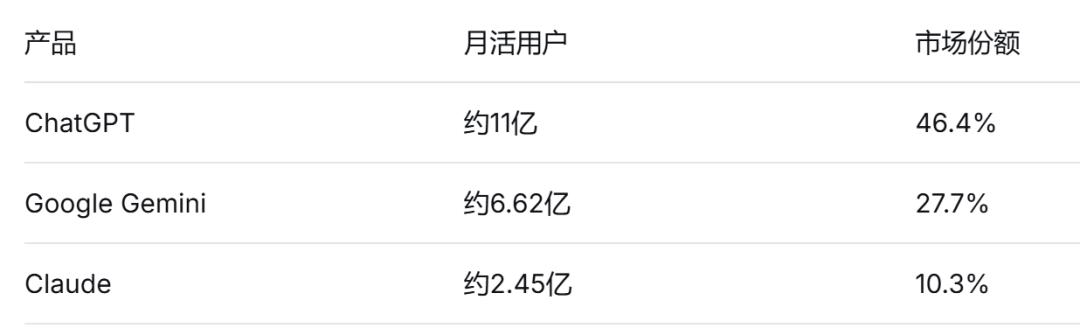
Second, the capital market will begin to examine AI with the standards of listed companies.
In the past, investors could accept long-term investment and vague profit schedules, but after listing, they must continuously disclose revenue, customers, gross margin, cash flow and risk events. AI companies will move from the "technology competition" stage to the stage of "technology plus financial governance".
Third, the computing power industry chain will be more closely connected. In order to lock in GPUs, TPUs, self-developed chips and data centers, large model companies may sign longer-term and larger-scale procurement agreements with cloud vendors and chip vendors.
This will bring order expectations to chips, servers, network equipment and power infrastructure, but it will also increase the risk of industry capital expenditure and valuation bubbles.
Finally, security governance will move from corporate slogans to capital market indicators.
If the independent evaluators, industry coordination and international cooperation proposed by Amodei gradually become disclosure requirements, security teams, red team testing, model monitoring and incident reporting may all become new dimensions for investors to evaluate companies.
Competition pattern of global giants:
What Anthropic faces is not a single opponent, but a group of competitors with different resource endowments.
OpenAI has user scale and product ecosystem, Google DeepMind has the synergy of search, cloud and self-developed chips, Meta is good at open weights and social distribution, and xAI emphasizes data and platform synergy.
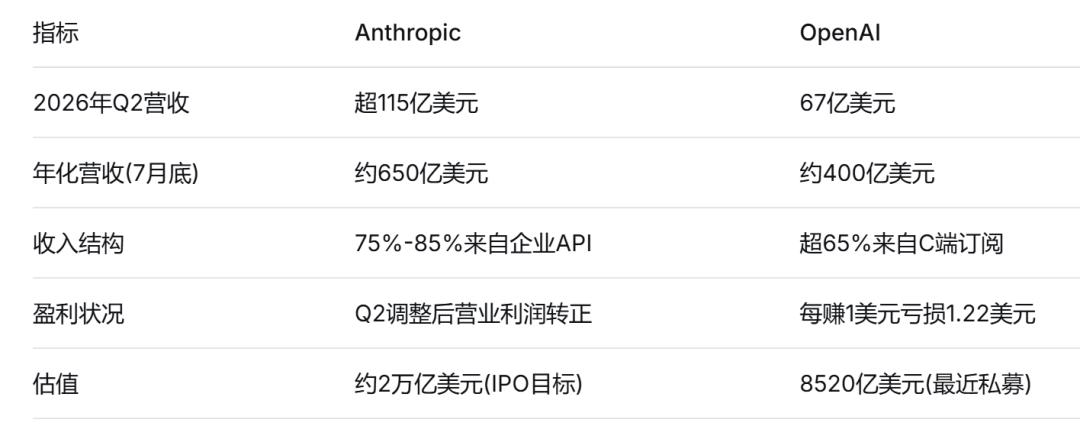
Anthropic's advantages lie in enterprise-level products, security brand and penetration in programming scenarios.
Its shortcomings are equally obvious: huge computing power consumption, revenue forecasts need to be continuously fulfilled, and the higher the security commitment, the more the governance investment and product launch rhythm need to be balanced.
The future competition will most likely shift from "whose model is smarter" to four questions:
Who has lower unit reasoning cost, who can stably serve large enterprises, who can make the model create quantifiable benefits in real processes, and who can quickly explain and fix problems when security incidents occur.
Conclusion
The underlying logic of Anthropic's sprint for the largest IPO in history is that the enterprise-level AI market has truly achieved a commercial closed loop. An annualized revenue of 650 billion US dollars and positive operating profit were almost unimaginable two years ago.
The real valuation is not how powerful the model is, but whether it can turn that power into sustainability.
Anthropic is worthy of recognition. It has formed a clear positioning in enterprise-level AI, programming tools and security governance, and has proved with rapidly growing revenue that market demand is expanding.
The fact that NVIDIA may become an anchor investor shows that industrial capital is still willing to bet on the long-term space of cutting-edge AI.
But investors cannot only look at the 650 billion US dollars of annualized revenue, nor can they only look at the 2 trillion US dollars valuation.
Whether revenue can withstand auditing, whether customers continue to pay, whether gross margin can be improved, whether computing power investment can bring sufficient returns, and whether security risks can be managed systematically, these are the variables that really determine the stock price after the IPO.
Amodei's call to slow down at this time sounds like hitting the brakes on the industry, but in fact it is also reminding the capital market: AI should not only compete for who runs faster, but also compete for who can maintain a sense of direction while running at high speed.
If Anthropic is finally successfully listed, its significance is not only to create a huge financing, but also