Shenzhen, it is still the same old Shenzhen.
Is Shenzhen still the same Shenzhen as before? This question has been raised twice in the 46-year development history of the city.
The first time was more than 20 years ago. At the end of 2002, an online article titled "Who Abandoned You, Shenzhen?" suddenly went viral. This was no casual joke. Back then, Shenzhen was truly in a state of anxiety.
In 2001, China joined the WTO, and the market opened up further. The policy advantages that once belonged to special economic zones began to weaken. Meanwhile, Pudong in Shanghai was booming rapidly. What made Shenzhen residents even more restless was that there were constant rumors on the market at that time that leading Shenzhen enterprises planned to move their headquarters to Shanghai. Huawei, ZTE, Ping An, China Merchants Bank and other enterprises were all involved in this "headquarters relocation" rumor.
The policy dividend of the special economic zone was fading, the industry needed transformation, and issues such as state-owned enterprise reform, government efficiency, urban environment and talent attraction were all put on the table. Even the question of "whether Shenzhen is losing its attractiveness" became an open topic for discussion.
Looking back today, none of these rumors came true later.
But at that time, they were enough to make Shenzhen residents nervous. Because everyone suddenly wondered whether what Shenzhen had been most proud of in the past could continue: would talents still be willing to come? Would enterprises still be willing to stay? Was Shenzhen still the most dynamic city in China? How many advantages did the special zone have left? Even, what on earth would Shenzhen rely on for development in the future?
In response, Shenzhen did not explain, but relied on actions: continued to develop the market economy, continued to develop the manufacturing industry, continued to attract enterprises, and continued to carry out scientific and technological innovation. Those enterprises that were rumored to leave back then, including Huawei, ZTE, Ping An and China Merchants Bank, not only did not abandon Shenzhen later, but took deeper roots here step by step.
25 years later, in 2025, Shenzhen faced the second round of doubts.
At the beginning of 2025, DeepSeek and Unitree Robotics became popular, and the "Six Little Dragons of Hangzhou" became a trending topic. Some people began to ask why Shenzhen did not have a sufficiently eye-catching "Six Little Dragons" in this round of technological boom? Is Shenzhen's innovation capacity no longer as strong as before? Is the Shenzhen that used to dare to pioneer and take action gradually getting old?
Shenzhen still did not explain, and also gave the answer with actions and results: Shenzhen is still the same Shenzhen as before.
Shenzhen + Guangzhou + Hong Kong, ranks first in the world in scientific and technological innovation strength
On September 8, the World Intellectual Property Organization (WIPO) released the top 100 innovation clusters list of the "2026 Global Innovation Index" in Geneva. The Shenzhen-Hong Kong-Guangzhou innovation cluster once again topped the list and retained the first place in the world.
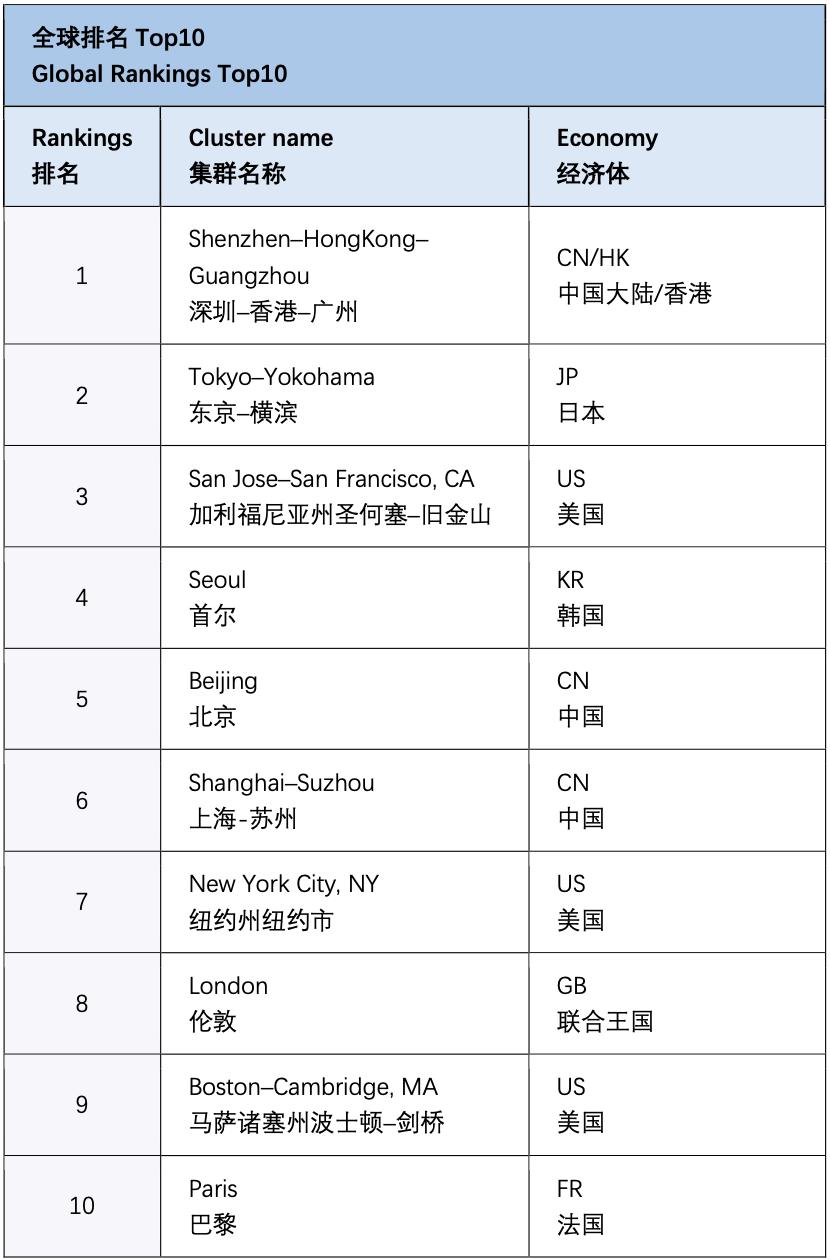
Source: WIPO Office in China
This is the second time that the Shenzhen-Hong Kong-Guangzhou cluster has won the championship, and the title has extremely high gold content. First of all, the rating agency is not a domestic institution, but the World Intellectual Property Organization, which means it is recognized by the most authoritative international organization. Secondly, the evaluation criteria are three quantifiable hard indicators: the number of PCT international patent applications, the number of scientific papers published, and the volume of venture capital transactions.
Shenzhen accounts for a core proportion in all three indicators, especially the number of patents.
Data from the Shenzhen municipal official shows:
In recent years, both the quantity and quality of intellectual property rights in Shenzhen have risen. In 2025, the number of patents authorized in the city reached 214,500, ranking first in China for 8 consecutive years; the number of PCT international patent applications reached 19,700, a year-on-year increase of 20.27%, ranking first among Chinese cities for 22 consecutive years.
The number of high-value invention patents per 10,000 people reached 119.7, 7.5 times the national average. The added value of patent-intensive industries accounts for more than 32% of GDP, and the supporting role of the intellectual property strategy has continued to become prominent.
In addition: In 2025, the city recorded 58,500 patent transfer transactions and 21,700 patent licensing transactions; the amount of pledge financing reached 59.229 billion yuan, ranking first in the province for six consecutive years; the cumulative issuance of intellectual property securitization products reached 121 with a total scale of 25.736 billion yuan, and the number and scale of issuances continued to lead the country.
In simple terms, this set of data actually reflects one thing: Shenzhen is not just "having a large number of patents", but has turned patents into a business, and a tool for enterprises to make profits, get financing and realize industrial upgrading.
Ranking first in China in PCT applications for 22 consecutive years shows that Shenzhen enterprises are not only applying for patents in the domestic market, but also actively applying for patents in the global market. In short, more and more technologies owned by Shenzhen enterprises are developed for the global market.
The figure of 119.7 high-value invention patents per 10,000 people is even more noteworthy.
The national average level is only 1/7.5 of that of Shenzhen, which shows that Shenzhen's patents are not simply "piled up in quantity", and there are a large number of patents with real technical content that can be used to develop products and generate profits. The fact that patent-intensive industries account for more than 32% of GDP means that in Shenzhen's economy, more than 30% of the economy is highly related to patents and technological innovation.
Even more notable are the subsequent data.
In 2025, 58,500 patent transfers and 21,700 patent licenses took place in Shenzhen. In plain language, the technologies held by enterprises began to flow. Some entities develop patents, some buy patents, some profit from patent licensing, and technologies are no longer left unused in enterprise drawers.
Patents can also be directly converted into cash. Last year, Shenzhen's intellectual property pledge financing reached 59.229 billion yuan, which means enterprises can use their own patents to get financing from banks. For many asset-light technology enterprises that do not have many factories and machines, but have technologies and patents in hand, patents themselves can be turned into collateral.
Intellectual property securitization goes a step further, packaging the originally intangible patent income into financial products for financing. Shenzhen has issued a total of 121 such products with a scale of 25.736 billion yuan, indicating that a relatively mature chain of "R&D - patent - transaction - financing - industrialization" has taken shape here.
This is the truly powerful part of this set of data, and also the truly powerful part of Shenzhen's scientific and technological innovation.
It shows that Shenzhen is turning scientific and technological innovation into an asset that can be traded, financed, priced, and continuously generate economic value.
This is the real value of the "City of Innovation".
How did Shenzhen achieve this?
A thousand-mile journey is accumulated by every small step; a vast river is gathered by every small stream.
Shenzhen's current scientific and technological innovation strength comes from its decades-long persistence in "building the city on industry and supporting the city with scientific and technological innovation". Industry is the prerequisite for scientific and technological innovation, and scientific and technological innovation is the goal of industry. Without industry, there will be no R&D scenarios; without industry, there will be no industrial chain; without industry, there will be no technology iteration; without industry, real scientific and technological innovation cannot be born.
This point can be clearly seen from the actions Shenzhen took when facing doubts 20 years ago.
20 years ago, when facing doubts, Shenzhen made a choice and launched the "industrial relocation and upgrading" operation, which was also a choice that Shenzhen had to make. With a large population but limited land, the industry needs to grow and the industry needs to develop, but the space is extremely limited. "Building the city on industry and supporting the city with scientific and technological innovation" is the guiding principle for urban development that Shenzhen has always implemented. Therefore, in order to continue to optimize the industry and manufacturing, changes had to be made.
Shenzhen's "industrial relocation and upgrading" back then did not simply drive out low-end enterprises. Instead, Shenzhen calculated an account: land, energy and environmental capacity are becoming increasingly precious, and the most scarce resources cannot continue to be used to support low-value-added industries.
Starting from around 2007, Shenzhen raised thresholds for environmental protection, energy consumption, investment intensity, etc., to eliminate a number of industries with high pollution, high consumption and low efficiency; at the same time, it renovated old industrial zones, freeing up inefficient factory buildings and land for R&D, advanced manufacturing and technology enterprises. For enterprises that can be upgraded, their low-value-added production links are transferred out, while high-value links such as headquarters, R&D, procurement and sales are retained in Shenzhen.
This set of adjustments quickly changed Shenzhen's industrial structure.
In 2006, the output value of Shenzhen's high-tech products had reached 587.9 billion yuan, accounting for more than 50% of the total industrial output value of enterprises above designated size; by 2025, the added value of strategic emerging industries had reached 1.67 trillion yuan, accounting for more than 40% of GDP.
Shenzhen has gradually transformed from the "three-plus-one" processing base in the past to an industrial city focusing on advanced manufacturing, electronic information, artificial intelligence and scientific and technological innovation.
After all, what Shenzhen vacated was not enterprises, but inefficient resource occupation. The vacated land, space, talents and resources finally brought higher industrial density and stronger innovation capacity. This is what the major industrial adjustment back then really left behind.
In addition to improving space use efficiency and upgrading industries, Shenzhen and its local enterprises are also continuously increasing investment in scientific and technological R&D.
What is the core competitiveness of a country, region or city? It is the industry, and the core competitiveness of the industry is the scientific and technological R&D capacity. And what is needed to promote the scientific and technological R&D capacity? One is capital, and the other is people, that is, R&D investment and R&D personnel, especially capital.
To see whether a place's scientific research is strong or not, you don't need to look at its fancy publicity, you only need to look at what it has done, that is, how much money it has invested in scientific and technological R&D.
This sentence also applies to enterprises. The growth potential of an enterprise does not depend on PPT and storytelling, but on real money investment in R&D funds.
The detailed R&D investment data of various regions in 2025 has not yet been released, so we still refer to the data of 2024.
In 2024, Guangdong Province invested a total of 509.961 billion yuan in research and experimental development (R&D), an increase of 29.699 billion yuan over the previous year, up 6.2%; the R&D investment intensity (R&D expenditure as a percentage of GDP) was 3.60%, 0.12 percentage points higher than the previous year.
The scale of scientific and technological investment in Guangdong Province continues to rank first in China. Of the 509.96 billion yuan of R&D investment in Guangdong Province, Shenzhen contributed half.
Data shows that in 2024, Shenzhen's R&D investment reached 245.307 billion yuan, a year-on-year increase of 9.7%, and the R&D intensity (the ratio of R&D expenditure to GDP) was 6.67%. Both indicators ranked first in the province.
Nationally, Shenzhen's R&D investment ranks second in China, higher than Shanghai, second only to Beijing, and its R&D investment intensity ranks first in China.
Although Guangzhou's R&D investment is less than half of Shenzhen's, it is also considerable nationwide, ranking fifth in China, second only to Beijing, Shenzhen and Shanghai, and Suzhou.
It is the persistence in industry and scientific and technological innovation, the continuous expansion of space for industrial development, and the real money investment in R&D instead of storytelling that have enabled Shenzhen to gradually transform from the original OEM and imitation to manufacturing and intelligent manufacturing, and finally become today's scientific and technological innovation highland.
How strong is Shenzhen today?
First, its industrial strength ranks first in China. In 2025, the total industrial output value of Shenzhen's enterprises above designated size reached 5.44 trillion yuan, forming a leading gap with Suzhou (the second largest industrial city) and Shanghai (the third largest industrial city). The same pattern applies to industrial revenue. In 2025, the industrial revenue of Shenzhen's enterprises above designated size was 55.17015 billion yuan, that of Suzhou was 49.39956 billion yuan, and that of Shanghai was 46.29033 billion yuan.
The most critical point is that this industrial scale of Shenzhen is basically supported by high-precision, high-tech output value products. Shenzhen's main industrial products include drones, mobile phones, computers, robots, electronic components, integrated circuits (chips), 3D printing equipment, servers and so on.
Second, its export volume has ranked first in China for 33 consecutive years. Shenzhen's export volume last year was 2.74 trillion yuan, leading the country for 33 consecutive years. Moreover, Shenzhen alone contributed more than one-tenth of China's total export volume, and 45.4% of Guangdong's total export volume.
In July this year, Shenzhen's import volume surpassed Shanghai for the first time, second only to Beijing. In the first 7 months of this year, Shenzhen's total import and export volume was 3.42 trillion yuan, a year-on-year increase of 32.8%, 422 billion yuan more than Shanghai. It should be noted that in the whole year of 2025, Shenzhen was only 43.05 billion yuan more than Shanghai. In just one year, the gap has multiplied.
In the first 7 months, Shenzhen's import volume reached 1.65 trillion yuan, a year-on-year surge of 61.9%. This is also the first time that Shenzhen's import volume has surpassed Shanghai. In the same period, Shanghai's import volume was 1.6449 trillion yuan.
In terms of export volume, Shenzhen has ranked first for 33 consecutive years. In terms of total import and export volume, it surpassed Shanghai in May 2024 and ranked first in China. Now its import volume has also surpassed Shanghai, second only to Beijing.
Third, its scientific and technological innovation strength ranks first in China, and is in the first echelon of the world.
In addition, Shenzhen has 4.65 million commercial entities, ranking first in China. The number of national-level specialized and sophisticated "little giant" enterprises reaches 1333, ranking first in China. The number of listed enterprises ranks third in China.
Shenzhen still does not dare to slack off
Today's Shenzhen, in the secular sense, can be said to have achieved great success.
But Shenzhen still does not dare to slack off, and still does not dare to relax its efforts in industry and scientific and technological innovation.
In 2024, the Shenzhen municipal official released an article titled "How Do Industry and Service Industries Promote Each Other? This Is What Shenzhen Does", further emphasizing the importance of industry, manufacturing and scientific and technological innovation to Shenzhen:
Taking industry as the pillar and backbone, implementing the requirements of high-quality development throughout the whole process of new industrialization, leading industrial innovation with scientific and technological innovation, and comprehensively improving the advanced level of industrial foundation and the modernization level of industrial chain... Adhering to the principle of industry building the city and manufacturing as the priority, with a stable foundation and sufficient momentum... The service industry and manufacturing industry are both on the "smile curve" industrial