WeChat is quietly making a big strategic move, enhancing the built-in browser in its Mac version, which appears to be paving the way for its super Agent.
A few days ago, Lei Technology found that the Mac version of WeChat has quietly received an update. One major change is the enhanced "built-in browser": when you click on official accounts or hyperlinks in the Mac version of WeChat, the content will no longer be displayed in an independent window as in the past, but will be shown on the right side in the form of a built-in browser.

(Image source: Lei Technology)
The right-side window can be expanded to more than half of the screen size, and it supports multi-tab display just like browsers such as Chrome that we use daily. Functions including web page translation, search, full-screen display, sharing, and bookmarking are all available, which can be regarded as the prototype of a "WeChat browser".

It is particularly worth noting that the display of "Mini Programs", one of the most important content forms in the WeChat ecosystem, still adopts the independent pane form for now, and the official built-in browser is not called for the time being.
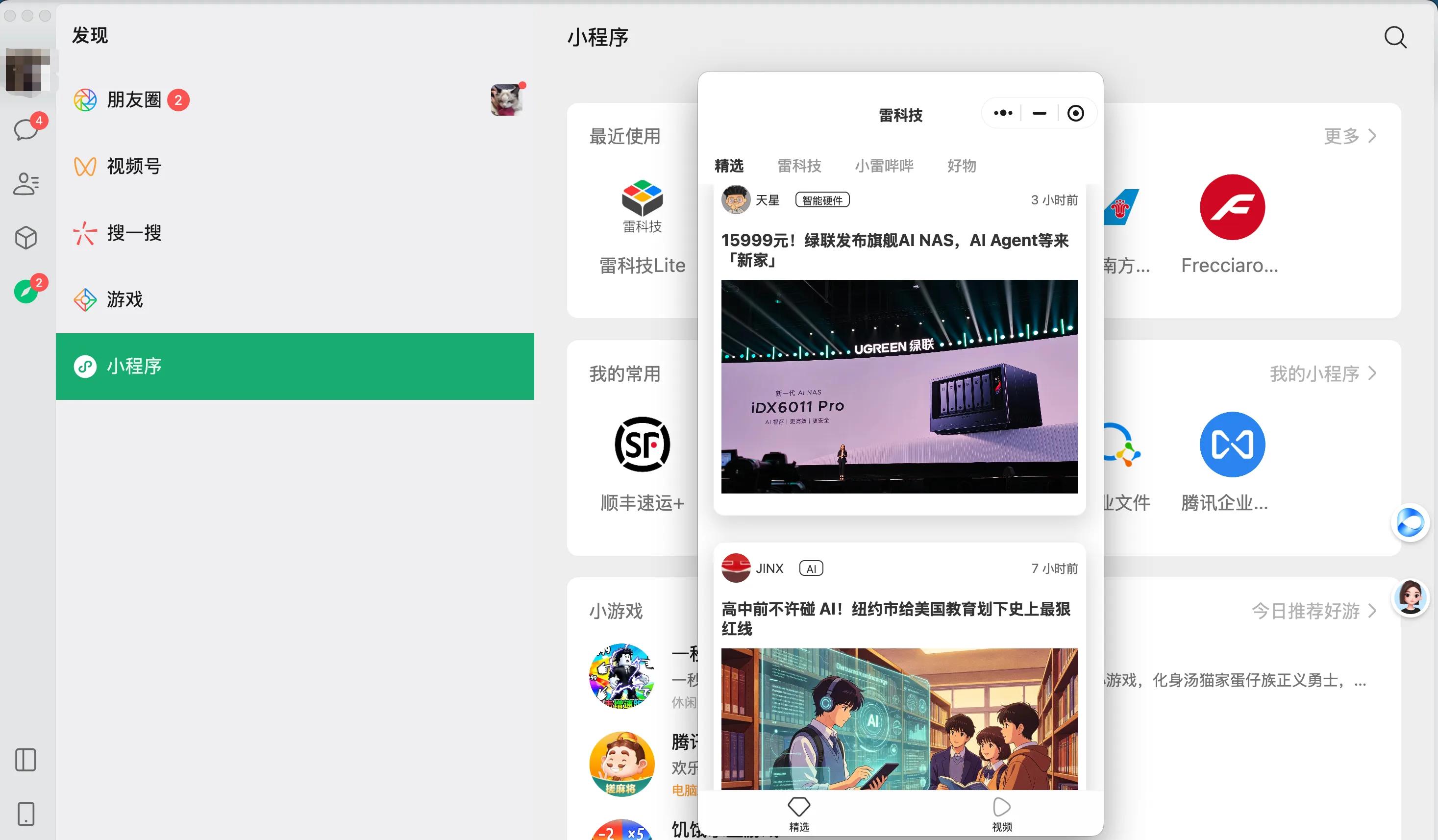
You might say this is a very small change. For many years in the past, clicking links in WeChat would also call WeChat's own browser for display. For Tencent, not to mention its early layout of browsers such as QQ Browser, and later the acquisition of Sogou, the technology related to browsers is just a piece of cake. But Lei Technology believes that what is really worth paying attention to is: why does WeChat adopt this split-screen display mode? Lei Technology believes that its essence is to further embed the browser into WeChat.
Why make such a change? The answer may be: Agent. The browser is the core form for Agent control and interaction, and all AIs are embedding browsers. WeChat is a platform that users cannot live without in both life and work. In the future, it will accelerate integration with Agent to become Tencent's super AI entry, and this small change paves the way for its Agent transformation.
If you have been keeping up with the trends of AI and Agent, you will find that the browser, the seemingly oldest application form, has long become an unavoidable focus for all AI giants.
OpenAI's AI Browser Exploration: From Independence to Integration
In October 2025, when OpenAI released ChatGPT Atlas, Sam Altman described it as an opportunity to rethink the browser. However, some time ago, OpenAI announced that it would stop the service of this browser, and reminded users to export bookmarks and save web pages. It stated that the browser Agent capabilities of Atlas will be transferred to ChatGPT and Codex.
An AI browser that was placed with high hopes just disappeared like this.
Frankly speaking, this result is not very surprising. When Atlas was released, Lei Technology once thought that the browser is the most suitable product form to carry Agents. The browser has web pages opened by users, login status, history records and private information. The Agent not only knows what the user is viewing, but can also directly click, input and submit.
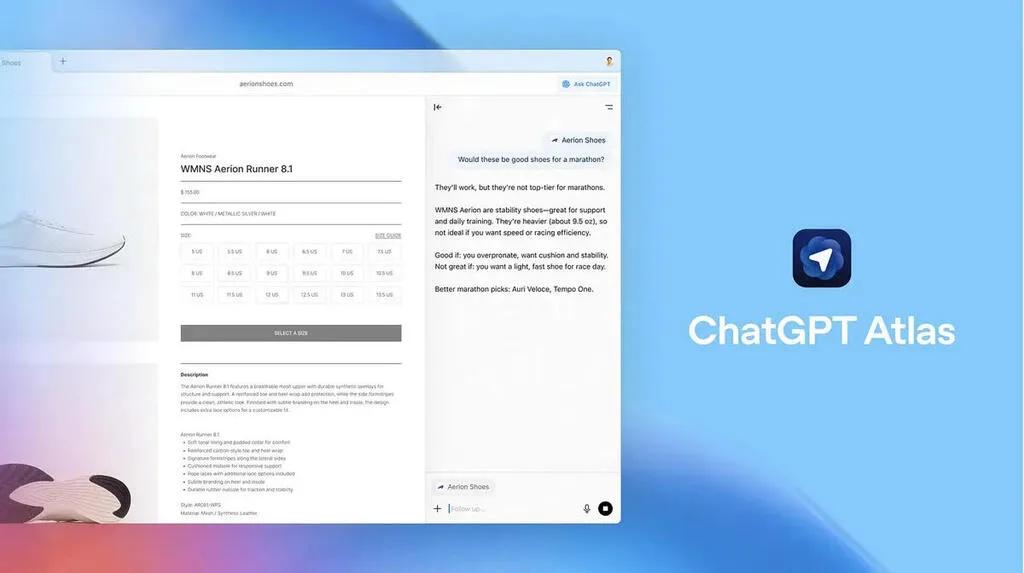
Image source: OpenAI
The problem is that general-purpose Agent products evolve faster than browsers. OpenAI shut down Atlas, but Codex integrated the browser early, and it was also merged into the new ChatGPT desktop client. The browser still exists, but it no longer needs an independent client.
So, what about other AI browsers?
AI Targets Browsers, Until the Explosion of Self-Surfing Agents
If we go back three years, AI browsers were nothing more than a sidebar added next to traditional browsers.
In 2023, Microsoft put Copilot into Edge, Opera launched Aria, and Arc also used generative AI to organize tabs, rename files and generate summaries. They did save users some actions of copying, pasting and switching windows, but most of their functions can be replaced by a plug-in. The browser was still a browser, and AI was more like a Q&A assistant living in the sidebar.
By 2025, Dia and Comet (under Perplexity) came out one after another, and the industry began to seriously discuss native AI browsers. AI can not only read the current page, but also understand multiple tabs, browsing history and user accounts, and then organize information around a specific task. For the first time, the browser has the opportunity to get rid of the role of web browsing and become a personal workstation with full context awareness.
After that, Atlas, Opera Neon and Gemini in Chrome further fueled the trend. Opera still defines Neon as "built to act", while Google lets Gemini handle food ordering, reservation and shopping on behalf of users. The selling point of AI browsers is no longer helping users view web pages, but operating web pages and handling affairs for users.
Domestic players also caught up quickly. Tabbit, launched by the Light Years Beyond team under Meituan, directly defines itself as an AI-native browser, which can reference tabs, screenshots and local files, and also allows Agents to autonomously read pages, fill out forms and perform tasks across websites. All these changes are transforming the browser into a working space for Agents.
This logic is not wrong. The browser carries a highly compatible Internet, and almost all online services (except for some platforms of domestic Internet giants) can be opened here. More importantly, AI browsers also retain the tabs, address bar and windows that users are familiar with. Users can watch the Agent work step by step and take over before making payments, sending messages and submitting forms.
But the browser is also a deep-rooted user habit at the same time. Data from StatCounter shows that in June this year, Chrome still accounted for 69.65% of the global browser market. For most people, replacing Chrome or Safari means re-migrating bookmarks, passwords, plug-ins and login status. AI browsers must prove that their value is far higher than that of a plug-in to convince users to switch.
The Agent platform completely overturns this logic.
What users want to accomplish is to find information, book hotels, organize files or submit a form, and they don't care which new browser they open for this. As long as the Agent can deliver results in ChatGPT, Codex or the operating system, it doesn't matter where the browser is launched from. If an API is available, call the API directly; if the website provides standard interfaces such as MCP, call the tool directly; if there is no machine access channel at all, then open the web page to identify the interface and simulate clicks.
Before Atlas was shut down, the Codex desktop client itself already had a built-in browser. The Agent can open web pages, operate across tabs and download files when the task requires, and can also call Chrome that has the user's existing login status. Later, Codex and ChatGPT were merged into a new desktop application, and the browser continues to exist as a shared task capability for Work and Codex.
This sequence is very illustrative. The most natural position for a browser is inside the Agent platform, appearing on demand, rather than wrapping the entire Agent with a full browser.
In China, Tencent WorkBuddy, ByteDance Doubao Work, and Alibaba Qwen Office all put the delivery of documents, forms, PPTs, web pages or project results in the foreground, while web search, file reading and tool calling are hidden in the execution process. Both Doubao Work and Qwen Office can directly operate web pages.
For users, what matters is getting the result, not how many web pages they have to open along with it. AI browsers reduce the labor of browsing web pages, while Agents start to reduce the act of "browsing web pages" itself.
Independent Browsers Will Not Disappear, But Are Stepping Back to the Background
Cloudflare released a report in July this year, pointing out that non-human traffic accounted for more than 50% of Internet traffic for the first time. But this number cannot be directly interpreted as AI Agents have generated half of the Internet traffic, which also includes training crawlers, search crawlers and other automated programs. But Cloudflare also disclosed that as of June, AI training has accounted for 52% of the crawler requests it identified, and crawlers for mixed search, Agent and training purposes account for more than 36%.
A more radical judgment comes from Thomas Seifert, CFO of Cloudflare. He expects that machine traffic may reach 1000 times of human traffic in the next five years. This is of course just a prediction, and Seifert also admits that his judgment may be biased. But the trend it points to has emerged: the Internet is welcoming more and more machine visitors with higher and higher frequency.
Elon Musk also fully recognizes this change.
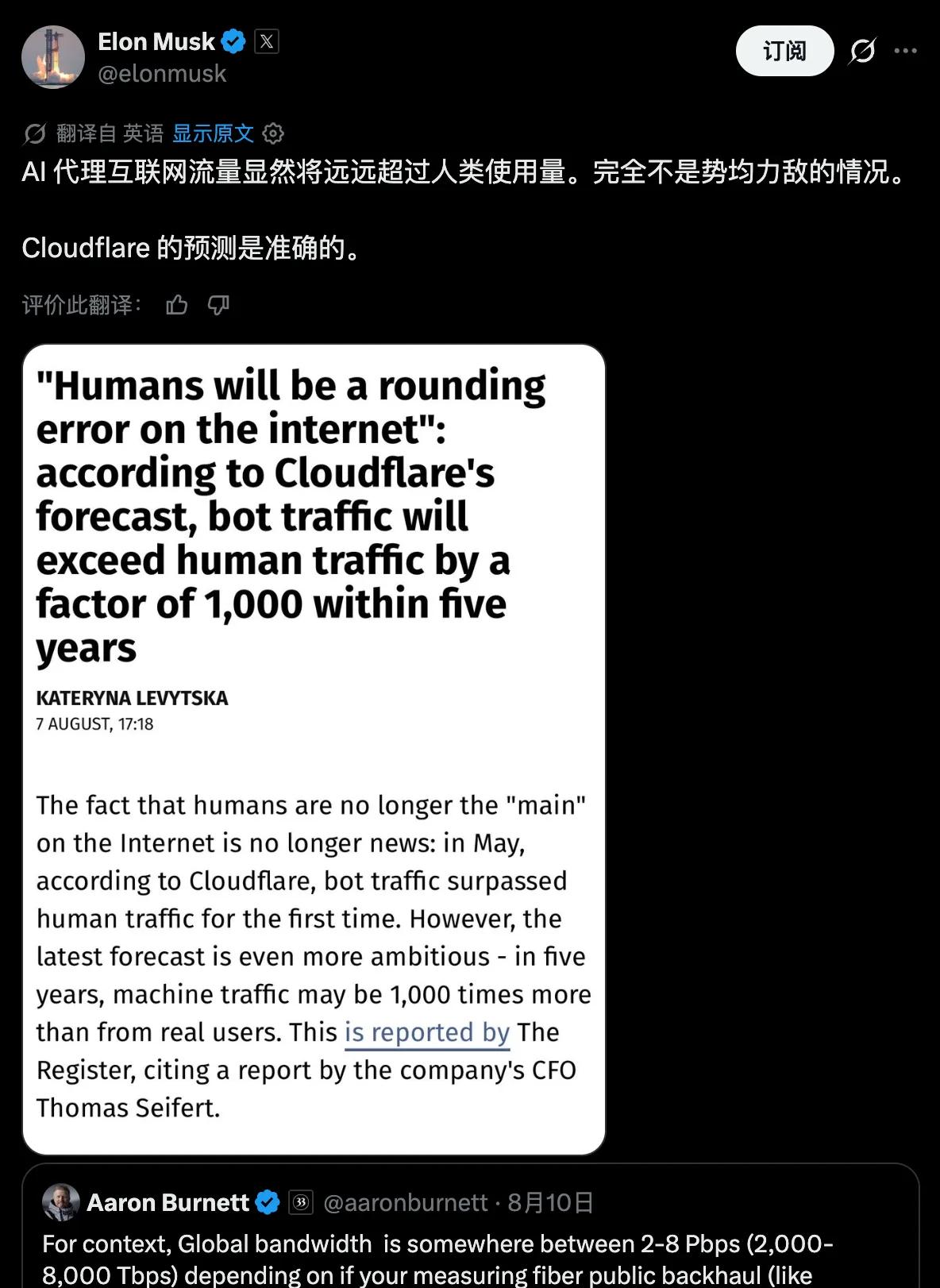
Image source: X
However, when the AI browsers oriented to humans are receding, browsers oriented to Agents are emerging instead. Cloudflare has renamed Browser Rendering to Browser Run - a cloud browser for Agents, which can launch headless Chrome in the cloud, allow Agents to operate web pages, capture content, generate screenshots, and support recording, playback and manual takeover.
This browser does not need a human-oriented GUI design, and will be destroyed after one task is completed, but can be awakened thousands of times in the cloud.
The reason is that today's Internet is still designed for humans. A large number of websites do not have APIs, let alone MCP. Login, verification codes, dynamic pages and payment processes all rely on graphical interfaces. If Agents want to operate this part of the old Internet, they still need a compatibility layer that can run web pages completely.
But clicking web pages is not the most ideal machine interface. Buttons will change positions, pages will be revised, pop-ups and verification codes may interrupt the task at any time. Cloudflare added WebMCP to Browser Run, which allows websites to directly expose structured tools to Agents, replacing the interaction loop of "viewing screenshots - finding buttons - clicking".
In essence, this means that the Internet is starting to be transformed for AI Agents. In the past, websites defaulted that visitors were humans, so services were organized with pages, buttons and forms. In the future, more and more websites will provide machine-readable content, identity, permission and transaction interfaces, so that Agents do not need to simulate mouse clicks to search, compare and place orders. Web pages will not disappear immediately, but there will be an additional machine-oriented entry.
On the other hand, browsers are starting to run in the background. In the past, users searched by themselves, opened ten web pages, compared information, and filled out forms. Now users only need to tell the Agent the goal, and web browsing and interaction are moved to the background. The Agent may start multiple browser instances continuously, or switch to API or MCP, and users only see the web page briefly when the result or key confirmation appears.
For example, Doubao Work has integrated the browser into its interaction interface, which is directly used for content presentation and user interaction:

(Image source: Doubao Work, generated by Lei Technology)
The more users use Agents, the less necessary it is for them to open the browser personally. The browser is still responsible for being compatible with old web pages that have no machine interface, but it has moved from the window for humans to access the Internet to the operating environment for Agents to operate the Internet.
Browsers Will Not Die, But Users Will Open Them Less and Less
At least for now, we cannot do without browsers when facing many desktop tasks.
In addition to the fact that the capabilities and experience of Agents still need to be further improved, security is also a limiting factor. Google calls indirect prompt injection the primary new threat faced by all Agent browsers, and OpenAI also continuously strengthened similar defenses during the existence of Atlas. However, permission isolation, identity authorization, key operation confirmation and task audit will continue to mature, and the current risks only indicate that the Agents are not reliable enough now.
But technology is advancing, especially the progress of AI technology has repeatedly exceeded many people's expectations.
Image source: Anthropic
Every time an Agent takes over a part of web operations, humans will have one less search, jump, comparison and form filling. This process will not be completed suddenly one day, but more likely happen in an imperceptible way: first, you no longer need to flip through ten web pages by yourself, then you rarely take the initiative to open websites, and finally you only occasionally open the browser when checking results.
Now it seems that AI browsers may hardly become a long-term independent product category. For a small number of research, development and professional users, a browser that can understand all tabs