Shao Tianlan flipped the table, Galaxy General called the police.
The world feels a bit surreal. A newly listed robotics company has fired a shot across the bow of the entire robotics industry.
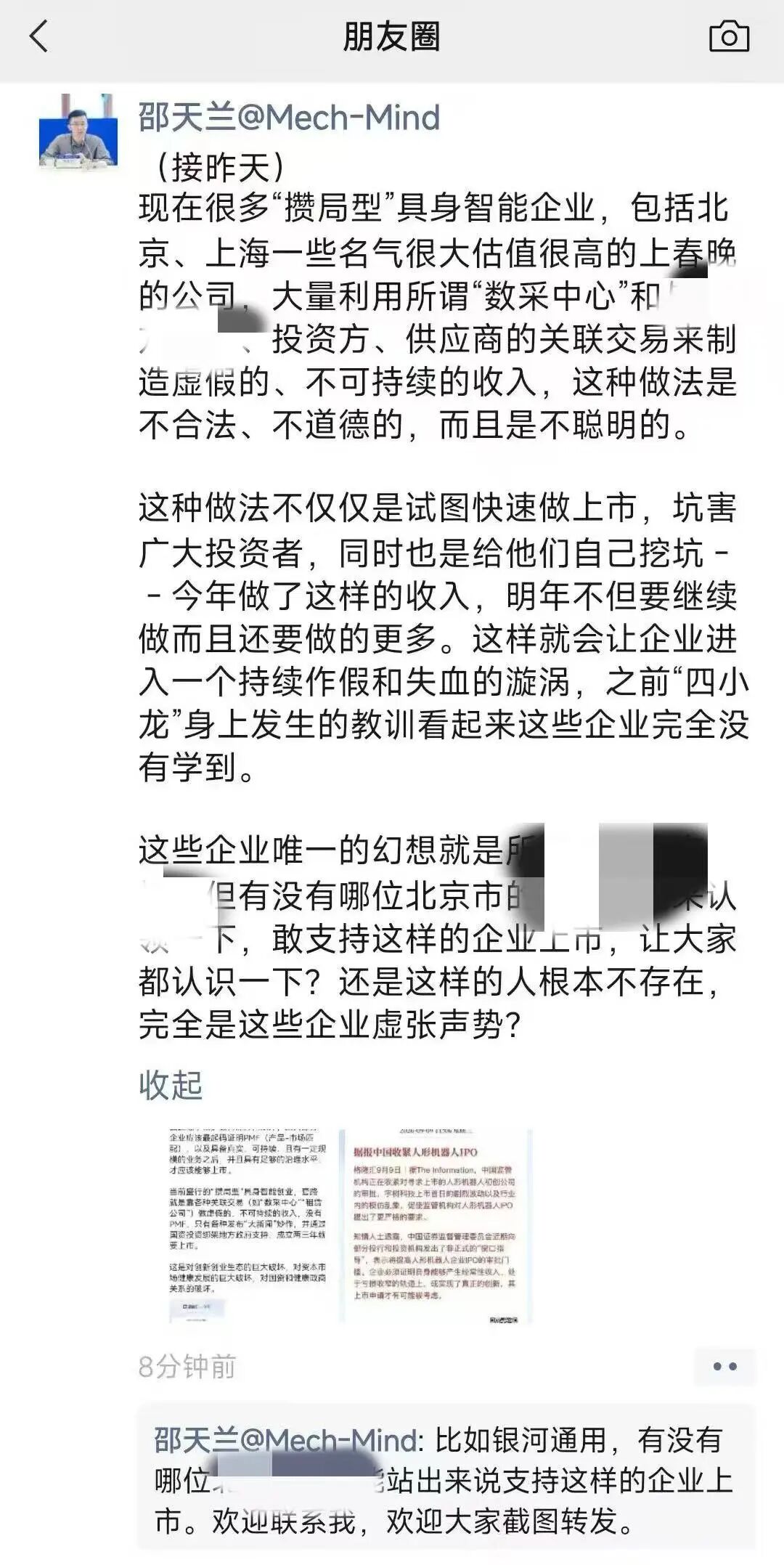
Recently, Shao Tianlan, founder of Mech-Mind, who had just listed on the Hong Kong Stock Exchange 10 days prior, made sweeping remarks on his WeChat Moments, directly pointing out that there are many "gathering-scheme" embodied AI enterprises in the industry that use related-party transactions to generate fake revenue. Among them are even well-known, high-valuation companies that have appeared on the Spring Festival Gala.
In the comment replies, Shao Tianlan went a step further and explicitly named Galaxy Universal, which is currently pushing forward its IPO process.
Galaxy Universal first released a statement saying it would not engage in verbal spats and would focus on doing its own work well. As the controversy escalated two days later, Galaxy Universal issued a statement to refute the rumors and said it had filed a report with the police.
The robotics industry has entered a turbulent period. The already-listed Unitree has seen its share price fall continuously, with its market cap dropping from a peak of 444.9 billion yuan to below 200 billion yuan; while a batch of enterprises that are sprinting for listing are also facing the crisis of having their livelihoods upended.
A
In fact, there have been no shortage of people pouring cold water on humanoid robots over the years, but very few have called out specific companies by name like this. And the one who launched the accusation is the founder of a robotics company that just listed on the Hong Kong Stock Exchange.
On September 9 and 10, Shao Tianlan publicly criticized the current state of the embodied AI industry on WeChat Moments for two consecutive days.
To sum up, his core views are twofold: First, enterprises should at least prove PMF (Product-Market Fit) and have real, sustainable business of a certain scale before they can go public.
Second, he directly pointed out that there is a type of "gathering-scheme" embodied AI enterprise in the industry: they rely on various related-party transactions such as "data collection centers" and "leasing companies" to generate fake, unsustainable revenue, have no PMF, hype through "big news" announcements, and seek to go public only two or three years after establishment.
Among these enterprises, there are even some very well-known, high-valuation companies based in Beijing and Shanghai that have appeared on the Spring Festival Gala.
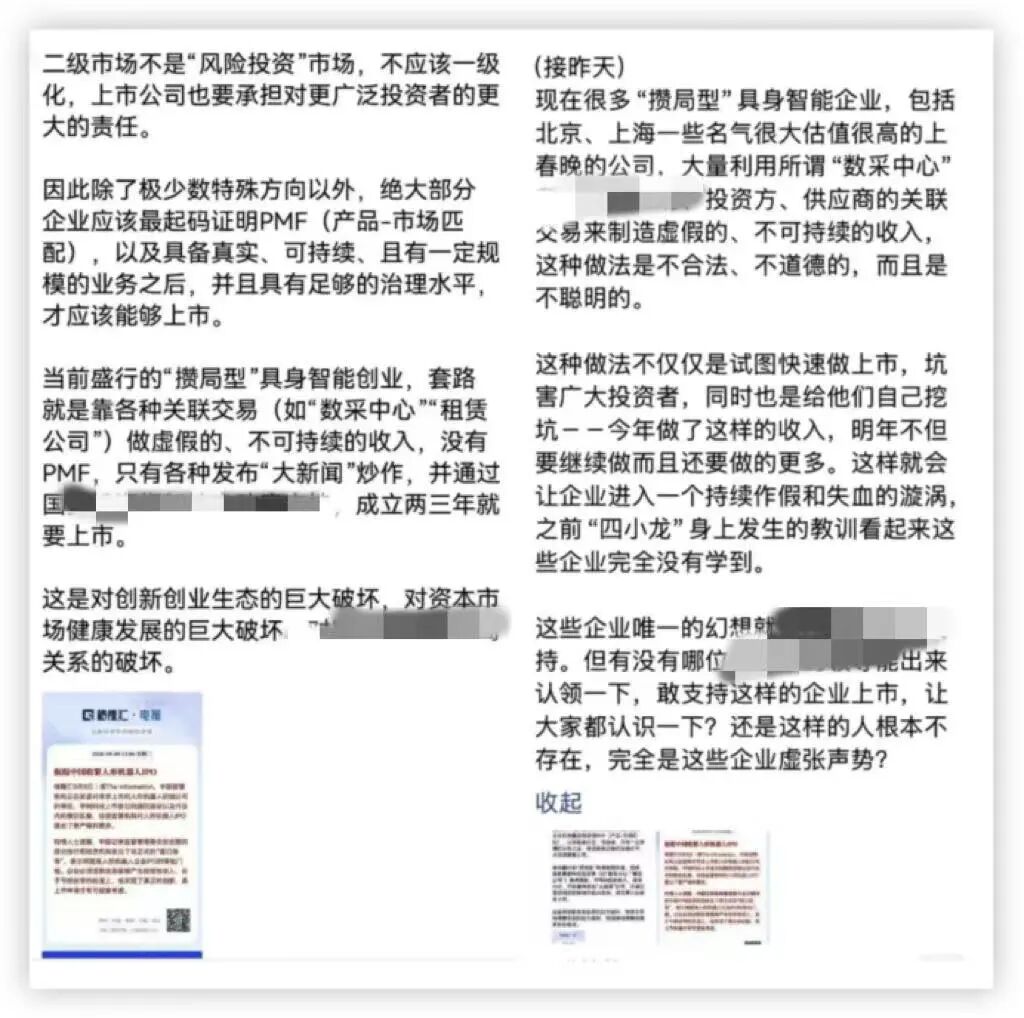
In Shao Tianlan's view, this practice not only harms investors, but also digs a pit for the enterprises themselves. After inflating their revenue, the companies need to achieve even higher operating income the following year, and eventually fall into a cycle of fraud.
After several rounds of denunciation, Shao Tianlan named Galaxy Universal in the comment section.
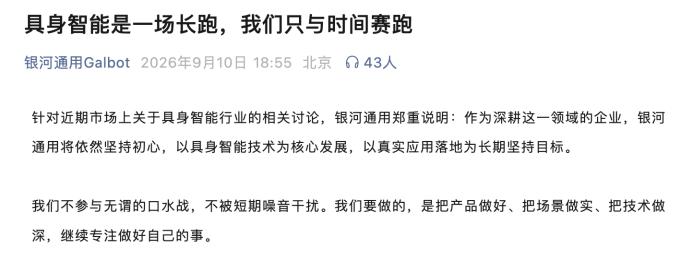
Faced with such accusations, Galaxy Universal released a statement titled Embodied Intelligence Is a Long-Distance Race, We Only Race Against Time on September 10, stating that it would not participate in unnecessary verbal spats, that what it would do is focus on doing its own work well, and emphasized: "The competitiveness of embodied intelligence comes from long-term technology accumulation, not short-term 'quick-gain involution'."
However, the incident did not end there.
A day later, the circulation of an anonymous essay added fuel to the fire.
An unsigned PDF document suddenly spread online, titled The Transformation Tricks and Sleight of Hand of Galaxy Universal's Hong Kong Stock Exchange Listing. The document claims that based on clues, it analyzes the dazzling packaging methods of Galaxy Universal and its founder and leader Yin Fangming, bringing sunlight and spotlight to the hidden corners of its so-called "18C confidential transactions".
Yin Fangming is a familiar figure. He was the first angel investor of Unitree Robotics, who invested 2 million yuan in Unitree, then sold his shares, and appeared as a partner of Junwan Hongyi, a shareholder of Unitree, when Unitree went public. LetterRank once estimated that the market value of his corresponding shareholding at the highest market value point on the first day of Unitree's listing was about 2 billion yuan.
According to public information at present, Yin Fangming is the chairman of Galaxy Universal. In July 2026, Galaxy Universal completed a change of senior management, 10 management personnel including former chairman Guo Xiaoliang withdrew, 9 new members joined, and Yin Fangming took over as chairman.
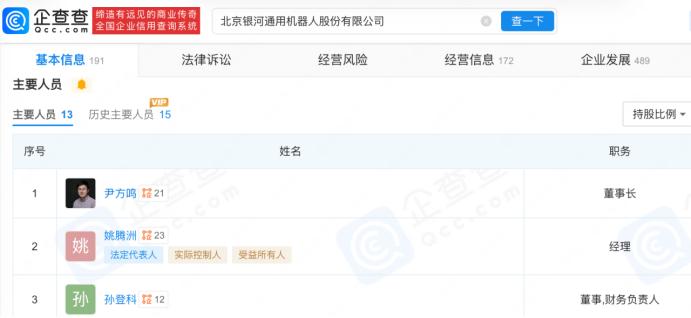
It is still unknown who wrote this PDF-style anonymous essay. But its emergence at the sensitive node of the two sides' tit-for-tat confrontation further complicated the incident.
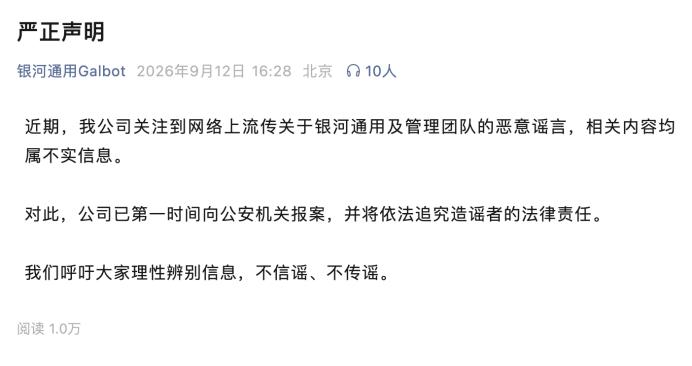
On September 12, Galaxy Universal issued a solemn statement on its official WeChat public account platform, stating that it has noticed malicious rumors spreading online about Galaxy Universal and its management team, that the relevant content is all untrue information, and that it has filed a report with the police.
B
Different from those who poured cold water on the industry in the past, Shao Tianlan is a front-line practitioner in the robotics sector.
37-year-old Shao Tianlan graduated from Tsinghua University with a bachelor's degree, then obtained a master's degree in robotics from the Technical University of Munich in Germany. After returning to China in 2016, Shao Tianlan co-founded Mech-Mind with his Tsinghua alumni.
Different from complete machine manufacturers like Galaxy Universal, Mech-Mind provides components such as the eyes, brains and hands of robots, which are adapted to various forms of robots, such as industrial robotic arms, collaborative robots, humanoid robots, etc.
In other words, Mech-Mind does not belong to the batch of emerging humanoid robot or embodied intelligence companies established after 2023.
In the past few years, Mech-Mind's revenue has gradually increased, from 180 million yuan in 2023 to 390 million yuan in 2025. Although it has not achieved profitability, its net loss has shown an overall downward trend, with a loss of 400 million yuan in 2023 and a loss of 360 million yuan in 2025.
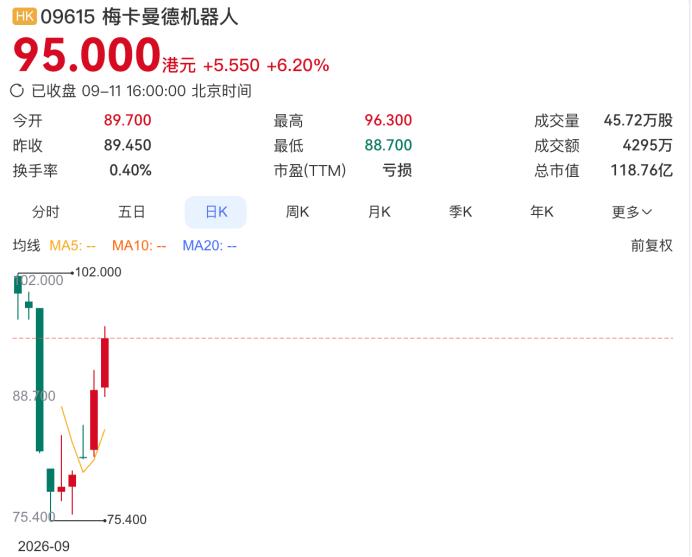
On September 1, Mech-Mind listed on the Hong Kong Stock Exchange with an issue price of HK$101.7. However, its share price quickly fell after listing, closing at HK$99.8 per share on the first day, with the lowest share price touching HK$75 per share. As of the close on the 11th, its share price was HK$95 per share, with a market cap of 11.9 billion Hong Kong dollars.
On the eve of its listing, Shao Tianlan mentioned the industry phenomenon he observed in an interview with "NetEase Tech": some companies generate revenue and public attention by relying on data collection centers, related-party transactions or over-packaged videos. For example, they cooperate with component factories, asking the other party to set up a joint venture to buy back the robots they produce.
He claimed: "We don't want to run the company into a game centered on market value and valuation, and financing is not the ultimate purpose of a company's existence."
It is such a traditional robotics company with a market value of 11.9 billion Hong Kong dollars that publicly named an emerging embodied intelligence company with a valuation of 20 billion yuan.
The Galaxy Universal he named is one of the most high-profile leading companies in the current embodied intelligence industry.
Galaxy Universal was founded in 2023. On its official website and many press releases, Wang He is its founder. Wang He graduated from Tsinghua University with a bachelor's degree, from Stanford University with a doctorate, and also serves as an assistant professor and doctoral supervisor at the Center for Frontiers of Computing, Peking University.
Different from Mech-Mind, which makes robot components, Galaxy Universal takes a software-hardware integrated route, with both self-developed embodied intelligence large models and complete robot machines, such as the wheeled dual-arm robot Galbot G1, the heavy-duty robot Galbot S1, etc.
Among them, the shipment volume of G1 in 2025 exceeded 1,200 units. For comparison, the shipment volume of Unitree's humanoid robot in 2025 was 5,500 units, and that of Agibot was 5,100 units.
Although it is slightly inferior in mass production, its financing speed is extremely fast.
According to information from Qichacha, in the three years since its establishment, Galaxy Universal has completed five rounds of financing, reaching the A+ round. The publicly disclosed financing amount is about 6.9 billion yuan, and its valuation has reached 20 billion yuan.
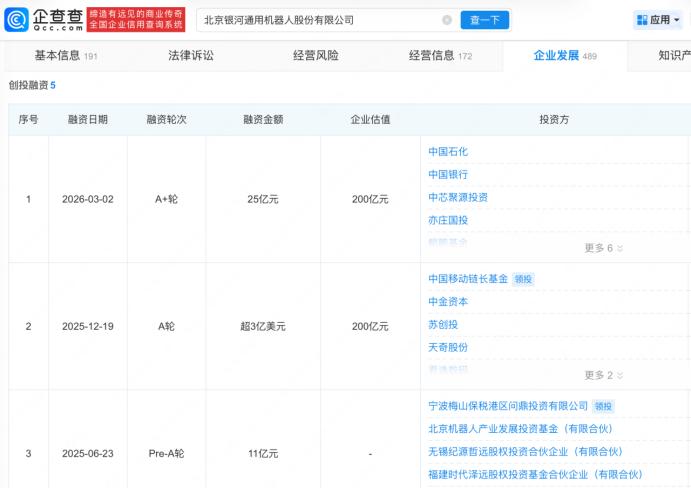
This is a typical embodied intelligence company established after 2023. It caught up with the explosion of generative AI and the humanoid robot boom represented by Tesla Optimus.
Its financing speed forms a contrast with Mech-Mind. According to Qichacha, Galaxy Universal completed five rounds of financing to the A+ round in three years and is now sprinting for listing; while Mech-Mind completed 15 rounds of financing to the D round in the past ten years before achieving listing.
Galaxy Universal's early investors were mainly VCs; later, industrial investors and state-owned capital began to enter. According to IT Juzi, there are about 47 investors in multiple rounds of financing: about 15 market-oriented institutions, about 17 state-owned capital-led funds, and about 15 industrial capital/CVCs.
In terms of equity structure, Qichacha shows that Galaxy Tuojie is the largest shareholder of Galaxy Universal, holding about 18% of the shares; Meituan is the second largest shareholder, holding about 9.4% of the shares; Wang He is the 11th largest shareholder, holding 2.6% of the shares. Among them, one of the partners of Galaxy Tuojie is Guo Xiaoliang; the second partner is Beijing Xingyuxing, with Yin Fangming holding 99% of the shares and Guo Xiaoliang holding 1% of the shares; the third partner is Beijing Boyinhui.
C
Why did Shao Tianlan fire this shot at this moment?
It originated from a rumor circulating online: The regulatory wind for humanoid robot IPOs is tightening.
According to media reports, people familiar with the matter said that domestic regulatory authorities have recently conducted informal "window guidance" to some investment banks and investment institutions to raise the approval threshold for humanoid robot enterprises' IPOs. The new requirements mention that pre-listing enterprises need to prove that they can generate sustainable revenue, are moving towards loss reduction, or have truly important technological innovations.
It was when reposting this news that Shao Tianlan expressed his views on the industry.
Regarding the commercialization narrative of robots, LatePost also once disclosed a similar status quo, stating that multiple identities and cross transactions have become a common phenomenon in the industry. In this model, industrial partners can obtain multiple benefits at the same time: selling components to robot companies, undertaking OEM production, operating data collection bases, etc., and then purchasing robots into factories or training sites. Robot companies then obtain production capacity, scenarios, investment and orders.
It also gave an example, saying that four of the top five customers of a robot company last year were in the related-party system, and they jointly contributed more than 30% of the company's revenue. The largest customer last year was also its shareholder, and the two sides also set up a joint venture.
All of these happen to hit the most sensitive issue in the current robotics industry: Can robotics companies really achieve sustainable, stable and real commercialization?
This is also what Shao Tianlan has repeatedly emphasized. In his view, a company should at least prove PMF and have stable revenue before seeking listing.
Why has this issue become so prominent at this time?
In the past year, the financing and valuation of robots have risen too fast. According to statistics from IT Juzi, the total domestic financing for embodied intelligence in the first half of 2026 exceeded 900 billion yuan, and there are as many as 22 enterprises with a valuation of over 10 billion yuan. Incomplete statistics show that at present, 8 robotics companies have a valuation of over 20 billion yuan.
At the beginning of this year, a valuation of over 10 billion yuan was still the threshold for robotics companies, but in only half a year, 20 billion yuan has become a new threshold.
At the same time, more and more robotics companies are sprinting for listing. According to reports, more than 40 robotics enterprises are queuing up for listing intensively.
In addition to Agibot, which has confirmed the launch of the Hong Kong listing process, a number of robotics companies have been exposed to have secretly submitted IPO applications to the Hong Kong Stock Exchange, such as XZY Robotics, StarNavi, and DynamicX, etc.
Most of these robotics companies were established around 2023, some started Pre-IPO round financing after financing to round B; some even started sprinting for listing only after financing to round A+.
High valuation and IPO sprinting are not only a halo, but also a yoke. It brings public attention, and also means that the outside world's scrutiny of their commercialization will only become more stringent.
Unitree proved that robots can achieve profitability and run through its own business model with 1.7 billion yuan in revenue and nearly 300 million yuan in net profit in one year; but at the same time, people also found that most of its robots were sold to scientific