Official Announcement: OpenAI has shut down the fastest model in its history.
The fastest model in OpenAI's history is gone.
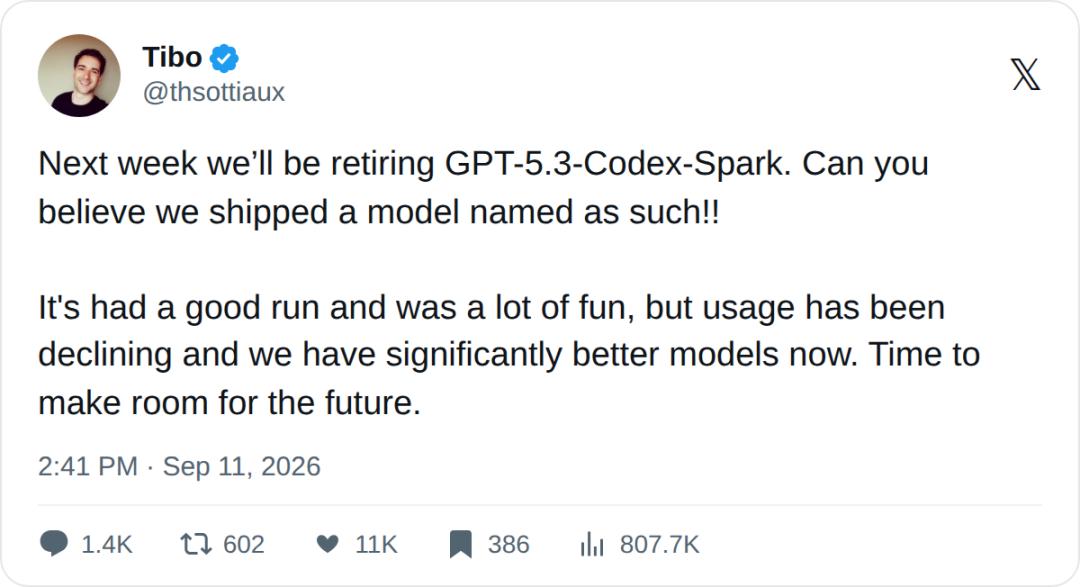
Tibo, head of Codex, posted that GPT-5.3-Codex-Spark will be retired next week.
Capable of generating 1200 Tokens per second, as OpenAI's first model that broke away from the NVIDIA stack and the first delivery of the massive 750MW Cerebras order, it only lived for 7 months from release to deactivation.
The reason Tibo gave was simple: usage has been consistently declining, and there are already significantly better models in hand. "It's time to make room for the future."
Then he added a follow-up comment: "I can't believe we ever released a model with such a long name!!"
At the farewell, all people care about is the "backup quota"
Spark's departure was quiet, even a bit awkward.
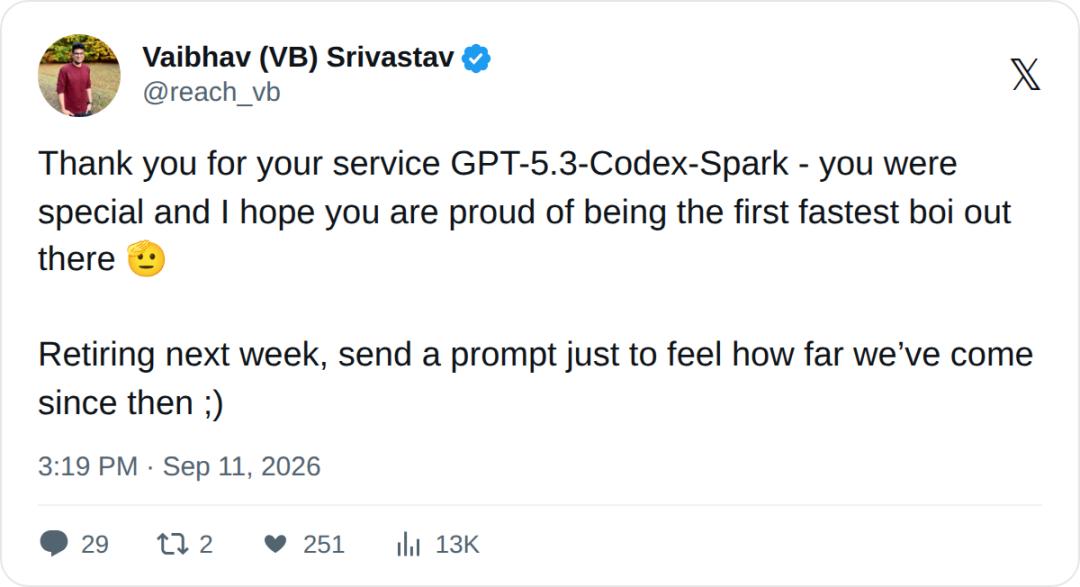
Vaibhav Srivastav from Hugging Face tried to leave a warm note in the comment section.
Thanks for your service, you were special. Hope you are proud of being the first "fastest kid". Before you retire next week, run a prompt to feel how far we have come since then.
The top comment right after that immediately took a sharp turn.
So what was it even used for? I was discussing this with my colleagues the other day.
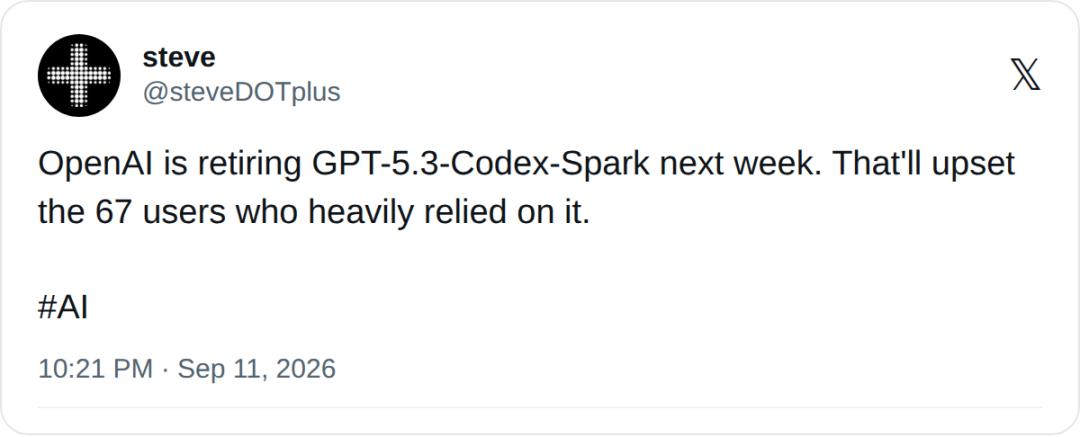
OpenAI is retiring Codex-Spark, the remaining 67 heavy users must be sad.
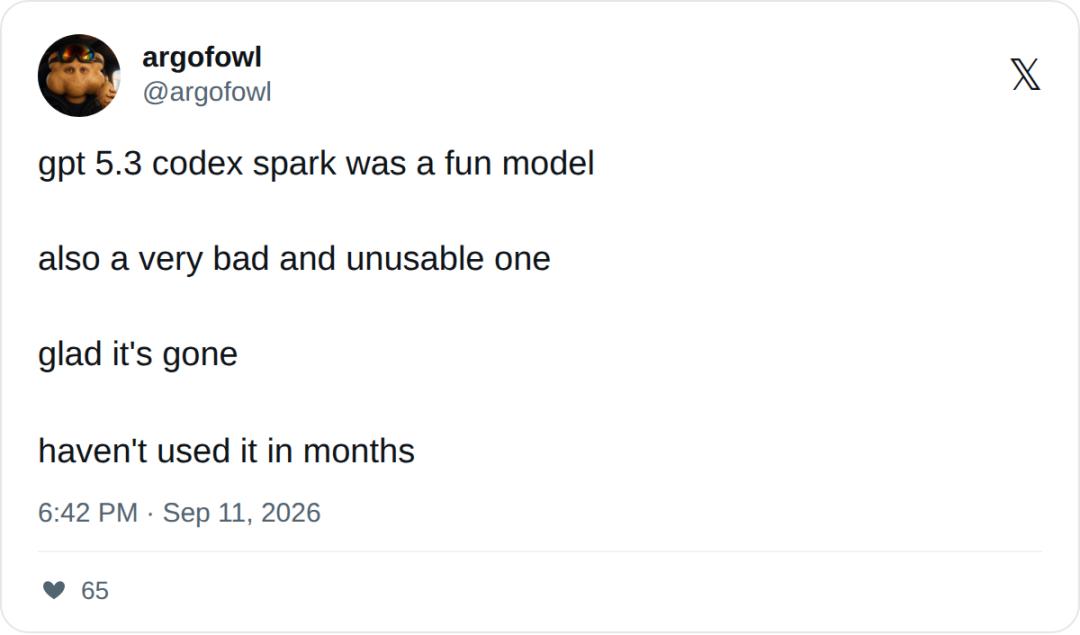
A more brutal review came from developer argofowl: "Spark was a fun model, but also an extremely terrible, completely unusable one. I'm glad it's gone, I haven't touched it for months."
Some other developers said that in several medium-to-large projects, they barely used Spark. Even basic tasks like understanding project context or analyzing logs would quickly fill up the context window, forcing them to open a new conversation.
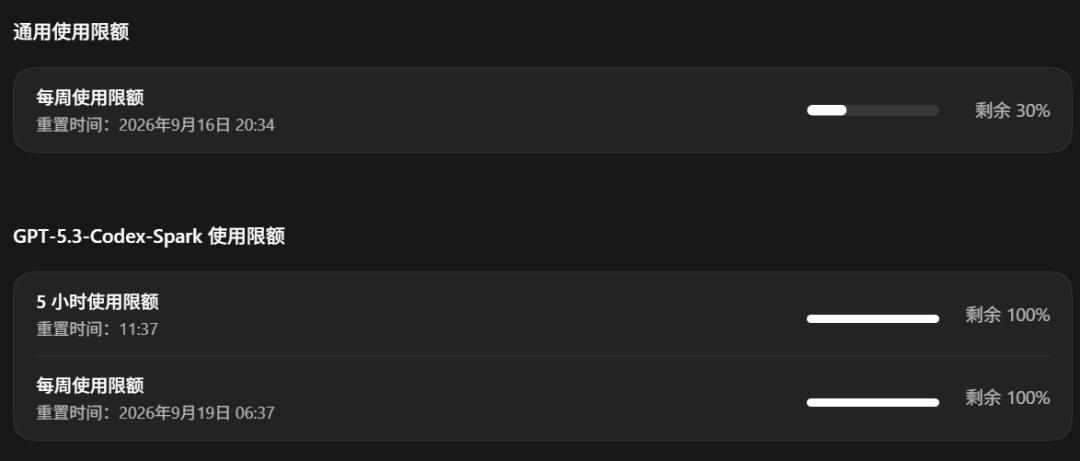
In fact, the only thing people feel a little sorry for about Spark's retirement is not the model itself, but its attached independent quota.
Well-known developer Chubby admitted that he wants a "GPT-6-Spark", because Spark has an independent package that does not occupy the main quota.
At a time when Astra's quota is extremely tight, many developers use Spark as a "backup fuel tank" to keep running after the main quota is exhausted.
The "future" from 7 months ago lost to "speedup via intelligence reduction"
Back on February 12 this year, the day Spark launched, the event was grand.
It was OpenAI's first model designed specifically for real-time coding, with 128k context and a generation speed of over 1000 Tokens per second.
According to official figures, the round-trip overhead between client and server was reduced by 80%, the processing overhead per Token was cut by 30%, and the first Token latency was halved.
Code no longer popped out line by line, but poured onto the screen in entire chunks.
The first batch of developers who got their hands on it were genuinely excited.
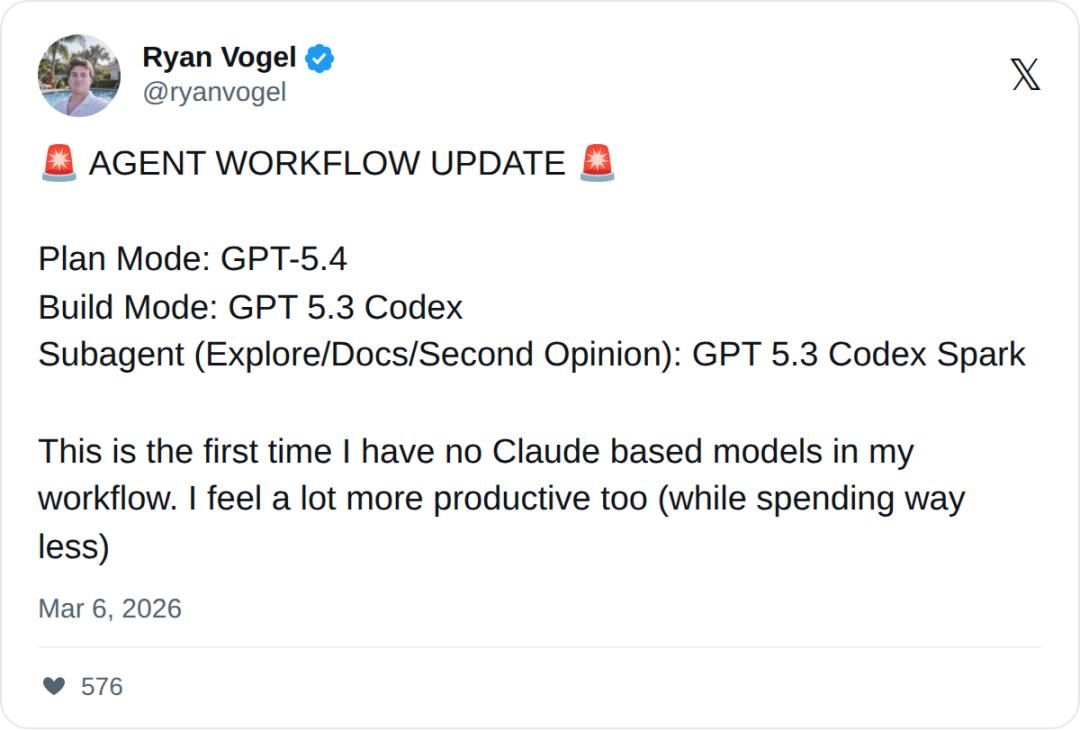
Developer Ryan Vogel directly integrated it into his official workflow: GPT-5.4 is responsible for planning, GPT-5.3-Codex for building, and Spark for exploring codebases, checking documentation, and providing second opinions.
He said it was the first time he had no Claude models in his workflow, "more efficient, less costly".
Jason Liu, author of Instructor, directly launched 20 Spark sub-agents to search the file system, declaring "RAG is dead".
Shortly after that, he joined OpenAI's Codex team.

More importantly, Spark carried OpenAI's ambition to get rid of single hardware dependency.
It was OpenAI's first production model running outside the NVIDIA technology stack, with underlying computing power from Cerebras's wafer-scale chip WSE-3.
It marked the first delivery of OpenAI's massive 750MW, over $20 billion total value computing power order with Cerebras.
But its popularity faded even faster than it rose.
Spark's fatal flaw is that a single wafer cannot fit a flagship model, and it is essentially a "distilled small model" compromised for extreme speed.
In the Terminal-Bench 2.0 evaluation, Spark only achieved 58.4% accuracy, far lower than the 77.3% of the full version GPT-5.3-Codex.
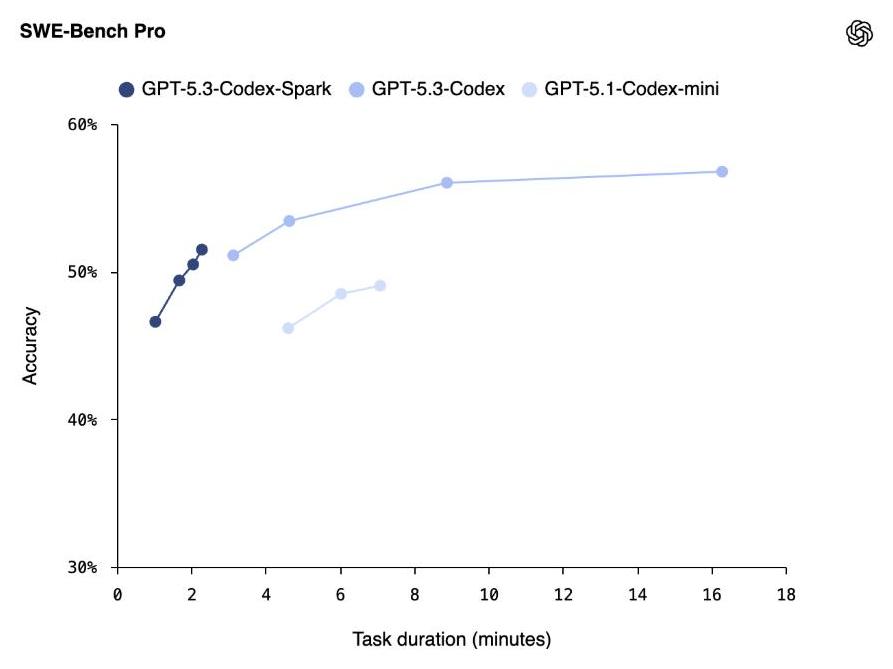
The SWE-Bench Pro curve released by OpenAI also shows that although Spark can compress task duration to 1-2 minutes, its accuracy stays between 47% and 51%.
In comparison, the full version GPT-5.3-Codex starts at 51% accuracy from 3 minutes, reaches 56% at 9 minutes, and hits 57% at 16 minutes.
That means the few minutes Spark saves comes at the cost of a 5-6 percentage point drop in accuracy.
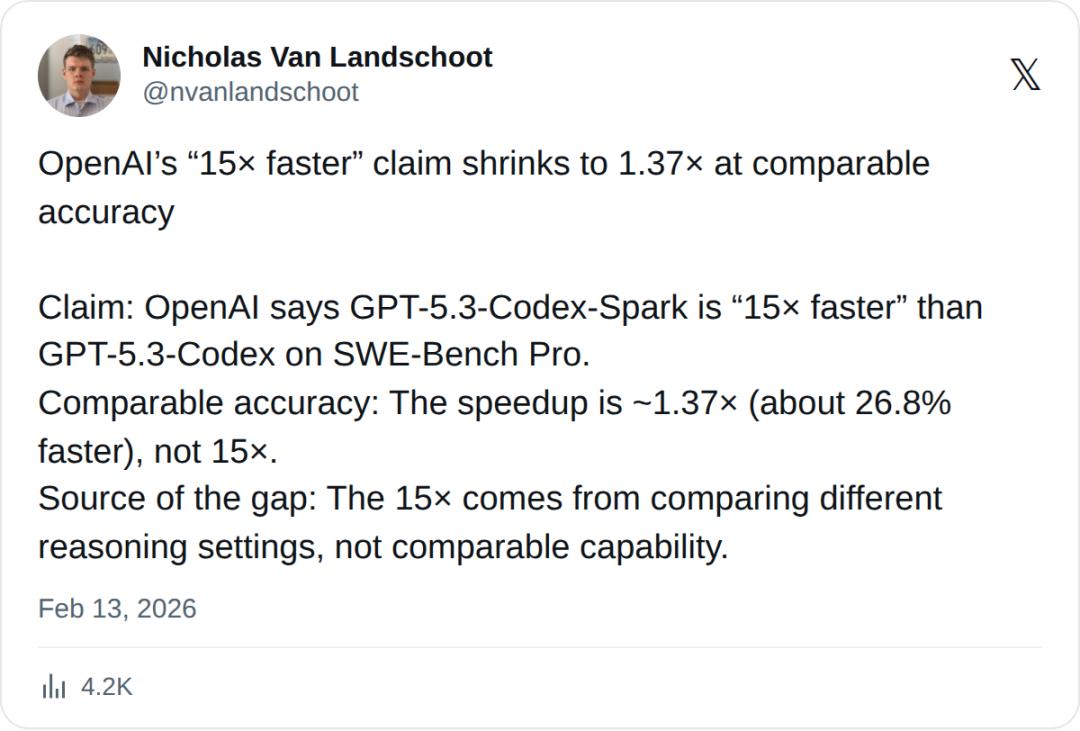
The advertised "15x speedup" was also debunked.
The day after release, developer Nicholas Van Landschoot published a long post on X, breaking down OpenAI's comparison conditions: the so-called 15x speedup was Spark compared to GPT-5.3-Codex running at maximum inference intensity.
Under equal accuracy, Spark was only 1.37 times faster.
In actual coding scenarios, its flaws are magnified infinitely: it fabricates API endpoints out of thin air, produces unstable JSON formats, and is extremely prone to going off track in multi-step tasks.
Training institution Turing College summed it up sharply: "Speed without intelligence is just failing faster."
For programmers, spending 17 minutes waiting for working code is always more cost-effective than spending 2 minutes getting a bug-ridden piece of junk.
As a result, this speed-focused model was destined to be marginalized.
The flagship itself arrives, Ultrafast ends Spark's life
The one that actually sentenced Spark to death was the Ultrafast mode released by Cerebras on August 13.
This time, what runs on the wafer is no longer the reduced version of Spark, but the flagship model GPT-5.6 Sol itself.

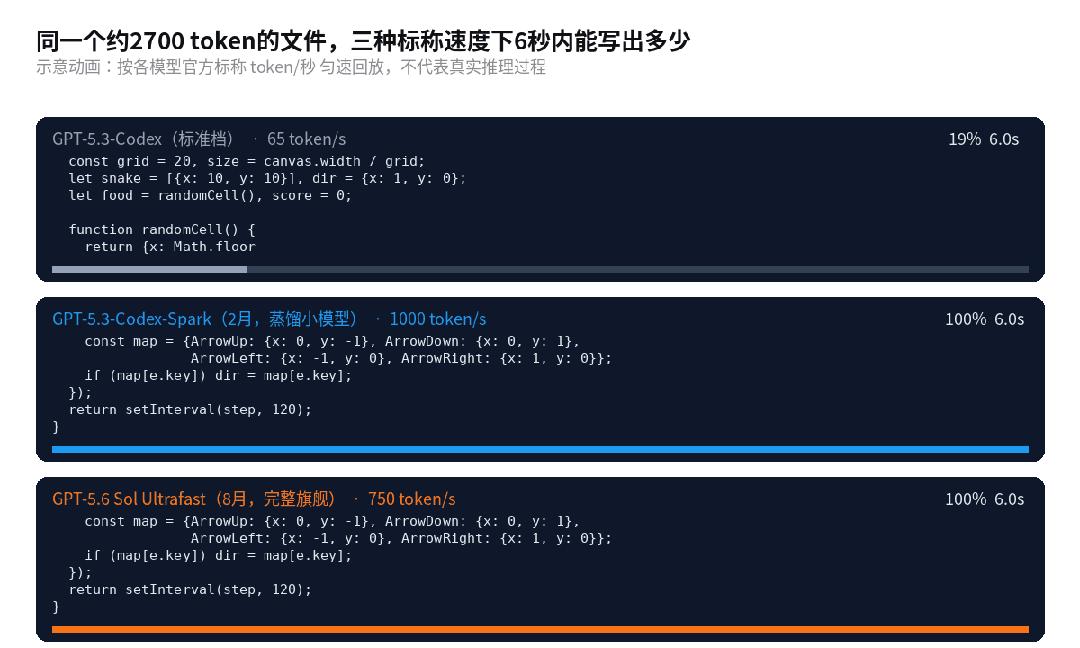
By slicing the huge flagship model layer by layer and deploying it across multiple CS-3 nodes to form a pipeline, the Ultrafast mode delivers a terrifying speed of 750 Tokens per second on the premise of ensuring "the same intelligence as the standard version".
Cerebras's comparison shows that Ultrafast is 14 times faster than the standard tier, and there is also a middle tier called Priority that is only 2.5 times faster.
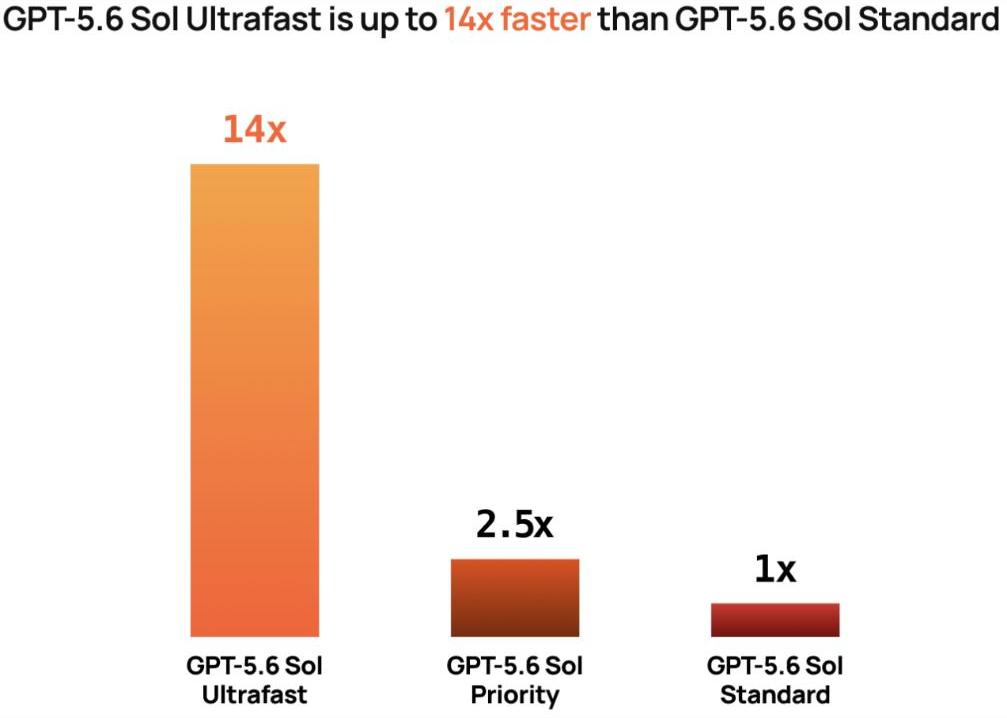
Cerebras CEO Andrew Feldman commented forcefully: "Speed and intelligence are no longer mutually exclusive."
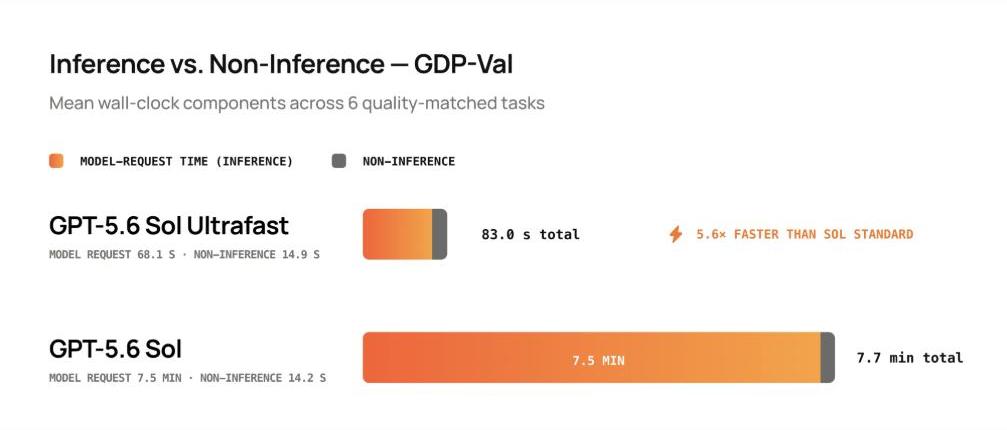
They ran a set of duration comparisons using 6 quality-aligned tasks in GDP-Val.
The standard tier Sol takes an average of 7.7 minutes, 7.5 minutes of which is spent on model generation. Switch to Ultrafast, the same task takes 83 seconds in total: 68 seconds for model generation, and the remaining 15 seconds for non-inference overhead such as tool calls.
That means it's 5.6 times faster end-to-end, with almost no difference in answer quality.
This statement not only announced a technological breakthrough, but also completely drained all meaning of Spark's existence.
Spark was originally designed to "trade intelligence for speed", but only half a year later, the same company's wafers can run the full flagship model, which is only a quarter slower with zero loss of capability.
Cerebras's production capacity is limited.
When the unpopular "reduced version" and the oversubscribed "flagship version" are squeezed onto the same batch of wafers, the answer to who should make room for the future is self-evident.

Speed is no longer a "dedicated model", but a "paid tier"
Spark is not the only historical burden to be cleaned up.
In the past three months, OpenAI's model library has been undergoing an aggressive "major overhaul".
On June 2, GPT-5.2 and GPT-5.3-Codex were retired.
On August 31, GPT-5.4 and 5.4 Mini were retired, and all users were migrated to the 5.6 generation.
On September 11, it was GPT-5.3-Codex-Spark's turn.
With the exit of the old generation, Codex has ushered in a new naming era featuring Sol, Terra, Luna and Astra.
Names like "GPT-5.3-Codex-Spark" with lengthy version numbers and product line suffixes really are relics of the last era.
