The quarterly service revenue reached 906 million US dollars, Da Vinci achieves monetization with the help of AI.
Global medical device giants are quietly making profits with AI.
Intuitive Surgical revealed a detail during its earnings call: the company completed the first wave of renewals for My Intuitive Plus (MI Plus), a digital service platform matched with the da Vinci 5 surgical system. It bundles features such as remote collaboration, simulation training and AI clinical case insights into its charging system. Although the initial renewal group of MI Plus is not large, no customer chose to opt out. This means that AI products have begun to generate steady revenue for Intuitive Surgical.
Meanwhile, Medtronic also mentioned at its earnings exchange meeting that its cardiovascular AI products and gastrointestinal AI diagnostic products have both achieved double-digit growth, driving the overall growth of its consumables and equipment business.
The earnings reports of global medical technology giants clearly reveal a clue that AI has become a key engine driving growth in the medical device industry. AI has started to bring tangible revenue to medical technology giants. How do medical technology giants restructure their businesses centered on AI?
Intuitive Surgical: Bundling AI into Subscription Services, Zero Churn Verifies Commercial Value
Intuitive Surgical is the forerunner of this transformation, being the first to verify the value of AI + medical devices.
In the second quarter of 2026, Intuitive Surgical posted revenue of USD 2.892 billion, up 19% year on year. Among which, revenue from instruments and accessories reached USD 1.735 billion (accounting for 60% of total revenue), up 18% year on year; revenue from system equipment was USD 685 million (accounting for about 24% of total revenue), up 19% year on year; service revenue hit USD 472 million (accounting for about 16% of total revenue), surging 21% year on year. The growth rate of service revenue systematically outpaced that of the hardware business.
A major highlight in service revenue is zero churn of MI Plus subscription renewals. Intuitive Surgical admitted at its earnings conference that the scale of the first batch of customers is not very large, but the result of zero renewal churn has proved that hospitals are willing to pay continuously for these AI features.
My Intuitive+ enhances robot-assisted surgical planning by combining AI-powered video analytics, real-time remote collaboration (Telepresence) and integrated console simulation (SimNow 2).
The value of AI clinical case insights among these features is to improve surgical quality. AI clinical case insights deeply integrate system telemetry data, manipulator kinematics data and surgical videos during the operation to conduct objective evaluation. In the past, these data were not systematically analyzed, but now AI can automatically track surgical actions, generate trend reports, mark outliers, and directly provide actionable improvement suggestions to support doctors in improving their surgical skills and peer learning. It can also be used to evaluate the performance of surgeons and projects, so as to improve the quality and safety of surgeries across the hospital.
After the surgery, doctors can intuitively check their operation time on the console, utilization rate of different instruments and action flow through My Intuitive, and make horizontal comparisons with the average technical level across the globe/the United States, helping doctors accurately find entry points to shorten operation time and optimize procedures. Hospitals can carry out personalized doctor training with the help of this AI feature.
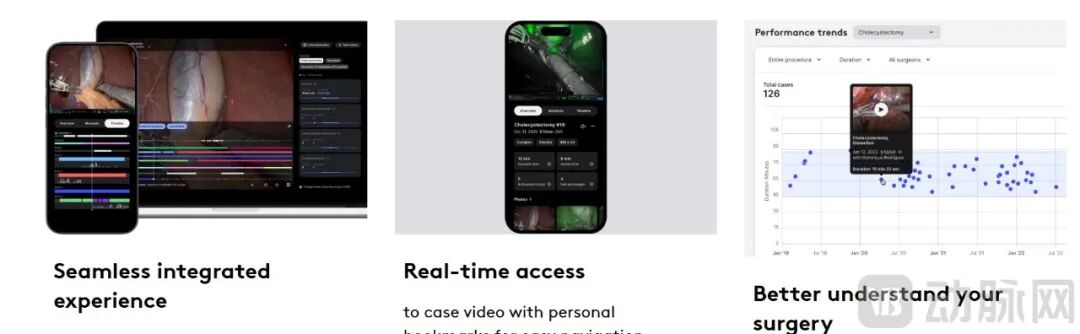
MI Plus
Behind this AI feature is the surgical dataset accumulated by Intuitive Surgical for 20 years — the Vision-Language Models and Reasoning Models trained based on these data can answer surgical questions involving complex clinical scenarios. Preliminary tests show that their performance on surgical operation understanding tasks is better than general-purpose AI systems.
Another value of MI Plus lies in remote collaboration. Through the MI+ platform, top surgical experts in different locations can remotely access the operating room at any time for real-time case observation, on-screen guidance and voice connection. This allows more hospitals to share high-quality medical resources.
In the short term, the revenue brought by MI Plus is limited, which may not be enough to catch the attention of domestic competitors; but from a long-term perspective, AI is quietly widening the product gap between different surgical robots. The datasets accumulated by AI and the identified surgical improvement points will become the core fuel for the iteration of next-generation robots, truly promoting surgical robots to a more intelligent stage.
AI Drives Growth of Multiple Traditional Businesses of Medtronic
Not only Intuitive Surgical has successfully sold AI applications to customers, Medtronic has also launched and sold a number of AI products.
At the Q2 earnings meeting for FY2026, Medtronic revealed that its Endoscopy and Esophageal business line recorded an overall growth of 8%, among which the important growth driving force is exactly the AI intelligent endoscopy system GI Genius, which achieved strong double-digit revenue growth and also drove the growth of colonoscopy hardware business.
GI Genius is mainly used to detect colorectal polyps in real time during colonoscopy, automatically mark high-risk areas in the real-time video stream, complement doctors' experience, help discover more early tiny lesions and improve lesion recognition ability. Compared with standard colonoscopy, its adenoma detection rate is increased by 14.4%, and the missed diagnosis rate is reduced by 50%.
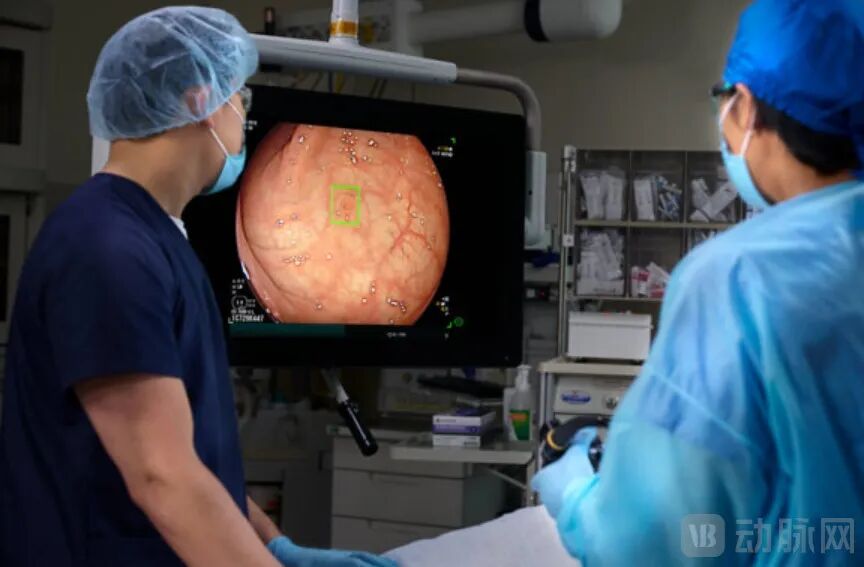
GI Genius™ intelligent endoscopy module
In the latest earnings report, Medtronic disclosed more commercialization performance of its AI products. Q1 FY27 (as of July 31, 2026) can be regarded as a clear verification point that Medtronic's AI investment has started to pay off.
AI has also become a bright spot for growth in Medtronic's cardiovascular business, which has seen flat growth. At the just-concluded Q1 earnings meeting for FY2027, Medtronic stated that the overall growth of its coronary business is moderate, but the cardiovascular AI business delivered outstanding performance. Executives specifically mentioned CathWorks, an AI image measurement platform built on an advanced computer science platform with FFR (Fractional Flow Reserve) functionality. CathWorks directly contributed nearly 300 basis points (about 3%) of organic revenue growth to the global coronary business, becoming a non-negligible contributor behind the 13% surge in the cardiovascular business in this quarter.
CathWorks is a powerful tool for instant surgical decision-making in the catheter lab. The FFRangio therapy adapted by the CathWorks FFRangio system achieves a technological breakthrough in wire-free and drug-free coronary physiology assessment. Combining artificial intelligence with advanced computing science, it can directly convert images into functional assessment, combine multi-dimensional information such as vascular structure and myocardial blood supply to judge whether the lesion needs interventional treatment, optimize stent selection and deployment, and predict treatment effect and prognosis. Surgeons can get the calculation results within minutes during the operation.
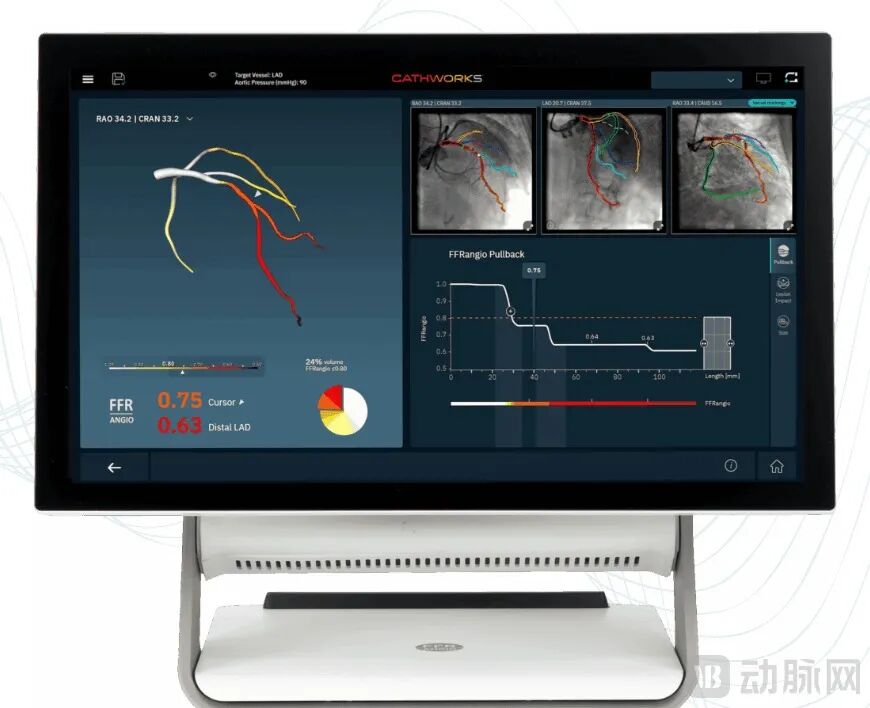
CathWorks FFRangio System
Medtronic's Cranial and Spinal Technologies business is also driven by AI, achieving an overall growth of 13%, including 14% growth in the US market and 10% growth in the international market. Medtronic believes that the key to the growth of its cranial and spinal business is the AiBLE ecosystem, which connects previously fragmented and isolated technical modules. By running AI-driven surgical planning, imaging, navigation, robots, implants and efficacy data through the entire surgical process, AiBLE helps surgeons make more adequate decisions, complete surgeries more accurately, and continuously learn and accumulate experience from every case.
Medtronic, which has reaped benefits from AI, is accelerating to shift its entire business to AI-driven operations, even willing to divest traditional mature businesses to feed AI investments. The company is divesting low-margin, low-growth businesses such as its diabetes business. The CFO clearly stated at the earnings meeting that the capital released from the spin-off will be prioritized for investment in high-growth areas, with medical AI, surgical robots (HUGO platform) and digital neuroscience as the core investment areas.
In the field of surgical robots, Medtronic is also building an AI ecosystem platform. Medtronic has deepened its underlying computing power cooperation with NVIDIA. Based on the NVIDIA Holoscan edge AI platform, it has upgraded the R&D focus of AI algorithms from a single product to an enterprise-level open AI ecosystem, allowing more third-party AI modules to access Medtronic hardware, thus reducing its own marginal R&D cost.
This direction has already seen landed products. Medtronic launched the native AI surgical computing platform — Touch Surgery Aide at the 2026 annual meeting of the Society of Robotic Surgery (SRS), which powers the entire Touch Surgery ecosystem. The first AI application IEP running on the platform has received FDA approval and is used in conjunction with the Hugo robot-assisted surgical system: with the help of computer vision technology, it will send visual prompts during the operation when the selected instrument goes beyond the visible field of view. This allows surgeons operating multi-arm robots to avoid repeatedly confirming the position of instruments, and the out-of-sight prompts can significantly reduce operation risks and cognitive load.
More importantly, Touch Surgery Aide is an open platform, and IEP is only the first application. It will be gradually expanded to more scenarios such as laparoscopic surgery in the future. Medtronic is building an app store for surgical AI: the platform provides computing power and basic capabilities, different AI applications solve different clinical problems, and each application can be charged separately.
With the maturity of medical AI applications, software licensing and upgrade services can generate recurring, continuous revenue, and the value of medical device enterprises may be re-evaluated in the future.
Domestic Enterprises: Firm Strategic Investment, No Public AI Revenue Disclosed
Like overseas giants, leading domestic medical device enterprises are also resolute in their investment in AI strategies, but their commercialization paths show obvious differences.
United Imaging and Mindray have successively mentioned the same judgment at their earnings exchange meetings: next-generation medical equipment will evolve into new intelligent diagnosis and treatment systems with intelligent perception, auxiliary decision-making, precise execution and continuous learning capabilities.
Li Xiting, Chairman of Mindray Medical, even stated directly in the annual report that medical devices will develop into embodied intelligence with the capabilities of "perception, thinking, decision-making and execution", and digital intelligence is exactly the key to profit improvement in the eyes of Mindray.
In Li Xiting's statement, the weight of this positioning far exceeds the product level. He mentioned that from the perspective of strategic direction, the digital intelligence transformation that Mindray is carrying out today, including the Qiyuan AI large model, surgical robots, wearable monitoring, etc., is not simply to sell better products, but to reshape the clinical management paradigm of the patient's life cycle. For Mindray, what it will create is no longer a simple product premium, but a complete solution with disruptive features, high user stickiness and high repurchase rate. This is the core code for Mindray to maintain a high-dimensional competitive advantage and truly lead the digital intelligence development of the global medical industry in the next ten years or even a longer period.
The two companies hold highly consistent statements on AI large models, and AI has been embedded in multiple medical device products of each. But at present, leading domestic medical device enterprises have not announced the performance of AI-related businesses, and AI investment has not yet generated visible returns at the commercialization level.
This is behind the difference in development stages between China and foreign countries. International giants have gone through the stage of increasing hardware penetration and entered the period of value-added for existing installed devices, needing to increase the revenue contribution per device and customer stickiness through AI software services. While domestic enterprises are still in the stage of "domestic substitution of hardware + overseas expansion", AI is more of a selling point to enhance hardware competitiveness and differentiation, and has not yet reached the stage of independent monetization.
The differences in payment environment and competition pattern further amplify this disparity, which determines that domestic medical device enterprises face more challenges on the road of AI transformation.
Medical device + AI has ushered in the period of revenue realization from products. With more AI-related products of medical device giants getting approval, it is expected that more medical technology companies will realize monetization of their AI products in the coming period, and the medical technology industry will also usher in value re-evaluation.
This article is from the WeChat Official Account Artery Network (ID: vcbeat), written by Yang Xue, published with authorization from 36Kr.