Galaxy General: 34 months after its establishment, 6 rounds of financing totaling 7 billion yuan —— the confidence and hidden worries of the "capital harvester" in the embodied intelligence track
In May 2023, Wang He, a researcher at Peking University, founded a robotics company named Galaxy Universal. At that time, embodied intelligence was still a brewing seed in China. Three years later, the company has raised a total of about 70 billion RMB in financing, with a valuation exceeding 200 billion RMB, making it the enterprise with the largest financing amount in the domestic embodied intelligence sector.
This is not a simple "technology entrepreneurship" story, but more like a multi-faceted game revolving around technology narrative, capital competition and industrial expectation.
Who is at the helm?
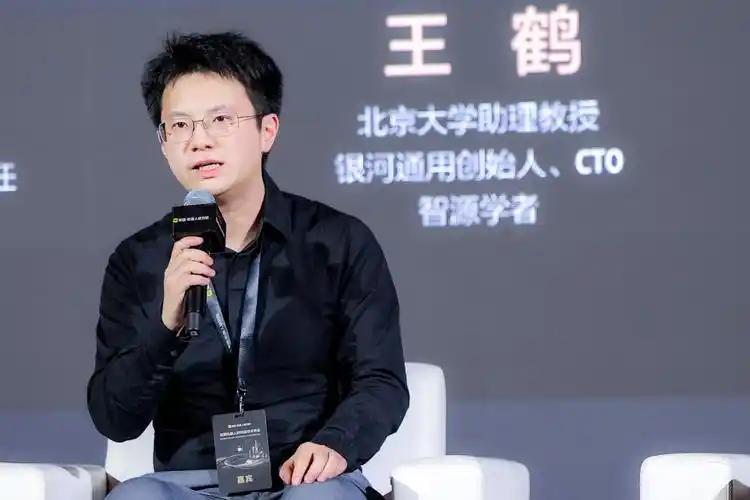
In public statements, the core figure of Galaxy Universal is Wang He, founder and CTO. He holds a doctorate degree from Stanford University, and currently serves as a researcher at Peking University, a Boya Young Scholar, and a national high-level overseas talent. Before starting his business, Wang He had long been deeply engaged in the fields of embodied intelligence and robot operation, and is one of the few founders in this track who have both top academic background and industrial ambition.
Co-founder Zhang Zhizheng is in charge of the large model direction, leading the construction of the "Galaxy Star Data" super-large-scale embodied intelligence dataset, and is also the deputy director of the Beijing Key Laboratory of Embodied Intelligence Large Model.
What is worth paying attention to is the change of the chairman candidate.
In July 2026, Galaxy Universal completed a senior management change: 10 management personnel including former chairman Guo Xiaoliang withdrew, 9 new members joined, Yin Fangming took over as chairman.
According to public information, Yin Fangming's career path spans MediaTek, Sogou and 360. He once founded the robotics company ROOBO, turned to investment after exiting, and his most well-known investment is the angel round of Unitree Robotics.
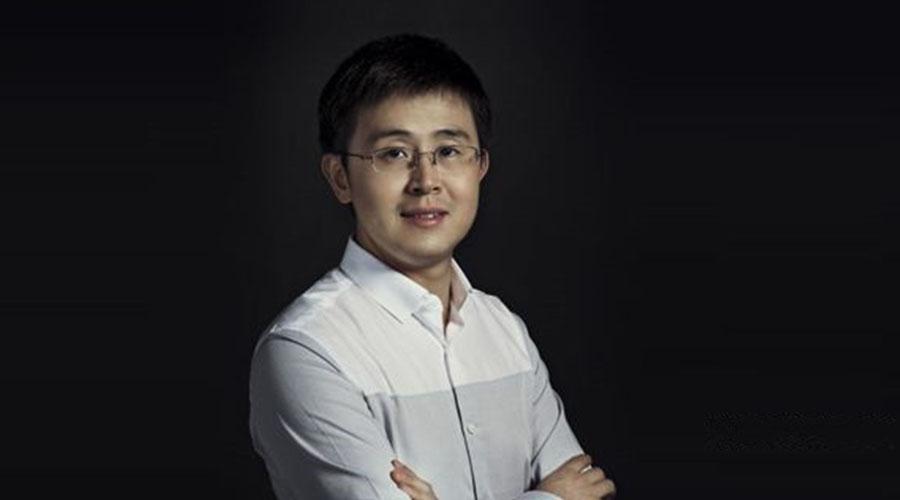
This personnel arrangement itself is a signal that Galaxy Universal is transforming from a "founder-driven" governance structure to a composite governance structure of "capital + industry".
The academic committee is led by Gao Wen, an academician of the Chinese Academy of Engineering, and its members cover top domestic scholars in the embodied intelligence field including Zhang Jianwei, Zeng Wenjun, Wang Tianmiao and Chen Baoquan. The weight of this lineup at the academic level is very solid.
Product roadmap: Prioritize brain, lighten ontology
Galaxy Universal has chosen a completely different path from Unitree Robotics — "prioritize brain, lighten ontology".
The core of the company's technology is the self-developed "AstraBrain" end-to-end embodied large model, which has built a complete closed loop of "brain - cerebellum - neural control".
At the cognitive level, it has launched the world's first general brain foundation model AstraBrain WAM 0.5, which unifies the two paths of vision-language-action and world model; at the motion control level, AstraBrain-WBC 0.5 reaches the GPT-1 magnitude, and verifies the Scaling Law in the field of motion control for the first time.
In March 2026, the team realized the world's first case of a humanoid robot playing tennis independently — the robot can independently complete incoming ball recognition, trajectory prediction, whole-body balance control and continuous hitting, which Elon Musk called "the AlphaGo moment of embodied intelligence".
At the hardware level, Galaxy Universal is not committed to developing the ontology from scratch, but directly uses mature hardware solutions such as Unitree as the carrier.
In 2025, Galaxy Universal contributed more than 18 million RMB in sales to Unitree.
The advantage of this strategy is to concentrate resources on algorithms and data, avoiding the long cycle of hardware R&D dragging down the iteration speed; the cost is that there is no independent barrier at the hardware ontology level, and the core competitiveness is highly dependent on the actual generalization ability of the large model.
Galaxy's current product line includes three models: the heavy-duty industrial robot Galbot S1 (priced at about 1.05 million RMB on JD.com), the wheeled dual-arm robot Galbot G1 for general services (about 700,000 RMB), and the family-scenario biped robot "Galaxy Star Kid" ET1 released in August 2026 (in the pre-sale stage).
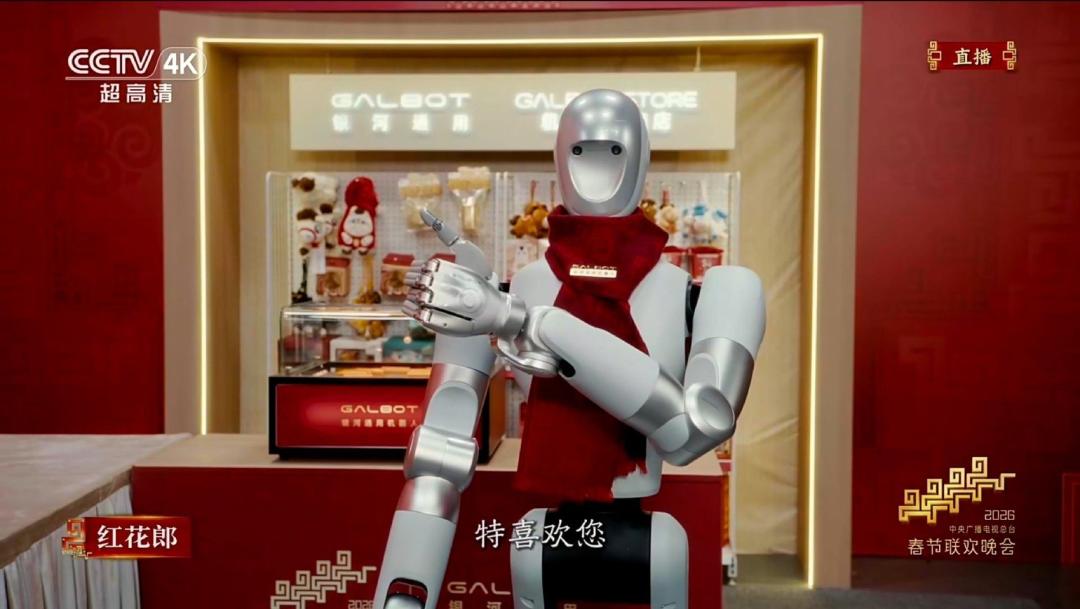
Among them, G1 appeared on the stage of CCTV Spring Gala in 2026, partnering with Shen Teng and Ma Li, and became the "Spring Gala Robot" overnight.
In terms of commercial implementation, S1 has been put into normal 7×24-hour operation in CATL's battery factories, G1 has been deployed in scenarios such as retail, pharmacies and medical care, and the "Galaxy Capsule" convenience stores have been launched in more than 170 locations in over 40 cities. In addition, Galaxy Universal signed a global strategic cooperation agreement with Ningjia Service under CATL, and more than 1,300 service stations will undertake the installation, deployment, operation and maintenance of Galaxy Universal's robots.
Financing history: A "relay race" from VCs to state-owned capital
The financing history of Galaxy Universal itself is a microcosm of the capital evolution of the embodied intelligence track.
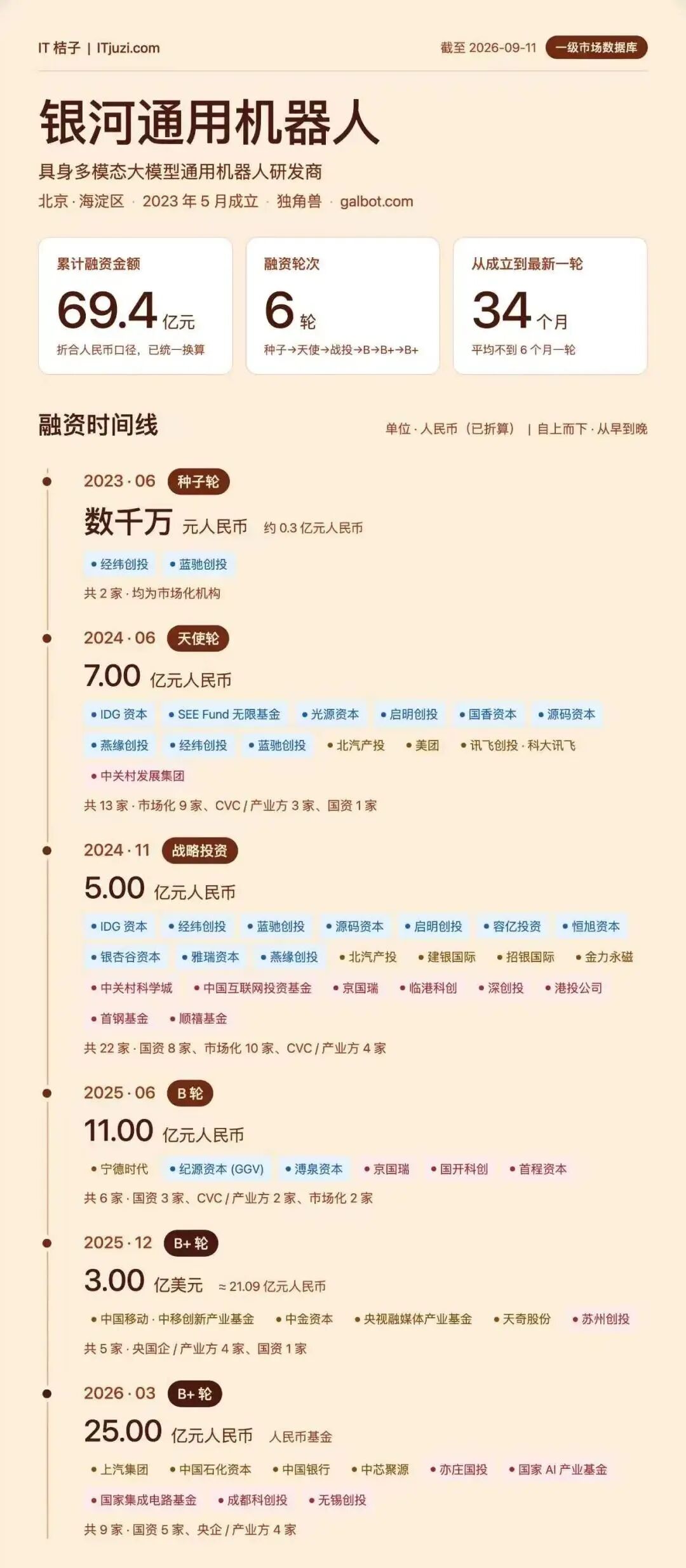
June 2023, Seed Round — tens of millions of RMB, two market-oriented institutions Matrix Partners China and BlueRun Ventures entered the market. This is the most typical early VC betting logic: focusing on the founder's background and technical direction.
June 2024, Angel Round — 700 million RMB, the investor lineup expanded sharply. 9 market-oriented institutions including IDG Capital, SEE Fund, Lighthouse Capital, Qiming Venture Partners, Guoxiang Capital, Source Code Capital and Yanyuan Venture Capital entered the market, together with three industrial investors Meituan, iFLYTEK Venture Capital and BAIC Capital, as well as Zhongguancun Development Group as the first state-owned capital participant. The scale of 700 million RMB was already at the top level in the robotics track at that time.
November 2024, Strategic Investment — 500 million RMB, 22 investors poured in. The key change in this round is the centralized entry of state-owned capital: 8 state-owned institutions including Shenzhen Venture Capital, Zhongguancun Science City, China Internet Investment Fund, Jingguorui, Lingang Science and Innovation, Port Investment, Shougang Fund and Shunxi Fund joined the investment. Together with industrial investors such as CCB International, CMBC International and Jinli Permanent Magnet, as well as continued investment from old shareholders, state-owned and quasi-state-owned capital accounted for more than half of the investors in this round.
June 2025, Series B — 1.1 billion RMB. CATL and GGV Capital entered the market, Jingguorui and Kaiguang Kechuang continued to increase their stakes. CATL's first entry is particularly critical — it is not only a financial investor, but also directly brings thousands of robot orders and subsequent global after-sales service cooperation.
December 2025, Series B+ — over 300 million USD (about 2.1 billion RMB). China Mobile, CICC Capital, CCTV Media Convergence Industry Fund, Tianqi Co., Ltd. and Suzhou Venture Capital entered the market. The leading role of central SOEs, local SOEs and national-level funds has been further enhanced.
March 2026, Series B++ — 2.5 billion RMB. 9 investors including National Artificial Intelligence Industry Investment Fund, Sinopec Capital, CITIC Group, Bank of China, SAIC Motor and SMIC Puhui participated. State-owned capital and central SOEs took absolute leading position in this round — 5 state-owned institutions including National AI Industry Fund, National Integrated Circuit Fund, Yizhuang State Investment, Chengdu Science and Innovation Investment and Wuxi Venture Capital, plus 4 central SOE/industrial investors.
34 months, 6 rounds of financing, total about 70 billion RMB. After deduplication of all rounds, there are about 47 investors in total: about 15 market-oriented institutions, about 17 state-owned/government guidance funds, and about 15 industrial capital/CVC.
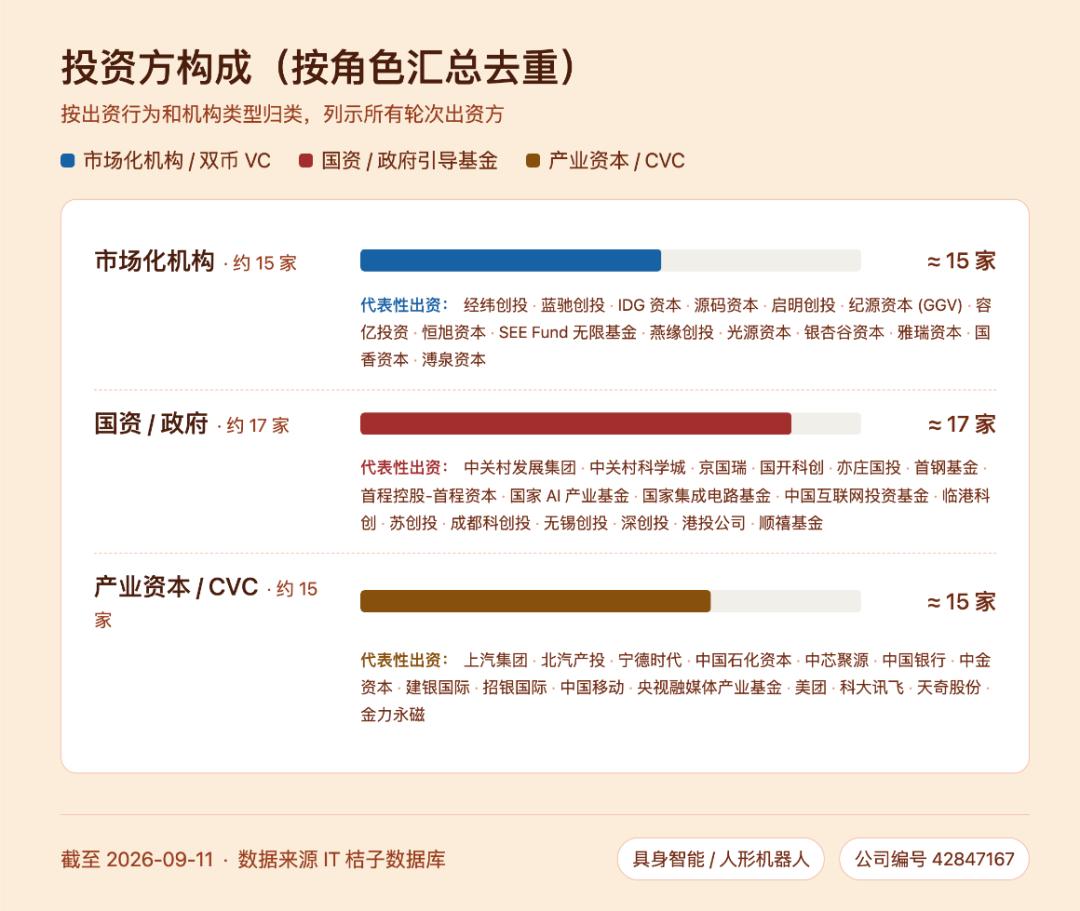
From the early stage dominated by market-oriented VCs, to the middle stage with a large influx of state-owned capital, to the recent stage where national-level industrial funds and central SOEs become the main force — this path clearly reflects the upgrading of the capital market's judgment on China's embodied intelligence track: from "a technical direction worth betting on" to "a strategic commanding height that needs to be seized".
Calm thinking: Under the confidence, where are the hidden worries?
First, high-frequency financing means continuous performance pressure.
On average, there is a new round of financing in less than 6 months, and each round needs to deliver new milestones to support the valuation jump. From the team and direction in the seed round, to the product prototype in the angel round, to the industrial customers in the strategic round, and then to the national-level laboratory in the Series B round — Galaxy Universal has indeed achieved that there is a "new story to tell" in each round.
But after the story is told, the next question to be answered is more cruel: can the revenue scale match the valuation of more than 200 billion RMB?
Second, the "state-owned capitalization" of the investor structure is a double-edged sword.
The large influx of state-owned capital provides Galaxy Universal with credit endorsement, scenario resources (such as order coordination with CATL and China Mobile) and policy support.
However, the requirements of state-owned capital for exit certainty, asset safety and audit compliance will also impose constraints on corporate governance and strategic choices. More importantly, when the financing subject of a company shifts from "market-oriented VC investment" to "state-owned capital + national fund" dominance, the valuation logic has begun to change — from "venture capital return expectation" to "national strategic asset allocation". The connection of these two sets of valuation systems will face the test when the company goes public in the future.
Third, the "order-driven by investment" model of industrial capital needs to be verified.
The entry of industrial capital such as CATL, SAIC Motor, China Mobile and Sinopec can theoretically bring orders and customers to Galaxy Universal.
However, the publicly verifiable large-scale commercial revenue is still limited at present — the selling price of G1 is about 700,000 RMB, and that of S1 is about 1.05 million RMB. Even if hundreds of units are delivered in total, the multiple relationship between the revenue and the valuation of 200 billion RMB is still very disparate.
Whether the investment of industrial capital can be truly transformed into sustainable commercial revenue, rather than just serving as a valuation endorsement, needs continuous tracking.
Fourth, industry disputes have emerged.
On September 10, 2026, Shao Tianlan, founder of Hong Kong-listed company Megvii, publicly questioned the business model of some embodied intelligence enterprises on WeChat Moments, saying that some "companies with great reputation, high valuation and having appeared on Spring Gala" generate revenue through "data collection centers", related transactions and other methods, and promote listing with the help of local government and state-owned capital investment, pointing directly at Galaxy Universal.
Galaxy Universal later released a statement in response, emphasizing that the company adheres to real R&D, real scenarios and real business closed loop. The right and wrong of this dispute remains to be tested by time, but it reflects an industry-wide problem: when embodied intelligence moves from high valuation in the primary market to public test in the secondary market, commercialization capability will become the watershed.
Galaxy Universal is not an isolated case. It is a typical sample of the capital frenzy in China's embodied intelligence track from 2023 to 2026. The speed of raising 70 billion RMB in 34 months not only reflects the market's recognition of this company, but also reflects the high-heat state of the entire track driven by the joint effect of policy expectation, technical narrative and capital inertia. When the boom recedes and commercialization becomes a hard indicator, who can truly stand firm? The answer is not in the financing rounds, but in every actual operation in the production line, pharmacy and convenience store.
This article is from WeChat official account "IT Juzi" (ID: itjuzi521), author: Judy, published with authorization from 36Kr.