"The US version of Doubao" has been updated again.
Recently, Gemini, which is often teased by Chinese netizens as "the US version of Doubao", has finally launched its Windows desktop client.

Google has officially released Gemini Desktop now, which can be downloaded and installed on both Windows and macOS. Windows users can press Alt + Space to evoke Gemini directly on any interface, no need to open the browser separately; it can also connect to Gmail, Google Drive, Docs and Calendar, directly pulling emails, documents and schedules into the current workflow. Gemini Spark has also landed on the desktop side, which can handle multi-step research, planning and information organization tasks.
The Mac version has gone even further for now. Gemini can already read screen context, connect to local folders, organize files, and aggregate local content into Docs and Sheets. Google has also made it clear that these more native desktop capabilities will be gradually available to Windows later.

If you only look at the news itself, it is no more than one sentence:
Gemini finally has a Windows client.
But when I saw this news, the first Google product that came to my mind was Antigravity instead.
Because I suddenly thought that, the days of Antigravity as an independent desktop App may not last much longer.
Gemini and Antigravity Have Started to Overlap
A few months ago, these two products were actually very easy to distinguish.
Gemini is a general-purpose AI assistant, responsible for chatting, searching, writing, and Deep Research; Antigravity is more developer-oriented, which can be understood as Google's own AI Coding and Agent workbench.
One is for ordinary users, the other is for programmers.
But since this year, this boundary is disappearing rapidly.
After Gemini moved to the desktop, it is no longer just a chat box. It starts to read the screen, access local files, connect to Google Workspace, and then perform long-term, multi-step tasks through Spark. What Google wants to make is obviously not a "Gemini web page for Windows", but an AI entry that stays on the computer all the time and can truly participate in work.
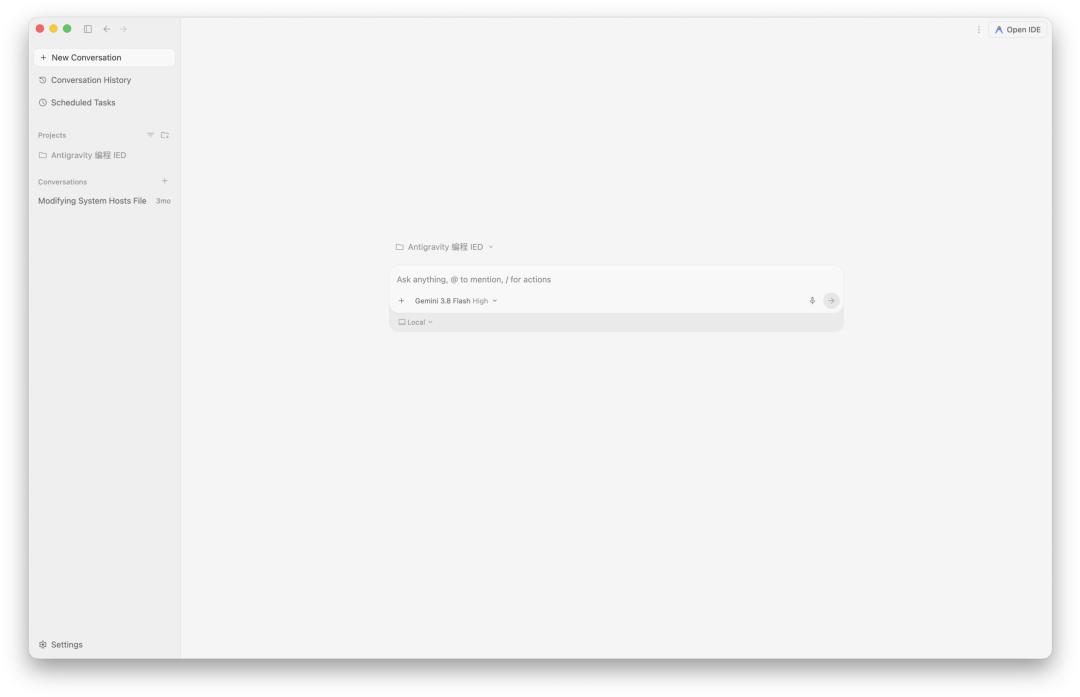
At the same time, Antigravity is also actively moving away from the position of traditional Coding tools.
Antigravity 2.0 released in May this year has been made by Google a desktop application completely independent of IDE. It can operate files, run system commands, search web pages, control Chrome, call Skills and MCP, and manage multiple Agents at the same time. Google officials even directly defined it as a central Agent console that can handle "knowledge work" and Coding tasks.
This actually brings up a very practical problem.
Gemini is evolving from a "chat assistant" to a desktop Agent, and Antigravity is evolving from a "Coding tool" to a general-purpose Agent.
The two products are heading in the exact same direction.
If it continues to develop like this, Google will sooner or later have to answer a question:
Why on earth should I install both Gemini and Antigravity on my computer?
ChatGPT Has Already Written the Answer on the Blackboard
This is also why I increasingly feel that Google will most likely choose to merge the entries in the end.
Because OpenAI has already done so.
In the past, ChatGPT was ChatGPT, and Codex had its own separate desktop App. But this year OpenAI has integrated them into the new ChatGPT Desktop: after users update the original Codex App, it will directly become the new ChatGPT desktop application, which provides Chat, Work and Codex at the same time. Codex's working mode and historical records are still retained, but the entry has been unified into ChatGPT.
This step is particularly critical.
OpenAI did not eliminate Codex, it just found that: Ordinary users do not need to switch to another App just because "I need to write code now".
You may first discuss a product plan in Chat, then ask Work to study competing products and organize materials, and then directly ask Codex to build the website.
For users, this is a continuous process by nature.
Claude is actually the same now.
Claude Desktop has put Chat, Cowork and Code into the same desktop application. Chat is responsible for ordinary conversations, Cowork is responsible for knowledge work and complex tasks, Code is responsible for local development; and Anthropic has made it clear that Cowork itself extends the Agent capabilities of Claude Code beyond Coding.
So two of the three major large model companies in the United States have already written out the answer:
You don't need three Apps for chatting, office work and Coding.
The Chinese Market Is Actually Moving Faster
If you look at the domestic market again, this trend is even more obvious.
Products like Doubao Work, WorkBuddy, and Qianwen Office are not making a pure chatbot now, but competing for the "AI work entry".

Illustration: Doubao Work Interface

Illustration: WorkBuddy Interface

Illustration: Qianwen Office Interface
Taking WorkBuddy as an example, its official positioning is already a "full-scenario AI office workbench". In one application, you can do documents, PPT, data analysis and in-depth research, also read local files, execute terminal commands, and generate code. It even shares accounts and point systems with CodeBuddy.
You will find a very interesting change.
In the past, AI products liked to split products by capabilities: one for chatting, one for Coding, one for office work, one for search.
Now everyone is doing the opposite:
Can all capabilities be stuffed into one single entry?
The reason is not complicated.
Real work never happens according to the "functional modules" divided by product managers.
For example, if I want to make a new product analysis today, I may first ask AI to search for news and read dozens of web pages, then sort out data and generate Excel, and then ask it to make a display page. Halfway through, I find that a small tool is needed, so I ask AI to write dozens of lines of code conveniently.
Which step here is called "office work", and which step is called "Coding"?
Users don't actually care.
Users only care about one thing:
I hand over the task to you, can you help me finish it.
So It Is a More Natural Result That Antigravity Will Eventually Be Integrated Into Gemini
Looking at Google's current product line from this perspective, I think the answer is getting clearer and clearer.
Gemini already has brand recognition, user scale, mobile end and web end, and now it has supplemented the Windows and Mac desktop entries; Antigravity has a set of very important Agent and Coding capabilities that Google currently owns.
Letting the two exist in parallel as two desktop Apps with increasingly similar functions for a long time will instead bring higher and higher user awareness costs.
Ordinary people may ask: If I want the AI to modify local files, should I open Gemini or Antigravity? What about building a web page? What about running an Agent? What about doing Deep Research and then writing programs conveniently?
The more such problems arise, the higher the necessity of product merging will be.
So now I tend to a very clear judgment:
Antigravity will most likely be integrated into Gemini in the end.
Of course, "being integrated" does not mean that the name Antigravity will disappear from now on.
It can completely retain professional entries such as CLI, SDK, and developer platform. Google has expanded Antigravity into a complete Agent ecosystem at I/O, including desktop App, CLI and SDK, and clearly positioned it as an Agent-first development platform.
But for the vast majority of ordinary desktop users, I don't think Google will eventually require everyone to install two AI assistants at the same time.
The more possible form is that a future version of Gemini Desktop will directly have stronger Build or Code capabilities. You still open Gemini, but when you need to develop, the Antigravity set of Agent capabilities will be called in the background.
This is actually very close to Codex in ChatGPT today.
The brand can be retained, the technology can be retained, but the entry will eventually be unified.
"The US Version of Doubao" Has Finally Started to Compete for the Desktop Market
So when Gemini launched on Windows this time, I think what is really worth paying attention to is not "Google finally made a PC client".
What Google is really starting to compete for is a more important position:
The default AI entry on the computer.

This is also why the desktop side is suddenly becoming so important.
ChatGPT is integrating Chat, Work and Codex into one App; Claude puts Chat, Cowork and Code into one Desktop; domestic products like Doubao, WorkBuddy and Qianwen Office are also stuffing more and more work capabilities into the same entry.
If Google still lets Gemini and Antigravity fight their own battles for a long time, it will look a little out of place instead.
Moreover, Google itself has actually revealed many signs. Antigravity's capabilities have entered Search, and Google also demonstrated the generative interface and Agent capabilities driven by Antigravity at I/O; in other words, Google is gradually transforming Antigravity from an independent Coding product into a set of capabilities that can be called by other Google products.
So what I am more curious about now is not whether Antigravity will enter Gemini.
It is:
When it will happen.
After all, ChatGPT and Claude have proved one thing — the next generation of desktop AI competition is probably not about who can make one more App, but about who can become the only App you need to open.
Now, "the US version of Doubao" Gemini has also officially entered Windows.
Antigravity may really only be one version update away from being "incorporated".
This article is from WeChat Official Account "Everyone is a Product Manager" (ID: woshipm), the author is Guai Ge, and it is released with authorization from 36Kr.